You pull down the attic hatch to check a stain, a draft issue, or a musty smell. Then the flashlight hits dark spotting on the roof decking, rafters, or insulation. Most property owners have the same first reaction. Is this dangerous, how bad is it, and who can I trust to tell me the truth?
That stress is normal. Attic mold sits in a part of the building that is rarely seen, and by the time it's visible, the internet usually offers two unhelpful extremes: panic or oversimplified “spray it and forget it” advice.
A sound response starts with slowing down and getting the sequence right. Confirm what you're looking at, keep people out of the space, and resist the urge to let the first company that spots mold also define the entire scope without documentation. If you need an unbiased starting point, begin with professional mold testing services near you so the conversation starts with evidence, not a sales pitch.
That Unsettling Discovery What to Do When You Find Attic Mold
A common version of this starts after a roof concern, a home inspection, or a seasonal humidity problem. Someone opens the attic and sees patchy discoloration on sheathing or framing. Another person notices the insulation looks compressed or damp. Then the calls begin, and the estimates don't match.
That mismatch happens for a reason. In attic work, one contractor may focus on cleaning visible growth, while another sees a moisture problem, insulation removal, ventilation correction, and possible material replacement. Both may use the word “remediation,” but they may be talking about very different scopes of work.
First actions that help
You don't need to make a rushed decision the same day.
- Limit disturbance: Don't brush, sweep, or spray the area. Disturbing mold can spread spores.
- Avoid storing items nearby: Keep personal belongings out of the attic until the condition is assessed.
- Document what you see: Take clear photos of staining, affected sheathing, wet insulation, roof penetrations, and any visible leaks.
- Watch for moisture clues: Ceiling stains, bathroom fans venting into the attic, rusty nails, and damp wood all matter.
Practical rule: Mold is rarely the first problem. Moisture is.
What not to do
A quick chemical spray feels productive, but it often skips the underlying cause. If the wood is still wet, if humid air is still entering the attic, or if a roof leak is still active, the mold issue isn't resolved. It has only been cosmetically interrupted.
That's why a calm, technical approach beats a fast one. A proper attic mold removal service should identify whether you're dealing with a roof leak, condensation, poor ventilation, wet insulation, or multiple conditions at once. Once that's clear, the rest of the decisions become more manageable.
Understanding the Causes and Risks of Attic Mold
You open the attic hatch expecting dust and storage smells, then see dark spotting across the roof sheathing and frost-like staining near the nails. That pattern usually points to a moisture problem that has been building for a while, not a one-day event.
Why attics become mold environments
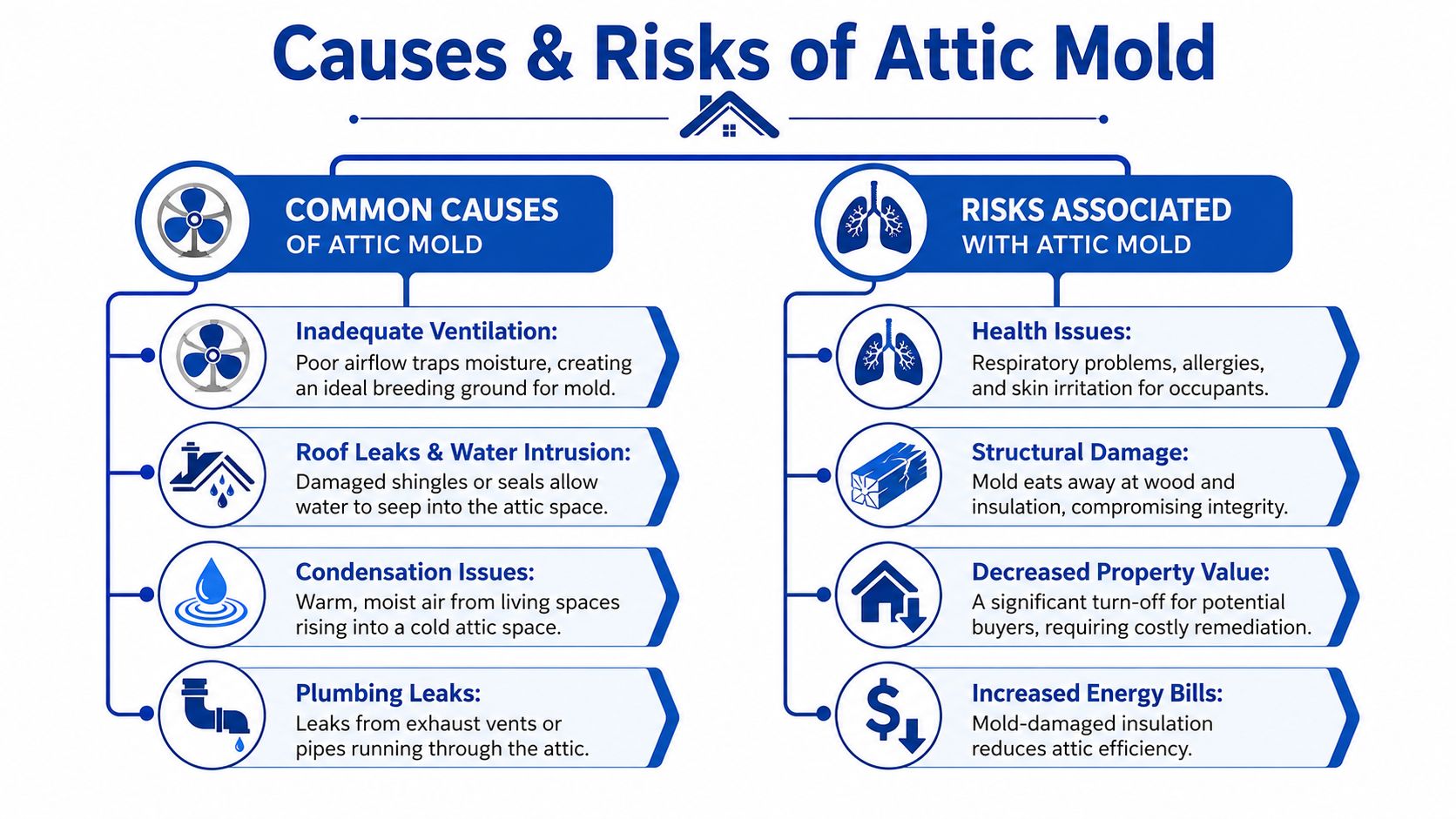
Attic mold needs two things. Repeated moisture and enough time on a material that can hold it. In the field, the usual trouble spots are roof sheathing, rafters, truss plates, insulation, and the colder corners where air movement is poor.
Some causes are straightforward. A roof leak wets the wood. A vent stack flashing failure or disconnected duct can do the same. Other causes are less obvious and often get missed during a quick sales inspection. Warm indoor air leaks into the attic around light fixtures, top plates, bath fan penetrations, or hatch covers. When that air hits cold sheathing, condensation forms. Over a season or two, that is enough to support mold growth even without a dramatic leak.
Ventilation plays a role, but it is not the whole story. I have seen attics with plenty of vent area still grow mold because bathroom fans were dumping moist air inside, insulation was thin at the eaves, or recent air sealing changed how the assembly dried. Homes with spray foam or hybrid insulation systems can be even harder to judge at a glance, which is why owners dealing with altered drying patterns often benefit from understanding how contractors approach addressing spray foam mold issues.
This is also where the assessment versus remediation conflict matters. A company that both diagnoses the problem and sells the cleanup has a financial reason to frame every stain as a remediation project. An independent assessor is more likely to separate old cosmetic staining from active microbial growth, identify whether moisture is current or historical, and tell you whether the first call should be a roofer, insulation contractor, HVAC technician, or remediation firm.
Roof leaks are common, but they are not the only explanation. Condensation, air leakage, and poor duct termination cause a large share of attic mold cases. If someone tries to reduce the diagnosis to a single cause without checking the moisture path, that is a warning sign.
Why the risk is more than appearance
Attic mold affects more than the look of the wood. Wet insulation loses thermal performance. Persistent moisture can corrode fasteners and metal connector plates. Wood sheathing can soften, delaminate, or become too damaged to clean effectively. In some homes, spore and dust movement through ceiling penetrations also adds to indoor air complaints, especially for people with asthma, allergies, or immune sensitivity.
The material involved changes the response.
| Material | Typical concern |
|---|---|
| OSB or sheathing | Can require removal when mold coverage is extensive |
| Fiberglass insulation | Often loses effectiveness when contaminated or wet |
| Metal components | Usually more cleanable than porous wood products |
Color alone is a poor guide. Black, white, green, or gray growth does not tell you the scope of work by itself. For homeowners trying to sort out what they may be seeing, this overview of different types of mold in homes helps with visual context, but the actual decision points are moisture source, material condition, and how far the contamination has spread.
A service that sprays a stain and leaves residue behind has not finished the job. Even inactive spores and settled fragments can remain a concern if contaminated dust is not controlled and removed.
The Professional Attic Mold Remediation Process
An attic mold job should start with scope control, not spraying. The first question is who defined that scope. If the same company diagnoses the mold, writes the protocol, and profits from the cleanup, the recommended work can drift wider than necessary. A cleaner process is to get an independent assessment first, then have remediation contractors bid against that written scope.
Assessment and moisture mapping
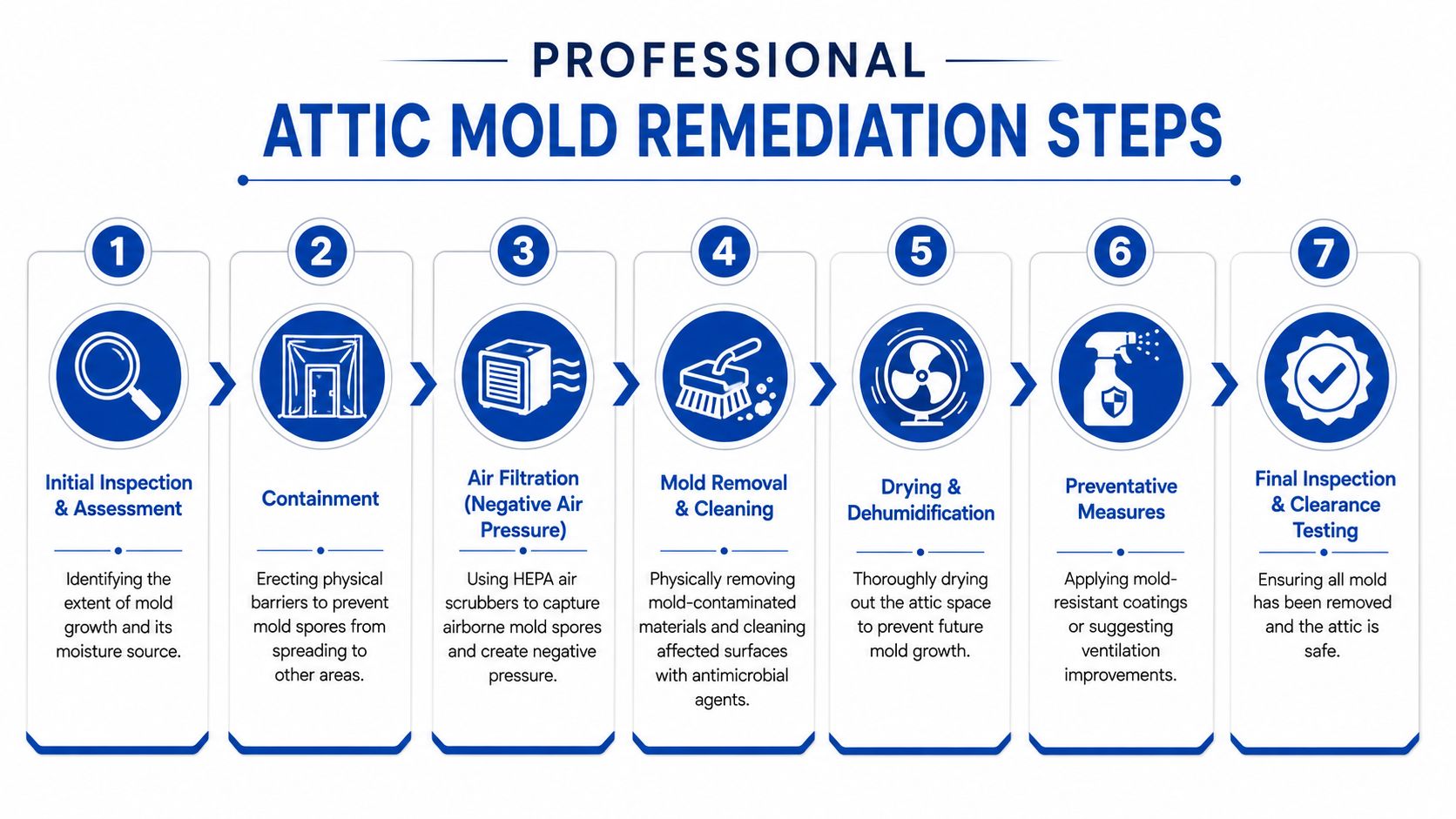
Before any crew sets containment, the attic needs a real evaluation of moisture conditions, material condition, and the likely path of contamination. That means checking roof penetrations, bath fan terminations, soffit and ridge ventilation, insulation displacement, and whether the wood is still wet or only stained from an older event. Meter readings matter because dry staining and active microbial growth do not call for the same response.
That assessment also separates remediation work from repair work. A remediation contractor may clean contaminated framing, but roof leaks, disconnected ducts, or failed ventilation usually belong to other trades. For owners who want a second set of eyes before approving a proposal, a mold remediation consultation can help sort out what belongs in the mold scope and what should be assigned elsewhere.
Containment and negative air
Containment protects the rest of the house from dust and spores released during cleaning or removal. The level of containment depends on how much material is affected, how the attic is accessed, and whether air movement from the work area could reach occupied rooms below. In practical terms, larger projects often require polyethylene barriers, controlled entry, and HEPA-filtered negative air to keep disturbed material from spreading through the home.
Here's the video version of what many owners find helpful when picturing how the work unfolds.
Cleaning, treatment, and surface stabilization
A sound remediation sequence handles residue first, then remaining growth, then surface stability where appropriate.
- Cleaning: HEPA vacuum loose debris and remove settled contamination from accessible surfaces.
- Treatment: Apply the selected antimicrobial or oxidizing product according to label directions and the written scope.
- Surface stabilization: In some attics, a post-cleaning coating is used on structural wood after the moisture problem has been corrected and the substrate is dry.
Each step has a different purpose. Cleaning removes what can become airborne. Treatment addresses residual contamination on the surface. A coating, when justified, can help lock down staining and make future inspection easier, but it should never be used to cover active moisture problems or avoid proper cleaning.
Removal when cleaning is no longer the right answer
Some attic materials can be cleaned. Some cannot. If sheathing is deteriorated, insulation is contaminated or wet, or mold growth has penetrated porous material too extensively, removal may be the safer and more durable option. That decision should be based on condition, cleanability, and whether the material can still perform its job after remediation.
This is one place where experience matters. A careful contractor knows the difference between cosmetic staining on solid framing, contamination that can be cleaned from durable surfaces, and material that has lost structural or thermal value. Waste also needs to be bagged and handled in a way that keeps contaminated dust from spreading through the house during removal and transport.
Estimating Your Attic Mold Removal Timeline and Cost
Most owners want two answers first. How long will this take, and what will it cost? The honest answer is that attic mold pricing is driven by scope, not by the word “mold” alone.
What the 2025 numbers actually show
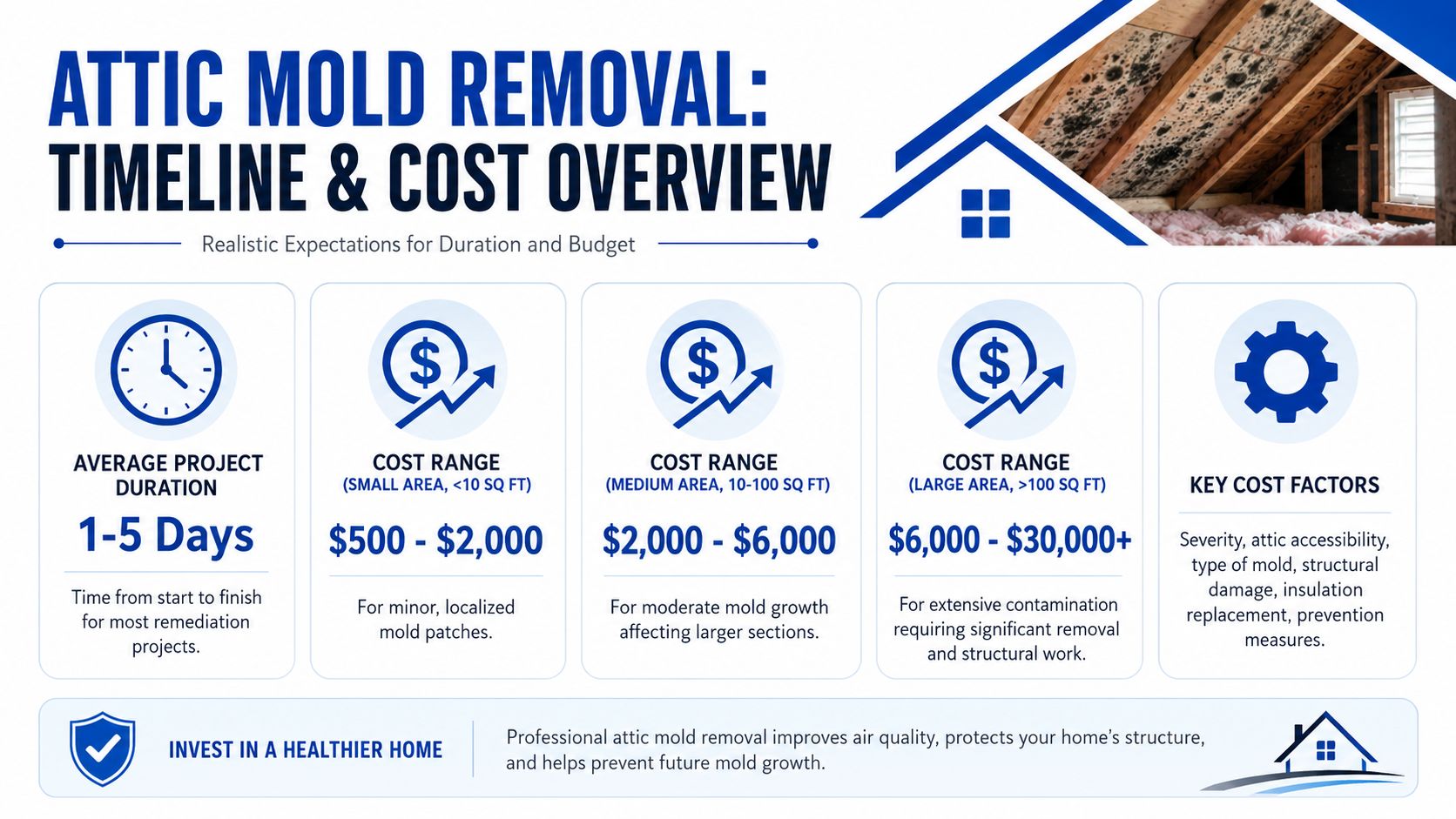
In 2025, professional attic mold remediation in the United States averaged $3.50 to $7.50 per square foot, with typical total project costs ranging from $1,800 to $8,000 for standard residential homes. Complex jobs involving toxic black mold or structural repairs can exceed $10,000, according to BUK Restoration's attic mold cost review.
The same source notes that approximately 90% of attic mold jobs without major structural damage fall within the $1,800 to $8,000 range. Jobs requiring insulation removal, sheathing replacement, or ventilation correction can rise to $10,000 to $15,000. Confirmed black mold infestations typically cost 15% to 25% more than standard mold removal, with pricing reaching $12 to $40 per square foot because of enhanced containment, HEPA air scrubbing, and specialized fungicides.
How long a standard job takes
A routine project often moves faster than people expect, but drying and verification add time. Most professional attic mold remediation projects take 1 to 3 days for the actual remediation work, followed by 1 to 2 days of drying time before clearance testing, for a total of 2 to 5 days on standard jobs, based on RestoreAdvisor's attic remediation timeline and pricing overview.
Larger attics or projects with full insulation removal and replacement can extend to 5 to 7 days total. The same source reports that small mold patches under 10 square feet may cost $500 to $1,200, while mold covering more than 10 square feet of attic sheathing typically requires professional intervention in the $1,500 to $6,000 range. Full sheathing remediation and replacement can cost $5,000 to $10,000, or $7,500 to $15,000 when air sealing and ventilation correction are included.
For owners trying to compare schedules, this guide on how long mold remediation takes is useful when planning tenant disruption, access windows, and follow-on trades.
If a quote sounds low, look for what's missing. Drying time, disposal, containment, insulation work, and post-remediation verification often explain the difference between bids.
What belongs in a useful estimate
A meaningful estimate should separate the line items. Mold removal is one line. Roof repair, ventilation upgrades, and insulation reinstallation are different tasks. The EPA framework cited in the RestoreAdvisor review treats corrective actions such as roof repair and ventilation upgrades as separate from the mold-removal scope, and roof repair alone averages $350 to $1,500 as an added cost in that source.
That separation protects the client because it shows what is remediation, what is rebuilding, and what is root-cause correction.
Navigating Insurance Coverage for Mold Damage
Insurance conversations around mold are frustrating because the answer usually isn't “yes” or “no.” It's “show me what caused it, when it started, and what you did once you discovered it.”
What carriers usually want to see
Adjusters often focus on origin. If mold followed a sudden and identifiable moisture event, the claim discussion tends to look different than it does when staining appears tied to long-term humidity, deferred maintenance, or an old leak that no one addressed. That's why documentation matters from the first day.
Keep a file with photos, inspection notes, roof invoices, moisture findings, and the written scope from whoever assesses the attic. If there's visible damage to insulation or sheathing, note that separately. If multiple trades are involved, keep each proposal distinct rather than rolled into one vague number.
Why wording in reports matters
A sloppy report can create problems. “Clean attic mold” tells the carrier almost nothing. A report that distinguishes visible contamination, moisture source, containment, removal of affected porous materials, and recommended corrective repairs gives the adjuster something concrete to evaluate.
This is one reason owners benefit from contractors who understand regulated cleanup documentation more broadly. In biohazard and environmental remediation work, compliance is built around chain of responsibility, work practices, and documented clearance. That mindset helps with mold claims too, even though policy coverage depends on the terms of the policy.
The cleaner your documentation is, the less room there is for guesswork by the carrier.
Don't wait for the claim decision to stop the cause
One mistake owners make is delaying roof or moisture correction while they wait for insurance approval. From a building-health standpoint, that delay can make the attic harder to dry and harder to defend in the claim file later. Stop the intrusion, preserve the evidence, and keep records of every decision.
When the remediation company and the assessor can clearly explain what was mold work and what was repair work, the claim discussion becomes more manageable. It's still a negotiation in many cases, but at least it's a documented one.
How to Choose the Right Mold Remediation Contractor
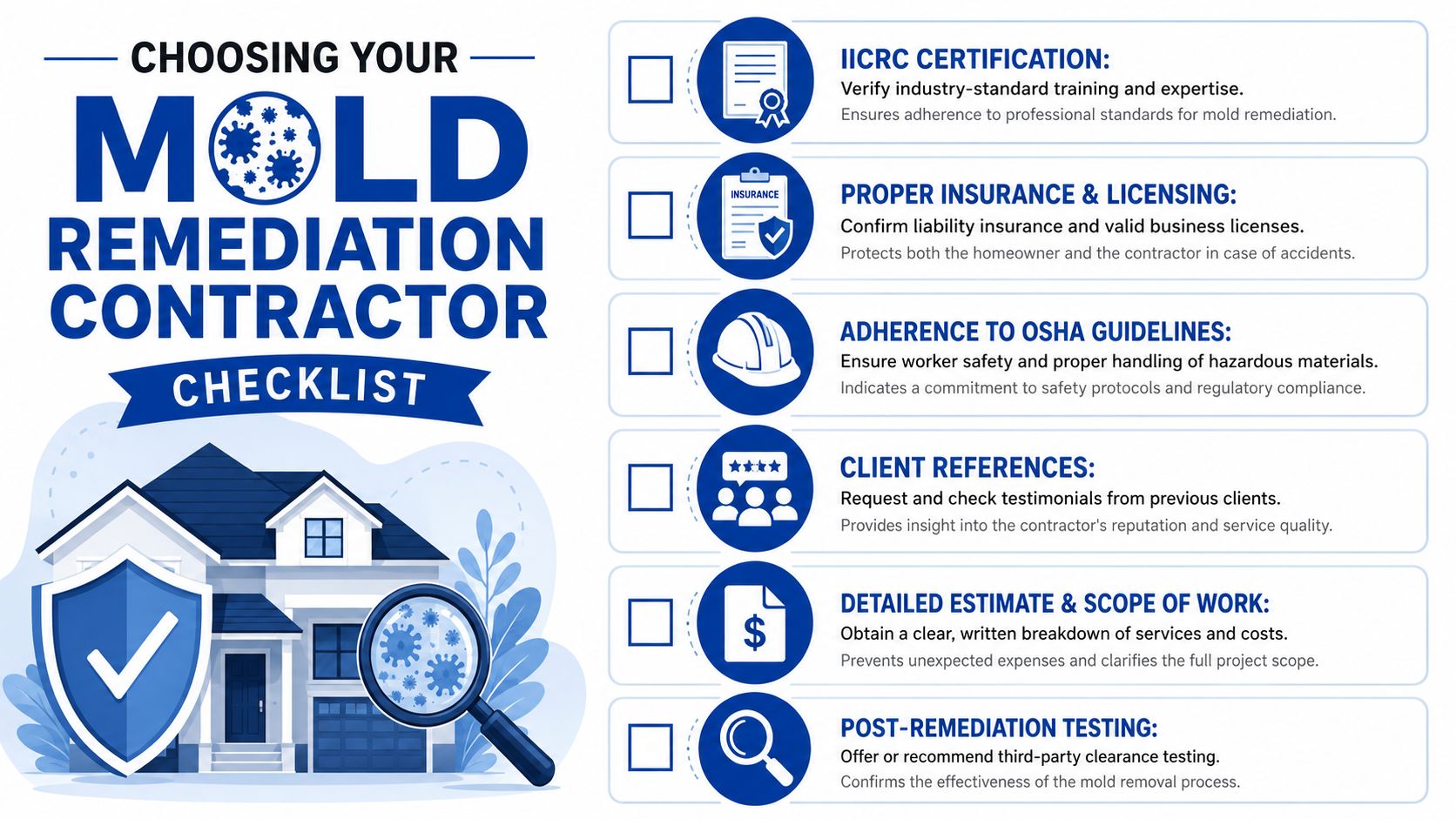
Most hiring mistakes in attic mold work happen before the first containment sheet goes up. They happen when an owner assumes the first company to identify mold is automatically the right company to define the entire project.
The conflict that owners need to understand
The most important hiring issue is incentive bias. If the same company diagnoses the problem and then bids to fix it, that company has a financial incentive to define the scope in a way that benefits its own contract. The IICRC S520 standard advises that assessment and remediation be handled by separate parties to prevent that conflict, and without a third-party protocol, homeowners are vulnerable to inflated verbal estimates, as explained in RestoreAdvisor's review of questions to ask a mold contractor.
That doesn't mean every combined assessment-and-remediation company is acting improperly. It means the structure itself creates risk for the client. The cleanest way to protect yourself is to have an independent assessor or industrial hygienist define the problem first, in writing, before you collect remediation bids.
What a serious contractor should provide
A strong contractor doesn't resist clarity. They welcome it.
- Written scope of work: The proposal should describe containment, filtration, cleaning method, removal criteria, disposal approach, and whether clearance testing is included or recommended.
- Proof of insurance and licensing: You want a company that can document its coverage and business standing.
- Safety discipline: OSHA expectations matter in contaminated environments. In biohazard cleanup, worker protection includes PPE such as gloves, masks, goggles, and protective suits under the Bloodborne Pathogens framework, as summarized in this overview of OSHA-related biohazard cleanup standards. Mold work has its own specifics, but the broader lesson is that safety isn't decorative.
- Clear separation of trades: If roof repair, insulation replacement, or ventilation correction are needed, the estimate should show who is doing what.
- Post-remediation verification plan: In regulated cleanup, treated spaces are often verified before reoccupancy. For biohazard remediation, that may include ATP or protein swab testing and, in regulated states, third-party industrial hygienist clearance after disinfectant contact times of 5 to 10 minutes, according to the National Junk Removal Authority discussion of post-remediation verification. The mold-world equivalent is a documented clearance approach that isn't hand-waved away.
Questions worth asking in the first call
Ask practical questions, not branding questions.
| Ask this | Why it matters |
|---|---|
| Who wrote the protocol? | Tells you whether scope came from an independent party |
| What materials will be removed versus cleaned? | Reveals whether the contractor understands salvage limits |
| How will you contain the attic from the living space? | Tests whether cross-contamination control is built in |
| What is excluded from your bid? | Exposes hidden add-ons early |
If you're evaluating providers, a mold clean up company should be judged by documentation quality, containment planning, and willingness to work from an independent protocol, not just by how quickly they promise to spray the attic.
A practical example is 360 Hazardous Cleanup, which provides mold remediation and mold inspection support within a broader environmental and regulated cleanup practice. What matters most isn't the brand name. It's whether the company respects scope transparency, safety, and third-party verification when appropriate.
Ensuring a Mold-Free Future Long-Term Prevention Strategies
An attic can be cleaned properly and still develop mold again if the building keeps feeding it moisture. Long-term prevention isn't complicated, but it does require follow-through.
Fix the moisture source first
If the roof leaks, repair it. If bathroom or dryer exhaust is terminating into the attic, reroute it correctly. If interior air is bypassing into the attic through penetrations, address the air leakage. The attic doesn't need more chemicals if the building is still delivering water to the same surfaces.
This point is where many failed projects begin. The visible growth gets treated, but the building defect remains. That's why callbacks happen.
Improve drying and control conditions
Ventilation changes can help, but only when they're tied to the actual moisture pattern in the building. More venting isn't automatically the answer if humid interior air is leaking upward. Likewise, adding insulation without solving condensation pathways can hide the problem instead of fixing it.
A prevention plan usually includes a few plain steps:
- Inspect after storms: Look for stains, wet insulation, and new discoloration around roof penetrations.
- Check exhaust pathways: Make sure bathroom fans and similar systems discharge outdoors, not into the attic.
- Monitor the attic seasonally: Cold-weather condensation and humid-weather moisture loads can create different problems.
- Keep records of repairs: If mold reappears, a repair history helps identify what changed and what didn't.
A successful remediation project ends with a drier attic, not just a cleaner-looking one.
Treat the attic as part of the whole building
Attics respond to what happens below them. Interior humidity, duct leakage, missing air sealing, insulation gaps, and roof defects all meet there. Owners who prevent recurrence usually stop thinking of the attic as an isolated box and start treating it as part of the building envelope.
When the cause is corrected, the scope is documented clearly, and the cleanup follows a real protocol, attic mold becomes a solvable building problem rather than a recurring mystery.
If you're dealing with attic contamination and want a calm, documented path forward, 360 Hazardous Cleanup can help evaluate the situation, explain the remediation scope in plain language, and coordinate the next steps with the safety, discretion, and regulatory discipline these projects require.