You're often reading about EPA hazardous waste disposal at the worst possible moment. A drum has leaked in a warehouse. A maintenance room contains old solvents nobody can identify. A clinic has mixed regulated medical waste with chemical waste, and now nobody's sure what rules apply.
That kind of uncertainty creates two risks at once. The first is immediate safety. The second is long-term liability. If you manage a facility, a practice, a plant, a rental property, or even a home with potentially hazardous contamination, you need a clear way to decide what you can handle internally and when professional remediation is the only responsible move.
The EPA's hazardous waste rules exist for that reason. They're dense on paper, but the basic logic is practical: identify the waste correctly, contain it safely, document every handoff, and make sure disposal happens through approved channels. If you understand those steps, you can make better decisions under pressure and avoid errors that stay with a property or business long after the cleanup looks finished.
Understanding Your Obligations for Hazardous Waste
Individuals confronted with a hazardous waste situation rarely begin by asking, “What are my RCRA obligations?” They start with a real-world problem. An unknown liquid is seeping from a container. A former tenant left behind chemicals. A nurse manager discovers stored materials with faded labels. The stress comes from not knowing whether you're dealing with housekeeping, a maintenance issue, regulated medical waste, or federally regulated hazardous waste.
The key framework is the Resource Conservation and Recovery Act, often shortened to RCRA. Under that system, the EPA regulates how hazardous waste is identified, accumulated, transported, treated, and disposed of. That framework matters because the law looks at your decisions from the moment waste is generated until it reaches its final destination.
A good first move is to stop thinking about disposal as the last step. In EPA hazardous waste disposal, compliance starts at identification. If you classify the material wrong at the beginning, every later step can be wrong too, including storage, labeling, transport, and recordkeeping.
For a plain-English overview of the rules themselves, review EPA hazardous waste regulations before anyone moves containers or arranges pickup.
Start with three immediate questions
When something suspicious turns up on site, ask:
- What is it: Is the material known, labeled, and tied to a process, product, or incident?
- Where is it now: Is it in a sound container, leaking, evaporating, or near drains, people, or ignition sources?
- Who has handled it: Has anyone already moved, mixed, or repackaged it without documentation?
Those questions sound basic, but they drive the next legal and safety decisions.
Practical rule: If the substance is unknown, leaking, mixed, or connected to blood, sharps, pharmaceuticals, or industrial chemicals, slow the process down. Fast guesses create expensive violations.
What the EPA expects from you
The EPA doesn't expect a facility manager to improvise chemistry. It does expect the generator or property operator to act responsibly. That means isolating the issue, preventing exposure, preserving labels and records, and using qualified help when the waste stream is unclear or dangerous.
For homeowners, the situation can be more confusing because household exclusions may apply in some contexts but not others. For businesses, clinics, labs, and commercial properties, assumptions are where trouble starts. Commercial activity usually brings you into a much stricter compliance environment.
What Is EPA Hazardous Waste
Before you can dispose of anything legally, you need to know whether it meets the EPA definition of hazardous waste. In practice, I tell managers to think of this in two ways. One is a recipe test. The other is a behavior test.
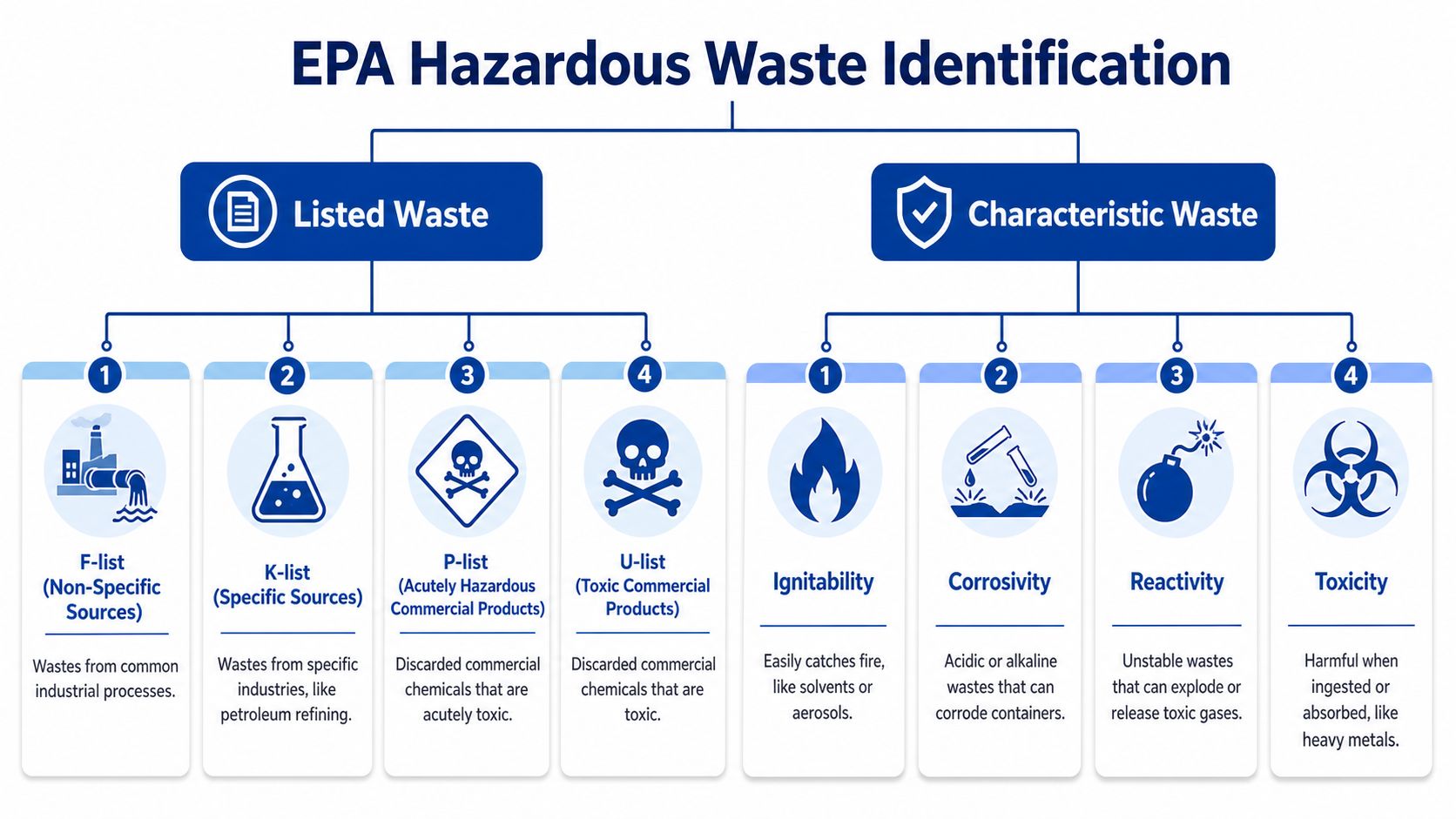
The recipe test asks whether the waste appears on one of the EPA's lists. The behavior test asks whether the material acts in a dangerous way, even if it isn't tied to a named industrial list.
Listed waste means the source matters
Listed wastes are specific wastes the EPA has already identified as hazardous. These include wastes from common industrial processes, wastes from certain industries, and some discarded commercial chemical products. If your material fits one of those categories, the analysis often starts with where it came from and what it was used for.
That's why process knowledge matters so much. A drum in a back room isn't just a drum. It may be spent solvent from equipment cleaning, unused lab chemical stock, or residue from a production line. Those details affect classification.
If your team regularly manages regulated materials, practical operations guidance like this overview of hazardous waste disposal for businesses can help align site procedures with disposal rules.
Characteristic waste means the properties matter
A waste may also be hazardous because of what it does. The four characteristic categories are easier to remember when translated into plain language:
- Ignitability: It can catch fire easily. Think solvents, some aerosols, or flammable cleaning chemicals.
- Corrosivity: It can eat through metal or damage tissue. Strong acids and caustics fall into this territory.
- Reactivity: It's unstable. Some materials can explode, react violently, or release dangerous gases.
- Toxicity: It can harm people or the environment if absorbed, ingested, or released.
A common mistake is assuming that a small amount isn't a big deal. Quantity affects generator status, but even a relatively small container can still be regulated hazardous waste if it has one of these properties.
Why this matters on a national scale
This isn't a niche issue. Historical EPA data indicates that the United States generates approximately 10 million tons yearly of nonradioactive hazardous waste, and about 90 percent of that waste occurs in liquid or semiliquid form. That one fact explains a lot of the rules around compatible containers, spill prevention, leak control, and transport discipline.
If most hazardous waste is liquid or semiliquid, the real risk isn't just “trash that needs special handling.” It's movement, seepage, vapor, and spread.
Where readers often get tripped up
People usually get confused in one of three places:
- They rely on labels alone. Old labels can be wrong, faded, or unrelated to current contents.
- They assume medical waste and hazardous waste are the same thing. They can overlap, but they aren't automatically identical.
- They treat unknowns as ordinary waste until proven otherwise. That reverses the logic you need for compliance.
If you're unsure, the safest working assumption is that unknown material needs evaluation before disposal, not after.
Your Role The Cradle to Grave Responsibility
The central idea in EPA hazardous waste disposal is simple and unforgiving. If your operation generates the waste, your responsibility doesn't end when a hauler picks it up.
Under the EPA's cradle-to-grave system, the generator remains legally responsible for hazardous waste through creation, storage, transport, and final disposal. Generator guidance summarizing this framework states that facilities become Large Quantity Generators if they accumulate 2,204 pounds (1,000 kg) or more of hazardous waste per month, which triggers stricter compliance and reporting requirements.
That's the part many managers underestimate. Disposal is not just a vendor transaction. It's a legal chain of custody tied back to your organization.
What generator status changes
Your generator status affects daily operations. It shapes how much waste you can accumulate, how formal your emergency planning needs to be, how thorough employee training must become, and how much documentation you need to maintain.
You'll usually hear three categories:
- Very Small Quantity Generator (VSQG)
- Small Quantity Generator (SQG)
- Large Quantity Generator (LQG)
Only the LQG threshold is cited here because it's the verified numerical threshold available for this discussion. The practical point is that once your operations increase in scale, the compliance burden rises with them.
EPA Hazardous Waste Generator Status Comparison
| Requirement | Very Small Quantity Generator (VSQG) | Small Quantity Generator (SQG) | Large Quantity Generator (LQG) |
|---|---|---|---|
| Typical waste volume profile | Lowest generation level | Mid-range generation level | Highest generation level |
| Regulatory burden | More limited federal obligations, but still not exempt from safe management | More structured storage, training, and shipment requirements | Strictest controls and reporting expectations |
| On-site accumulation oversight | Simpler, but still requires sound waste management | More formal limits and controls | Highest scrutiny for accumulation and storage practices |
| Emergency planning | Often less extensive | More defined contingency expectations | Expanded emergency preparedness obligations |
| Reporting | Less extensive routine reporting | More documentation than VSQG | Biennial reporting required |
| When professional support becomes more important | When waste is unknown, mixed, spilled, or unusual | When multiple waste streams or shipping issues arise | Often essential because mistakes carry wider consequences |
Why facilities slip into higher risk
Most facilities don't decide to become noncompliant. They drift there. A site stores expired product longer than intended. Departments combine waste streams in one room. A contractor leaves behind chemicals after a project. The facility's monthly generation changes, but procedures don't.
That's why waste determination and monthly tracking matter. The issue isn't only whether you generated hazardous waste. It's whether your internal systems are good enough to notice when your obligations have changed.
Field advice: If your waste profile changes faster than your written procedures, your compliance program is already behind.
Special concern for healthcare and lab settings
Labs, pharmacies, research facilities, and treatment environments face a harder version of this problem because chemical hazards often overlap with occupational exposure concerns. If your team handles hazardous drugs or related compounds, guidance for lab hazardous drugs is a useful operational companion to waste compliance planning.
In those settings, the wrong decision isn't only a paperwork problem. It can expose staff, housekeeping teams, transport workers, and downstream disposal personnel.
The Path to Disposal Packaging Labeling and Manifests
Once you know you're dealing with hazardous waste, the next phase is procedural discipline. In this phase, many organizations create avoidable liability. The waste may be correctly identified, but if it's packed in the wrong container, labeled poorly, or shipped without the right paperwork, the compliance failure is already in motion.
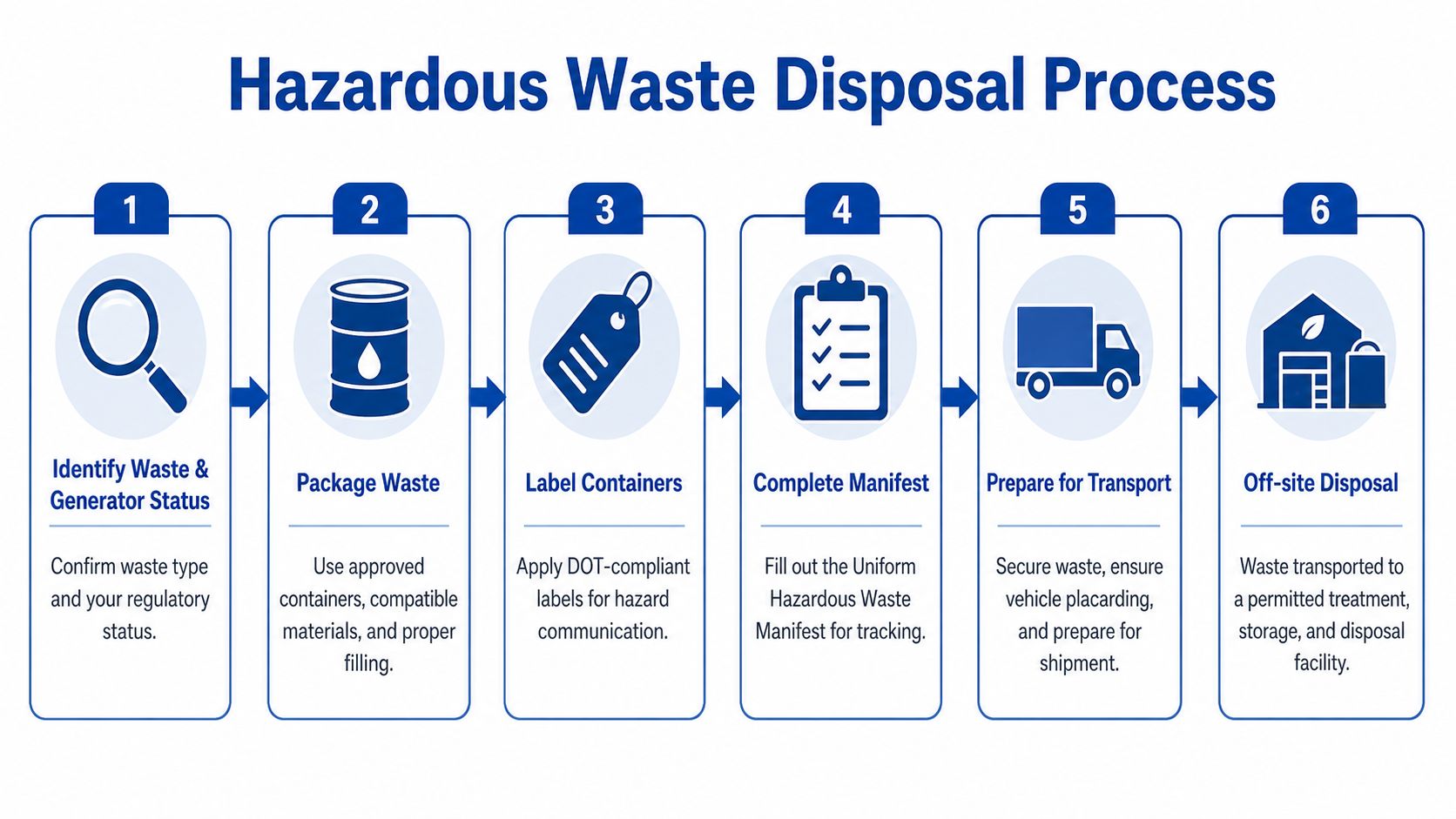
The first administrative step is not boxing up the waste. It's obtaining the required identifier. Under EPA regulations in Title 40 CFR Parts 260 to 299, the generator must obtain a unique EPA Identification Number before packaging, labeling, and marking hazardous waste containers for off-site transport.
Packaging has to match the waste
Packaging isn't just about using a sturdy drum. The container has to be compatible with the waste, in good condition, and appropriate for transport. A liquid corrosive, a flammable solvent, and a sharps-related infectious stream don't belong in the same packaging conversation.
For regulated infectious waste, the mechanics matter. EPA guidance states that liquid or semi-liquid blood and other potentially infectious materials must go into closable, leakproof red or biohazard-labeled bags or containers, while contaminated sharps require closable, puncture-resistant, leakproof red or biohazard-labeled containers. For medical settings managing both streams, practical disposal guidance for medical waste handling and removal helps separate waste categories before shipment.
Labeling needs to be usable, not just present
A label that exists but doesn't communicate anything useful won't protect you. In practice, labels need to stay legible, match the contents, and support the chain of custody. Sites often fail here by using internal shorthand that means something to one department but nothing to a transporter or receiving facility.
For biohazardous waste, container markings usually need to be obvious to anyone who encounters them. For hazardous chemical waste, the accumulation point, hazard communication, and generator details all matter. The point is consistency. If a responder, transporter, or inspector can't understand the package quickly, the label isn't doing its job.
The manifest is your legal travel record
The Uniform Hazardous Waste Manifest is the paper trail that follows the waste from your site to the receiving facility. Think of it as the shipment's legal biography. It documents who generated the waste, who transported it, where it went, and what the designated facility received.
That matters because if a question surfaces later, after a spill, rejection, discrepancy, or enforcement review, you need a document trail that shows responsible management at every transfer point.
Use a stepwise review before any shipment leaves:
- Confirm identity: Make sure the waste determination is current and documented.
- Check containers: Verify condition, closure, and compatibility.
- Review labels: Ensure they're visible, durable, and understandable.
- Match paperwork: The manifest should reflect the actual shipment, not a template from the last pickup.
- Verify destination: The receiving facility must be authorized to accept that waste stream.
A manifest doesn't fix a bad waste determination. It records it. That's why the decisions before signing matter more than the signature itself.
Transport and Treatment Options
Once hazardous waste leaves your site, it enters a more specialized part of the system. At this stage, facility managers sometimes become passive. They assume the transporter handles everything from that point forward. Legally and practically, that's too loose a view.
A compliant shipment depends on two outside parties doing very specific work. The transporter has to move the waste safely and lawfully. The Treatment, Storage, and Disposal Facility, or TSDF, has to accept, manage, treat, store, or dispose of the waste under its permit conditions.
What a licensed transporter actually does
A hazardous waste transporter isn't just a trucking service with extra forms. The transporter is part of the custody chain. The company needs the right training, equipment, procedures, and documentation discipline to move regulated materials without creating exposure or release risks.
Container choice matters before loading even begins. If your team needs a practical, non-regulatory primer on equipment fit and freight considerations, this overview on understanding container types and sizes is a helpful operations reference.
For hazardous shipments involving chemicals, infectious waste, or mixed remediation debris, transportation planning also affects segregation, securement, and receiving acceptance. That's why organizations with recurring hazardous shipments benefit from a more formal approach to hazardous material transportation requirements.
What happens at the destination
At the TSDF, the waste is evaluated and managed according to its type and the facility's permit. Some waste is treated to reduce hazard. Some is stored pending treatment. Some is destroyed or placed into long-term disposal systems engineered for that purpose.
One disposal pathway stands out nationally. According to the EPA's reporting indicator on hazardous waste, deep well or underground injection accounted for 90 to 96 percent of all RCRA hazardous wastes disposed of on land in the United States over nearly two decades. That makes it the dominant land disposal mechanism for industrial hazardous materials.
That fact surprises many readers, but it tracks with the broader reality that large portions of hazardous waste are liquid or semiliquid and require highly controlled disposal routes.
Why vendor selection still matters to the generator
Even though treatment and disposal happen off-site, your risk doesn't disappear at the property line. If the wrong facility receives the waste, if the shipment is mischaracterized, or if records don't line up, your organization may still be pulled back into the problem.
That's why disposal planning should include more than scheduling. You want audited vendors, acceptable waste profiles, clear manifest workflows, and documented receiving procedures. The strongest programs treat transport and TSDF selection as compliance decisions, not purchasing decisions.
Recordkeeping Timelines and Penalties
If you want to know how regulators view your waste program, look at your records. Not your intentions. Not the verbal explanation from a supervisor. The records.
In EPA hazardous waste disposal, documentation is the proof of a compliant process. Without it, even a properly managed shipment can become hard to defend. And when records are weak, insurance carriers, auditors, and attorneys start asking sharper questions.
Keep records like someone will need them years from now
That sounds obvious, but many facilities still manage hazardous waste records like routine vendor files. They're scattered across email threads, shared drives, accounting systems, and handwritten logs in accumulation areas. That setup fails when you need a complete chain of custody under pressure.
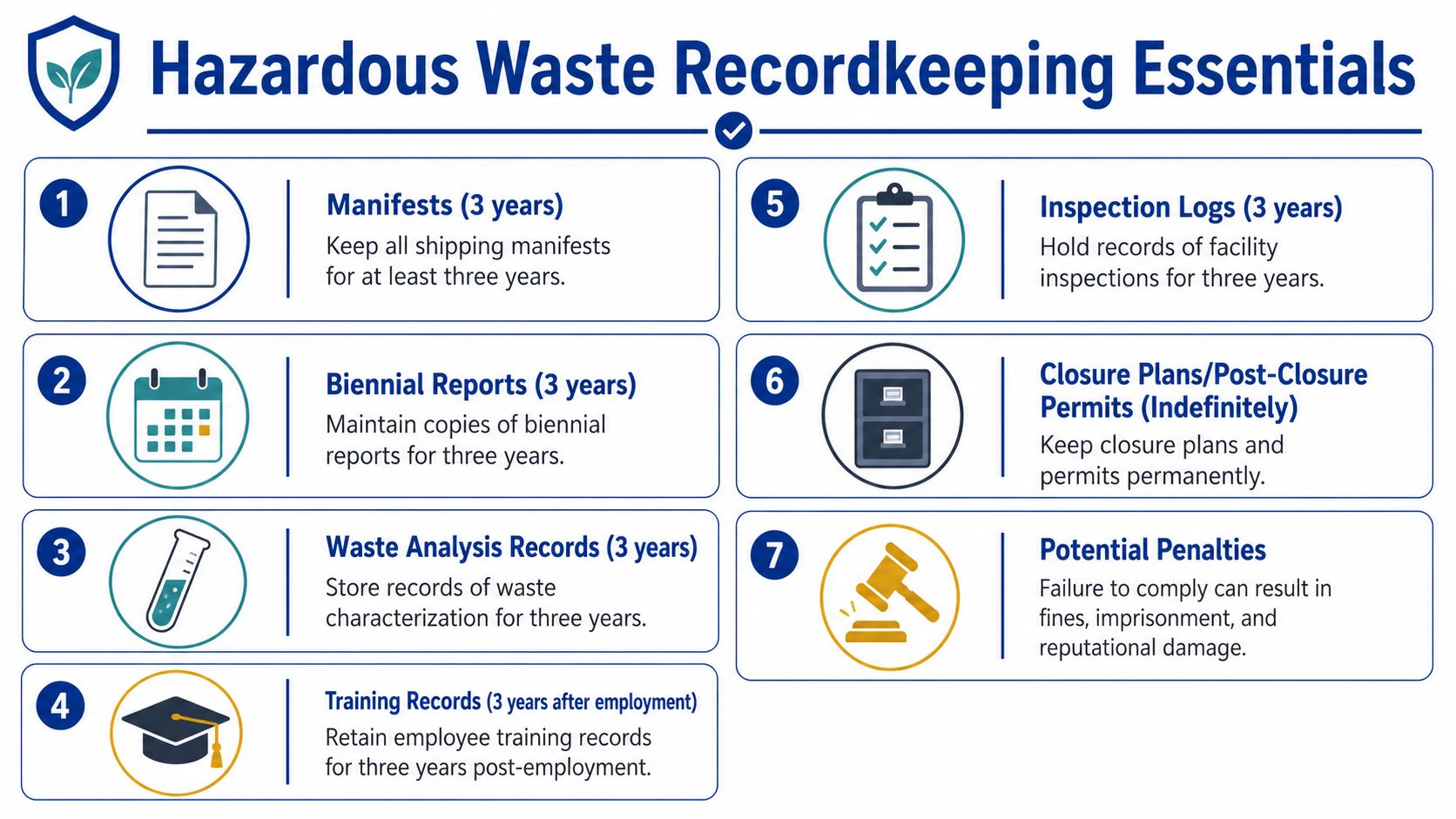
Use a records system that keeps related items together, such as manifests, waste determinations, container logs, training records, inspection records, and any correspondence tied to discrepancies or rejected loads.
A practical compliance benchmark is keeping your procedures aligned with broader environmental compliance standards rather than treating waste paperwork as a stand-alone task.
Why the long tail of liability matters
The hidden issue isn't only an inspection next month. It's whether your documentation can still protect you long after disposal occurred. According to a GAO report on hazardous waste financial responsibility, EPA regulations mandate that generators retain financial responsibility for hazardous waste releases for up to 40 years post-disposal, while many standard commercial policies exclude these environmental impairment claims.
That creates a gap a lot of owners and operators don't see coming. They believe the cleanup bill ended the problem. In some cases, the paperwork and liability survive far longer than the visible contamination.
Risk perspective: A missing document today can become a coverage dispute or liability argument years after the waste left your site.
Records that deserve special attention
Not every document carries the same practical weight. Focus on the ones that establish identity, movement, and oversight:
- Waste determination files: These show why the material was classified the way it was.
- Shipment records: Manifests and related documents prove transfer and receipt.
- Training records: They help show that personnel were qualified to perform regulated tasks.
- Inspection and incident logs: These can support your response if a spill, discrepancy, or complaint occurs.
Penalties aren't just financial
Poor recordkeeping can contribute to fines, enforcement actions, operational disruption, insurance friction, and reputational damage. In serious situations, it can also intensify scrutiny after an incident because regulators may see the record failure as evidence of a broader management problem.
For facility managers, that's why recordkeeping should be viewed as operational risk control. It's not clerical cleanup after the essential work. It is part of the essential work.
When to Call a Hazardous Waste Professional
Some hazardous waste situations can be managed internally by a well-trained team with a stable waste stream, clear procedures, and reliable vendors. Others shouldn't be touched without specialist support. The hard part is knowing the difference early enough to avoid a preventable mistake.
If the waste is unknown, mixed, actively leaking, linked to a spill, or tied to biohazard exposure, that's already a strong signal to escalate. The same goes for properties with abandoned chemicals, trauma scenes, medical accidents, hoarding-related contamination, or industrial incidents where chemical and biological hazards may overlap.
Situations that justify immediate escalation
Bring in a qualified hazardous waste or remediation professional when any of these are true:
- The material is unidentified: If nobody can say what's in the container, disposal decisions are premature.
- The waste streams are mixed: Chemical waste, pharmaceutical waste, sharps, bloodborne material, and general trash should never be sorted by guesswork.
- The incident involves release or exposure: Leaks, splashes, vapors, and employee contact raise the stakes immediately.
- The property has legacy materials: Tenant abandonment, foreclosure, estate situations, and old maintenance stock often come with poor labeling and missing records.
- Your internal team lacks confidence: Uncertainty is itself a decision point. If staff are debating the basics, the risk is already too high.
The household exclusion is narrower than people think
One of the most common mistakes involves the household hazardous waste exclusion. People hear “household waste is excluded” and assume that anything similar in a commercial setting is also excluded. That's not how the rule works.
The EPA states that the household hazardous waste exclusion applies only to items generated in households, not commercial sources. Retailers, small businesses, clinics, and other operators can create major problems by mixing household-return items with commercial inventory or operational waste. Once that happens, they may trigger full hazardous waste obligations they didn't expect.
This is especially important for outpatient clinics, behavioral health settings, and mixed-use operations where home-return items, pharmaceuticals, cleaning chemicals, and clinical supplies can end up in the same handling stream.
Don't use “it came from a consumer” as a shortcut for “it's exempt.” In a commercial setting, that assumption can unravel your whole waste determination.
What a professional actually brings
A qualified hazardous waste remediation company doesn't just remove material. Its core value is control over uncertainty.
That includes:
- Accurate waste characterization
- Safe segregation and packaging
- Proper labeling and shipping documentation
- Access to compliant transport and disposal channels
- Incident containment and decontamination
- A stronger record trail for future audits, claims, or disputes
For homeowners, the benefit is often clarity during a stressful event. For facility managers, it's risk reduction. For both, the main advantage is the same: fewer assumptions, better documentation, and a safer path from discovery to final disposal.
The best time to call is before staff start repackaging, combining, draining, flushing, or moving questionable material. Once that happens, the original problem can turn into a larger one with more exposure, more regulatory complexity, and a weaker evidence trail.
When hazardous waste, biohazard contamination, or an unknown spill puts your property, staff, or family at risk, 360 Hazardous Cleanup provides professional support grounded in safety, discretion, and regulatory compliance. Their team handles complex remediation situations with a trauma-informed approach, helps clients document conditions properly, and works to reduce the long-term liability that often gets overlooked in the first hours of a cleanup decision.