You're busy, operations are moving, and then someone finds a container in a back room with a faded label, no date, and no clear owner. At that moment, the question isn't “How fast can we get rid of this?” It's “What is it, who touched it, and what liability just landed on the business?”
That's how hazardous waste problems usually surface. Not as a tidy compliance project, but as an interruption tied to safety, documentation, transport, insurance, and legal exposure. For property owners, facility managers, healthcare operators, and industrial teams, hazardous waste disposal for businesses is less about hauling waste away and more about controlling risk before it spreads into an injury, an audit, or a shutdown.
A strong disposal process protects people first. It also protects contracts, operating continuity, and the paper trail your business will need if regulators, insurers, or counsel ever ask what happened and who handled it.
Why Hazardous Waste Compliance Is a Business Imperative
An unlabeled drum, a leaking solvent container, a red bag in the wrong waste stream, or residue left after an industrial incident all create the same business problem. Once waste is generated, your company owns the responsibility to manage it correctly. That responsibility doesn't disappear when a truck leaves the site.
Under federal RCRA rules, the generator remains responsible under a cradle-to-grave framework. In practical terms, that means your business can't treat disposal as someone else's problem after pickup. If a transporter lacks proper authorization, if manifest paperwork is incomplete, or if waste ends up mishandled downstream, the generator can still be pulled back into the issue. That's why hazardous waste disposal for businesses belongs in risk management, not just janitorial or facilities.
The volume of waste makes this a leadership issue
The scale alone should reset how companies think about disposal. Globally, more than 400 million tonnes of hazardous waste are produced annually. In the US, the average household generates 7 kg per year, but commercial and industrial sources account for the vast majority according to Business Waste's hazardous waste facts. The implication is clear. Businesses generate the waste stream regulators care most about, and they're expected to manage it accordingly.
That expectation extends beyond factories and labs. Office campuses, maintenance shops, clinics, warehouses, apartment portfolios, and retail properties all produce materials that may qualify as hazardous depending on their characteristics and handling.
Practical rule: If your team can't identify a waste stream on sight, stop movement first and verify classification before anyone repackages, combines, or disposes of it.
Disposal is a continuity issue, not just a cleanup task
Companies often underestimate the indirect costs of a waste mistake. The first bill might be for emergency response or repackaging. The larger cost usually comes later through disrupted operations, internal investigations, reportable incidents, tenant complaints, employee exposure concerns, or contract friction with landlords and customers.
That's why mature programs treat compliance as a safeguard for continuity. Clear identification, storage controls, trained handling, and documented transfer all reduce the chance that one neglected container becomes a much bigger event. For a closer look at how these exposure pathways develop, this guide to biohazard waste management risks and compliance is a useful companion.
Identifying and Classifying Your Hazardous Waste
Most disposal failures start earlier than the pickup date. They start when a business guesses. A liquid gets called “cleaning waste” instead of being characterized. A maintenance team mixes materials into one drum because it seems efficient. A container gets labeled with a department name instead of the actual contents.
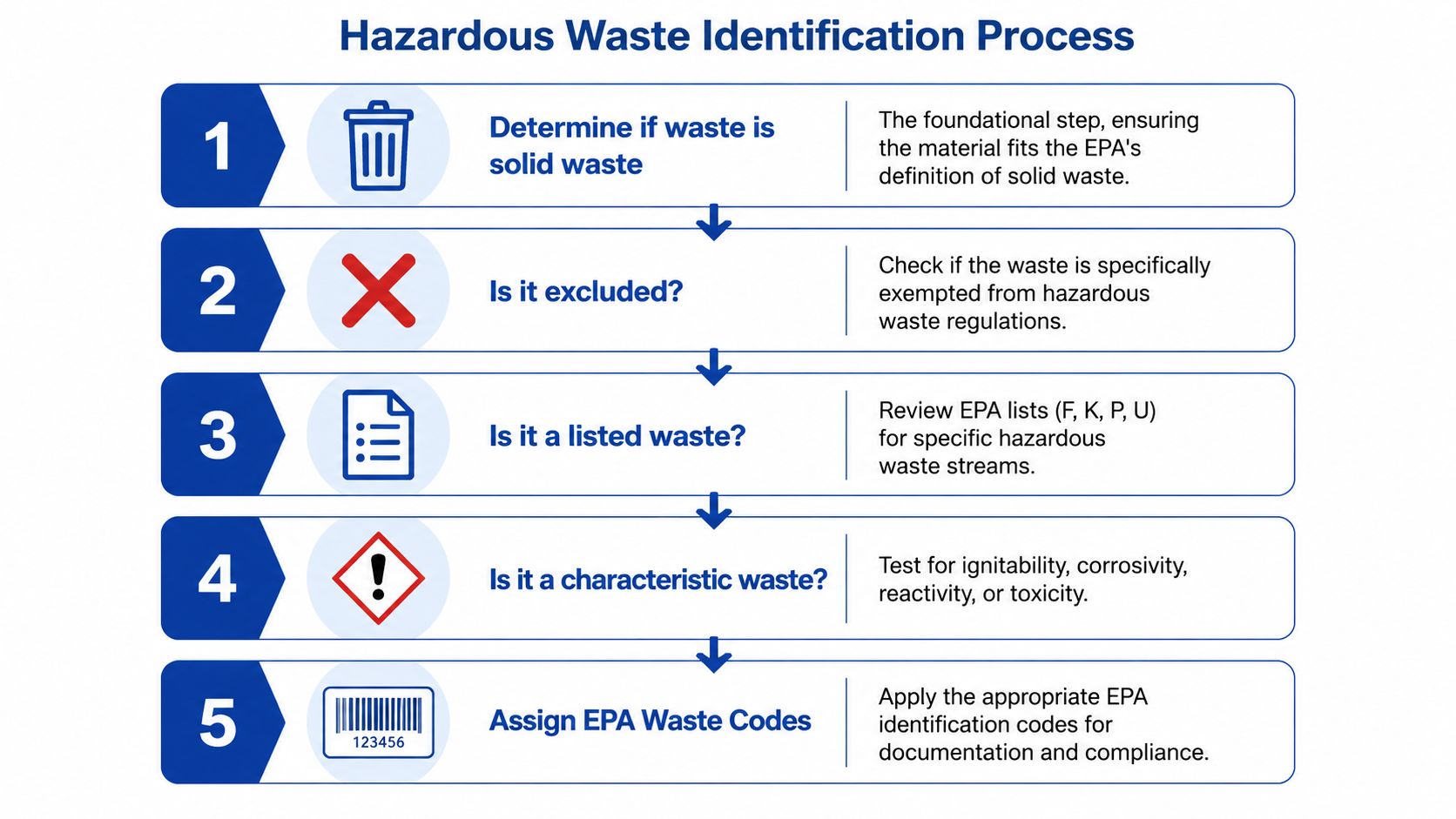
Under federal RCRA regulations, hazardous waste is defined in part by four characteristics: ignitability, corrosivity, reactivity, and toxicity. If you don't classify the waste correctly, every step after that gets weaker, from labeling to storage to manifesting.
The four characteristics that matter
Here's the plain-English version facility teams can use during internal audits:
Ignitability: Wastes that can catch fire easily. Common examples include solvent residues, paint-related materials, fuel-contaminated absorbents, and some aerosol-related waste from maintenance areas or auto operations.
Corrosivity: Wastes that can burn or destroy metal and tissue. Acidic or caustic cleaning compounds, certain process chemicals, and some commercial kitchen or industrial wash products can fall here.
Reactivity: Wastes that are unstable or can react violently under certain conditions. These materials may generate heat, pressure, toxic gases, or explosions if mishandled or mixed improperly.
Toxicity: Wastes that contain substances capable of causing harm when released into the environment. Lead-containing debris, some construction-related materials, chemical residues, and certain electronics or manufacturing byproducts often trigger closer review.
A good working rule is simple. If your team is using words like “probably,” “basically,” or “leftover stuff,” classification hasn't been done well enough.
What a real waste audit looks like
Walk the site and identify where waste is generated, not where it's finally stored. Production lines, janitorial closets, maintenance bays, treatment rooms, loading docks, and spill response areas all deserve attention. Compare what each area says it generates with what is physically in the containers.
Use a short checklist:
- Locate generation points: Find where the waste first appears.
- Match container contents to process activity: If the room says “used absorbents,” confirm that's what's in the drum.
- Separate unknowns immediately: Don't combine unidentified material with known waste.
- Check labels and dates: Missing details usually signal a wider process problem.
- Escalate unusual materials for professional review: Especially after spills, trauma scenes, chemical releases, or mixed waste events.
Misclassification is where businesses lose control. Once the wrong material goes into the wrong container, the disposal problem becomes a safety problem.
The legal consequences are serious. Under federal RCRA regulations, non-compliance with hazardous waste disposal laws can lead to immediate fines starting at $50,000 per day per violation, with knowingly endangering others carrying penalties up to $250,000 per day for businesses according to the EPA's generator compliance guidance.
For teams that need a practical primer on what qualifies and how these materials are handled safely, this overview of hazardous waste identification and disposal gives a solid foundation.
Determining Your EPA Generator Status
Once waste has been identified, the next question is volume. The amount your facility generates each month determines which federal generator category applies, and that category shapes storage, notification, documentation, and operational expectations.
Many businesses get this wrong because they estimate loosely or only count one department. Generator status should reflect the site's actual monthly hazardous waste generation, not a rough guess from one manager's memory. If your site has multiple waste streams, they all need to be accounted for in the same compliance picture.
EPA hazardous waste generator categories
| Generator Category | Hazardous Waste Generation Rate (per month) | Acutely Hazardous Waste Generation Rate (per month) |
|---|---|---|
| Very Small Quantity Generator (VSQG) | 100 kg or less | 1 kg or less |
| Small Quantity Generator (SQG) | Between 100 kg and 1,000 kg | Not stated here for category assignment beyond the VSQG and LQG thresholds |
| Large Quantity Generator (LQG) | 1,000 kg or more | More than 1 kg |
These thresholds matter because they trigger different obligations. A VSQG may face fewer federal requirements, though state law can still impose additional duties. An SQG has a heavier burden, especially around state notification and management controls. An LQG carries the highest level of federal compliance obligations, including re-notification every four years using EPA Form 8700-12 under the federal rules described earlier.
State rules can be stricter than federal assumptions
Many operators often falter when they look up the federal category, assume that's the full answer, and miss state-specific steps. State regulations, such as those in Illinois, often require Small Quantity Generators (SQGs), those producing 100 kg to 1,000 kg monthly, to re-notify the state environmental agency of their status every four years as noted by the Illinois Environmental Protection Agency hazardous waste guidance.
That requirement sounds mechanical because it is. But mechanical tasks are exactly where businesses fall out of compliance. The waste may be stored properly. The transporter may be licensed. Then an audit finds the re-notification was missed.
How to calculate status without guessing
Use a rolling monthly process. Pull shipping records, waste logs, manifests, and internal accumulation data. Reconcile what was generated, not just what was shipped out. If drums stayed on site into the next pickup cycle, they still count in the month they were generated.
A practical approach is to assign one owner for the calculation and one reviewer for signoff. EHS, facilities, operations, and clinical departments often all touch waste generation, but one person needs to control the final count. Teams that want to understand why certifications and structured training matter during that handoff process can review why cleanup certifications and standards matter.
If your monthly category changes, your obligations may change with it. Don't treat generator status as a one-time setup item.
Safe Storage Labeling and Transport Preparation
Once waste has been identified and categorized, the operational discipline starts on site. Most enforcement problems don't begin on the highway. They begin in storage rooms, maintenance cages, utility closets, and loading areas where waste sits too long, gets mislabeled, or is placed in the wrong container.
Strong on-site management is what makes off-site disposal defensible. Without it, the manifest is just paperwork attached to a weak process.
What to control in the storage area
Start with separation. Incompatible wastes should never share containers or sit together casually because “pickup is tomorrow.” That mindset causes spills, reactions, and expensive emergency interventions.
Focus your site checks on these points:
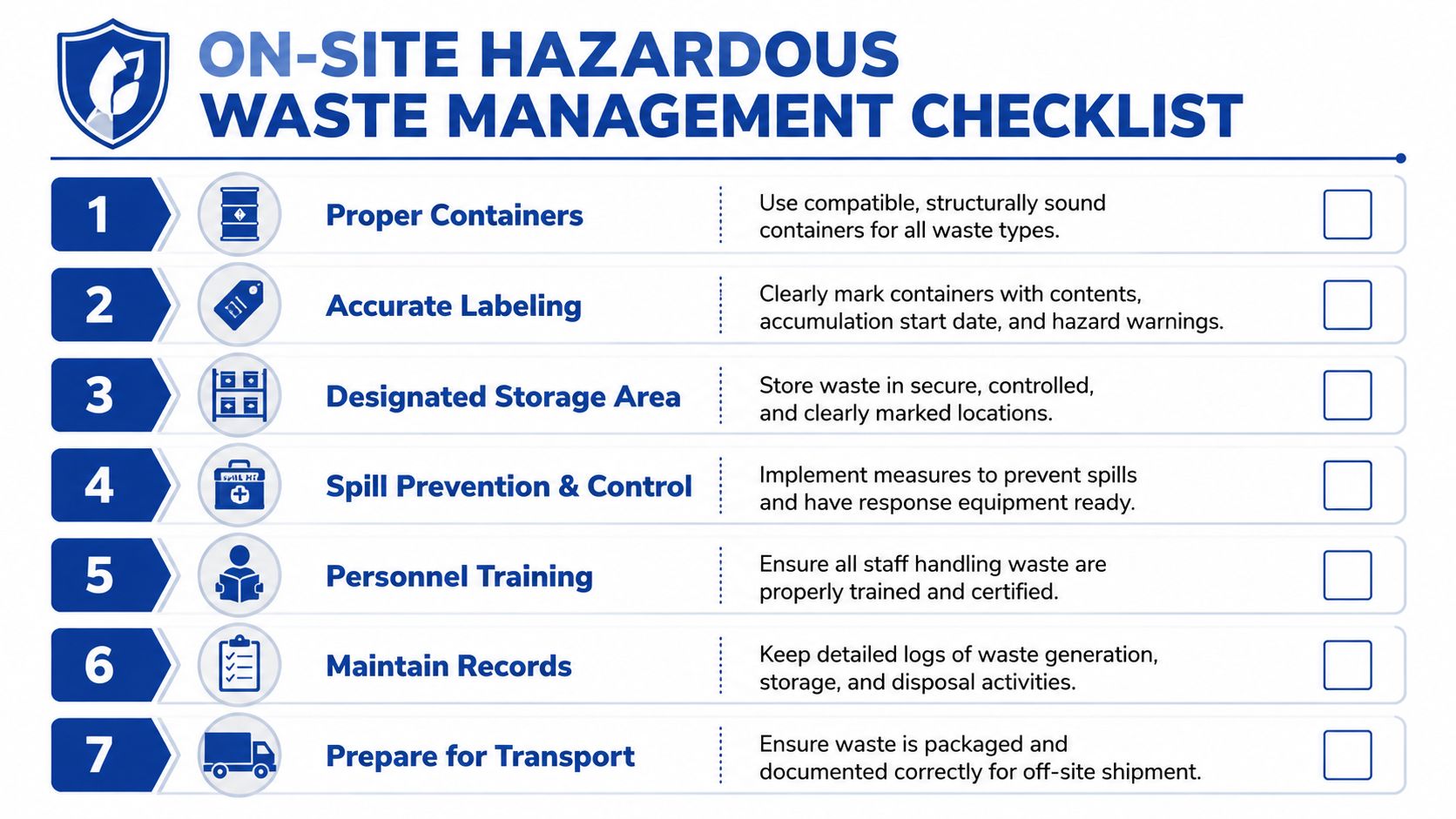
- Container condition: Use compatible, structurally sound containers with secure closures. If a lid is damaged, rusted, bulging, or improvised, replace it.
- Segregation: Keep hazardous, universal, recyclable, and ordinary waste streams distinct. Mixing streams creates compliance exposure and often raises disposal complexity.
- Location control: Store materials in a designated, marked area with restricted access. Waste shouldn't migrate into hallways, shared docks, or general supply space.
- Spill readiness: Keep response supplies accessible and make sure staff know who to call if containment fails.
Labels and manifests need to hold up under scrutiny
Labels should identify the contents clearly enough that a regulator, transporter, or responder can understand what's there without detective work. “Shop waste” and “miscellaneous chemical” aren't good enough. Accumulation dates and hazard warnings need the same level of discipline.
The manifest is the formal chain-of-custody document for regulated shipments. It connects the generator, the transporter, and the receiving facility. If one signature is missing, one waste description is inaccurate, or one copy can't be retrieved later, your company may be left defending a gap in the record.
For teams that want a plain-language way to think about documented transfer, Packaging Panda's UK custody guide offers a useful explanation of chain-of-custody principles that translates well to waste handling discipline.
A clean handoff isn't just physical. It's documentary. If the paperwork is weak, liability can circle back to the generator.
The transport side has its own legal mechanics. The Hazardous Materials Transportation Act requires businesses to use licensed carriers with valid permits and manifests. Failure to properly document waste streams with retention schedules of three to five years can void a generator's liability shield during an audit according to RTS waste compliance guidance.
A workable preparation routine
Before any pickup, run a pre-transport review:
- Verify the carrier's authorization and scheduled waste types.
- Match each container to its label and manifest entry.
- Confirm signatures, dates, and internal log entries are ready.
- Archive copies where EHS or compliance staff can retrieve them quickly.
If your site handles biohazardous, chemical, or mixed-risk events that require more specialized coordination, this overview of hazmat services and response support is worth keeping on hand.
Choosing Your Hazardous Waste Disposal Partner
The wrong vendor usually looks fine at the beginning. The quote is quick. The language is reassuring. The scope sounds broad enough. What's missing is the detail that tells you whether the company can effectively protect your business when something goes wrong.
That's why vendor selection should be treated like a liability decision, not a purchasing exercise. A disposal partner touches your permits, your manifests, your chain of custody, your employees' exposure environment, and your downstream legal risk.
What to ask before you sign
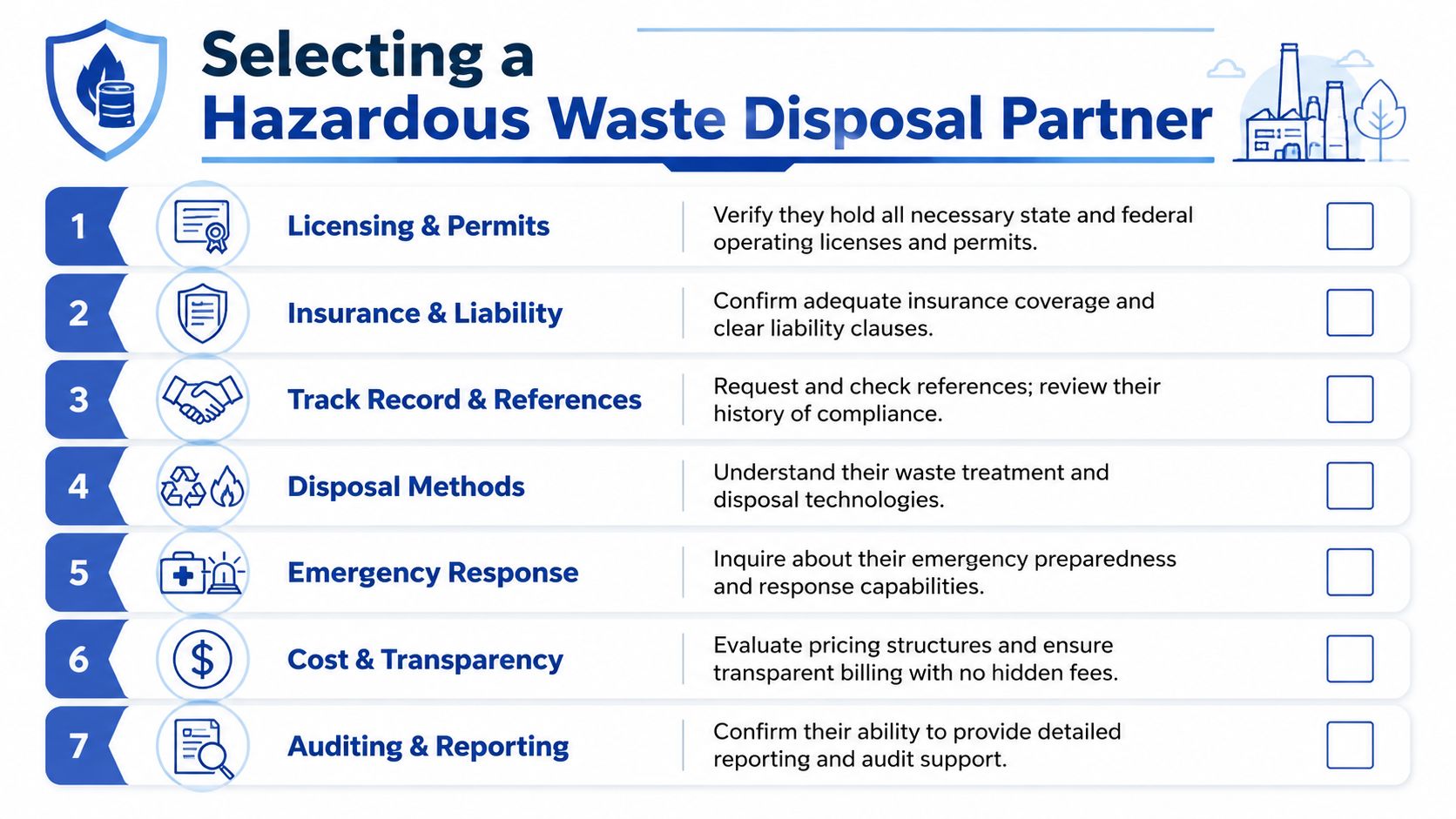
A credible provider should be able to answer direct questions without hedging. Ask for documentation, not broad assurances.
Use a vetting list like this:
- Licensing and permits: Ask which state and federal authorizations apply to the waste streams you generate.
- Insurance: Confirm pollution liability and other relevant coverage, then review the certificate language.
- Waste acceptance: Make sure the vendor is prepared to handle your specific waste types, not just “hazardous waste” in general.
- Safety history and procedures: Ask how they manage packaging, loading, spill response, and exception handling.
- Audit support: Confirm what records they provide and how quickly they can retrieve them.
- Reporting quality: Find out whether manifests, certificates, and disposal documentation are organized in a way your team can use later.
This short video is a helpful checkpoint while evaluating providers and internal expectations.
The pricing detail many businesses miss
One of the most expensive mistakes in hazardous waste disposal for businesses is accepting vague pricing. “Full service disposal” sounds simple, but it often hides the actual billing mechanics. The only reliable way to compare bids is to require itemized, unit-based pricing in the scope of work.
A critical but often-missed step is demanding unit-based pricing, such as per pound, in the scope of work. This prevents opaque billing and allows for true cost comparison between vendors, a nuance that protects businesses from inflated fees hidden until the final invoice as explained in Crystal Clean's business disposal guide.
That single step changes the conversation. You can compare drum charges, labor assumptions, packing supplies, transportation fees, and disposal rates on the same basis. Without that detail, a low quote can turn into a very expensive final invoice.
Don't reward the shortest proposal. Reward the clearest scope.
If your organization is creating a formal vendor review process, this guide on finding and choosing a trusted cleanup partner can help frame the questions that matter most.
Building a Long-Term Waste Management Strategy
A compliant disposal event is good. A repeatable waste management system is far better. Businesses that stay out of trouble usually don't rely on last-minute pickups and institutional memory. They build routines that make correct handling the default.
That matters even more as the market continues to mature. The global hazardous waste management market was valued at USD 56.40 billion in 2026 and is projected to grow to USD 77.42 billion by 2031, reflecting stronger regulatory enforcement and increasing business demand for compliant disposal solutions according to Mordor Intelligence's market outlook. Growth in the market doesn't make compliance easier. It usually means more vendors, more specialization, and more pressure on businesses to choose and document carefully.
The three habits that keep programs stable
The strongest long-term strategies usually rest on three habits.
First, train the people who touch the waste. That includes maintenance staff, environmental services, clinical teams, supervisors, and anyone preparing containers or paperwork for transport. Training should be practical, site-specific, and refreshed when processes change.
Second, keep records like you expect to need them. Manifests, disposal certificates, internal logs, exception notes, and vendor communication should all be retrievable without a scavenger hunt. When records are fragmented across inboxes, clipboards, and filing cabinets, compliance weakens even if the physical handling was sound.
Third, audit your own waste streams periodically. Waste programs drift. Containers migrate. Labels become inconsistent. New products enter the building. Contractors change procedures. Short site reviews catch small failures before regulators or insurers do.
What works and what doesn't
What works is boring on purpose. Named responsibilities, standardized labels, documented storage areas, verified vendors, and recurring internal checks.
What doesn't work is improvisation. Shared assumptions, “temporary” storage that becomes permanent, unexplained charges from disposal vendors, and paperwork that only one employee understands all create unnecessary exposure.
A durable program lowers the chance of crisis, but it also gives leadership better control over cost, vendor performance, and operational disruption. In hazardous waste management, that's what good strategy looks like. Quiet, documented, and defensible.
When your business needs a compliant, discreet, and experienced partner for biohazard remediation, hazmat response, or complex waste handling, 360 Hazardous Cleanup provides practical guidance and professional support built around safety, documentation, and risk reduction. Their team helps organizations respond quickly, protect occupants and staff, and move forward with a process that respects both regulatory requirements and the people affected by the event.