A call comes in before business hours. A tenant reports blood in a restroom, an employee says a waste container leaked in the loading area, or a patient room has been vacated after an infectious incident and your team wants to know whether housekeeping can handle it. In that moment, the problem isn't only cleanup. It's exposure, documentation, disposal, liability, and whether every decision made in the next few hours will hold up later.
That's where environmental compliance standards stop being abstract. They become the operating rules that protect your staff, your building occupants, your vendors, and the surrounding community. For a facility manager, property owner, or administrator, the first priority is to stabilize the scene. The second is to make sure every action after that is legally defensible and technically sound.
A hazardous incident can feel chaotic. It doesn't have to stay that way. With the right process and the right records, you can turn an emergency into a controlled response.
Your Responsibility in a Hazardous Materials Incident
When contamination is discovered on your property, you inherit a duty to control access, prevent further exposure, and preserve a clean chain of decision-making. That applies whether the incident involves bodily fluids, medical waste, chemical residues, or a mixed event where more than one hazard may be present.
What responsibility looks like in the first hours
Start with the site itself. Restrict entry. Protect employees and occupants from accidental contact. Avoid moving waste or cleaning materials unless you know how they must be handled. A rushed, well-meant response often creates a second problem by spreading contamination, mixing waste streams, or destroying evidence of what happened.
Then shift to documentation. Write down when the incident was discovered, who reported it, which area was affected, and what immediate controls were put in place. If a contractor is called, document when they arrived, what they observed, and what they removed.
Practical rule: If you can't prove what happened, what was removed, and where it went, you may have trouble proving you responded appropriately.
This matters more today than many facility managers realize. Environmental enforcement has changed over time. In the United States, federal environmental inspections fell from nearly 22,000 in 2007 to 12,000 in 2017, a decline of about 45%, reflecting a shift toward targeted oversight, reporting, and risk-based enforcement rather than universal on-site review, as noted in this Stanford policy brief on environmental compliance enforcement. In practice, that means regulators and investigators often evaluate your paperwork, logs, manifests, and audit trail just as closely as the physical condition of the site.
The questions that matter immediately
A facility manager under stress usually asks some version of the same questions:
- Is the area safe to enter: If there's any uncertainty about exposure, treat it as restricted until trained personnel assess it.
- What counts as regulated waste: That depends on the material, how it was generated, and where you're located.
- Can regular janitorial staff handle it: Often, no. Not if the event involves biohazardous waste, worker exposure concerns, transport rules, or specialized disposal.
- What records should I start keeping now: Incident notes, photos if appropriate, access restrictions, contractor communications, waste tracking documents, and disposal records.
Your role is oversight, not improvisation
You don't need to become a lawyer, industrial hygienist, or hazmat transporter in one morning. You do need to recognize that environmental compliance standards are not a side issue after a hazardous event. They are the framework for every defensible next step.
Your job is to keep people out of harm's way, bring in qualified help when needed, and insist on a cleanup process that leaves a complete record. That's how you reduce risk long after the scene itself is clean.
The Regulatory Landscape An Overview
A single cleanup can involve several legal systems at once. That's why people get confused. One rule governs the site, another governs the workers doing the cleanup, and another governs what happens once waste leaves your property.
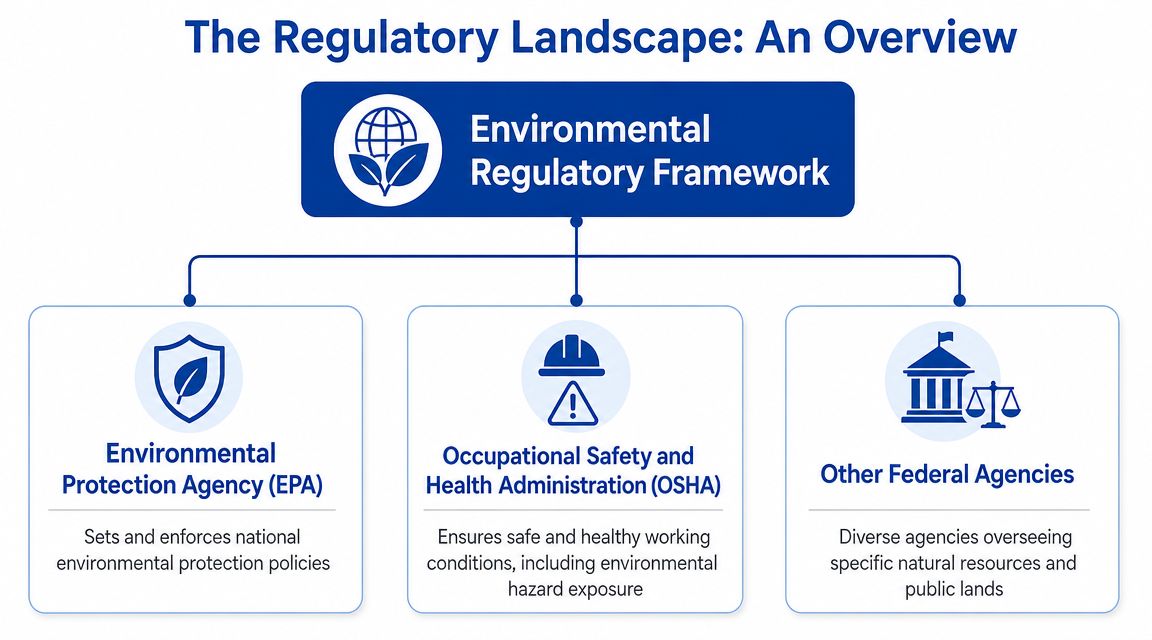
Think in three lanes
Use this simple model when you're sorting out responsibilities.
| Agency area | What it governs in practice | What you should ask |
|---|---|---|
| EPA | Environmental protection, waste handling, releases, contamination pathways | Was anything generated, discharged, stored, or disposed of incorrectly? |
| OSHA | Worker safety, exposure controls, training, protective equipment | Were employees or contractors protected from contact and trained for the hazard? |
| DOT | Transport of regulated materials and waste off-site | Was the waste packaged, labeled, and moved by approved methods? |
The agencies don't work in isolation. A cleanup contractor might wear PPE because of worker safety requirements, package waste under transport rules, and document disposal under environmental standards. One incident can activate all three lanes on the same day.
Why this matters to facility managers
If you only think about the stain on the floor or the visible debris, you'll miss the compliance picture. However, the questions are broader. Did anyone enter the area without proper protection? Was contaminated waste placed into the wrong container? Was the transporter authorized to move it? Was the receiving facility appropriate for that waste stream?
That broader view is also why many organizations now try to integrate ESG into security operations. Safety, environmental governance, and incident response are increasingly connected in day-to-day operations, especially in healthcare, industrial, and multi-site property settings.
A clean-looking site is not the same thing as a compliant response.
Federal rules are the framework, not the whole answer
Federal agencies set the structure, but your obligations depend on what happened and how the material is classified. A blood spill in an office restroom is different from an industrial accident with mixed chemical and biological contamination. A clinic, warehouse, long-term care facility, and apartment building may face different operational duties even when the visible hazard looks similar.
If you want a practical primer focused specifically on the cleanup industry, this guide to biohazard remediation laws and regulations is useful because it frames the legal environment around real remediation work, not just abstract statutes.
Key Federal Environmental Compliance Standards
The most important federal standards are easier to manage when you translate each one into a plain-language duty. Don't start with code sections. Start with the question, “What must happen correctly on my property?”

What the major standards mean on the ground
RCRA and hazardous waste handling
The Resource Conservation and Recovery Act matters when waste generated by the incident may be regulated based on its characteristics, contents, or handling requirements. For a facility manager, that usually means you can't assume all contaminated debris goes into the same bag or dumpster. Segregation, storage, labeling, and disposal pathway all matter.
A common failure point is mixing ordinary trash, sharps, absorbents, PPE, and potentially hazardous residues in one stream. Once that happens, disposal becomes harder to defend and sometimes more expensive to correct.
OSHA and worker exposure
OSHA's standards matter any time employees or contractors face contact risks during cleanup. If workers may be exposed to blood or other hazardous materials, the cleanup process needs controls, training, and the right protective equipment. Here, many organizations make a costly mistake by assuming a maintenance employee can “just wipe it down.”
That isn't a judgment on the employee. It's a reminder that cleanup competency is hazard-specific.
DOT and off-site transport
Once waste leaves your building, transport rules take over. Packaging, labeling, chain of custody, and the destination facility all become part of compliance. If your team wants a readable outside reference on transport basics, My Safety Manager's hazmat guide is a practical starting point for understanding how DOT expectations shape packaging and movement.
Why these standards have become a major operating function
Environmental compliance is no longer a narrow legal back-office issue. One market report projects the global environmental compliance services market will reach $22.1 billion by 2034, and says the industrial sector accounts for about 52.3% of that market, highlighting how central compliance has become in higher-risk environments, according to this environmental compliance services market analysis. The takeaway isn't just market size. It's that organizations with waste, emissions, hazardous materials, or permitting exposure increasingly treat compliance as a standing operational system.
The facility manager's checklist
When a federal standard may apply, ask these questions before work starts:
- Who classified the waste: Someone should be able to explain why the waste is being handled a certain way.
- Who is protecting the workers: PPE, exposure controls, and training shouldn't be improvised.
- Who is transporting the material: The handoff off-site should be documented and appropriate for the waste stream.
- Who keeps the records: You need copies, not verbal assurance.
For a deeper view of why certifications and training matter in this setting, this resource on OSHA, HAZWOPER, EPA, and IICRC standards helps connect credentials to actual field performance.
Navigating State and Local Compliance Variations
Federal law is the floor. It often isn't the ceiling.
That distinction trips people up because a response can look acceptable at the federal level and still be incomplete under state medical waste rules, local health department requirements, sewer discharge restrictions, building occupancy rules, or permit conditions tied to the property.
Why location changes the answer
A hospital, behavioral health center, warehouse, and multifamily complex may all ask the same question after an incident: “What do we have to do?” The honest answer is, “It depends on the state, the city, the waste type, and the site history.”
Some jurisdictions define regulated waste more narrowly. Others are stricter about packaging, labeling, storage times, transporter registration, or what can enter the municipal waste stream. Local fire code, wastewater authority requirements, and redevelopment conditions can also affect cleanup decisions.
Here's the practical comparison:
| Question | Federal baseline | State or local variation |
|---|---|---|
| Waste classification | Sets broad framework | May define categories more strictly |
| Storage on site | General compliance duties | May impose local containment or time limits |
| Disposal route | Regulated by waste type | May require specific state-approved pathways |
| Site reuse or reopening | General safety and environmental concerns | May trigger local health, zoning, or occupancy reviews |
Environmental justice can change the review lens
Another layer is emerging in many jurisdictions. EPA guidance now directs analysts to consider the distribution of risks within population groups, not just average effects, which is especially important near overburdened communities, as described in this EPA environmental justice technical guidance. For facility managers, that means the compliance question may extend beyond “Did we clean it up?” to “Who remains exposed, and how are impacts distributed around this site?”
If your property sits near a vulnerable neighborhood, school, dense residential area, or medically sensitive population, cleanup choices can carry added review pressure even when the immediate incident is contained.
Local knowledge is not optional
A national template won't solve a local compliance problem. The provider or consultant handling your incident should understand not only federal rules, but also the expectations of the state environmental agency, health department, local waste authorities, and any redevelopment or community-impact issues attached to the site.
Responsibility can also become blurred in leased spaces, shared facilities, and mixed-use properties. Ownership and operational control are key considerations in such environments. If you're sorting through that question, this guide on who is responsible for biohazard cleanup can help you frame the issue before delays create more exposure.
Mastering Compliance Documentation and Recordkeeping
After the scene is stabilized, your strongest protection is the file you build. Not the summary email. Not the invoice. The full compliance record.
Modern environmental compliance standards increasingly treat documentation as an audit-grade data system. Records should include process descriptions, material specifications, operating conditions, calibration details when relevant, and sample calculations that let an auditor verify outcomes step by step, as explained in this guide to environmental compliance documentation and reporting. That's a very different standard from “we cleaned it and threw it away.”
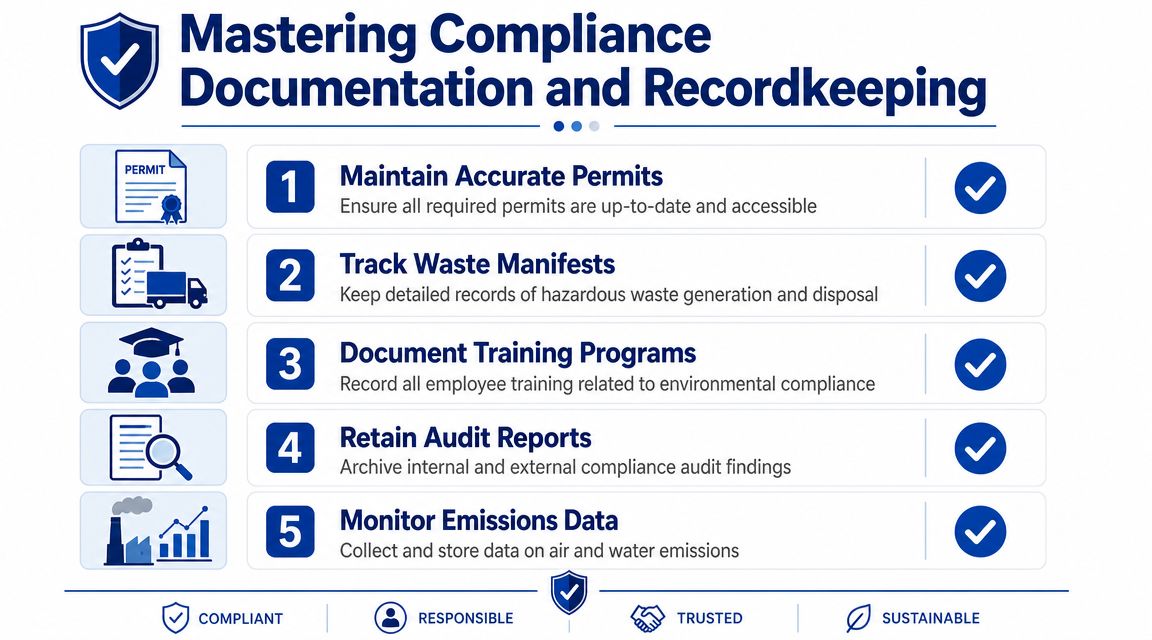
What belongs in a complete compliance file
For most hazardous or biohazard cleanup events, your file should include:
- Incident record: Time discovered, reporting party, affected area, access controls, and initial conditions.
- Scope of work: What contamination was identified, what materials were removed, and what areas were cleaned or treated.
- Waste paperwork: Manifests, pickup records, container descriptions, and destination facility documents where applicable.
- Training and qualifications: Proof that the people performing the work were trained for the hazard involved.
- Site communication log: Emails, approvals, change orders, tenant notices, and internal decision records.
- Completion support: Final report, photographs if appropriate, and any clearance or disposal confirmation provided.
Some incidents also need chain-of-custody records, equipment logs, exposure documentation, or environmental sampling records. The point is consistency. If someone reviews the file later, they should be able to reconstruct what happened without guessing.
What makes documentation audit-grade
Audit-grade documentation answers three questions clearly.
- What was the condition of the site before work began
- What exactly was done
- How can an outside reviewer verify the result
That means details matter. Container labels matter. Waste descriptions matter. Dates matter. If measurements or monitoring were part of the response, you need the underlying numbers and method, not just the conclusion.
Good documentation should let a regulator, insurer, attorney, or future buyer follow the response from discovery to final disposal without a missing link.
Records to ask your provider for before they leave
Don't wait until the invoice arrives. Ask for the closeout package while the response is underway.
- Waste manifest copies: These are often the backbone of disposal proof.
- Crew training confirmation: You need confidence that the responding personnel were qualified.
- Cleanup protocol summary: This shows what method was used and why.
- Disposal confirmation: Final destination records matter when questions arise later.
- Photos and site notes: Only where appropriate and privacy-compliant.
If waste handling is part of your event, this overview of biohazard waste disposal is a useful companion because it shows why disposal records are not secondary paperwork. They are part of the legal proof that the incident was closed correctly.
Common Compliance Pitfalls and How to Avoid Them
Most compliance failures don't start with bad intentions. They start with shortcuts taken during stress. Someone uses the wrong container, calls the wrong vendor, reopens a room too early, or assumes redevelopment plans can be handled later.
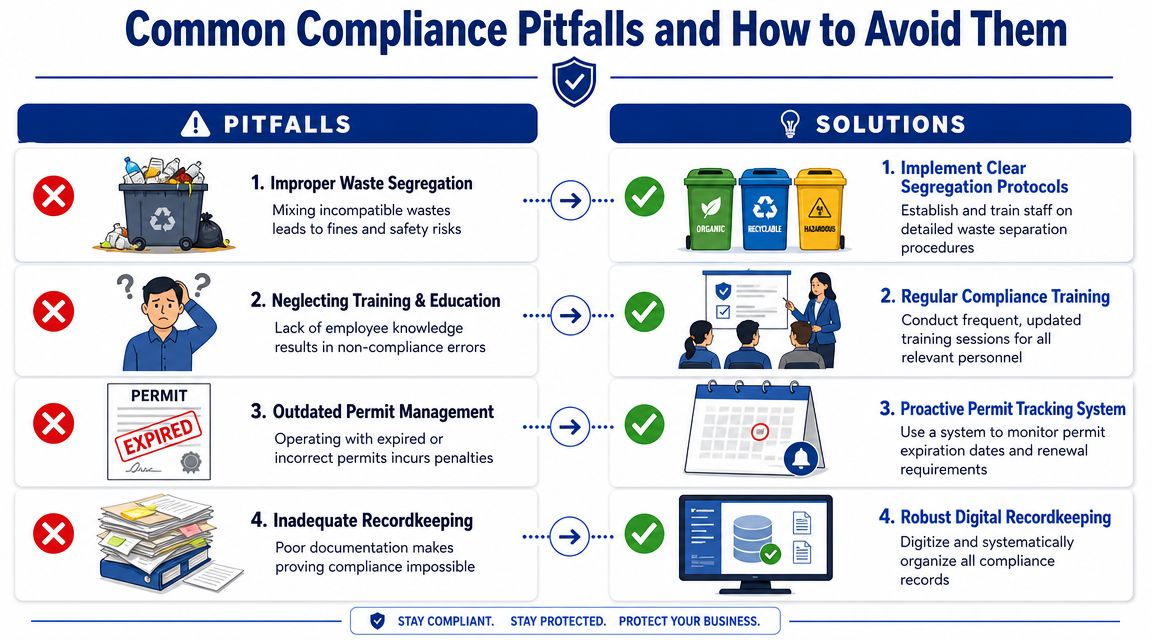
Four mistakes that create avoidable exposure
Improper waste segregation
A mixed waste container may seem efficient during an emergency, but it can undermine disposal compliance and worker safety. Keep sharps, absorbents, PPE, and any potentially regulated materials in the correct stream from the start.
Using a general cleaner for a specialized incident
If the hazard involves bodily fluids, medical waste, industrial contamination, or uncertain material classification, general custodial service is often the wrong fit. The right question isn't “Who can clean?” It's “Who can clean and document this correctly?”
Leaving without the paperwork
A site can look fully restored and still leave you exposed if waste tracking records, disposal documentation, and incident notes are incomplete. Verbal assurances won't help much during an insurance dispute or later inquiry.
Ignoring the site's future use
This one gets missed often. EPA guidance notes that compliance can intersect with land-use projects, redevelopment pressure, low-impact development, and broader environmental review questions, as described in this EPA guidance on urban nonpoint-source and development considerations. If you clean for today without considering a pending renovation, sale, tenant improvement, or site reuse, you can create delays and gaps later.
The better pattern
Use a simple discipline during every incident:
- Pause before cleanup starts: Confirm hazard type, restricted area boundaries, and waste path.
- Match the vendor to the hazard: Ask about training, transport process, and documentation package.
- Track every handoff: Waste, keys, access, approvals, and disposal should all leave a record.
- Think beyond cleanup day: Ask whether planned redevelopment, reopening, or occupancy changes affect the response.
Fast response matters. Controlled response matters more.
A small procedural error made early can become a larger legal and operational problem later. The safest pattern is disciplined escalation, careful waste handling, and complete closeout records.
Why Professional Partnership Is Your Greatest Asset
Environmental compliance standards are difficult to comply with under normal conditions. During a hazardous incident, they become harder because decisions must be made quickly, across safety, environmental, disposal, and liability issues at the same time.
That's why professional partnership matters. A qualified remediation partner should know how to assess the site, contain the hazard, protect workers, separate waste correctly, document every material step, and support insurance and legal record needs without adding confusion. The right provider also understands that occupants, staff, and families may be under stress and need calm, clear communication.
For many facilities, using a specialist such as 360 Hazardous Cleanup means the response includes not only physical cleanup, but also waste handling documentation, regulatory awareness, and coordination that helps management return attention to operations. That is often the difference between a resolved incident and a lingering liability file.
When a hazardous event happens, speed matters, but defensible process matters more. 360 Hazardous Cleanup helps property owners, facility managers, healthcare sites, families, and responders manage biohazard incidents with compliant handling, clear documentation, and compassionate support so the site can be restored safely and the record can stand up to scrutiny.