A lot of people first think about hazardous material transportation at the worst possible moment. A drum is sweating in the corner of a warehouse. A tenant leaves behind chemical containers with torn labels. A clinic has regulated waste after an emergency. A family is already dealing with a traumatic event and then learns that some of what remains can't go in the trash.
That moment is confusing because the problem doesn't look like “transportation.” It looks like cleanup, storage, liability, smell, fear, or a call from an inspector. But the minute a hazardous material has to leave a property, transportation rules come into play. Those rules affect what the material is, how it's packaged, what paperwork follows it, who can move it, and what happens if something goes wrong on the road.
For property owners, facility managers, and families under stress, the hardest part is often knowing what to do first. The safest answer usually isn't “move it quickly.” It's “identify it correctly, secure the area, and make sure the next step is compliant.”
Why Hazardous Material Transportation Matters
A common real-world example starts small. Someone finds an unlabeled container in a maintenance room after a tenant move-out. The cap is crusted. The liquid inside has separated. Nobody on site knows whether it's a cleaner, a solvent, a pesticide, or something much more dangerous.
Another example is more personal. After a medical or trauma-related event, a homeowner may assume the main issue is visible cleanup. In reality, some materials generated from that scene may require specialized handling, packaging, and disposal channels. Once those materials are prepared to leave the property, transportation compliance becomes part of the job.
Why the risk doesn't end at the property line
Hazardous material transportation matters because danger travels. A substance that seems stable in a closed room can become far more dangerous if it's jostled, heated, punctured, or mixed with the wrong material in transit. That's why regulators care so much about classification, packaging, labels, and documentation. Those steps aren't administrative busywork. They tell every person in the chain what they're dealing with before a preventable mistake turns into an emergency.
Recent U.S. data show how important that chain has become. Annual hazardous materials transport incidents rose from 14,806 in 2010 to more than 27,355 in 2025, an increase of 84.8%, according to Trace One's compilation of federal incident data.
Practical rule: If you can't confidently identify a material, you're not ready to move it.
Hazardous material can mean more than people expect
Many readers hear “hazmat” and think of tanker trucks, industrial plants, or dramatic highway scenes on the news. In practice, the category is much broader. It can include industrial chemicals, corrosives, flammable liquids, compressed gases, infectious substances, contaminated absorbents, and waste generated after an accident or trauma scene.
That breadth is where people get tripped up. They assume household scale means low regulatory significance. It doesn't always. A small amount of the wrong material, packed the wrong way, can put drivers, responders, neighbors, and disposal workers at risk.
Here's the deeper reason this topic matters:
- Safety comes first: The rules aim to prevent fires, toxic exposure, contamination, and secondary injuries.
- Liability follows the material: Responsibility doesn't disappear because a container left your building.
- Bad decisions multiply harm: One rushed transport decision can turn a contained property problem into a roadway incident, environmental release, or enforcement issue.
If you're staring at an unknown or clearly dangerous material, your first job isn't transport. It's control, identification, and getting competent help.
Defining Hazardous Materials The 9 Official Classifications
Federal transportation rules organize hazardous materials into nine classes. That structure helps everyone speak the same language, from the person preparing the shipment to the driver to the emergency responder who may need to act fast.
A simple way to think about these classes is this. Regulators aren't just asking, “What is it?” They're asking, “How can it hurt people, property, or the environment during transport?”
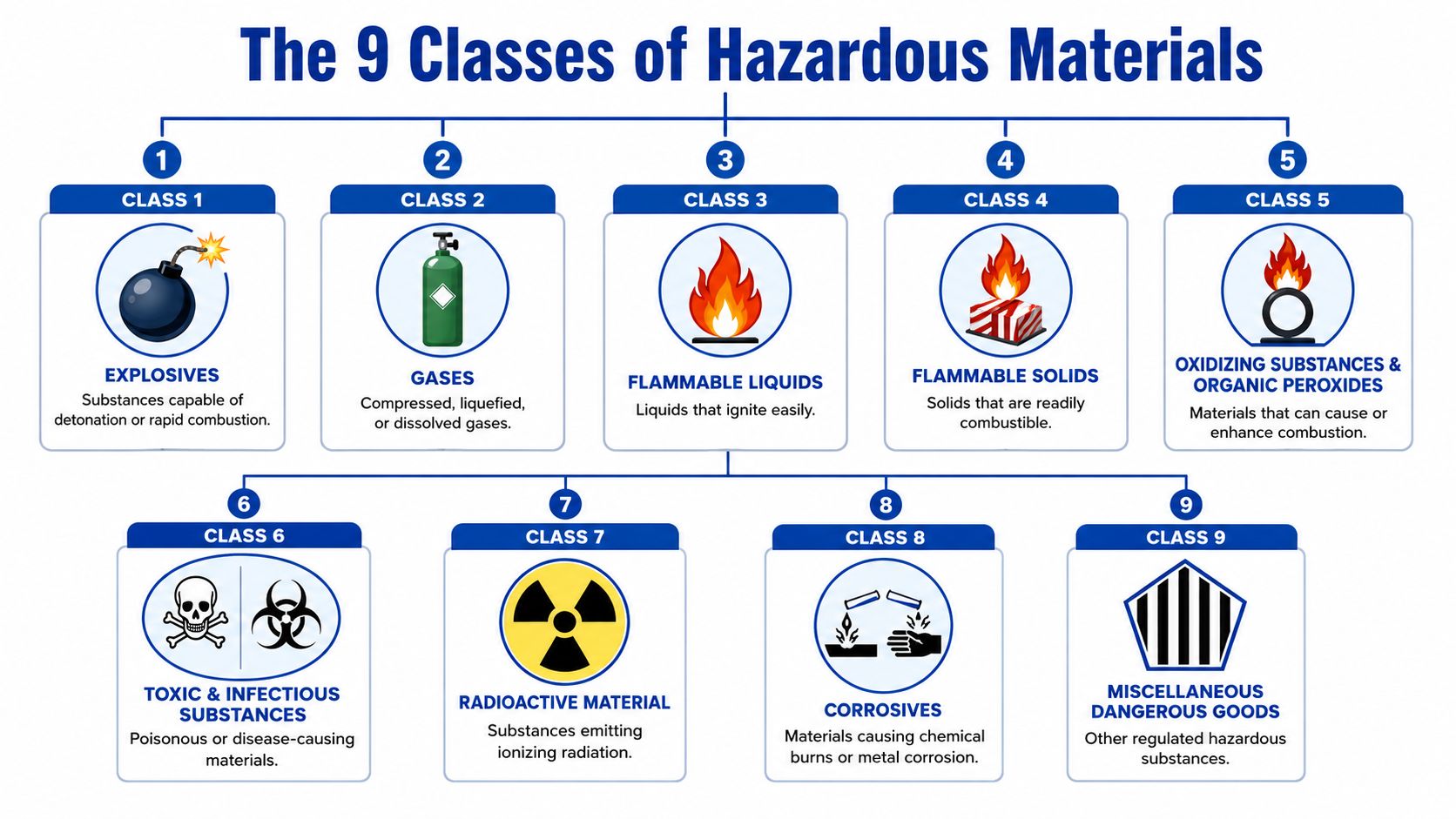
The nine classes in plain language
| Class | What it means | Plain example |
|---|---|---|
| Class 1 | Explosives | Materials that can detonate or rapidly combust |
| Class 2 | Gases | Compressed, liquefied, or dissolved gases |
| Class 3 | Flammable liquids | Liquids that ignite easily |
| Class 4 | Flammable solids | Solids that can catch fire readily |
| Class 5 | Oxidizers and organic peroxides | Materials that can intensify fire |
| Class 6 | Toxic and infectious substances | Poisons and disease-causing materials |
| Class 7 | Radioactive material | Materials that emit ionizing radiation |
| Class 8 | Corrosives | Substances that burn tissue or corrode metal |
| Class 9 | Miscellaneous dangerous goods | Regulated hazards that don't fit neatly elsewhere |
The category that often surprises healthcare facilities, landlords, and families is Class 6. People often associate it only with poisons, but it also includes infectious substances. That matters when regulated medical waste or contaminated materials must be removed safely after certain incidents.
Why classification changes everything
Once a material is placed in the right class, almost every downstream decision starts to make sense. The class influences the container, the label, the handling precautions, the shipping description, and the emergency information that travels with it.
Think of classification as the foundation under the whole process. If that first judgment is wrong, every step after it may also be wrong.
A few examples make that clearer:
- A corrosive liquid can eat through the wrong container.
- A flammable liquid may need controls to reduce ignition risk during handling.
- An infectious substance may require a completely different packaging and disposal path than ordinary trash.
- A miscellaneous dangerous good may seem less dramatic, but it can still be regulated for transport.
For readers trying to sort out what may qualify as regulated waste before transport, this guide on understanding hazardous waste and safe disposal pathways gives helpful context.
The label on a container isn't just a warning. It's an instruction set for everyone who touches that shipment next.
Where people get confused
The biggest misunderstanding is assuming a product's everyday use determines its transport status. It doesn't. A substance may feel familiar on a shelf and still be tightly regulated once it enters the transportation system.
Another point of confusion is mixed waste. If absorbent pads, PPE, sharps-related materials, damaged containers, or contaminated debris are bundled together, the transport classification may become more complex, not less. That's why guessing is risky. In hazardous material transportation, identification comes before movement.
Navigating the Maze of Hazmat Regulations
The main federal framework for highway hazmat shipping in the United States sits in 49 CFR Parts 100–185. That citation sounds technical, but the underlying idea is straightforward. Before a hazardous material goes onto the road, someone has to identify it correctly and prepare it in a way that protects everyone else in the chain.
According to the U.S. Department of Transportation's hazmat guidance, shippers must classify the material before offering it for shipment using the hazardous materials table to determine the correct UN/NA ID number, proper shipping name, hazard class, packing group, and required hazard communication such as marks, labels, and shipping papers.
The shipper carries the first burden
This is the point many property owners and facility teams miss. If your business or property is the source of the material, you may be treated as the shipper for regulatory purposes. That means the responsibility starts with you, not with the truck that later arrives.
The carrier has obligations too, but the system assumes the shipment was correctly identified and prepared before the driver receives it. If the classification is wrong at the beginning, the error can ripple through packaging, placards, loading, routing, and emergency response.
A useful way to think about it is:
- Classification answers what it is
- Packaging answers how it must be contained
- Marking and labeling answer how others will recognize the hazard
- Shipping papers answer what responders and inspectors need to know
Why the rules feel overwhelming
Hazmat regulations feel dense because they combine chemistry, logistics, documentation, and legal accountability. A facility manager may know operations well and still feel uncertain about whether a containerized waste stream needs a specific shipping name or whether mixed debris can travel in the same load.
That uncertainty is normal. It's also why untrained improvisation is dangerous. Compliance depends on details that seem small until something goes wrong.
For teams coordinating pickups across multiple sites, route planning also matters operationally. Even a resource focused on optimizing field sales operations helps illustrate a broader truth. Routing discipline affects timing, driver efficiency, and decision quality. In hazmat work, those logistical choices carry safety and compliance consequences as well.
Key point: The law cares about who offered the material for transport, not just who drove it away.
Why training matters beyond paperwork
This area isn't just about forms. People need enough training to understand what the forms mean, when exceptions apply, and when a shipment needs to stop until the facts are clear. That's especially true when waste comes from a trauma scene, medical event, industrial accident, or mixed-use property where ordinary trash and regulated material may be side by side.
If you want a practical look at why credentials matter in this space, this article on certifications and training beyond the basics explains the difference between surface-level familiarity and real operational competence.
Critical Steps Before Transport Packaging and Documentation
The most important pre-transport question is simple. What exactly is leaving the site? Until that answer is solid, packaging and paperwork can't be reliable.
That's why competent hazardous material transportation starts before a box is sealed or a drum is loaded. It starts with identification, segregation, and deciding whether the material is stable enough to move at all.
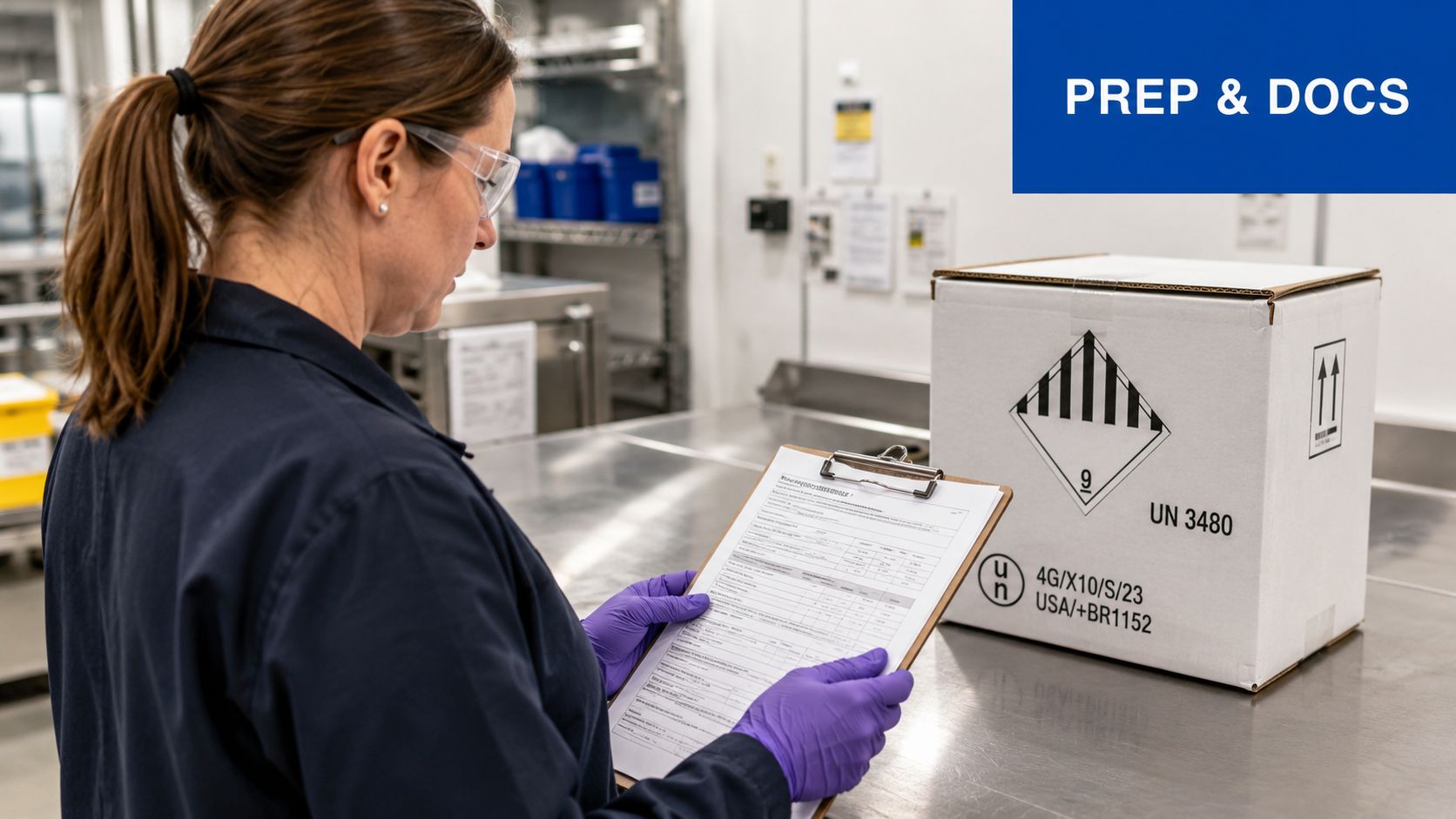
Packaging is a safety system
People sometimes think of packaging as a container choice. In hazmat work, it's more accurate to treat packaging as a containment system. It has to match the material's hazards, the condition of the waste, and the realities of transit such as vibration, stacking, heat, or accidental impact.
A leaking bottle inside a random plastic tote isn't “contained” in the regulatory sense. A compromised sharps container shoved into a general waste bin isn't a transport solution. The package has to protect the people who load, move, inspect, and receive it.
Before transport, teams usually need to address several practical questions:
- Condition of the material: Is it intact, leaking, reactive, contaminated, or mixed with debris?
- Compatibility: Can these items share the same outer packaging, or do they need separation?
- Closure: Is the lid, liner, absorbent, or overpack suitable for the hazard?
- Communication: Will the package clearly tell the next person what hazard is present?
A short educational walkthrough can help make these steps more concrete:
Documentation creates chain of custody
Documentation isn't there just to satisfy an inspector. It creates traceability. It tells the next handler what the material is, where it came from, and how it's supposed to be managed. For hazardous waste streams, chain-of-custody thinking matters because the risk doesn't vanish when the truck door closes.
That's one reason facilities should avoid informal handoffs. “Someone picked it up” is not a compliance strategy.
Good documentation supports several goals:
- Hazard communication for handlers and responders
- Accountability for who prepared and transferred the material
- Disposal control so the waste reaches the right endpoint
- Defensible records if questions arise later
For a broader look at compliant end-of-line handling, this resource on safe and responsible hazardous waste disposal is useful.
Battery shipments need special caution
One transport challenge getting more attention is the movement of lithium-ion batteries. According to industry guidance on risk management in hazmat transportation, the transportation ecosystem is being reshaped by these shipments because thermal runaway, re-ignition, and fire suppression complexity don't fit neatly into older hazmat assumptions.
That matters in the field. A damaged battery, a recalled device, or a battery packed near incompatible items can create a very different response problem than a traditional chemical container. Basic classification still matters, but battery shipments often require more specialized judgment about segregation, damaged goods handling, and emergency planning.
Clarifying Roles Shipper and Carrier Responsibilities
When people are stressed, they often assume hiring a transporter transfers the whole problem. Legally and practically, it usually doesn't. Hazardous material transportation works as a chain of shared duties, and the handoff only works when each party does its own part correctly.
What the shipper is responsible for
The shipper is the party that causes the hazardous material to be offered for transportation. In plain terms, that's often the generator of the waste or the organization arranging its movement from the property.
The shipper's responsibilities usually include:
- Correct identification: The material has to be classified accurately before transport.
- Proper packaging: The chosen packaging has to fit the hazard and condition of the material.
- Accurate paperwork: Shipping descriptions and related records have to match what is contained in the load.
- Hazard communication: Marks, labels, and any required information have to be in place before pickup.
This is why a facility can't safely delegate judgment it never made. If the source side guesses wrong, the rest of the chain starts from a bad premise.
What the carrier is responsible for
The carrier is the party physically moving the shipment. That role comes with its own operational and regulatory obligations. The carrier has to manage transport conditions, driver readiness, equipment, and vehicle-level compliance.
A practical comparison helps:
| Role | Core focus |
|---|---|
| Shipper | What the material is and how it is prepared |
| Carrier | How the prepared material is lawfully and safely moved |
The distinction matters because each side may face different exposure if something goes wrong. A packaging mistake might trace back to the shipper. A routing, security, placarding, or driver issue may implicate the carrier.
If either side treats compliance as “the other company's job,” gaps open fast.
Some shipments trigger extra permit requirements
Some loads are serious enough that ordinary hazmat readiness isn't the end of the story. The Federal Motor Carrier Safety Administration explains that certain high-consequence shipments require a Hazardous Materials Safety Permit, including any highway route-controlled quantity of Class 7 radioactive material or more than 25 kg (55 lb) of Division 1.1, 1.2, or 1.3 explosives.
Even if your site never handles those materials, the lesson is important. Hazmat transportation isn't one flat category. The rules scale with the hazard. As consequence rises, so do the demands around permitting, loading, routing, and oversight.
For property managers and homeowners, the practical takeaway is simple. Ask direct questions before any pickup:
- Who classified this material?
- What packaging standard is being used?
- What paperwork will accompany it?
- Does this load require any special transport authority?
- What happens if the shipment is refused or found noncompliant in transit?
Those aren't confrontational questions. They're responsible ones.
When Incidents Occur Response Reporting and Cleanup
A transport incident rarely begins as a dramatic scene. It often starts with a small failure. A lid loosens. A package shifts. A hidden incompatibility becomes obvious only after transit begins. Someone notices odor, seepage, smoke, residue, or a damaged outer container.
Because hazardous materials move largely by road, highway exposure matters most. In the United States, about 87% of reported hazmat incidents involved trucks, according to the National Academies review of hazardous materials transportation. That's one reason roadway incidents matter to businesses, neighborhoods, first responders, and property owners alike.
What the first response should look like
The first obligation is safety, not curiosity. People should secure distance, prevent unnecessary contact, and avoid creating a second victim. If the material is unknown, responders should treat uncertainty itself as a hazard.
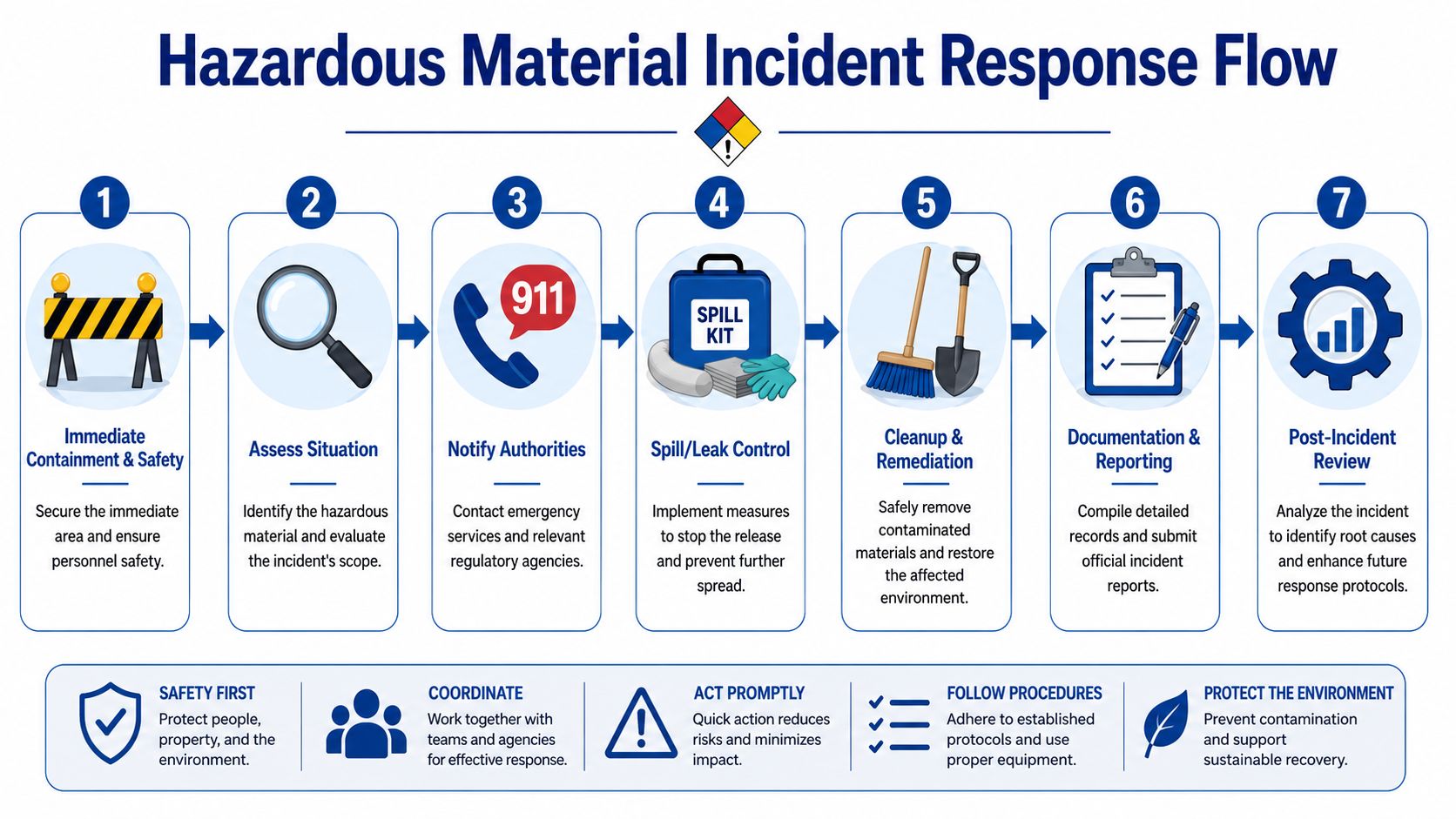
In practical terms, a disciplined response often follows this pattern:
- Secure the area so bystanders and staff don't walk into exposure.
- Identify the material if possible using labels, shipping papers, placards, or responder guidance tools.
- Notify the right authorities and internal contacts without delay.
- Control the release only if trained and equipped to do so safely.
- Document what happened while facts are fresh.
- Arrange proper cleanup and disposal of all contaminated materials.
Cleanup is more than wiping up the visible mess
At this stage, many incidents get mishandled. Once the immediate release is stopped, people want closure. They wash down the area, bag debris, and assume the event is over. But the actual cleanup phase may only be starting.
Contaminated absorbents, PPE, porous materials, packaging, runoff, and adjacent surfaces can all become part of the waste stream. If the release involved infectious material, corrosives, or mixed contaminants, the remediation plan has to address worker exposure, cross-contamination, and lawful disposal, not just appearance.
This is especially important for facilities near agricultural operations or chemical application areas, where off-site movement and contamination concerns can overlap with broader liability issues. Readers dealing with land, runoff, or neighboring exposure questions may find this discussion of farm pollution and drift risks helpful as a related risk perspective.
A hazmat incident ends when the site is safe, the waste is properly managed, and the records can withstand scrutiny.
Reporting and follow-through matter
After the scene is stabilized, reporting and documentation become critical. Notes, photos, internal logs, transport records, and waste tracking can all matter later. So can the question of who was exposed and what decontamination steps were taken.
For biohazard-related workplace exposures and scene management concerns, this resource on OSHA guidelines for biohazard exposure and workplace incidents offers useful guidance.
A good incident response doesn't only answer, “How do we clean this up?” It also answers, “How do we keep this from happening again?” That means reviewing packaging, training, loading practices, storage conditions, vendor coordination, and emergency communication after the event is over.
Choosing a Compliant Partner for Transport and Disposal
By the time someone starts looking for outside help, they're usually under pressure. Operations are disrupted. Residents are upset. Staff are nervous. There may be inspectors, insurers, or first responders involved. In that environment, it's tempting to choose the first company that says it can haul the material away quickly.
That's exactly when careful selection matters most.
What a strong partner should be able to demonstrate
A compliant hazardous materials partner should be able to explain its process in plain language. Not in slogans. In specifics. If a provider can't clearly describe how it identifies, packages, documents, transports, and disposes of hazardous material, that lack of clarity is a warning sign.
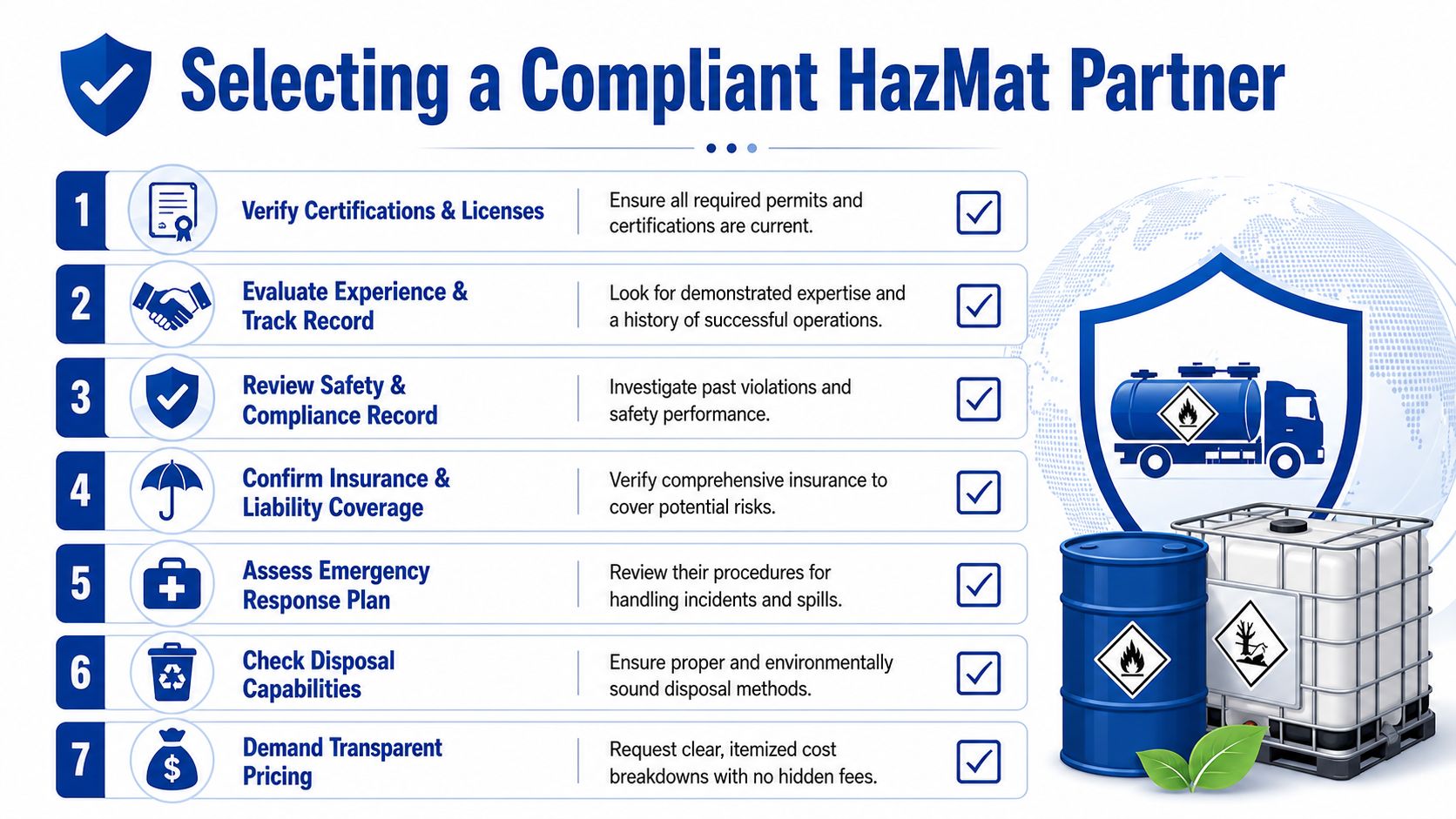
Use questions like these when you evaluate a provider:
- Licensing and credentials: What permits, training, and certifications support the work they're offering to perform?
- Scope clarity: Are they handling only transport, or can they also manage packaging, remediation, and disposal coordination?
- Documentation discipline: What records will they generate, and what will you receive for your files?
- Incident readiness: If a package is leaking, rejected, or damaged in transit, what is their response protocol?
- Insurance and liability: Can they explain their coverage in a way that makes sense for your risk?
- Discretion and communication: Will they work professionally in sensitive settings such as occupied buildings, healthcare sites, or trauma scenes?
Speed matters, but competence matters more
A fast response is valuable. A rushed, noncompliant response is expensive. The right partner should know when to move quickly and when to slow the process down because the material hasn't been identified or stabilized.
That judgment matters a great deal in high-stress settings. A family dealing with a death scene, for example, doesn't need dramatic language or vague reassurances. They need a team that can explain what must be removed, what can't be transported casually, how privacy will be protected, and how the property can be made safe without creating new risks.
The same applies in commercial settings. Facility managers need providers who can coordinate with operations, safety personnel, insurers, and downstream disposal channels while maintaining a clean chain of custody.
What the best partnerships feel like in practice
The best hazardous material transportation partners usually share a few traits:
| What you ask | What a good answer sounds like |
|---|---|
| How will you determine what this is? | They describe a real identification and evaluation process |
| Can you transport this today? | They answer based on classification and condition, not guesswork |
| What paperwork should I expect? | They explain the records and why each matters |
| What if this is biohazardous or mixed waste? | They discuss segregation, packaging, and disposal implications clearly |
That last point is where many providers become thin. Transport isn't isolated from cleanup. Disposal isn't isolated from packaging. Trauma-informed service isn't isolated from compliance. In real life, these issues arrive together.
For readers comparing options, this overview of hazmat services and support capabilities can help frame what thorough service should include.
The safest choice usually isn't the company with the simplest promise. It's the one that respects the complexity, communicates clearly, and has the training and systems to carry the problem all the way through.
If you're dealing with a hazardous material situation and need calm, compliant guidance, 360 Hazardous Cleanup provides 24/7 support for hazmat, biohazard, trauma scene, and environmental remediation needs. Their team works with property owners, families, facilities, insurers, and first responders to manage cleanup, handling, and disposal with professionalism, discretion, and respect for what you're going through.