A worker slips in a warehouse break area. A tenant is found after an unattended medical emergency in an apartment. An employee tries to help during a bleeding incident in an office lobby before paramedics arrive. In each case, the first question is usually medical. The second question comes fast: who makes this space safe again, and what are you now responsible for?
That's where many facility managers and business owners get stuck. Most bloodborne pathogens guidance is written with hospitals and clinics in mind. But occupational exposure bloodborne pathogens issues don't stop at the clinic door. They show up in offices, distribution centers, multifamily properties, schools, plants, and anywhere people work, visit, or live.
If you manage a building, supervise staff, or own property, you need more than a general awareness of OSHA. You need a practical way to recognize exposure, protect employees, document the event, and prevent an unsafe cleanup decision that creates a second incident.
Beyond the Clinic The Reality of Workplace Exposure
A lot of people hear “bloodborne pathogens” and think of nurses, emergency rooms, and sharps containers. That's only part of the picture. OSHA's rules can also matter in non-clinical settings when an employee's duties include first aid, cleanup, or any task where blood or other potentially infectious materials may be encountered.
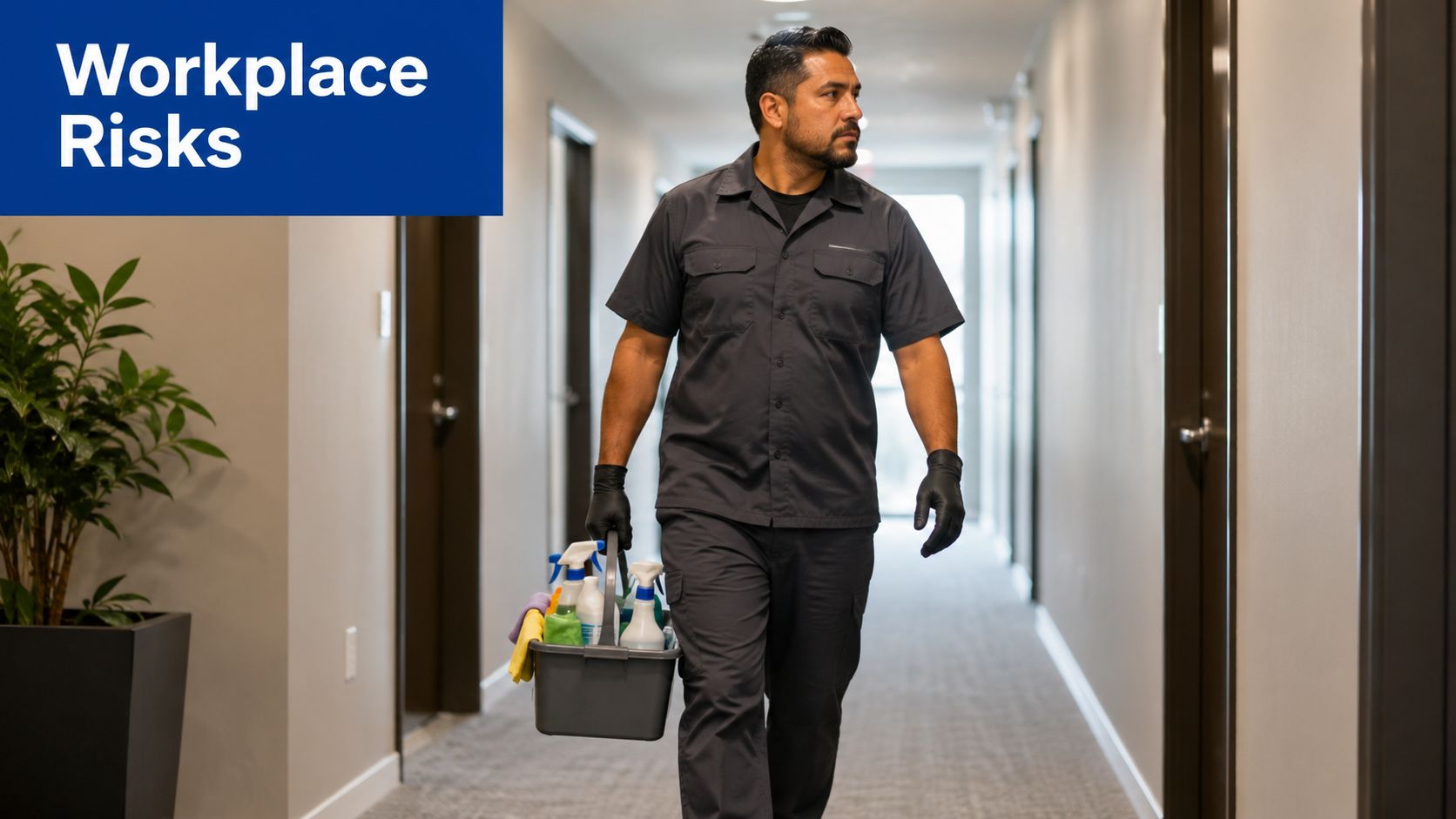
Where non-clinical exposure actually happens
In practice, the trigger event is often ordinary at first. Someone falls through a glass door panel. A maintenance technician finds used sharps in a stairwell. A property manager enters a unit after a welfare check and discovers bodily fluids on porous surfaces. A supervisor asks a custodian to “just disinfect it and reopen the area.”
That last step is where risk expands. The immediate health concern is only one part of the problem. The site itself may remain contaminated, employees may be shaken or untrained, and the organization may not have a clear process for restricting access, documenting the incident, or handling waste.
Practical rule: If a scene involves visible blood, unknown bodily fluids, contaminated porous materials, or an emotionally traumatic event, treat it as a regulated safety issue first and a cleaning issue second.
The gap managers feel in the moment
OSHA addresses medical reporting and post-exposure follow-up, but many managers in offices, warehouses, and residential properties still face an operational blind spot after a trauma event. As noted in OSHA bloodborne pathogens guidance, the psychological and long-term trauma cleanup burden for facility managers after bloodborne exposure events is a critically underserved angle: while OSHA mandates immediate medical reporting and PEP, existing content rarely addresses the liability and operational gap for non-clinical settings (e.g., offices, warehouses) where a suicide or trauma scene involving bodily fluids occurs.
That gap affects business continuity. It also affects judgment. Unprepared teams may use standard janitorial supplies, allow unprotected staff into the area, or throw contaminated waste into normal trash streams. Those choices can expose more people and create documentation problems that are hard to unwind later.
A strong response starts with one shift in mindset. Bloodborne exposure isn't only a healthcare topic. For facility managers, it's also a workplace safety, liability, and recovery issue.
Defining the Risks Bloodborne Pathogens and OPIM
A property manager gets a call after an injury in a warehouse break room. There is blood on the floor, a chair leg, and a trash can. No one on site knows whether this is a first-aid matter, a janitorial task, or a regulated exposure event. That uncertainty is where risk grows.
What OSHA means by occupational exposure
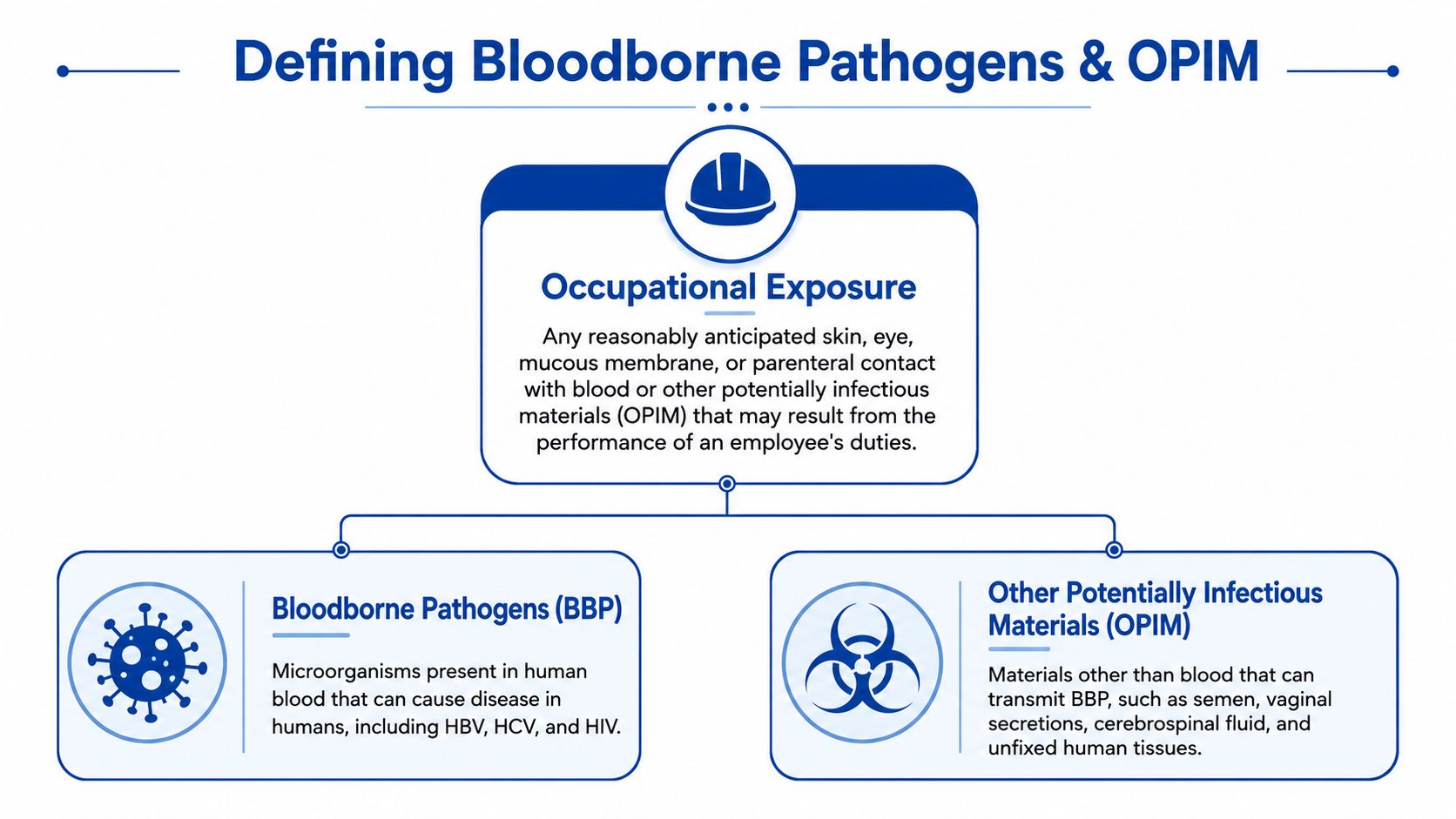
OSHA defines occupational exposure as “reasonably anticipated skin, eye, mucous membrane, or parenteral contact with blood or other potentially infectious materials that may result from the performance of an employee's duties” in its official interpretation on occupational exposure and first-aid duties. For managers outside healthcare, the important point is practical. If an employee's job could foreseeably place them in contact with blood or qualifying body fluids, the standard may apply.
Two parts of that definition cause confusion.
- Reasonably anticipated does not mean exposure happens every day. It means the employer can foresee it as part of the job, even if only during unusual events such as tenant injuries, accidents, fights, maintenance calls, or emergency first aid.
- Parenteral contact means contact through a puncture or break in the skin, such as a needlestick, a cut from contaminated broken glass, or a puncture from a sharp hidden in waste.
A useful way to view this is to separate routine cleaning from exposure-prone duties. Mopping a normal restroom floor is one task. Entering an apartment after a traumatic injury, collecting blood-soaked materials, or asking a supervisor to provide first aid is a different category of work.
So if your security staff, maintenance team, school staff, custodians, or supervisors may respond to injuries or enter contaminated spaces, this topic may apply to them.
Bloodborne pathogens and OPIM in plain language
Bloodborne pathogens are disease-causing microorganisms found in human blood. The names managers hear most often are HBV, HCV, and HIV. You do not need to diagnose them. You need to recognize when the exposure conditions that can transmit them may be present.
Other potentially infectious materials, or OPIM, widens the hazard category beyond blood alone. It includes certain human body fluids, any body fluid visibly contaminated with blood, and situations where the material cannot be safely identified. For non-clinical settings, that matters more than many managers expect. After an assault in an office, a fall in a lobby, or a traumatic event in a residential unit, the substance on surfaces may be mixed, partially dried, or impossible to identify by sight.
The safest rule is simple. If a material is visibly bloody or cannot be identified with confidence, treat it as potentially infectious until trained personnel assess it.
For a practical companion resource focused on non-medical workplaces, this guide to blood-borne pathogen risks in real-world environments helps translate the hazard into day-to-day facility decisions.
The pathogens people worry about most
The medical names can feel abstract, so it helps to connect them to how exposure occurs on a property or job site.
| Term | Why it matters at work |
|---|---|
| HBV | Can spread through blood exposure and is a concern after sharps injuries or contact with contaminated materials |
| HCV | Associated with blood exposure, especially incidents involving punctures or cuts |
| HIV | Demands immediate medical evaluation after a qualifying exposure, even though transmission conditions are more limited than many people assume |
In offices, apartments, schools, industrial sites, and mixed-use properties, exposure rarely looks like a clinical procedure. It looks like first aid after a fall. It looks like a superintendent opening a unit after a violent incident. It looks like a cleaner reaching into a waste bag with hidden sharps inside. The OSHA terms matter because they help managers classify those moments correctly before someone turns a controlled incident into a wider exposure problem.
Treat unknown blood and qualifying body fluids as infectious until a trained process says otherwise. That approach is safer for staff, easier to defend, and far more responsible than guessing.
Your Regulatory Blueprint The OSHA Exposure Control Plan
The central compliance document is the Exposure Control Plan, often shortened to ECP. If occupational exposure is reasonably anticipated in your workplace, this plan can't be generic and it can't sit untouched in a binder.
Under OSHA's standard, employers must establish a written plan that's updated every year to reflect changes and must document that they have considered and begun using safer medical devices while seeking input from non-managerial employees. OSHA explains these requirements in its Bloodborne Pathogens fact sheet on exposure control planning.
What the plan has to do
A workable ECP answers three operational questions.
- Who is exposed
- How exposure will be prevented
- What happens after an incident
The annual update matters because tasks change. Staffing changes. Equipment changes. A property portfolio changes. If your plan still reflects an old workflow or ignores first-aid duties that supervisors perform, it's already drifting out of compliance.
A more detailed breakdown of these requirements appears in this guide to a bloodborne pathogen exposure control plan.
Core elements managers shouldn't skip
The plan should clearly identify job classifications and tasks with exposure potential. It should also describe the schedule and method for implementing controls, and it must include procedures for evaluating exposure incidents.
Here's a simple way to think about those pieces:
- Exposure determination: Which jobs and tasks carry risk? Maintenance, security, custodial staff, school staff, leasing personnel, and managers who provide first aid can all belong in this review.
- Control methods: What physical tools, procedures, PPE, and reporting steps are in place?
- Incident evaluation: After exposure, who documents it, who receives the report, how is follow-up triggered, and how do you correct the root cause?
Why the annual update is more than paperwork
Many businesses treat the ECP like an audit document. That's too narrow. It's an operating manual for stressful moments when people need clear direction.
A weak plan forces employees to improvise. In bloodborne exposure incidents, improvisation creates secondary risk.
The requirement to seek input from non-managerial employees is also practical, not symbolic. The people who perform first aid, collect sharps, move waste, or clean high-risk areas often know exactly where the process breaks down. Their input helps management choose controls that people will use.
For facility managers, the best test is straightforward. If an incident happened this afternoon, could your supervisors identify who is exposed, what immediate actions to take, what documentation is required, and where the boundary lies between employee response and specialist remediation? If not, the plan needs work.
Prevention in Practice The Hierarchy of Controls
Prevention works best when it doesn't rely on memory alone. That's why safety professionals use the Hierarchy of Controls. It ranks protective measures from most effective to least effective.
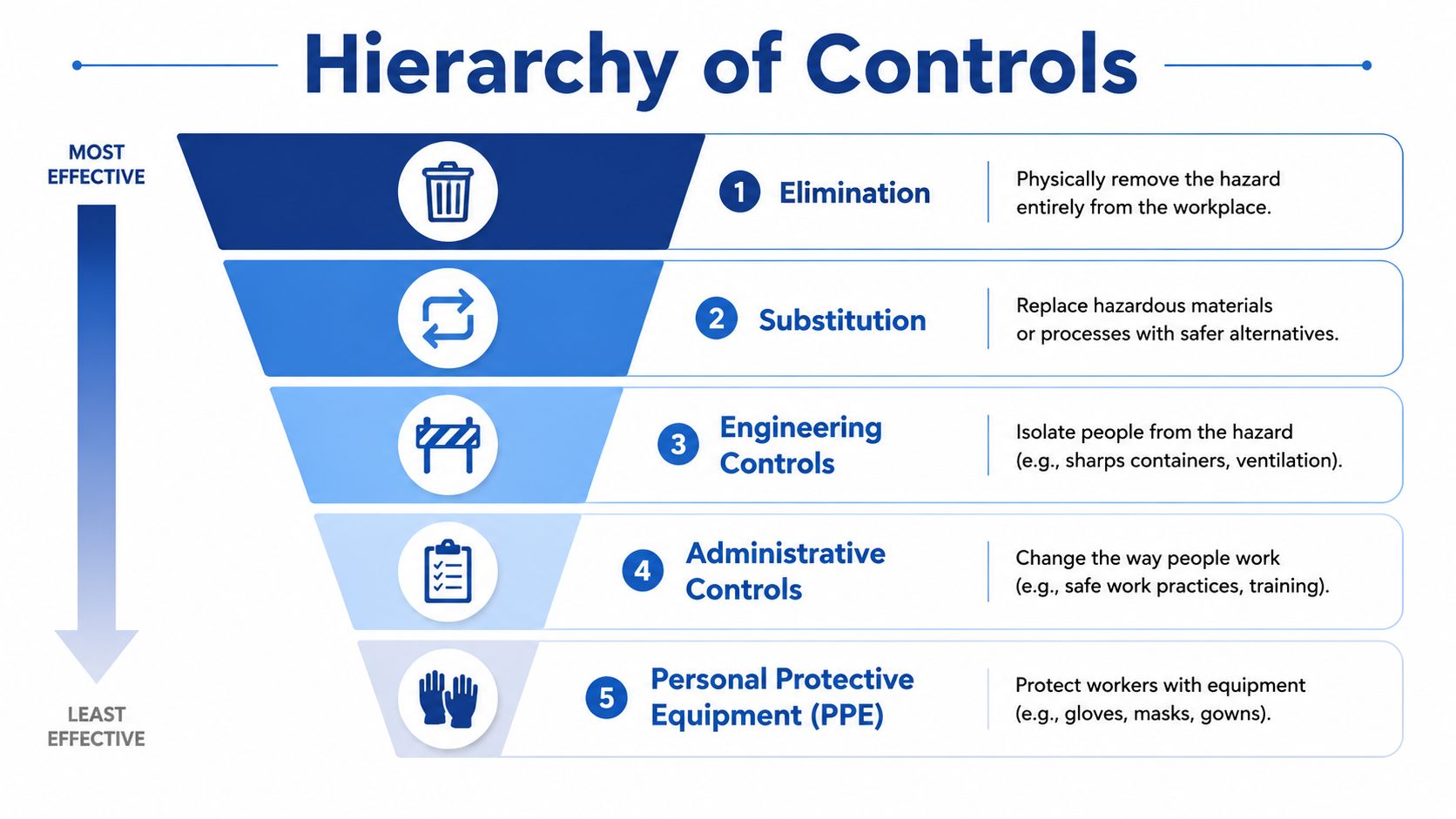
OSHA's bloodborne pathogens framework places strong emphasis on engineering controls and universal precautions. According to the NCBI overview of OSHA's Bloodborne Pathogens Standard, employers must implement engineering controls like safer needle devices, which have been proven to reduce needlestick injuries by up to 70% in clinical settings, and must enforce universal precautions that treat all human blood and certain body fluids as potentially infectious.
Start high on the hierarchy
The best control removes or isolates the hazard before a worker has to depend on gloves or good luck.
Elimination means removing the source entirely when possible. In a non-clinical setting, that can mean closing and restricting access to a contaminated office, apartment, or restroom until qualified personnel assess it.
Substitution is less common in bloodborne work, but process substitution still matters. A site may replace informal first-aid handling with a contracted medical response protocol or switch from loose sharps handling to rigid approved containers.
Engineering controls are the physical tools that isolate the hazard. In healthcare, examples include needleless systems and safer sharps devices. In broader facilities, that principle extends to sharps disposal containers, physical barriers, controlled waste containers, eyewash access, and clearly separated cleanup equipment.
Administrative and work practice controls
Policy becomes behavior. OSHA also requires specific work practice controls, including bans on eating, drinking, smoking, applying cosmetics or lip balm, and storing food where blood or OPIM are present. Employers must also maintain a sharps injury log with the device type, brand, department, and explanation of what happened, as summarized in the UNC SPICE overview of OSHA's final rule requirements.
Administrative controls include:
- Training and designation: Make it clear who is authorized to render first aid and who is not.
- Restricted access: Close off affected areas immediately so bystanders and untrained staff don't enter.
- Incident recording: Maintain logs and records consistently. For leaders who want a broader overview of injury logs and compliance duties, this article on OSHA recordkeeping for business leaders is a practical reference.
PPE is essential, but it's the last barrier
PPE matters. Gloves, eye protection, masks, gowns, and similar equipment are often the visible part of the program. But PPE is the last layer, not the first.
That distinction matters because managers sometimes stop at “we provided gloves.” Gloves do not fix a poor cleanup decision, an open access scene, bad waste handling, or a worker being asked to perform a task beyond training. A stronger approach is to match PPE to the task and pair it with the right controls above it. This guide to PPE for biological hazards is a useful reference point when reviewing your own procedures.
PPE protects the wearer. Good systems protect everyone in the area.
In offices, apartment buildings, and industrial sites, the hierarchy helps answer a practical question: are you trying to make risky work slightly safer, or are you redesigning the situation so fewer people face the hazard at all?
After an Exposure The Post-Exposure Protocol
When exposure happens, speed matters. A delayed response can cost time that medicine and documentation can't easily recover later.
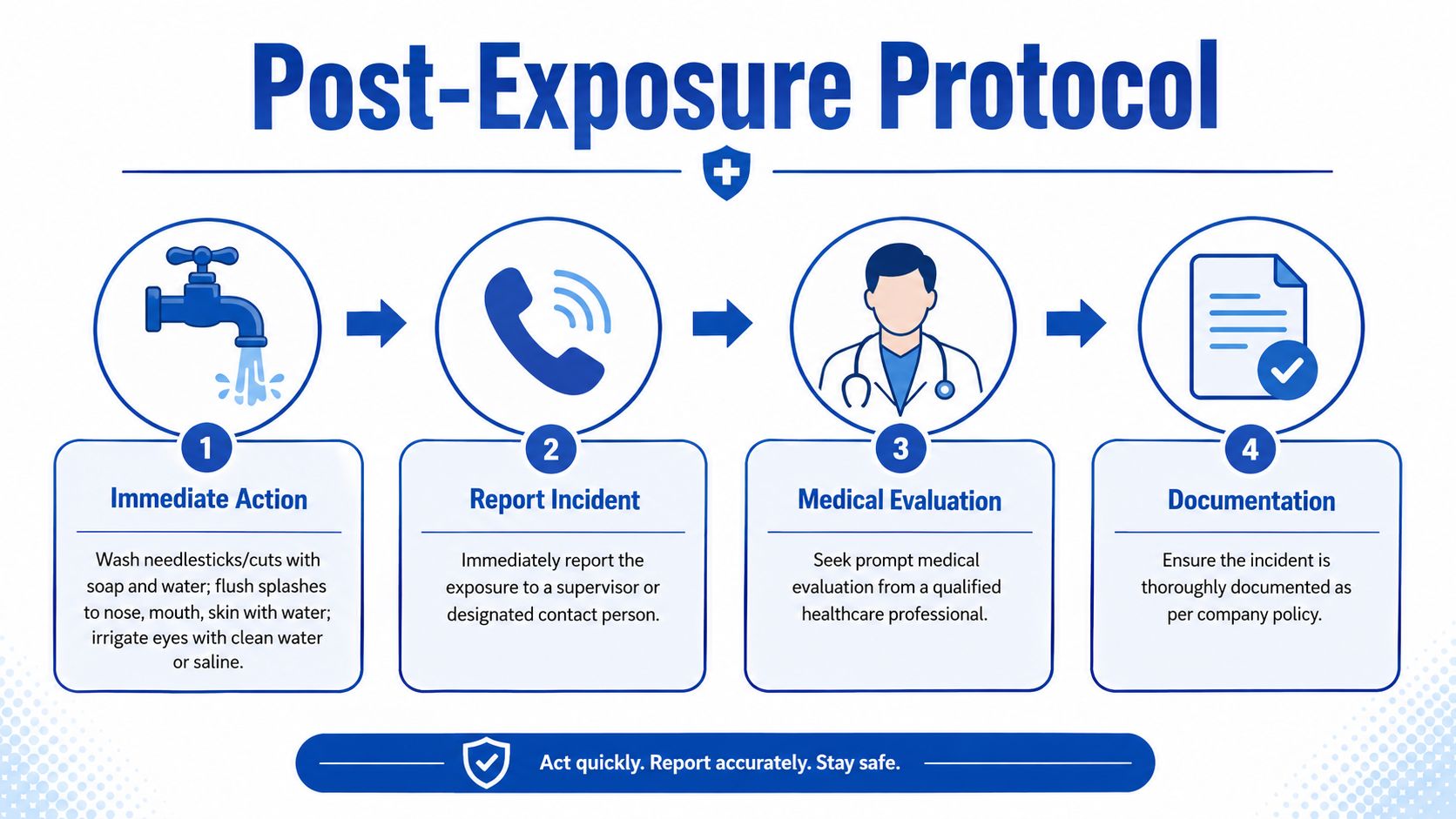
This visual summary helps teams remember the order of response.
First actions in the first minutes
The World Health Report discussion of sharps exposure and transmission risk makes clear why this response has to be immediate. The risk of contracting HIV from a needlestick is approximately 0.3%, while the risk for HBV can be as high as 30%. The same source notes that HIV cellular infection can begin within two days of exposure, which is why post-exposure prophylaxis, or PEP, is critical within hours.
Immediate first aid should be simple and direct:
- For punctures and skin exposure: Flood the area with water and wash the wound with soap and water or an appropriate disinfecting approach under your protocol.
- For eye, nose, or mouth exposure: Flush thoroughly with water.
- For all incidents: Report it right away. Do not wait to “see if it seems serious.”
Here is the embedded training resource many teams find useful for refresher viewing:
Reporting, medical evaluation, and follow-up
Once first aid is done, the exposure must move into your reporting chain. Supervisors should know exactly who receives the report and where the employee goes for a prompt confidential medical evaluation.
That evaluation isn't optional. It helps determine whether PEP is appropriate, what baseline testing is needed, and what follow-up schedule applies. Managers don't need to practice medicine, but they do need to remove obstacles so the employee gets seen immediately.
For employers thinking through the financial side of workplace injury response, this guide to workers' comp benefits gives helpful context on how coverage may relate to medical care and follow-up after an on-the-job incident.
A practical operational reference for managers handling this kind of event is this page on bloodborne pathogen exposure response.
What employees need from leadership
In the moment, affected employees usually need three things:
| Need | What leadership should provide |
|---|---|
| Urgency | Immediate reporting instructions and fast medical referral |
| Privacy | Confidential handling of the employee's health information |
| Clarity | Written documentation and a calm explanation of next steps |
After an exposure, your role is to reduce delay, confusion, and additional contact with the hazard.
That's especially important in non-clinical settings, where managers may not handle these incidents often. A calm protocol protects the employee and prevents a second failure caused by guesswork.
The Final Step Professional Remediation and Waste Disposal
After employee care is underway, the environment still has to be made safe. Many organizations make a dangerous assumption at this point. They believe the incident is over once the exposed worker has washed up, filed a report, and gone for evaluation.
It isn't over if the scene still contains contaminated materials, affected porous surfaces, hidden seepage, or improperly handled waste.
Why standard cleaning is the wrong response
Janitorial cleaning and biohazard remediation are not the same task. Routine custodial work focuses on appearance and basic sanitation. Bloodborne contamination requires hazard assessment, containment, correct PPE, compliant packaging and labeling, controlled transport, and regulated disposal of affected materials.
Cross-contamination is the central problem. A mop, shop towel, vacuum, or standard trash bag can spread contamination instead of containing it. The same is true when untrained staff remove carpet, upholstery, drywall, mattresses, or absorbent materials without understanding what has penetrated below the visible surface.
What compliant site recovery requires
A safe remediation process usually includes several decisions that ordinary staff aren't equipped to make:
- Material evaluation: Which items can be disinfected and which must be removed as regulated waste?
- Area control: How do you isolate traffic flow, HVAC concerns, and adjacent surfaces?
- Waste handling: How will contaminated materials be packaged, labeled, transported, and documented under applicable rules?
- Clearance for re-entry: When is the area safe to reopen for staff, tenants, or residents?
For managers reviewing disposal obligations, this overview of clinical waste disposal regulations provides a helpful compliance lens.
Why professional remediation is the responsible choice
Non-clinical organizations usually don't have the training, equipment, or disposal pathways needed for trauma scenes, blood contamination, or bodily fluid events. Asking in-house staff to handle that work can expose them physically and emotionally, and it can create liability if the cleanup is incomplete or the waste stream is mishandled.
Professional remediation is not just about cleaning what you can see. It's about restoring the space in a way that protects people, respects privacy, and aligns with regulatory expectations. For a facility manager, that's the difference between a quick-looking fix and a defensible recovery.
Building a Culture of Safety and Compliance
A property manager gets a call before sunrise. An employee found blood in a restroom after an overnight incident, tenants will arrive in two hours, and everyone is waiting for direction. In that moment, safety culture stops being a policy binder on a shelf. It becomes the set of decisions your organization can make quickly, calmly, and correctly.
A dependable program comes down to three habits that work together. Keep a current written plan. Prevent exposure through layered controls. Respond to incidents with clear reporting, medical follow-up, and scene management. Those steps are familiar in healthcare, but they matter just as much in office buildings, apartment communities, warehouses, and industrial sites, where exposure events happen outside a clinical setting and managers often have fewer internal resources.
Training is part of that system, not a stand-alone task. Staff need to know what bloodborne pathogen precautions look like in their actual workplace, not only in a generic OSHA example. For teams improving staff education, these VideoLearningAI compliance insights offer useful ideas for making training more consistent and easier to retain.
The critical question is whether you have a plan before the incident happens. Who secures the area? Who documents the event? Who determines whether an exposure occurred? Who has authority to call a qualified remediation vendor? Clear answers reduce confusion at the worst possible time.
For facility and property managers, that clarity works like a fire drill. You do not create the procedure while people are standing in the hallway waiting for instructions. You build it in advance, review it regularly, and make sure the final step is already accounted for.
Many employers can create the written program, training schedule, and reporting process. Very few should perform the final remediation themselves. When blood or other potentially infectious materials affect the environment, specialized cleanup is the final control that protects your people and your property. For managers who need to secure that final step, knowing who to call is part of the plan.
When a bloodborne exposure or trauma scene affects your workplace, building, or property, 360 Hazardous Cleanup provides the specialized support many organizations do not have in-house. Their team handles biohazard remediation, compliant waste handling, and trauma-informed site recovery with discretion, urgency, and respect for everyone affected.