
The call usually comes when someone is already overloaded. A nurse reports a splash to the eye. A maintenance supervisor finds blood and a loose sharp in a restroom. A property manager learns that a tenant or contractor may have had contact with contaminated material during cleanup. In that moment, people aren't looking for theory. They need to know what to do first, what can wait, who has to be notified, and how to keep one exposure from becoming several.
A bloodborne pathogen exposure event is never just a cleaning problem. It's a medical issue, a workplace safety issue, a documentation issue, and often an emotional one. The right response protects the exposed person immediately. It also protects everyone else who could enter the space, handle the waste, or inherit the liability later.
What Is a Bloodborne Pathogen Exposure Event
A bloodborne pathogen exposure event starts the moment blood or other potentially infectious material has a realistic path into a person's body. That might be a needlestick in a clinic, a cut from contaminated broken glass in a warehouse, or a splash to the eyes during trauma scene cleanup. The setting changes. The core problem doesn't.
An exposure event has three parts that matter right away. First, there's the human exposure itself. Second, there's the contaminated environment that can create additional risk. Third, there's the record of what happened, because medical care and regulatory compliance both depend on accurate reporting.
According to World Health Organization data on occupational bloodborne pathogen exposure, approximately 3 million healthcare workers globally experience occupational exposure to bloodborne pathogens annually, and more than one in three healthcare workers experience exposure in the last year, with more than two in three experiencing it throughout their careers. That matters because it strips away the false belief that exposure events only happen in chaotic or poorly run places. They happen in trained environments too.
What counts as an exposure
Exposure isn't limited to a dramatic injury. These incidents often involve:
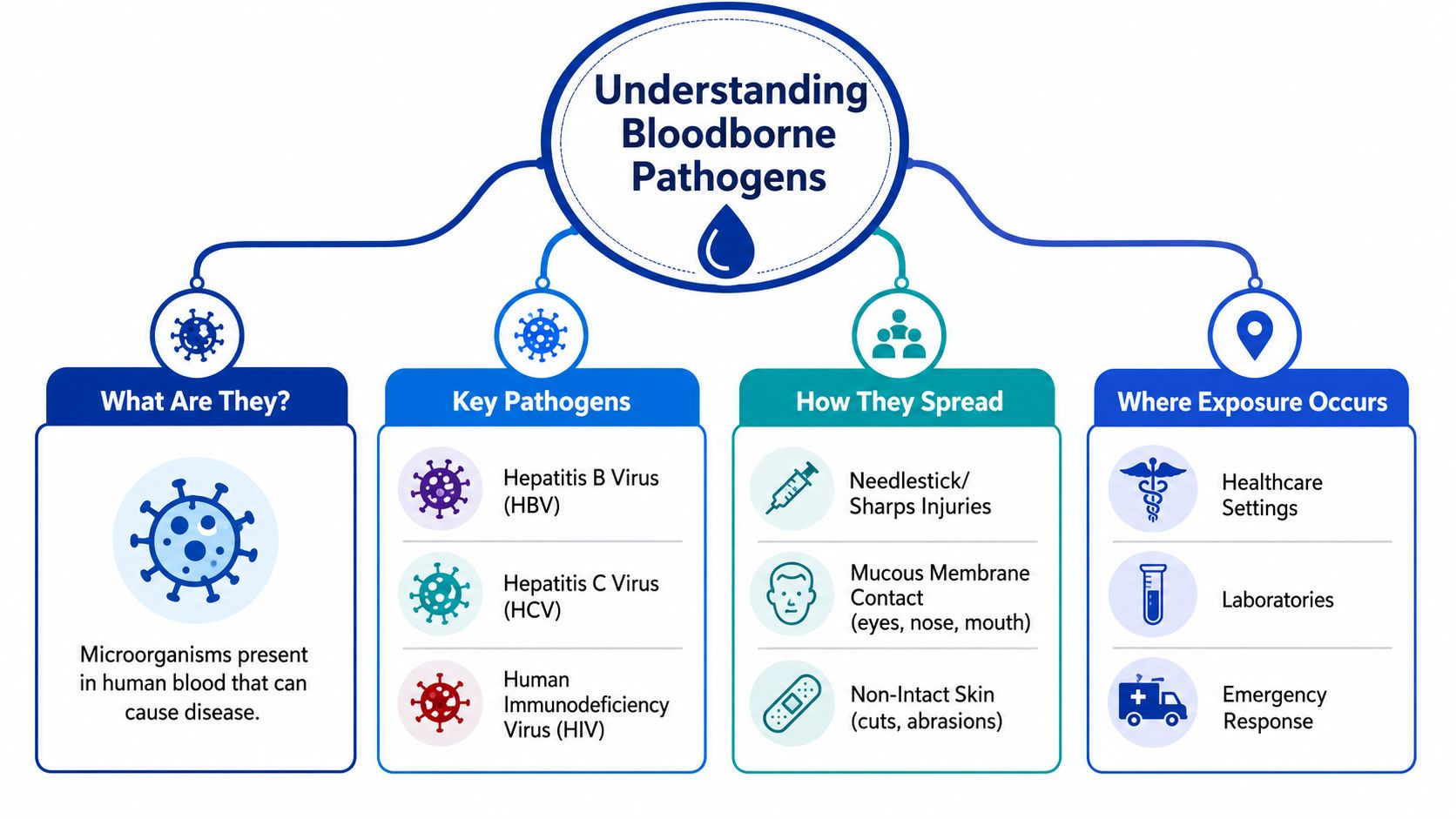
- Sharps injuries such as needles, blades, or contaminated fragments
- Mucous membrane contact involving the eyes, nose, or mouth
- Non-intact skin contact when blood reaches cuts, abrasions, dermatitis, or other compromised skin
- Secondary contact during cleanup when untrained staff handle soaked materials, waste, or contaminated surfaces
For many readers, the first challenge is identifying whether the event is serious enough to activate a full response. The safe answer is straightforward. If blood or other potentially infectious material contacted a puncture site, damaged skin, or mucous membrane, treat it as a real exposure until medical professionals say otherwise.
Practical rule: If you're debating whether it “counts,” act as if it does. Lost time is harder to recover than an unnecessary phone call.
Why these events escalate quickly
A supervisor may focus on the spill. An exposed worker may focus on embarrassment. A family may focus on the visible scene. The fundamental priority is sequence. Personal decontamination comes first. Medical evaluation follows immediately. Property remediation comes after the exposed person is protected.
People who need a plain-language primer on the basics can start with what bloodborne pathogens are. That foundation helps, but during an active incident, the main goal is disciplined action under pressure.
Understanding Pathogens and How They Spread
The term bloodborne pathogen sounds technical, but the concept is simple. These are microorganisms present in human blood that can cause disease. In practical response work, the pathogens that drive most protocols are HIV, Hepatitis B virus (HBV), and Hepatitis C virus (HCV).
The chain that has to be broken
The easiest way to understand spread is to think in links, not labels. A bloodborne pathogen exposure happens when several conditions line up:
| Link | What it means in real life |
|---|---|
| Pathogen | A harmful microorganism is present in contaminated blood or fluid |
| Source | The blood, sharp, soaked material, or contaminated surface carrying that pathogen |
| Route | A puncture, splash, or contact with damaged skin creates movement from source to person |
| Entry point | Eyes, nose, mouth, cuts, abrasions, or a sharps injury |
| Susceptible host | The exposed person |
Break any one of those links and transmission is less likely. That's why so much of exposure control feels repetitive. Gloves, sharps containers, face protection, restricted access, hand hygiene, and proper disinfection all interrupt a different part of the same chain.
Where people misunderstand the risk
A lot of confusion comes from treating all contamination the same. It isn't. A sealed, undisturbed stain on a hard surface presents a different operational challenge than an uncapped sharp hidden in linens or debris. A visible spill is easier to control than a splash that reached the eye and then went unreported.
That's also why cross-training matters. People who work around moisture intrusion, housekeeping, restoration, or janitorial tasks already know that not every biological hazard behaves the same way. For example, discussions around understanding window mold health risks help illustrate a broader point. You can't rely on appearance alone. You need to understand the material, the route of exposure, and the setting.
Typical transmission routes in the field
In healthcare, laboratories, and emergency response, the common routes are well recognized. In commercial buildings and residential scenes, they're often underestimated.
Sharps route
A hidden lancet in bedding, a loose syringe in a restroom, or broken contaminated glass in a trash area can puncture gloves and skin.Splash route
Cleanup work, waste handling, or disturbance of soaked materials can send droplets toward the face, especially when someone leans in too close.Compromised skin route
Small cracks around fingernails, dermatitis, paper cuts, and abrasions can become an entry point if workers skip hand checks before donning PPE.
The exposure you notice isn't always the only one that occurred. If one person had contact, assume the scene may still pose a risk to others until it's controlled.
For a closer look at risk categories and exposure scenarios, understanding the risks associated with blood-borne pathogens is useful reading for managers building training around real tasks instead of generic warnings.
Immediate Steps After a Potential Exposure
A custodian reaches into a liner to compact trash and feels a sharp stick through the glove. An EMT wipes blood from a cheek and realizes some may have reached the eye. In those first minutes, the priority is the exposed person. Scene cleanup comes after first aid, reporting, and control of the hazard.
First actions that should happen immediately
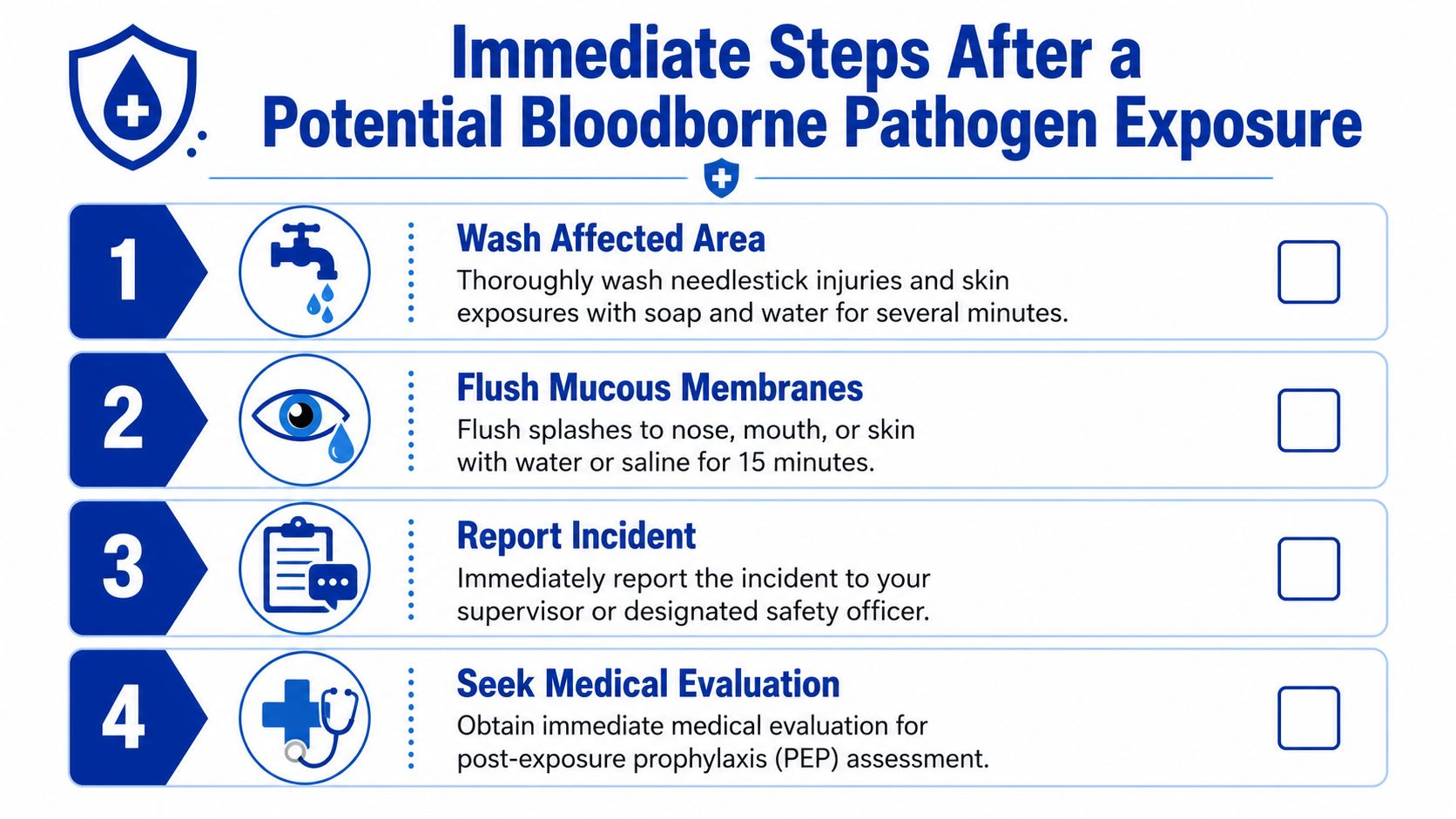
Clean the exposed area right away
Wash punctures, cuts, and contaminated skin with soap and water as soon as possible. Use enough water to rinse well, but do not scrub hard or cut into the tissue. Aggressive cleaning can damage skin and complicate the injury.Flush eyes, nose, or mouth without delay
If blood or other potentially infectious material reaches a mucous membrane, begin flushing at once with water or the appropriate irrigant. CDC guidance calls for a thorough flush, commonly treated in training and field protocols as about 15 minutes. The goal is simple. Reduce the amount of material left in contact with vulnerable tissue.Report the exposure while details are still clear
Notify the supervisor, charge nurse, safety officer, or designated exposure contact immediately. A fast report helps the medical team assess the route of exposure, the source material, and the urgency of treatment. It also protects the worker and the employer from the confusion that starts when facts are reconstructed hours later.Secure the immediate area
Keep other people out of the contaminated zone and isolate the sharp, spill, or affected materials if that can be done safely. Do not hand cleanup to untrained staff, and do not turn the exposed employee into the cleanup crew.
Prepared facilities make this easier. If staff have to hunt for gloves, absorbent, disinfectant, and disposal bags after an incident, the response is already off track. A stocked blood spill clean up kit helps with early containment and isolation of contaminated material, but it does not replace prompt medical evaluation.
A quick visual walkthrough can help reinforce the sequence:
Why speed matters medically
Post-exposure care is time-sensitive. The worker may need wound care, vaccination review, source testing procedures, and a decision about whether preventive medication should start right away. In practice, every delay makes the next step harder. Memories fade, source information gets lost, and treatment options can narrow.
From an operations standpoint, managers frequently make an incorrect trade-off. They focus on restoring the room, reopening the vehicle, or finishing the shift. The better decision is to pause the task, get the person evaluated, and preserve the facts. Floors can wait. Treatment windows do not.
What not to do
Certain mistakes show up repeatedly after exposure events:
- Do not squeeze or milk the wound in an attempt to force blood out.
- Do not stop at a quick wipe-down if the eyes, nose, mouth, or broken skin were exposed.
- Do not clean the scene first while the exposed person waits for help.
- Do not send the person home to “watch for symptoms” instead of directing them into the reporting and medical process.
- Do not let embarrassment or uncertainty suppress the report. If the event might qualify as an exposure, treat it that way until a qualified medical evaluation says otherwise.
The sequence should be drilled until people can do it under stress. Decontaminate the person, report the incident, control the area, and get medical follow-up started. That order protects health, preserves documentation, and keeps one bad moment from becoming a larger failure.
Navigating Medical and OSHA Reporting Requirements
A supervisor gets the call at 10:40 p.m. An employee had blood contact during a cleanup, rinsed off, and wants to finish the shift. That is the moment a manageable incident turns into a medical, regulatory, and liability problem if the reporting chain is vague or slow.
Once immediate decontamination is done, the job changes. The priority is no longer the scene. It is getting the exposed person into proper medical follow-up, documenting the facts while they are still clear, and meeting the employer duties that OSHA can enforce. These steps belong together. Treat them as one response, not separate tasks handled by different departments days apart.
What the employer must provide
OSHA's Bloodborne Pathogens Standard requires the employer to provide a confidential medical evaluation and follow-up after an exposure incident, at no cost to the employee. That duty includes prompt referral for evaluation, documentation of the exposure, and access to post-exposure measures when a clinician determines they are indicated. A published review of OSHA-aligned post-exposure requirements also notes that decisions about HIV post-exposure prophylaxis are time-sensitive and are ideally made within hours, not at the end of the week.
From an operations standpoint, the trade-off is straightforward. If a manager waits to clarify paperwork, verify billing, or reach a higher-level approver, the employee loses time the clinician may need to act.
What medical follow-up usually includes
A proper evaluation connects four things: the exposure details, the source information if available, the employee's vaccination history, and the medical decisions that depend on timing.
In practice, clinicians usually look at:
The exposure event itself
They need to know what fluid was involved, how contact occurred, whether there was a needlestick or splash, what body site was exposed, and how long ago it happened.Baseline laboratory work
Follow-up protocols commonly include baseline testing tied to bloodborne infection risk, then repeat testing on a defined schedule. The exact panel and timeline depend on clinical judgment and current guidance, but the operational lesson is simple. The employer should never be building the process in real time after the incident.Hepatitis B and HIV post-exposure decisions
These decisions depend on vaccination status, source information, and the route of exposure. Delay narrows options.Confidential counseling and record handling
Exposure cases involve protected medical information. Supervisors need enough detail to document the incident and correct the hazard, but they do not need access to private medical findings beyond what the standard allows.
The CDC's occupational exposure guidance remains a useful reference for the medical follow-up framework, especially for baseline and follow-up testing schedules, source evaluation, and counseling after blood or body fluid exposure (CDC guidance document).
Medical follow-up and OSHA reporting are one workflow
Organizations get into trouble when clinical care, incident reporting, and corrective action are split apart. The treating clinician needs accurate facts. The employer needs those same facts for the OSHA record, internal review, and control changes. If either side works from incomplete information, the whole response weakens.
That is why a written bloodborne pathogen exposure control plan should spell out reporting contacts, medical referral locations, transportation arrangements, documentation steps, and who reviews whether a work practice or control failed. A plan that lives only in a binder does not protect anyone at 2 a.m.
What managers should verify before the next incident
I tell clients to audit the response path, not just the paperwork. A short checklist usually exposes underlying weaknesses.
| Question | Why it matters |
|---|---|
| Who receives the first report after hours | Exposure incidents often happen outside normal office coverage |
| Where does the employee go immediately | Uncertainty causes delays even when everyone means well |
| Who can authorize treatment | No one should wait for budget approval before being evaluated |
| How is confidentiality protected | Privacy failures discourage prompt reporting the next time |
| Who reviews root cause and corrective action | Without follow-through, the same exposure pattern repeats |
OSHA also requires a written Exposure Control Plan that is reviewed and updated at least annually to reflect changes in tasks, procedures, and safer technology, as described in OSHA's bloodborne pathogens requirements. Many programs fall short here. The form exists, the policy exists, but the actual workflow no longer matches the work being done.
The strongest systems are simple under stress. One reporting path. One medical destination or decision tree. One documentation process. Clear accountability. That structure protects the exposed worker, gives the clinician what they need, and leaves the employer with a record that can stand up to scrutiny.
Prevention PPE and Engineering Controls
Organizations often reach for PPE first because it's visible. Gloves are easy to buy. Face shields look serious. Training posters photograph well. But PPE is the last layer, not the strongest one. The safer strategy is to reduce the chance of contact before a worker ever needs to trust a glove seam or mask fit.
Start with the controls that remove choices
Engineering controls outperform reminders. A puncture-resistant sharps container protects the careful worker and the distracted one. A safety-engineered sharps device reduces risk even when the shift is busy. A self-closing disposal unit works better than telling people, again, to be cautious.
According to CDC and NIOSH guidance on bloodborne infectious disease risk factors, puncture-resistant sharps disposal containers can reduce percutaneous exposure risks by 60–80%. That is a major reduction, and it explains why mature programs invest in design controls instead of relying only on behavior.
What layered protection actually looks like
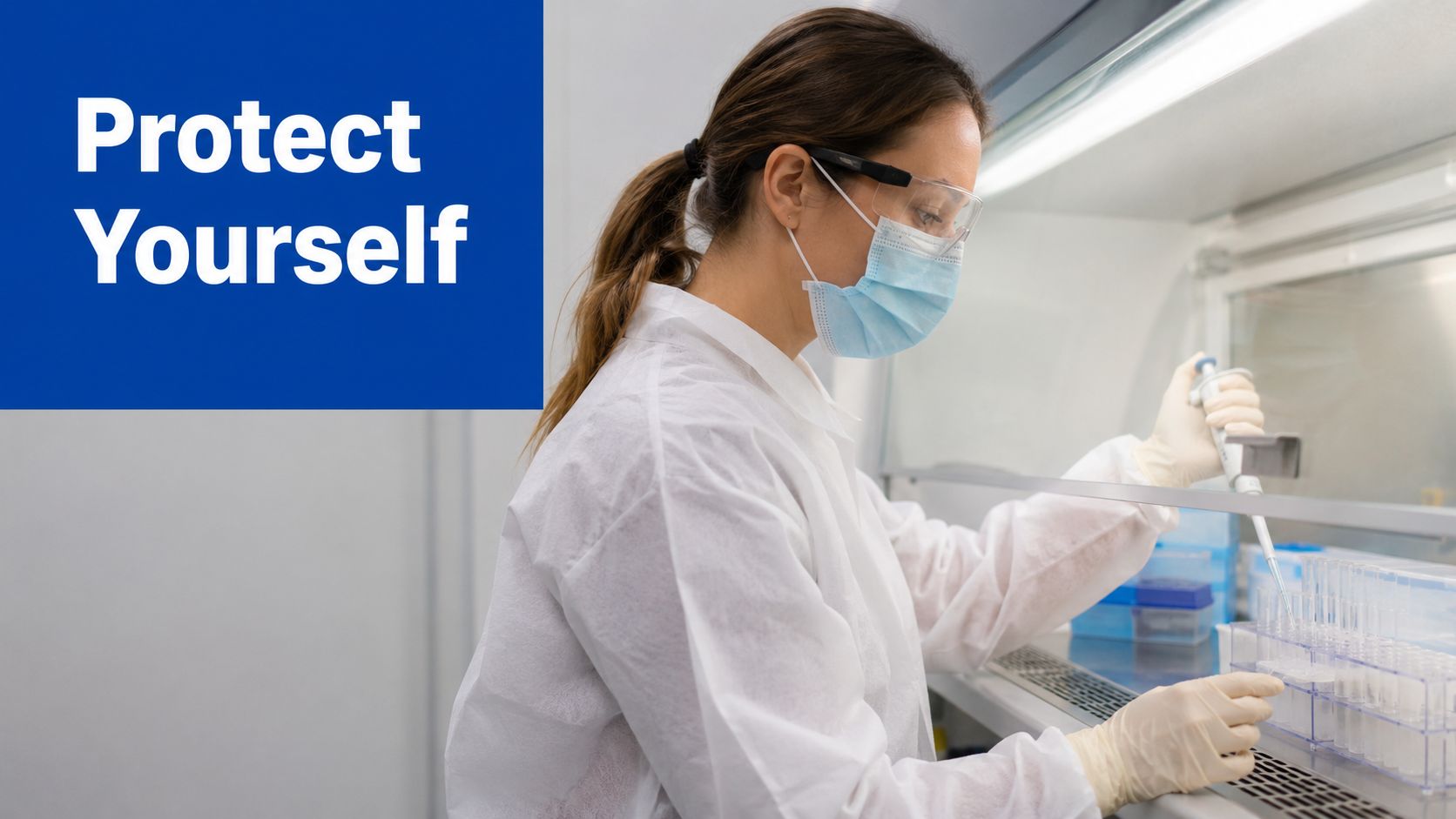
For high-risk blood exposure, PPE has to be selected as a system. The same CDC and NIOSH guidance states that PPE requires a layered approach, including impermeable gloves, fluid-resistant gowns, and facial protection with side shields to prevent mucous membrane contact.
In practice, that means:
Hand protection
Impermeable gloves, commonly nitrile, selected for the task and changed when compromised.Body protection
Fluid-resistant gowns or other barriers that prevent strike-through during splash or contact work.Face and eye protection
Masks plus goggles or a face shield with side protection when splash is possible.Respiratory protection when conditions justify it
In settings with aerosolization potential or airborne concerns, the respiratory component has to match the hazard.
Administrative controls are where discipline lives
Engineering controls reduce opportunity. Administrative controls reduce confusion. They include training, restricted work practices, task-specific procedures, vaccination access, incident review, and annual updates to the Exposure Control Plan.
This is also where cleanup operations often fall short outside hospitals. A clinic may have sharps protocols built into daily routine. A warehouse, apartment complex, or restoration contractor may face the same biological hazard without the same structure. One practical option in those situations is to bring in a trained remediation provider such as 360 Hazardous Cleanup, which performs blood and bodily fluid remediation using hospital-grade disinfectants within a regulated biohazard cleanup process.
PPE matters. It just works best when the system around it is strong.
Cleanup Decontamination and Insurance Claims
Once the exposed person is safe and the reporting chain is active, attention shifts to the physical site. Many individuals then make the second major mistake. They assume visible blood can be handled like any other spill. It can't.
Biohazard remediation requires controlled removal, disinfection, waste segregation, and disposal practices that standard janitorial work doesn't address. The challenge isn't only the stain you see. It's the absorbent materials, hidden migration paths, contact surfaces, and waste stream created by the cleanup itself.
Why ordinary cleaning fails
Consumer cleaners aren't a response plan. Neither is handing the task to maintenance with extra gloves. A proper cleanup has to account for surface type, porous versus non-porous materials, cross-contamination risk, and whether the area contains sharps or mixed waste.
A practical field assessment usually asks:
| Site issue | Why it changes the cleanup |
|---|---|
| Porous materials are involved | Soft goods and building materials may absorb contamination beyond the visible boundary |
| Sharps may be present | Handling methods and waste packaging must change immediately |
| Traffic moved through the area | Secondary contamination may exist outside the obvious scene |
| The event involved a contractor or volunteer | Liability and coverage questions become more complicated |
That last point matters more than many organizations realize.
The insurance and liability problem people discover too late
According to the University of Tennessee biosafety manual discussion of coverage gaps, contract-based cleanup workers may not be covered under an employer's OSHA-mandated post-exposure evaluation and could be personally responsible for treatment costs. For property managers, facilities, and families hiring outside help, that creates a serious planning issue before work even starts.
If the exposed person is not a direct employee, assumptions break down fast. Who pays for evaluation? Whose insurer is notified? Which agreement controls medical follow-up? If nobody has clarified those answers, the pressure lands on the exposed worker at the worst possible moment.
Questions to settle before remediation begins
Ask these before anyone starts handling contaminated materials:
- Who is the employer of record for every person on site?
- Who authorizes emergency medical evaluation if an exposure occurs?
- What insurance carrier is involved for property damage and biohazard remediation?
- Who documents the chain of events if a contractor is exposed?
- How will biohazardous waste be packaged, transported, and disposed of under applicable rules?
These aren't abstract legal details. They shape whether a site is handled safely and whether the people involved are protected afterward.
Why professional decontamination changes the outcome
Professional remediation teams don't just wipe down surfaces. They isolate the work area, identify affected materials, apply regulated handling practices to waste, and perform disinfection with products and methods appropriate to bloodborne risk. They also build documentation that helps owners, adjusters, and risk managers understand what was removed, what was treated, and why.
For owners and managers trying to understand the decontamination side in more detail, bloodborne pathogen disinfection is the operational standard to focus on, not cosmetic cleaning. That distinction affects health, compliance, and whether the property can be safely returned to use.
Cleanup is complete when the hazard is controlled, the waste is managed correctly, and the documentation can withstand scrutiny. It's not complete when the room merely looks clean.
Why Professional Biohazard Remediation Is Essential
The average person doesn't need a remediation company every day. That's exactly why they underestimate what these scenes require. They see blood, absorbent material, and hard surfaces. A trained crew sees exposure routes, regulated waste, scene control, and a family or staff group that should not have to carry the burden of cleanup themselves.
The cleanup and sanitation industry also faces a serious information gap outside clinical settings. According to an AIHA publication on bloodborne pathogen exposure beyond healthcare, most prevention literature centers on clinical needlesticks and overlooks the varied exposures faced by trauma scene remediation crews. That gap is one reason generalized cleaning advice so often fails in real-world scenes.

Situations where trained remediation isn't optional
Some scenarios leave very little room for improvisation:
- Unattended death scenes where decomposition fluids may have migrated into structural materials
- Suicide or trauma scenes involving blood loss, mixed porous contents, and severe emotional stress on occupants
- Industrial accidents where blood exposure is combined with equipment hazards, debris, or confined work areas
- Rental property contamination where landlords need safe turnover, proper documentation, and discretion
- Any scene with possible sharps hidden in bedding, trash, furniture, or flooring transitions
In these settings, asking a relative, employee, tenant, or maintenance worker to clean the area isn't just unfair. It can create additional exposure, destroy evidence or documentation, and leave contamination behind.
What professional response protects
Professional remediation protects more than surfaces.
It protects the health of anyone who might enter the scene next. It protects compliance by aligning the work with handling, containment, and disposal requirements. It protects privacy because discreet crews know how to manage a scene without turning it into a spectacle. And it protects recovery by removing one of the most distressing tasks from the people already carrying the emotional weight of the event.
The difference is especially important in high-stress situations. A competent provider should understand the science of decontamination and the human reality of shock, grief, fear, and confusion. Those two pieces belong together.
When an exposure event has already happened, the safest decision is usually the one that removes untrained people from the hazard and puts a qualified process in place.
When bloodborne pathogen exposure affects your home, facility, staff, or tenants, fast decisions matter. 360 Hazardous Cleanup provides 24/7 biohazard remediation, trauma scene cleanup, blood and bodily fluid cleanup, and insurance coordination with a compassionate, compliance-focused approach so people can focus on safety and recovery.