A small blood spill can stop a room cold. A facility manager sees it near a restroom sink. A supervisor finds it on a warehouse floor beside a first-aid station. A parent notices it on tile after a home medical event. The scene may be limited, but the uncertainty is immediate.
These questions are frequently asked. Is this safe to handle? Do I use the kit on the wall or keep people away and call for help? If someone cleans it incorrectly, who carries that risk afterward?
Those questions matter because a blood spill clean up kit is useful only when the incident fits the job it was built to do. The kit itself isn't the decision-maker. The person standing in front of the spill is. That's why the safest response starts with knowing the limits, not just the contents.
The Moment of Discovery Responding to a Spill
A common call starts with something that doesn't look dramatic. Someone had a nosebleed in a break room. A patient moved through a hallway after treatment. An employee cut a hand opening equipment. The blood volume looks small, but the room changes immediately because nobody wants to make the wrong call.
The first mistake people make is treating the scene like a housekeeping problem. It isn't. The second mistake is panicking and assuming every spill requires the same response. It doesn't. Good response depends on assessment, control, and restraint.
What usually happens in the first minute
The right instinct is to pause movement around the area. Keep shoes, carts, and cleaning tools from tracking material outward. If the source person is still present and needs medical attention, that takes priority over cleanup. If the source is unknown, staff usually become even more hesitant, and that hesitation is reasonable.
A spill creates two problems at once. Surface contamination and decision pressure.
In commercial settings, I've seen well-meaning staff grab paper towels barehanded, spray a general cleaner, and throw everything in normal trash. That reaction is fast, but speed without procedure creates a second incident. Exposure, improper disposal, and incomplete decontamination are all avoidable when someone stops and assesses before acting.
A practical first step is to follow a clear post-discovery checklist instead of improvising. 360 Hazardous Cleanup provides a useful checklist for what to do and not do after discovering a biohazard that helps people slow the situation down and avoid common errors.
The real issue isn't fear
The primary concern is fit. Some incidents fall within the working limits of a standard kit. Others don't. If the spill is larger than staff can confidently contain, if the surface is absorbent, or if the event involves trauma, unknown contamination, or sharps, the safest response may be to secure the area and stop there.
That's not overreacting. It's competent risk management.
What a Blood Spill Cleanup Kit Is For and What It Is Not
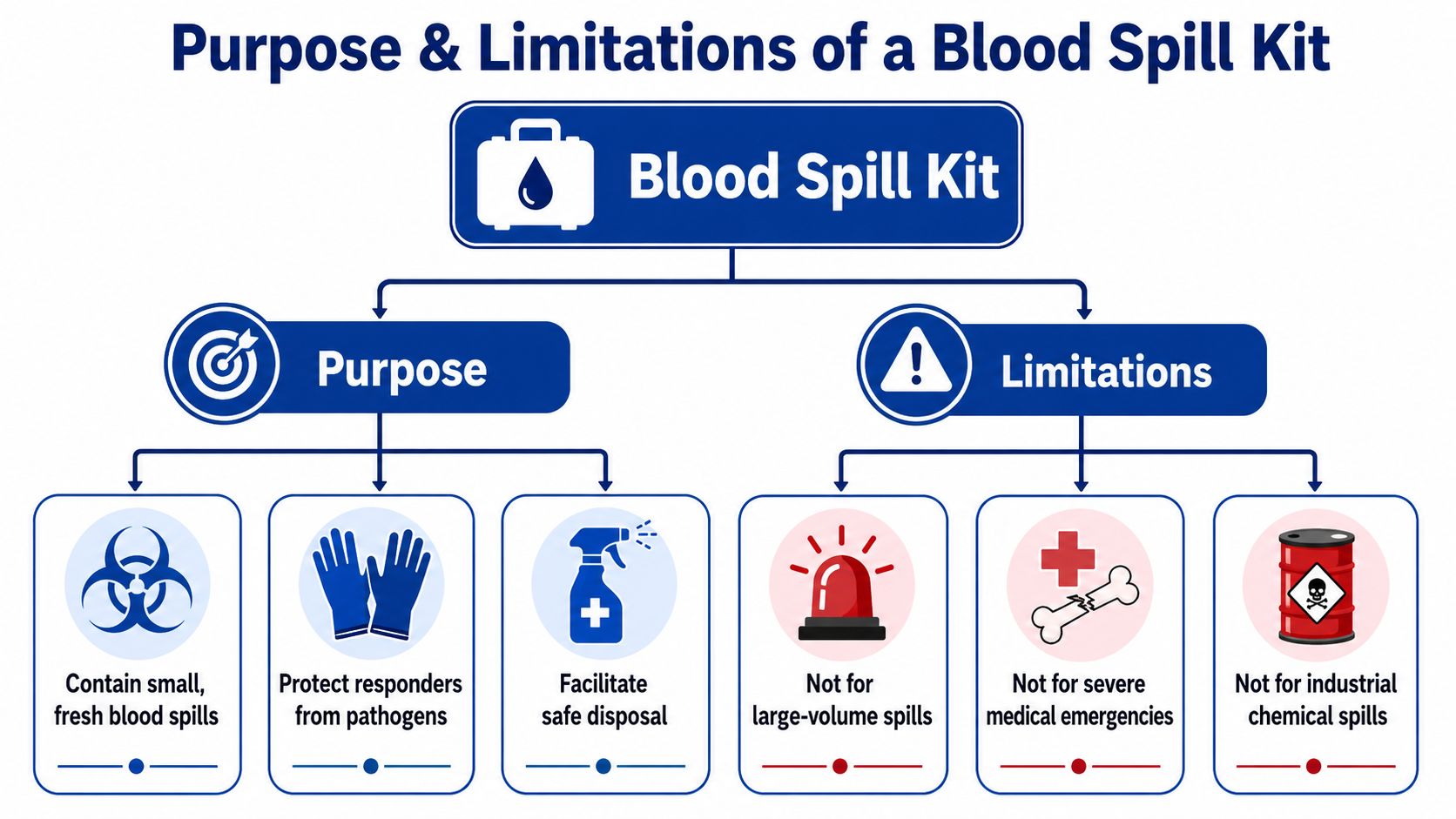
A blood spill cleanup kit is a first-response tool. It exists to help someone safely contain, disinfect, and package a limited spill without spreading contamination further. That's very different from saying it can solve every blood-related incident.
Victoria's public health guidance draws an operational line that many safety teams should know: spots or drops and other small spills up to 10 cm can be wiped immediately, while spills more than 10 cm require containment and a longer disinfection process, according to Victoria's guidance on managing spills of blood and body fluids. That threshold matters because it separates a simple immediate response from a more controlled biohazard event.
What the kit is meant to do
A properly stocked kit is designed for a narrow but important mission:
- Contain a small, fresh spill: The goal is to stop spread before shoes, wheels, or cleaning motions enlarge the footprint.
- Protect the responder: PPE and handling tools reduce direct contact with blood and contaminated surfaces.
- Support compliant packaging: Waste from cleanup has to be isolated and bagged correctly, not dropped into routine trash.
What the kit is not for
Many articles approach the topic too casually. A kit isn't a substitute for trained remediation.
It is not the right answer for:
- Large-volume contamination
- Porous materials such as carpet, upholstery, unfinished wood, or grout
- Mixed bodily fluid events
- Trauma scenes or unknown-source spills
- Situations involving sharps, broken glass, or active exposure concerns
Practical rule: A kit is for controlled response, not uncertain scenes.
That distinction matters in workplaces especially. Staff often feel pressure to “just handle it,” but the safer decision is often to recognize when the event exceeds the kit's design limits. If your team needs help deciding where that line is, this overview on why professional biohazard cleanup is not the way to go as a DIY project explains the broader risk clearly.
A blood spill clean up kit isn't a box of generic cleaning supplies. It's a limited-use infection-control system. Used within its range, it's useful. Used outside that range, it can give people false confidence.
Anatomy of a Compliant Biohazard Spill Kit
A compliant spill kit works because each part supports a sequence. Protection comes first. Containment follows. Disinfection happens after spread is controlled. Disposal closes the process. When a kit is missing one of those functions, the responder starts improvising.
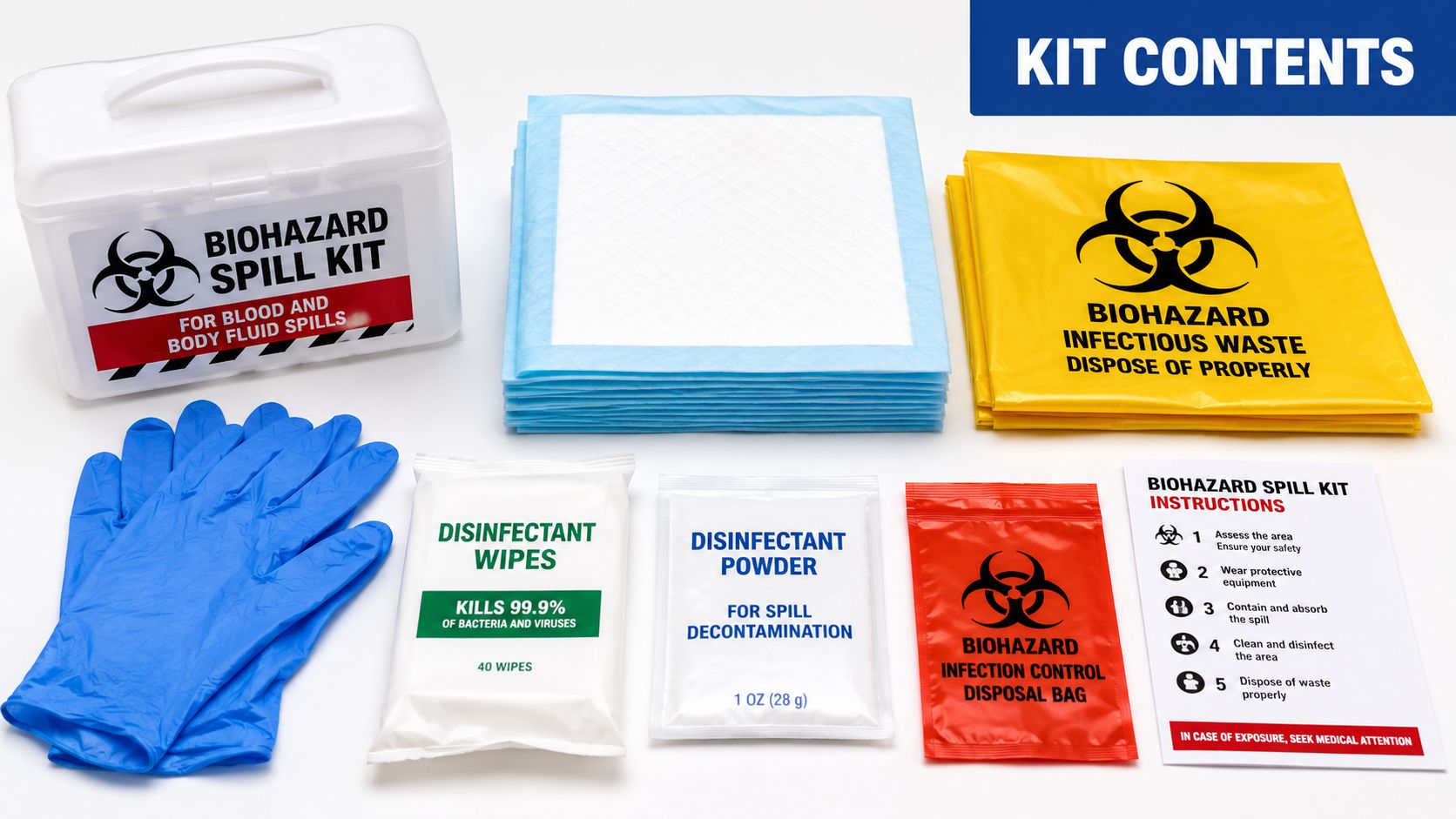
WHO guidance calls for 0.5% sodium hypochlorite, equivalent to 10,000 ppm available chlorine, prepared daily, after visible fluid is removed with disposable towels and the area is cleaned with water and detergent. The same guidance also requires incident recording if a specimen is lost or someone is exposed. In parallel, a University of Wisconsin procedure specifies that a spill clean up kit should contain PPE, disinfectant, absorbent material, and disposal bags, as described in the WHO laboratory biosafety guidance hosted by NCBI. Those standards explain why a real kit is built for exposure prevention and regulated waste handling, not ordinary janitorial work.
Core components that matter
Here's what should be doing the work inside the kit:
| Component | Why it matters |
|---|---|
| Gloves and other PPE | Creates a barrier between the responder and contaminated material. |
| Absorbent material | Controls free liquid so it can be handled without splashing or spreading. |
| Disinfectant | Targets the contaminated surface after visible material has been removed. |
| Scoops or scrapers | Lets the user lift contaminated solids and absorbents without direct contact. |
| Biohazard disposal bags | Separates contaminated waste from normal trash and supports regulated handling. |
What weak kits get wrong
Some kits look complete at first glance but fail under real conditions. They may include gloves and wipes yet leave out proper absorbent material. Others include disposal bags but no tools for picking up contaminated debris. That forces staff to use paper towels by hand or grab supplies from unrelated cabinets.
The better way to think about a kit is as a system with no optional step. Remove PPE, and the user is exposed. Remove absorbent, and the spill spreads. Remove disposal packaging, and the risk moves from the floor to the trash stream.
PPE is only one layer. The full protection comes from using the whole system in the right order.
Facilities that want a stronger understanding of responder protection should review this practical piece on the role of PPE in ensuring safety during biohazard cleanup. It's especially relevant for teams that stock kits but haven't trained staff on what each item does.
High-Level Decontamination and Safety Procedures
The sequence matters more than speed. Most failed cleanups go wrong because someone jumps to spraying disinfectant before the spill is contained, or wipes through the middle first and enlarges the footprint. A blood spill clean up kit works best when the user follows a disciplined order.
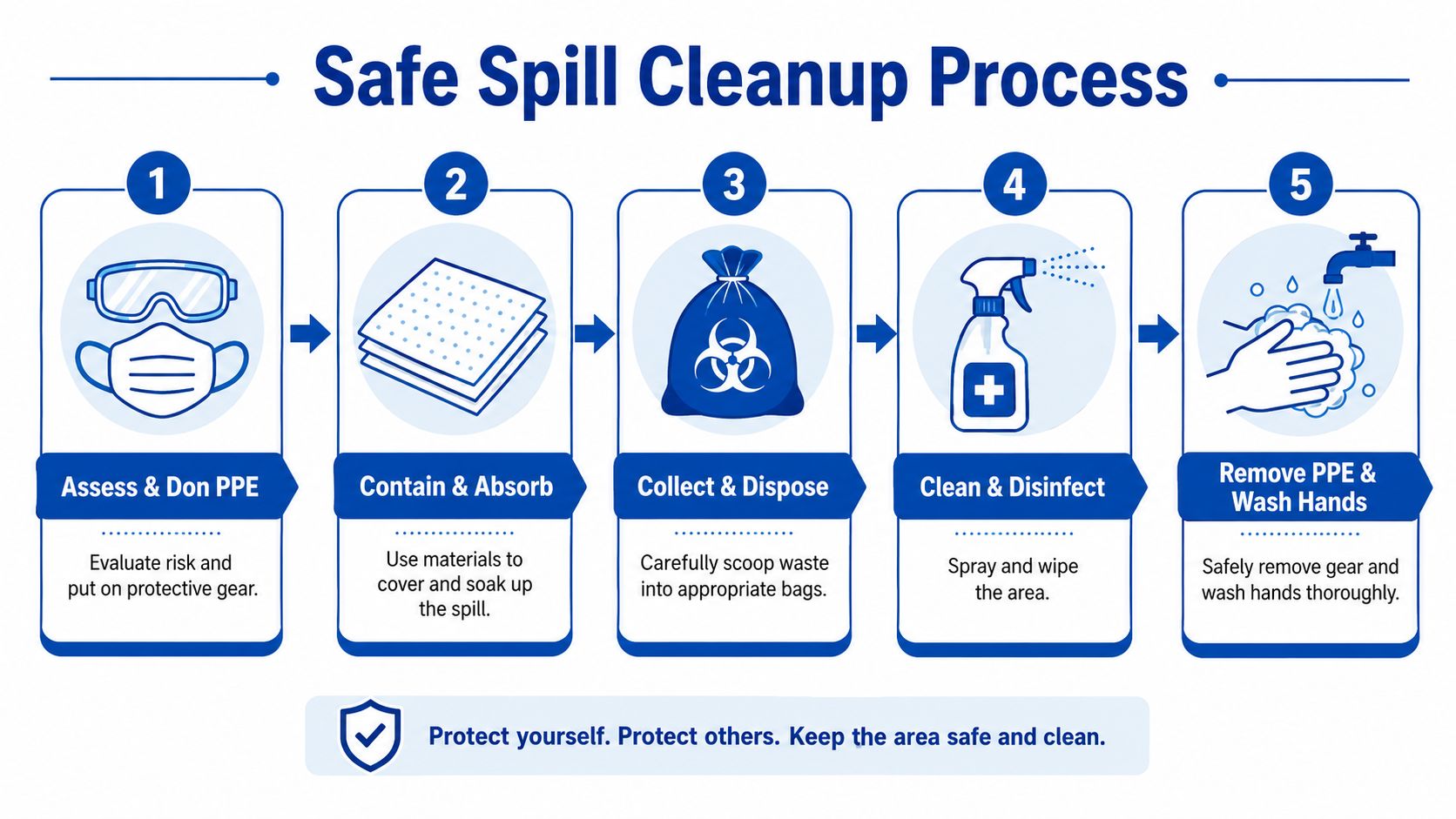
This infographic gives a quick visual of the process before any hands-on action starts.
The safest working sequence
Authoritative procedures emphasize containment first, disinfection second. They recommend starting at the spill perimeter and working inward with absorbent material, then applying an EPA-registered hospital disinfectant or a freshly prepared 1:10 bleach solution and keeping the surface visibly wet for the required contact time. Industry guidance citing CDC-aligned practice also notes that university SOPs commonly specify 10 minutes for non-viscous spills and up to 30 minutes for viscous spills, as outlined in this blood spill kit procedure guide. Shortening that dwell time undercuts the disinfectant step.
For readers who prefer a visual walk-through, this video can help reinforce the overall flow before a real incident occurs.
A practical high-level workflow
Secure the area first
Limit foot traffic. Keep bystanders back. If there's any chance of injury, sharps, or active medical need, stop and reassess before cleanup starts.Put PPE on before touching anything
The mistake here is using gloves as the only protection while leaving eyes, clothing, or nearby surfaces exposed.Contain from the outside inward
Don't push liquid across the floor. Use absorbent material at the edge first so the spill doesn't spread.Apply disinfectant only after visible material is controlled
The surface must remain visibly wet for the full contact time required by the product or protocol being used.Package waste immediately after collection
Contaminated absorbents, used PPE, and cleanup tools must go into the designated disposal packaging.
What people often miss
The details that look minor usually control the outcome:
- Splash prevention matters: Fast wiping motions can aerosolize droplets or spread material to nearby surfaces.
- Wet time matters: If the disinfectant dries too early, the process isn't complete.
- Handwashing still matters: Gloves reduce contact risk, but they don't replace final hygiene.
If a responder can't identify the disinfectant, the contact time, or the disposal path, they're not ready to use the kit.
The Red Line When You Must Call a Professional
The hardest decision for staff isn't usually how to wipe up a spill. It's deciding when not to try. That decision protects people, reduces liability, and keeps a manageable incident from becoming a building-wide contamination problem.
A standard kit has clear boundaries. Once those boundaries are crossed, continuing with a DIY response can become the hazard.
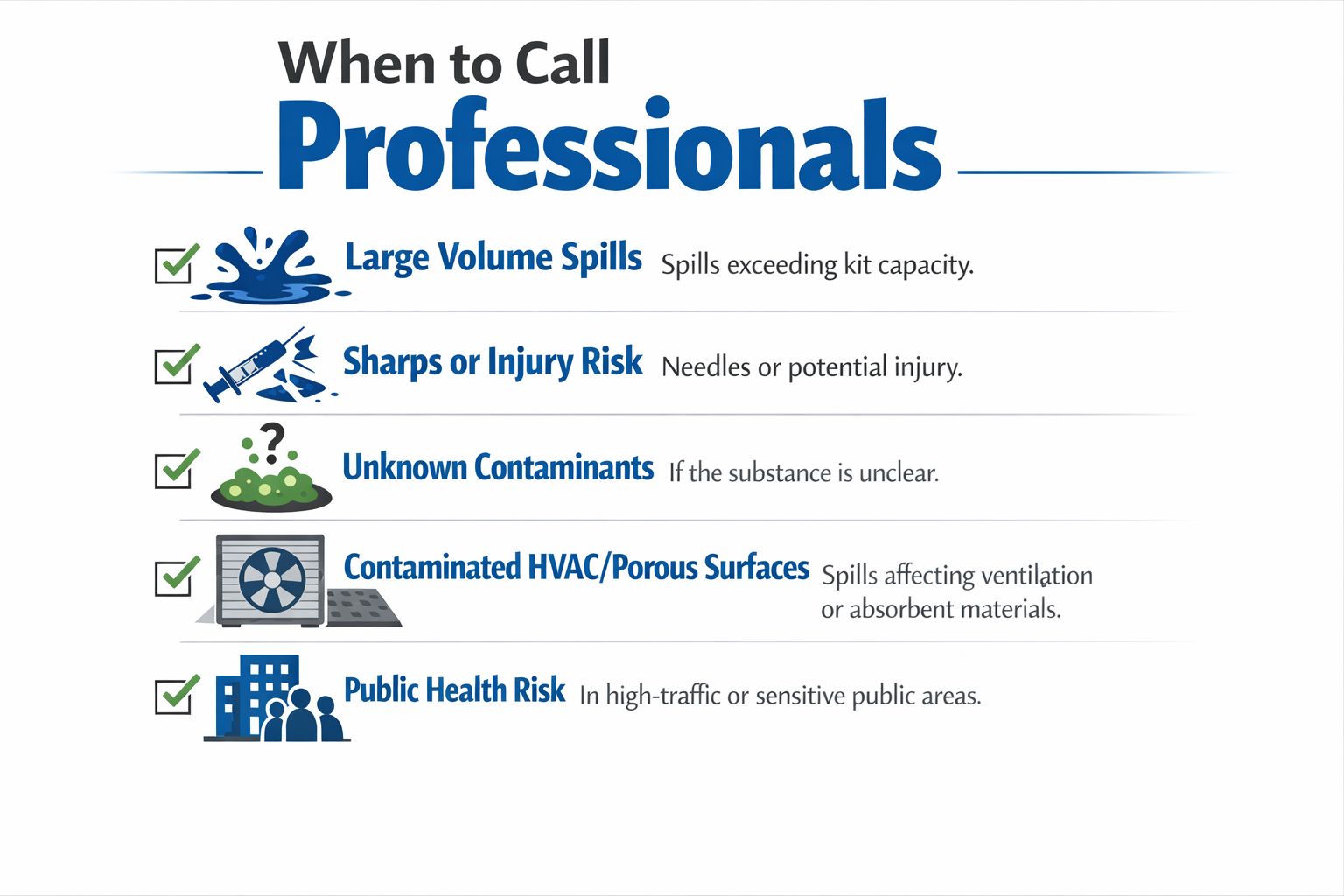
Signs the kit is no longer enough
Use this as a practical decision screen:
- The spill exceeds easy containment: If staff can't isolate it quickly with the materials on hand, the scene is already outside a basic kit response.
- The material reached porous surfaces: Carpet, grout, fabric seating, cardboard, and unfinished wood change the job completely.
- There are sharps or breakage hazards: Needles, broken glass, metal fragments, or hidden injury risks should stop an untrained cleanup.
- The source or substance is unclear: Unknown contamination calls for a higher level of caution.
- The area serves the public or vulnerable occupants: Hallways, waiting areas, care settings, and shared restrooms carry broader exposure concerns.
Why calling for help is the responsible move
Professional intervention isn't an admission that your team failed. It's the correct decision when the event involves uncertainty, structural contamination, or disposal complexity. In those cases, controlling access and calling a qualified service is more responsible than improvising.
Property teams sometimes also need broader restoration support after contamination affects finishes, subflooring, or adjacent materials. In that context, this guide to Western Washington restoration specialists can help readers understand how restoration contractors fit into the larger recovery process after a hazardous event has been stabilized.
If you're trying to distinguish between events staff can handle and events that require escalation, this resource on mold, blood, or chemicals and when to call a hazardous cleanup professional is a practical reference.
One factual option in that category is 360 Hazardous Cleanup, which provides biohazard cleanup services for blood and bodily fluid contamination when the scene exceeds the safe limits of a standard kit.
Disposal Compliance and Hidden Post-Cleanup Risks
Many people think the job ends when the floor looks clean. That's the most common misunderstanding in this entire topic. The visible spill is only the first half of the event. The second half is what happens to every glove, absorbent, wipe, and disposable tool that touched it.
Institutional procedures are direct on this point. Used PPE, absorbents, and contaminated items must be placed in sealed biohazard bags and handled through regulated medical-waste processes, as explained in this blood spill cleanup compliance overview. The risk ends with compliant disposal, not with wipe-up.
Why disposal is where many responses fail
A team can perform the visible cleanup reasonably well and still create a serious downstream problem. If contaminated materials sit in an open liner, get tossed into routine trash, or remain accessible in a janitorial closet, the site is still unsafe. The hazard has only been moved.
That's why disposal deserves the same attention as surface cleaning:
- Sealed containment matters: Waste has to stay isolated after collection.
- Handling rules matter: Biohazard waste is not ordinary facility refuse.
- End-point verification matters: Staff should know who takes custody of the waste and how that process is managed.
The cleanup is finished only when the contaminated waste is packaged, transferred, and handled under the right process.
The hidden legal and human side
Improper disposal creates more than compliance trouble. It can expose custodial workers, waste haulers, maintenance staff, and anyone else who encounters the materials later. In a workplace, that can also trigger documentation issues if an exposure concern arises after the fact.
Readers who want a broader look at how blood-related materials are handled after testing may find this article on rights regarding blood samples after testing helpful for understanding the chain of handling around biological material.
For facility managers, the practical takeaway is simple. If your plan ends with “bag it and toss it,” the plan isn't finished. Consequently, a clear disposal policy, designated vendors, and staff instruction become essential. 360 Hazardous Cleanup also outlines the broader issue in its page on biohazard waste disposal, which is worth reviewing alongside your site procedures.
Choosing Storing and Maintaining Your Response Kits
A kit is only useful if it's present, complete, and understood. I've seen facilities buy the right supplies once, mount the case in a hallway, and then assume the problem is solved. Months later, gloves are missing, the disinfectant is outdated, or nobody on shift knows where the kit key is.
Preparedness is less about ownership and more about readiness.
Choose the kit for the environment
A small household kit and a workplace response kit don't serve the same purpose. In a commercial property, clinic, warehouse, school, or care setting, the kit should match the kinds of incidents staff could reasonably face and the surfaces involved.
A good selection process asks:
- Who will use it: Trained safety staff, general employees, clinical personnel, or residents
- Where it will be used: Restrooms, treatment rooms, loading areas, common corridors, vehicles
- What must happen after use: Internal packaging, temporary storage, and regulated disposal coordination
If those answers are vague, the kit choice is probably vague too.
Store it where decisions happen
The best location is visible, accessible, and close to the kind of event it supports. Don't bury it in a locked office across the building. Don't place it in a room staff avoid opening. Don't store it in conditions that can degrade components.
A workable storage standard includes:
- Easy access: Staff should be able to retrieve it without delay.
- Clear labeling: Nobody should mistake it for a generic janitorial tote.
- Routine checks: Missing or expired contents should be caught before an incident.
Maintenance and training close the gap
Restocking should happen immediately after any use, even partial use. A kit that lost gloves, bags, or absorbent material is no longer a dependable system. The same goes for instructions. If the response sheet is gone, damaged, or unreadable, the kit has already degraded.
Training doesn't need to be dramatic, but it does need to be real. Walk staff through where the kit is, what it can handle, what it cannot handle, and who makes the escalation call. A brief drill is often more valuable than a long policy nobody remembers.
Preparedness means your team can make the right call quickly, including the call not to use the kit.
A blood spill clean up kit is a focused tool. It supports a narrow category of controlled incidents. The safest organizations treat that limitation as a strength, because it keeps staff from overextending into situations that require a higher level of containment, decontamination, and disposal management.
When a spill is larger, more complex, or beyond what your team can address safely, 360 Hazardous Cleanup is available for professional biohazard remediation. Their work covers blood and bodily fluid contamination, regulated handling, and compliant disposal, which can help property owners, facility managers, and families move from uncertainty to a safe next step.