When facing a C. difficile cleaning challenge, you are dealing with an invisible threat that standard janitorial services are not equipped to handle. Effectively neutralizing this pathogen requires specialized EPA-registered sporicidal disinfectants and an unwavering adherence to safety protocols. This professional approach is the only way to eliminate the incredibly resilient spores that cause dangerous infections and prevent outbreaks in high-risk environments.
Understanding the C. Difficile Threat in Your Facility
Clostridioides difficile, or C. diff, is a uniquely challenging pathogen. It is not just another bacterium; it armors itself by forming microscopic spores. These spores are exceptionally durable and can persist on dry surfaces like bed rails, light switches, and doorknobs for months, awaiting an opportunity to spread.
The primary danger is that these dormant spores are highly resistant to common disinfectants and alcohol-based hand sanitizers. This is why standard cleaning methods can create a false sense of security—they may make a room appear clean while leaving behind a hidden reservoir of infection. All it takes is for someone to touch a contaminated surface and then their mouth for the cycle of infection to begin again.
The Science Behind Its Stubborn Survival
The lifecycle of C. difficile is what makes it such a persistent challenge. When faced with environmental threats—like oxygen or standard cleaners—the bacterium shields itself inside a protective spore. In this state, it can survive conditions that would instantly kill most other germs.
Consider a real-world scenario in a long-term care facility. A resident with an active C. diff infection uses a shared bathroom. Even if that bathroom undergoes daily cleaning with standard products, the spores can easily remain on the toilet handle, sink faucet, and grab bars. The next person to use that bathroom, who may have a compromised immune system, touches those same surfaces. The spores are transferred, and a new infection can take root, potentially leading to a facility-wide outbreak. This is the precise mechanism by which C. diff spreads daily.
The consequences of this pathogen's persistence are significant. In 2012, C. difficile was responsible for an estimated 500,000 infections in the U.S. alone, resulting in 29,000 deaths. A staggering 80% of those deaths occurred among individuals aged 65 and older, underscoring the extreme danger it poses to vulnerable populations.
Key Takeaway: The primary danger of C. difficile lies in its ability to form spores. These are not merely germs on a surface; they are microscopic, resilient structures that can survive for months, resist standard cleaning, and await the right moment to cause a new infection.
Why Standard Cleaning Protocols Are Insufficient
To effectively combat C. diff, it is critical to understand the difference between standard cleaning and true sporicidal disinfection. A typical cleaning service may wipe away dirt but will almost certainly leave the spores untouched.
Effective C. difficile cleaning is a mandatory two-step process:
- Physical Removal: First, all surfaces must be meticulously cleaned with a detergent to remove organic matter, particularly feces or other bodily fluids. This step is non-negotiable, as organic material can act as a shield, protecting the spores from the subsequent disinfection stage.
- Sporicidal Disinfection: Once surfaces are physically clean, an EPA-registered sporicidal disinfectant must be applied. It is imperative to follow the manufacturer's instructions precisely, especially regarding the required contact time (or "dwell time"). This is the duration the surface must remain wet for the chemical to effectively break down and destroy the spore's protective shell.
If either of these steps is skipped or rushed, the entire effort is compromised. This is precisely why specialized C. difficile cleaning by trained professionals is an essential health and safety intervention, not just a service. It is a technical process that demands a deep understanding of microbiology and safety protocols, similar to what is required for cleaning superbugs and other infectious bacteria.
Engaging a certified provider ensures that every contaminated surface is properly remediated, effectively breaking the chain of infection and protecting everyone within the facility.
Your Action Plan for C. Difficile Decontamination
Addressing a C. difficile contamination is not a simple cleaning task; it is a methodical, scientific process demanding a precise plan of action. These resilient spores are unaffected by standard cleaners. A successful decontamination depends on using the correct tools, following a strict sequence, and maintaining an unwavering focus on safety.
The objective is not to make a room look clean. It is to make it biologically safe.
This process diagram illustrates the journey from a contaminated surface to a safe environment, highlighting the persistence of C. difficile spores.
As shown, simple contact is all that is needed to initiate the chain of infection. The spore’s incredible ability to survive is exactly why professional decontamination is so critical.
Selecting The Right Disinfectant And PPE
First, it is imperative to choose the correct tools for the task. Everyday household cleaners will not affect C. difficile. You must use a sporicidal disinfectant—one specifically registered with the EPA as proven to kill C. difficile spores.
Equally important is the proper use of Personal Protective Equipment (PPE). This is a non-negotiable safety requirement. Anyone entering the contaminated area must be fully protected.
- Gloves: Disposable, non-porous gloves are the first line of defense against direct contact.
- Gowns: Fluid-resistant gowns or full coveralls are essential to protect skin and clothing.
- Eye Protection: Goggles or a face shield are mandatory to prevent splashes from contaminated fluids or chemicals.
- Respiratory Protection: Depending on the disinfectant used, a respirator may be necessary to protect against aerosolized particles.
Without correct PPE, the individual performing the cleaning can become a carrier, inadvertently spreading spores to other areas. This is why professional remediation teams adhere to strict donning and doffing procedures.
The Critical Sequence Of Cleaning Operations
Effective C. difficile cleanup follows a precise order. Executing the steps incorrectly renders the entire effort ineffective. The most important rule is that you cannot disinfect a dirty surface.
The first step is always the physical removal of all visible soil and organic material, especially fecal matter. This debris creates a physical barrier, protecting the spores from the disinfectant. Our certified technicians meticulously clean every surface with a detergent and disposable cloths before applying a sporicidal agent.
Only after this thorough cleaning can the disinfection phase begin. This clean-first, disinfect-second approach is the foundation of any legitimate biohazard cleanup. You can explore the full professional process in our step-by-step guide to the biohazard cleanup process.
Sporicidal Agents Effective Against C Difficile Spores
Choosing the right sporicidal agent is crucial. Not all disinfectants are created equal, and their effectiveness, contact time, and compatibility with different materials can vary significantly. This table breaks down some of the most common options to help guide the selection process.
| Active Ingredient | Effectiveness | Typical Contact Time | Key Considerations |
|---|---|---|---|
| Sodium Hypochlorite (Bleach) | Highly effective against spores. Typically a 1:10 dilution. | 10 minutes | Can be corrosive to metals and damage fabrics. Strong fumes require good ventilation. |
| Peracetic Acid | Very effective. A powerful oxidizer. | 5-10 minutes | Less corrosive than bleach but can still be harsh. Environmentally friendly (breaks down into water and vinegar). |
| Hydrogen Peroxide (Accelerated) | Effective sporicidal activity at higher concentrations. | 5-10 minutes | Generally safer on surfaces than bleach. Shorter contact times are a major advantage. |
| Chlorine Dioxide | Excellent sporicidal properties. | 5-10 minutes | Must be generated on-site. Can be corrosive. Effective in both liquid and gas forms. |
Ultimately, the best choice depends on the specific environment, the types of surfaces being treated, and safety protocols. Always follow the manufacturer's directions to the letter.
Proper Application And Dwell Time
Once surfaces are physically clean, the sporicidal disinfectant must be applied exactly as the manufacturer instructs. Precision is paramount. The product must completely wet the entire surface without pooling or running off.
The single most critical factor in this stage is dwell time, also known as contact time. This is the minimum duration the disinfectant must remain visibly wet on a surface to kill C. difficile spores. This can range from a few minutes to 10 minutes or more.
In a professional setting, if a disinfectant requires a 10-minute dwell time, that surface must remain wet for the full 10 minutes. If it dries prematurely, it must be reapplied. Rushing this step is the most common reason amateur cleaning attempts fail.
High-touch surfaces are primary transmission points and require obsessive attention. These include:
- Bed rails and call buttons
- Light switches and doorknobs
- Remote controls and telephones
- Medical equipment like IV poles and monitors
- All bathroom fixtures—toilets, faucets, grab bars
Each of these items must be treated with the same meticulous attention to both cleaning and dwell time. In a healthcare setting, managing these protocols can be complex, which is why facilities often rely on tools like healthcare safety software to track compliance. A successful action plan is built on science, executed with precision, and leaves no room for error.
Navigating High-Risk Environment Protocols
In environments such as an intensive care unit (ICU), a long-term care facility, or any room housing immunocompromised individuals, standard cleaning protocols are inadequate. These are high-stakes situations with zero margin for error. This is where professional biohazard remediation goes far beyond a simple surface wipe-down to guarantee a biologically safe space.
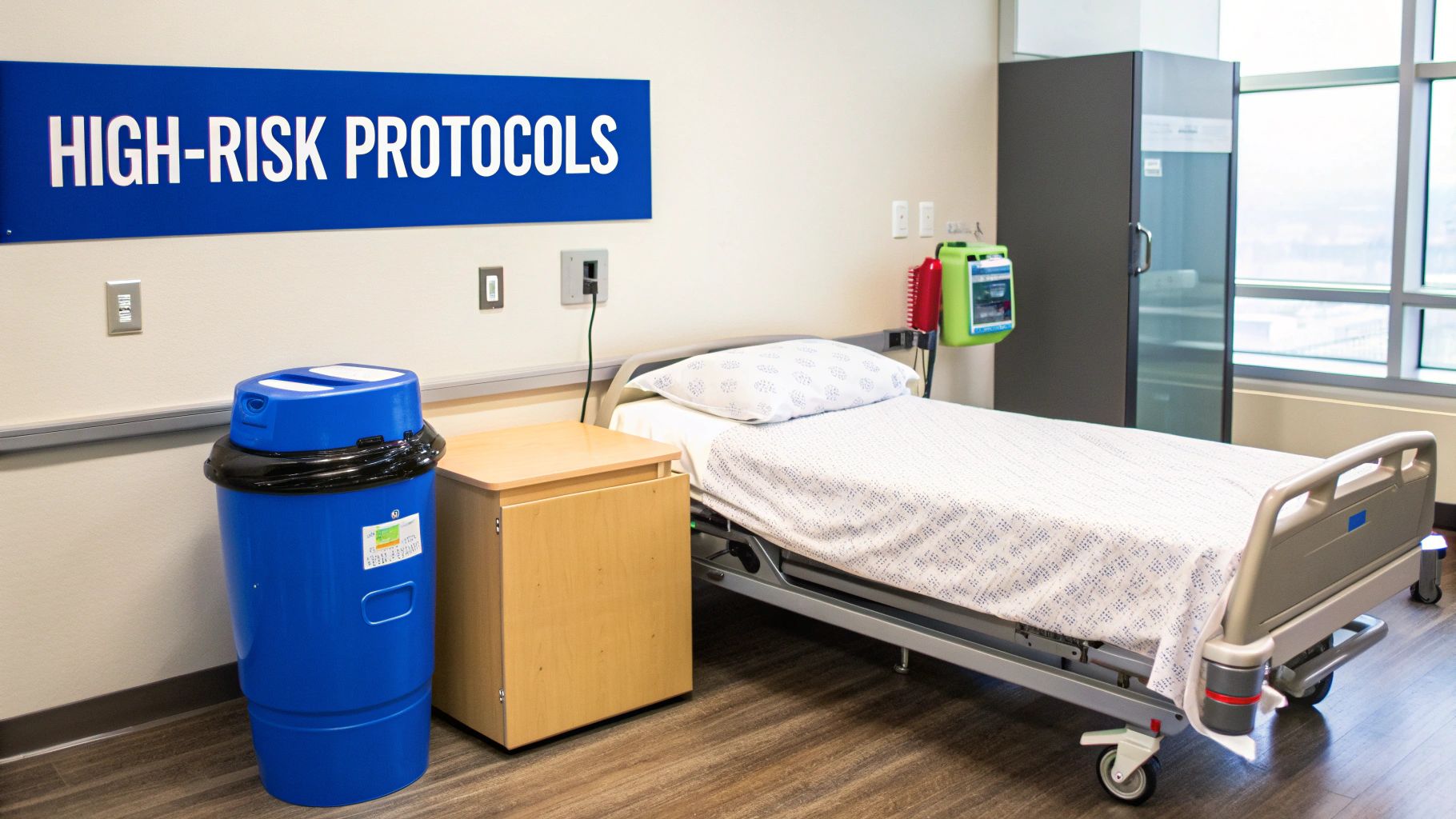
The necessity for this level of protocol is supported by data. Between 1990 and 2019, global deaths from C. difficile increased from 8,321 to 32,134. A significant driver of this increase was healthcare-associated exposures. Since these spores can survive for months and are resistant to most common sanitizers, only a rigorous combination of physical cleaning and potent sporicidal agents will effectively break the chain of infection.
Advanced Terminal Cleaning Procedures
Terminal cleaning is the comprehensive, top-to-bottom disinfection process performed after a patient with an infectious disease like C. difficile vacates a room. It is vastly different from daily tidying. The sole objective is to eradicate any lingering pathogens and render the room completely safe for the next occupant.
This process involves more than just the obvious surfaces. A true terminal clean addresses every possible hiding place for spores.
- High-Touch Surfaces: Light switches, TV remotes, call buttons, and doorknobs are meticulously scrubbed and disinfected, ensuring adherence to the chemical’s required dwell time.
- Medical Equipment: IV poles, blood pressure cuffs, monitors, and other non-critical equipment are decontaminated according to strict manufacturer and CDC protocols.
- Air Vents and Fixtures: HVAC grilles, overhead lights, and ceiling fans are wiped down to remove dust that can collect and recirculate spores.
- Floors and Walls: All surfaces receive attention. Cleaning and disinfection proceed from the cleanest area of the room toward the dirtiest to prevent cross-contamination.
This level of detail is why standard janitorial staff are not equipped for C. difficile cleaning. It requires technicians who are deeply trained in infection control principles to execute it correctly every time.
Handling Contaminated Textiles and Linens
Contaminated fabrics are a significant and often overlooked vector for spreading C. difficile. Bedding, privacy curtains, towels, and patient gowns can all become heavily laden with spores. Improper handling can aerosolize these spores, dispersing them throughout the facility.
Professional teams follow a strict, non-negotiable process. We carefully roll contaminated items inward to contain the biohazard, place them directly into marked, leak-proof bags, and never shake them. Containing the threat at its source is paramount.
The laundering process itself must be equally specific. To be effective against C. diff spores, hot water cycles of at least 160°F / 71°C are required, supplemented with an EPA-approved laundry sanitizer or bleach. This is not a suggestion; it is a critical step to protect laundry staff and all future patients.
Demystifying Biohazardous Waste Disposal
The final component of professional C. difficile cleaning is managing the resulting waste. Everything from our disposable PPE and cleaning cloths to any contaminated patient items is classified as regulated medical waste.
Attempting to bypass proper disposal procedures is not only a safety hazard but also a direct violation of local, state, and federal laws. As a professional remediation company, 360 Hazardous Cleanup possesses the expertise to navigate these complex regulations.
Key Disposal Steps:
- Segregation: All contaminated waste is placed directly into red biohazard bags without exception.
- Containment: These bags are sealed inside rigid, puncture-proof containers clearly marked with the universal biohazard symbol.
- Transportation: A licensed biohazardous waste hauler transports the contained waste to a certified disposal facility.
- Documentation: We maintain a detailed manifest—a chain-of-custody document—that tracks the waste from its point of origin to its final destruction, ensuring full compliance.
Mastery of these regulations is a core part of our professional service. For a closer look at the regulations that govern our work, you can learn more about OSHA guidelines for biohazard cleanup in our article. This expertise protects not only the facility but the entire community.
How to Verify and Document a Successful Cleaning
After the painstaking process of a C. difficile cleaning is complete, the area may look spotless. But how can you be certain the invisible threat is gone?
Visual inspection alone is insufficient. Scientific proof is required to confirm that the C. diff spores have been neutralized. This step is not merely for peace of mind; it is a non-negotiable part of managing a safe facility and provides definitive evidence that the space is truly decontaminated.
Equally critical is the subsequent documentation. This is not a bureaucratic formality. Proper documentation serves as the official record for regulatory compliance, insurance claims, and internal quality control. A detailed log demonstrates that all necessary measures were taken to create a safe environment, protecting your organization from liability.
Modern Verification Methods for Peace of Mind
The era of subjective visual assessment is over. Today, technology provides objective, quantitative data to confirm the efficacy of disinfection protocols.
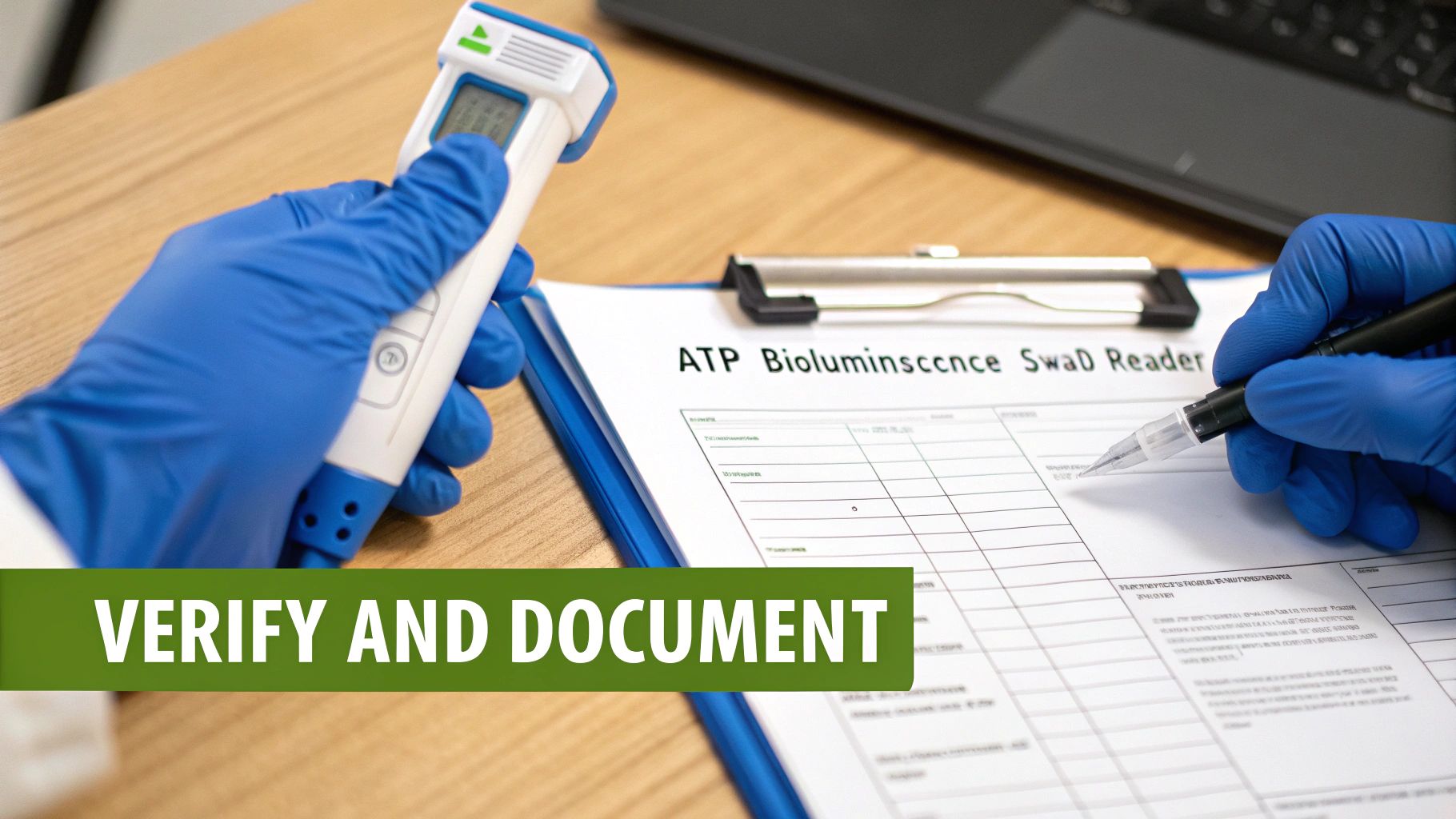
One of the most effective tools is ATP (adenosine triphosphate) testing. ATP is an energy molecule found in all living cells, including bacteria and residual organic material. An ATP meter measures the amount of this molecule on a swabbed surface, providing a numerical score in seconds. A low reading confirms that organic debris has been physically removed, ensuring the surface was sufficiently clean for the disinfectant to effectively kill the spores.
Expert Insight: At 360 Hazardous Cleanup, we utilize ATP testing as a core component of our quality assurance. By taking a reading before we begin and another upon completion, we provide clients with undeniable, scientific proof of a massive reduction in the biological load, removing all guesswork from the process.
The Critical Role of Documentation
Creating a detailed record of the decontamination is non-negotiable. For managers of healthcare or long-term care facilities, this logbook is the backbone of the infection control program and a primary focus during audits.
Your C. difficile cleaning log must capture several key details:
- Date and Time: When did the cleaning and disinfection occur?
- Specific Location: Pinpoint the exact room or area that was treated.
- Personnel: List the names of the technicians who performed the work.
- Products Used: Name the EPA-registered sporicidal disinfectant, its EPA registration number, and the product lot number.
- Dwell Times: Document that the required contact times were met on all surfaces.
- Verification Data: Log the results from ATP tests or any other verification methods used.
This log is invaluable. In the event of a future outbreak, it helps infection control teams quickly determine if the environment was a contributing factor. For insurance purposes, it validates the work performed and justifies the associated costs.
Shifting from Reactive to Proactive Prevention
While post-infection cleanup is essential, the ultimate goal is to prevent outbreaks from occurring in the first place. A proactive approach distinguishes well-managed facilities, moving them out of a constant cycle of crisis management.
Implementing robust prevention measures drastically reduces the risk of C. difficile gaining a foothold. The tools for this have improved significantly over the years, as detailed in our article on how decontamination technology has advanced in the last 5 years.
Key Prevention Strategies:
- Hand Hygiene Programs: This is the single most effective preventive measure. Alcohol-based sanitizers do not kill C. diff spores, so staff training must emphasize the importance of washing with soap and water, especially after contact with an infected patient.
- Antibiotic Stewardship: Collaborate with clinical teams to promote responsible antibiotic use. Over-prescribing broad-spectrum antibiotics disrupts healthy gut bacteria, creating an environment where C. diff can thrive.
- Routine Environmental Cleaning: Implement a consistent, scheduled cleaning and disinfection plan for high-touch surfaces throughout the entire facility. This serves as a critical first line of defense.
By integrating these strategies, you create multiple layers of defense that make it incredibly difficult for C. difficile to spread. This comprehensive approach protects everyone—patients, residents, and staff—and demonstrates a true commitment to health and safety.
Why Professional Remediation Is Your Safest Choice
When facing a C. difficile contamination, the initial impulse may be to manage the cleanup internally to save time or reduce costs. While understandable, the science behind these spores demonstrates that C. difficile cleaning is not a simple janitorial task—it is a complex biohazard remediation where the stakes could not be higher.
The risks associated with improper cleaning, from triggering a new outbreak to facing significant legal repercussions, are too great to leave to chance. Attempting to manage this without specialized training, equipment, and chemicals creates a false sense of security while leaving a dangerous, invisible threat behind.
The Unseen Risks of an Inadequate Cleanup
The greatest danger lies in what cannot be seen. C. difficile spores are microscopic, adhere strongly to surfaces, and can survive for months. A standard cleaning crew, despite best intentions, is not trained to identify all potential contamination points or execute the strict, multi-step process required for true sporicidal disinfection.
Inadequate procedures can have devastating consequences:
- Renewed Outbreaks: Missing a single high-touch surface or failing to observe the required disinfectant dwell time can leave enough spores to restart the cycle of infection.
- Reputational Damage: For any healthcare facility, long-term care home, or business, a C. diff outbreak represents a significant breach of public trust and suggests a failure in safety protocols.
- Legal and Financial Liability: If an inadequate cleaning leads to further infections, the organization could be held liable for medical costs and other damages, leading to lawsuits and regulatory fines.
Environmental studies have shown that as few as 1 in 3 standard hospital cleanings effectively eliminate all C. diff spores in a contaminated room. This high failure rate directly contributes to further transmissions and underscores why an expert approach is non-negotiable.
Engaging a certified biohazard remediation company is a crucial act of risk management. It is a direct investment in the health of your patients, residents, and staff, and a critical measure to protect your organization's future.
The Professional Advantage in High-Stress Situations
A certified biohazard remediation team provides an essential combination of expertise, technology, and compliance knowledge. We understand the microbiology of C. diff and the precise chemistry required to destroy its spores. This level of expertise is invaluable, especially in sensitive situations where discretion and compassion are as important as technical proficiency.
When you partner with a professional service like 360 Hazardous Cleanup, you ensure that several critical standards are met:
- Specialized Training and Certification: Our technicians are extensively trained in infection control, biohazard handling, and OSHA safety standards.
- The Right Tools for the Job: We utilize hospital-grade, EPA-registered sporicidal disinfectants and the proper Personal Protective Equipment (PPE) to prevent cross-contamination and ensure safety.
- Regulatory Compliance: We are experts in navigating the complex web of local, state, and federal regulations for handling and disposing of biohazardous waste, ensuring your facility remains compliant.
- Verification and Documentation: We can scientifically validate the cleaning's success with tools like ATP testing and provide you with comprehensive documentation for your records, offering proof that the job was completed correctly.
North America has the highest incidence of healthcare-associated C. difficile in the world, with rates reaching 6.23 cases per 10,000 patient-days, partly driven by the spread of hypervirulent strains. These statistics demonstrate why a casual approach to disinfection is not an option when public health is at stake.
When hiring outside experts, using a clear commercial cleaning contract template is a prudent step to define the scope and expectations for specialized C. difficile decontamination.
Ultimately, choosing professional remediation is about guaranteeing safety and peace of mind during a stressful, time-sensitive crisis. It is about entrusting the situation to a compassionate expert who will handle it correctly, discreetly, and completely, allowing you to focus on caring for your people. You can learn more about why hiring certified biohazard professionals matters for your safety in our detailed guide.
Your C. Difficile Cleaning Questions, Answered
When dealing with a C. difficile contamination, many questions arise. During this stressful time, receiving clear, expert answers is key to moving forward with confidence. Here are some of the most common questions we receive from facility managers and homeowners.
Can I Just Use Regular Bleach to Clean C. Diff?
While a 1:10 dilution of household bleach can kill C. diff spores, relying solely on this method is risky in a real-world cleanup. Standard bleach has significant disadvantages.
It is highly corrosive and can damage metal fixtures, flooring, and fabrics. Its fumes are harsh, requiring a level of ventilation that many facilities cannot achieve. Furthermore, bleach is only effective on a surface that has already been meticulously cleaned of all organic matter. If any soil is missed, the bleach's efficacy is compromised.
Professional remediation teams do not take this risk. We use EPA-registered, hospital-grade sporicidal disinfectants designed specifically for this purpose. These products are powerful enough to eliminate the spores while being formulated for compatibility with a wide range of materials, preventing collateral damage. For guaranteed results, a commercial-grade product applied by trained technicians is the only reliable solution.
How Long Can C. Diff Spores Actually Survive on Surfaces?
The resilience of C. difficile spores makes this pathogen incredibly difficult to control. These microscopic structures can remain viable on dry surfaces like bed rails, countertops, doorknobs, and light switches for an extended period—up to five months or even longer.
This is not a pathogen that dies off on its own in a few days. Its remarkable longevity is precisely why a quick wipe-down or standard janitorial cleaning is insufficient. It underscores why a thorough, professional-level terminal cleaning is absolutely essential to break the cycle of infection and prevent the environment from re-contaminating individuals weeks or months later.
Does Hand Sanitizer Work Against C. Diff?
No, it does not. Alcohol-based hand sanitizers are completely ineffective against C. difficile spores. The alcohol cannot penetrate the spore's durable protective shell, leaving it intact and capable of causing infection.
The only proven method for removing C. diff from hands is thorough washing with soap and water. The mechanical friction from scrubbing physically lifts and removes the spores from the skin. This is a non-negotiable training point for staff in any facility managing a C. diff case.
When Is It Time to Call a Professional for C. Diff Cleaning?
The answer is immediately following a confirmed diagnosis. Attempting a DIY cleanup poses a significant risk to your health and the health of others, and it can create substantial liability. It is especially critical to engage experts in situations involving:
- Shared spaces or high-traffic areas (e.g., hospital rooms, nursing home common areas, bathrooms).
- Any visible fecal matter or bodily fluid contamination.
- Environments where elderly, immunocompromised, or other vulnerable individuals reside or visit.
A professional biohazard remediation company ensures all protocols are followed correctly. Technicians use the proper PPE to prevent cross-contamination, apply the correct sporicidal agents with precise, documented dwell times, and manage the legal disposal of all biohazardous waste. This is your best and only guarantee of a truly safe, decontaminated environment.
When you're facing the challenge of a C. difficile cleanup, you need a partner you can trust to handle the situation with expertise, discretion, and compassion. 360 Hazardous Cleanup provides certified, compliant, and thorough biohazard remediation services to ensure your environment is safe and spore-free. Contact us 24/7 to restore safety and peace of mind at https://360haz.com.