A persistent odor changes how a property feels. You clean, ventilate, shampoo, wipe down surfaces, and the smell still returns when the building warms up, when the HVAC starts, or when humidity rises. That's usually the moment people start searching for ozone machines and “shock treatment” solutions that promise to erase the problem fast.
That promise is where many property owners get into trouble. Ozone treatment odor removal is not an air-freshener strategy. It's an industrial oxidation process with real health risks and very narrow best-use scenarios. In biohazard, trauma, decomposition, smoke, and severe contamination cases, the first question is never “Which machine should we rent?” It's “What is producing the odor, where has it migrated, and what has to be physically removed?”
For families and facility managers under stress, that difference matters. If the odor source is still present in subflooring, drywall, duct insulation, porous furnishings, or contaminated debris, ozone won't turn a bad situation into a safe one. For a closer look at one of the most misunderstood odor categories, 360 Hazardous Cleanup's guide to the odor of decomposition and biohazard cleanup helps explain why source identification comes first.
The Reality of Stubborn Odors and Ozone Promises
Most stubborn odors aren't just “in the air.” They're tied to residue, absorbed contamination, moisture, or a hidden source that keeps releasing gases over time. That's why a room can smell better for a few hours after cleaning, then worsen again.
Ozone gets marketed as the shortcut. Plug in a machine, leave the property, come back, and the odor is supposedly gone. The problem is that the science doesn't support that kind of simple promise in occupied indoor environments. The EPA states that at ozone concentrations which do not exceed public health standards, ozone has little to no potential to remove indoor air contaminants or effectively eliminate odor-causing chemicals in indoor spaces, as explained in its guidance on ozone generators sold as air cleaners.
Why the quick fix is attractive
When a home, office, apartment, or care facility smells wrong, people want relief now. That's understandable. Odor can interrupt sleep, trigger anxiety, complicate leasing, upset staff, and make normal use of a property feel impossible.
But odor removal only works when the response matches the material involved.
- Surface odor issues may respond to targeted cleaning, filtration, or material-specific treatment.
- Absorbed odors in wood often need finish-safe cleaning and restoration methods. In some situations, practical wood floor odor removal techniques can help clarify what belongs in flooring restoration and what needs broader remediation.
- Biohazard-related odors require a containment, removal, cleaning, and decontamination process before any deodorization tool should even be considered.
Practical rule: If nobody has identified and removed the source, odor treatment is premature.
What property owners should assume at the start
Assume the smell has a cause. Assume that cause may be inside porous material, under finish layers, or within contents that look visually intact. And assume any device marketed as a universal cure is oversimplifying a problem that may involve health, compliance, and liability concerns.
That mindset leads to better decisions. It also keeps people from using an oxidizing gas where they really need inspection, source removal, and a documented remediation plan.
How Ozone Attacks Odors The Science Explained
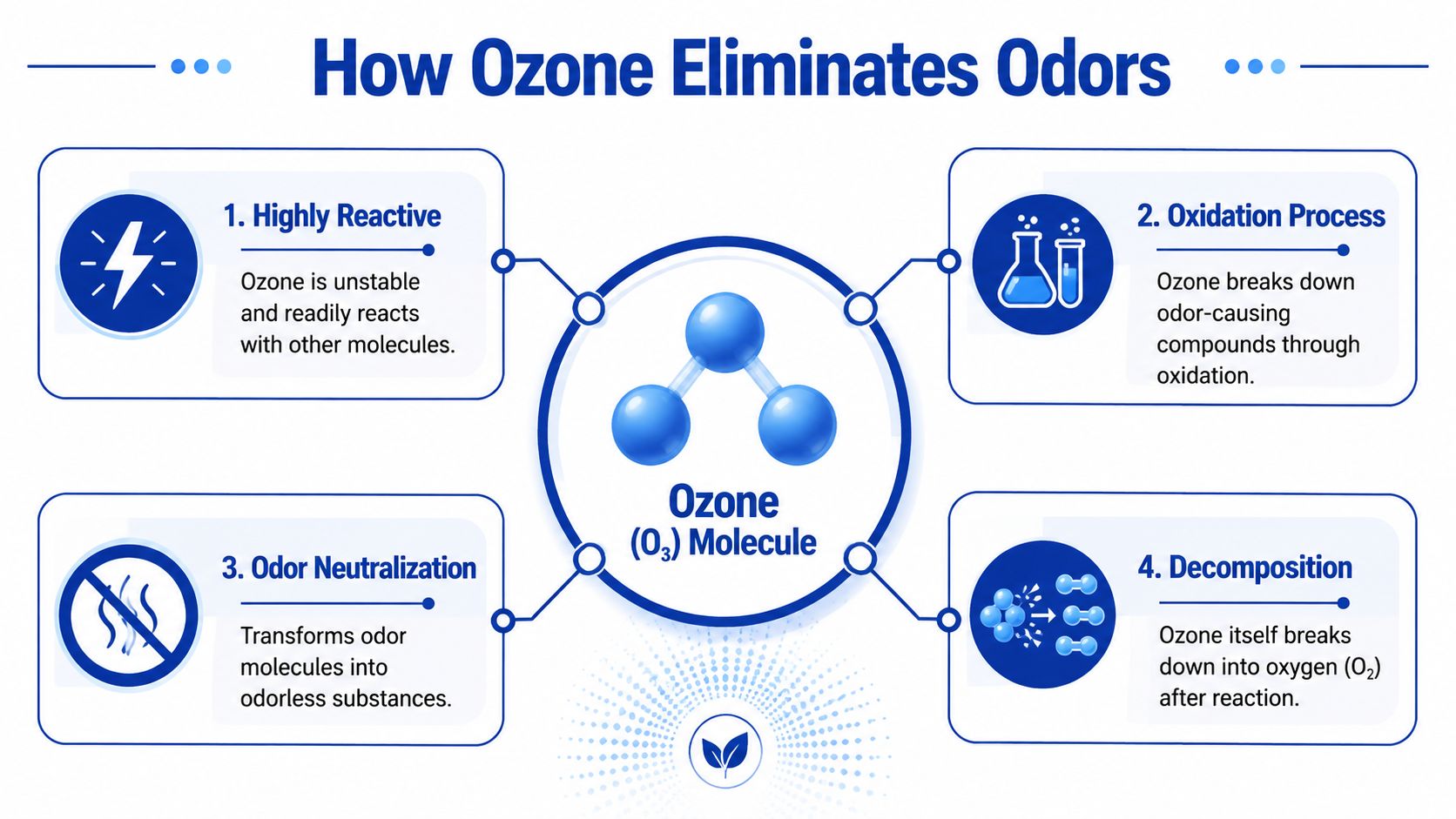
Ozone is O₃, a molecule made of three oxygen atoms. That extra oxygen atom makes it unstable and highly reactive. In plain terms, ozone wants to react with other compounds. When it does, it can alter the chemistry of odor-causing molecules through oxidation.
Think of it as a chemical bulldozer. It doesn't sort carefully between “bad smell” and “everything else.” It reacts with whatever is chemically available.
What oxidation means in real rooms
If ozone contacts a reactive odor compound in the air or on an exposed surface, it may change that compound enough to reduce the smell. That's the part marketers focus on. In controlled conditions, oxidation can contribute to odor reduction.
But the same non-selective chemistry is why ozone can also damage sensitive materials and irritate living tissue. Lungs, eyes, mucous membranes, rubber components, and some finishes don't get a special exemption because the machine was sold for household use.
A good technical overview from 360 Hazardous Cleanup on the science behind biohazard decontamination helps connect this broader principle. Effective remediation tools work because they create chemical or physical change. That's also why they have to be controlled.
The part many people miss
Ozone doesn't “think.” It doesn't identify a decomposition source, remove contaminated insulation, or decide whether smoke residue has entered the return air side of an HVAC system. It reacts where it can.
That matters because ozone treatment odor removal is strongest as a chemical reaction, not as a diagnosis. If the odor is being fed by hidden organic residue, fluids in porous material, or smoke contamination deep in building assemblies, oxidation in room air alone won't solve the underlying problem.
Ozone is powerful because it is aggressive. That is also what makes it dangerous.
Why control matters
Professionals don't just place a generator and walk away. They evaluate the source, the room volume, the materials present, occupancy risk, isolation needs, and post-treatment ventilation requirements. In remediation work, the machine is the easy part. The judgment around when not to use it is what protects people and property.
Efficacy and Limitations What Ozone Can and Cannot Fix
Ozone has a place in remediation. It just doesn't deserve the “fixes anything” reputation it often gets. Used correctly, it can serve as a supplementary tool for certain residual airborne or surface-level odor issues in a tightly controlled, unoccupied area. Used as a substitute for source removal, it usually disappoints.
Where ozone may help
A professional may consider ozone after cleaning and removal are already complete, especially when lingering vapors remain in a sealed environment. It can be useful when the target is limited and the space can be fully vacated.
Situations that sometimes justify it include:
- Residual smoke-related odor after soot removal, cleaning, and filtration.
- Surface vapor issues where the main contamination source has already been extracted.
- Final-stage deodorization in a controlled remediation sequence, not the opening move.
That last point is the one many DIY approaches skip.
Where ozone fails
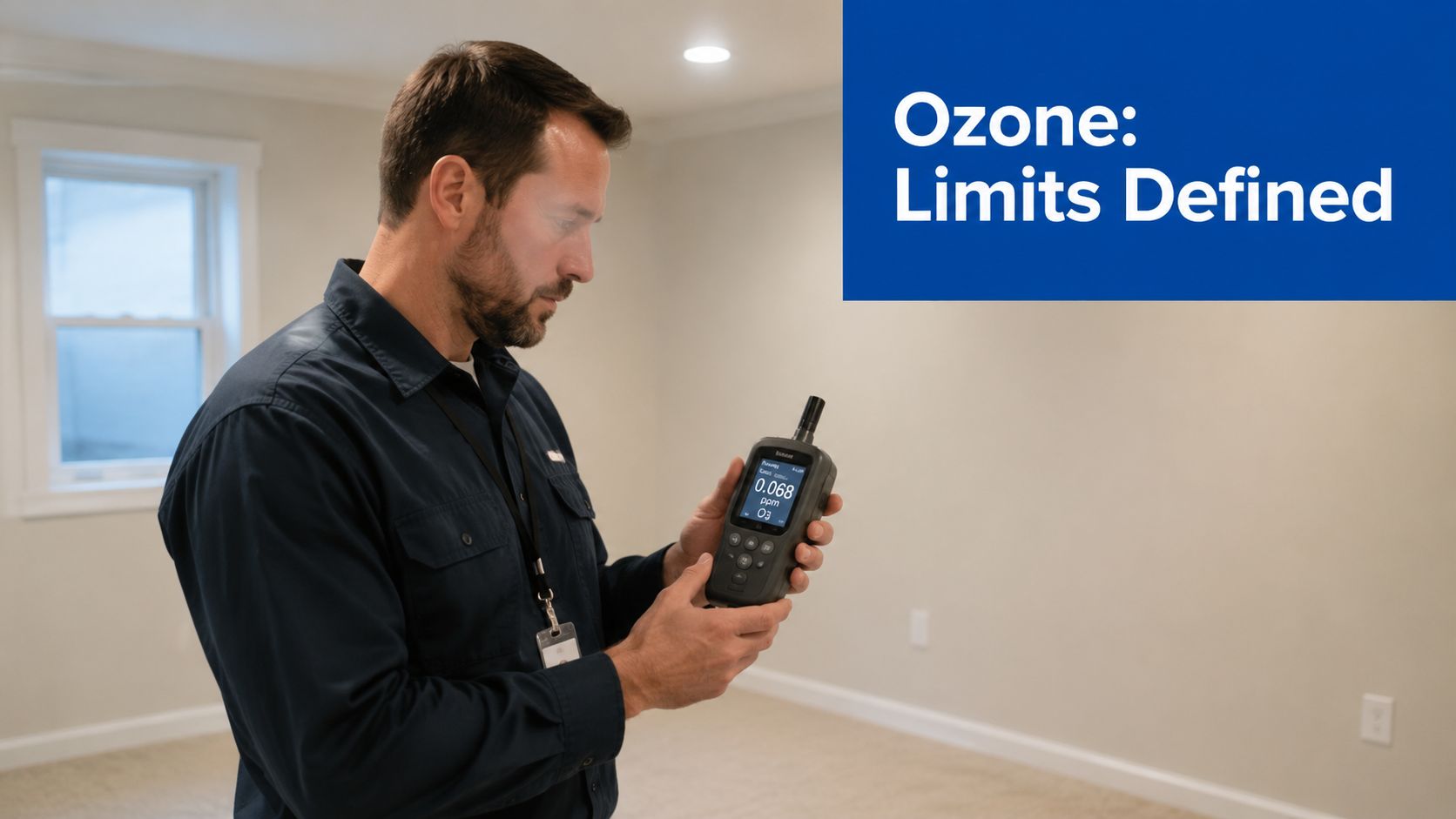
The EPA's position is especially important here. It states that at concentrations not exceeding public health standards, ozone is ineffective against biological contaminants embedded in porous materials, and even high concentrations may have no effect on firmly embedded agents, which is why ozone is only a supplementary step for surface vapors and requires aggressive mechanical extraction and cleaning first.
Porous materials are the problem. Drywall, unfinished wood, carpet pad, upholstered furniture, ceiling tiles, duct liner, insulation, and subfloor assemblies can all trap contamination below the surface. In trauma, unattended death, sewage, animal contamination, and hoarding conditions, that is often where the odor resides.
If odor is embedded in material, the material usually has to be cleaned by a method that reaches it, sealed when appropriate, or removed entirely.
What ozone cannot do by itself
It cannot stop an active source. If moisture remains, bacteria remain active, or contaminated material is still present, the odor will continue.
It also can't reliably solve these problems on its own:
| Odor problem | Why ozone alone falls short |
|---|---|
| Decomposition in porous assemblies | Source material and absorbed fluids remain in place |
| Smoke in wall cavities or HVAC components | Residue continues to off-gas |
| Hoarding-related contamination | Multiple overlapping organic sources require removal and sanitation |
| Mold inside porous building components | Embedded contamination needs physical remediation |
| Blood or bodily fluid intrusion | Biohazard material must be removed under proper protocols |
A seasoned remediation crew knows when oxidation is helpful and when it's a distraction. In difficult losses, the winning sequence is usually inspection, containment, removal, cleaning, drying if needed, filtration, then selective deodorization.
Health Dangers and Critical Safety Protocols
The concentration issue is what property owners need to understand clearly. The level of ozone that may contribute to meaningful odor treatment is the same reason people, pets, plants, and unprotected workers cannot be present during use.
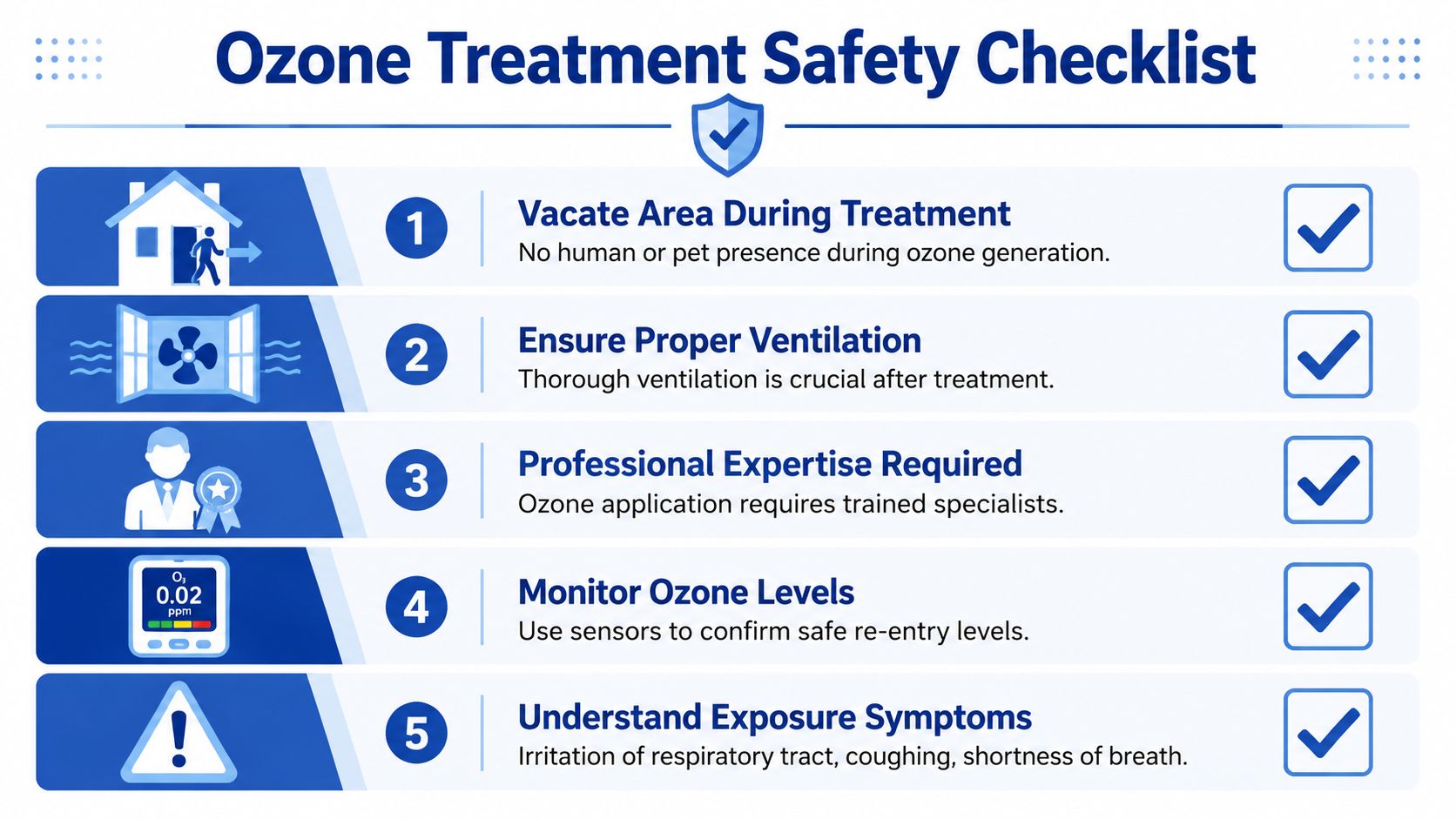
The guidance is straightforward. Expert consensus and EPA guidelines mandate that ozone generators must only be deployed in unoccupied spaces, with strict protocols for evacuation of people, animals, and plants. Safety protocols require the area to be evacuated for the duration of the exposure and for a prolonged period afterwards to allow ozone to convert back to oxygen, as discussed in this peer-reviewed overview of ozone use and safety considerations.
What safe handling looks like
Professional use means more than telling people to leave for a while. A proper protocol usually includes:
- Full evacuation: No occupants, staff, visitors, pets, or plants in the treatment zone.
- Isolation of the area: Doors, returns, and pathways are managed so ozone doesn't migrate where it shouldn't.
- Timed application: Exposure isn't improvised. It's planned around the space and the remediation objective.
- Ventilation after treatment: The area must air out long enough to allow dissipation before re-entry.
- Verification: Re-entry should be based on conditions, not guesswork.
The same principle applies to soft goods and floor coverings. If the odor issue is in textiles or rugs, mechanical cleaning often belongs ahead of any oxidizing treatment. In those cases, readers looking for material-specific help may find professional rug cleaning for Birmingham rugs useful as a reminder that not every odor problem is an ozone problem.
A workplace context adds another layer. Facilities dealing with exposure incidents, contaminated rooms, or hazardous residue should also understand their obligations under OSHA guidelines for biohazard exposure and workplace incidents.
Why DIY use is such a bad gamble
Small rental machines and consumer devices create false confidence. The user often has no reliable way to judge whether the concentration was too low to matter, high enough to be hazardous, or allowed to linger after treatment. That's a dangerous combination.
This short video captures the safety mindset well:
“If a machine requires you to vacate the property to use it, treat it like a controlled remediation tool, not a household appliance.”
Common exposure concerns
People exposed to ozone may experience irritation and breathing discomfort. In a facility with medically vulnerable occupants, that risk is even harder to justify. That's why professional remediation firms treat ozone as a restricted option, not a default setting.
Comparing Professional Odor Removal Technologies
A professional odor-removal plan shouldn't start with loyalty to one machine. It should start with the source, the affected materials, and whether the space must remain occupied. The industry learned that lesson a long time ago. In 1989, ASHRAE formally concluded that ozone is ineffective for removing odors in building ventilation systems unless concentrations are raised to levels that pose a significant health risk, a milestone documented in ASHRAE Standard 62-1989.
That finding helped shift serious remediation work away from one-size-fits-all ozone claims and toward more targeted methods.
Odor Removal Technology Comparison
| Technology | Mechanism | Best For | Safety Considerations |
|---|---|---|---|
| Ozone generator | Oxidation with ozone gas | Limited post-cleaning deodorization in sealed, unoccupied spaces | Requires strict vacancy and controlled re-entry |
| Hydroxyl generator | Produces hydroxyl radicals for slower oxidation | Some odor work where occupancy constraints matter | Generally treated as a safer option for active environments, but still requires professional judgment |
| Thermal fogging | Fog penetrates areas where odor residues settled | Smoke-related odor and certain residue patterns | Product selection and placement matter, and prep is critical |
| Air scrubber with activated carbon | Captures particulates and adsorbs odor compounds | Continuous air cleaning and odor reduction support | Useful as part of a broader remediation sequence |
| Source removal and cleaning | Physically removes contaminated material and residue | Biohazard, decomposition, hoarding, sewage, smoke, and persistent organic odors | Usually the foundation of any real solution |
How professionals choose
The right method depends on questions like these:
- Is the odor source still present? If yes, removal and cleaning come first.
- Is the contamination airborne, surface-bound, or embedded? The answer determines whether filtration, fogging, oxidation, or demolition is needed.
- Can the space be vacated? If not, ozone may be off the table immediately.
- What materials are affected? Textiles, wood, drywall, insulation, and HVAC components all behave differently.
Some companies, including 360 Hazardous Cleanup's decontamination technology services, use both hydroxyl and ozone tools as part of a broader toolkit. That's the right framework. Not every odor needs oxidation, and not every oxidation job should use ozone.
The most reliable sequence
In real remediation, the hierarchy is simple.
- Find the source.
- Remove or clean what is contaminated.
- Dry and stabilize the environment if moisture is involved.
- Use filtration or targeted deodorization as needed.
- Verify that the property is safe and usable.
That approach is slower than a sales pitch. It's also the one that gets results.
Hiring a Professional Remediation Service
The safest way to evaluate a company is to listen for what they emphasize first. If the conversation starts and ends with “we'll ozone it,” keep asking questions. A qualified remediation provider should want to inspect, define the contamination, discuss safety, and explain what must be removed before any deodorization device enters the picture.
That standard isn't just industry common sense. Even commercial ozone generator manufacturers say their machines should only be used by trained professionals and only after preliminary steps such as cleaning the area and removing the odor source have been completed, as stated in this guidance from OdorFree on ozone generator facts and FAQs.
Questions worth asking before you hire
Use these questions in the first call or site visit:
- How will you identify the actual odor source? A serious firm should discuss inspection, affected materials, and migration patterns.
- What has to be removed before treatment begins? If the answer is “nothing,” be cautious.
- What are your occupancy and safety protocols? You want clear language about evacuation, containment, ventilation, and re-entry.
- Do you handle biohazard materials under regulatory requirements? This matters in trauma, decomposition, sewage, and bodily fluid cases.
- Will you provide a written scope? The plan should explain cleaning, removal, deodorization, and verification.
What a competent consultation feels like
You should expect a calm, direct conversation. The estimator or project lead should explain what they know, what they still need to verify, and where the biggest risks are. They should be able to separate cosmetic odor concerns from contamination issues.
Field advice: If a contractor treats odor as a fragrance problem instead of a contamination problem, you're talking to the wrong company.
For a broader hiring checklist, this guide on choosing a biohazard cleanup company and avoiding common pitfalls is a useful reference.
What matters most
Credentials matter. Insurance matters. Experience matters. But the biggest signal is whether the company respects sequence. Source removal first. Controlled deodorization second. Documentation and safety all the way through.
That's the mindset you want when the property issue involves health, liability, or a family under pressure.
Frequently Asked Questions About Ozone Treatment
Are small home ozone air purifiers safe?
Treat any ozone-producing device cautiously. If a product relies on ozone for air cleaning, the same basic concern still applies. The chemistry doesn't become harmless because the machine is smaller. For occupied homes, offices, clinics, and common areas, safer and more targeted options are usually the better path.
Can ozone permanently remove cigarette smoke smell from a house?
Sometimes it can reduce residual odor after cleaning, but it won't permanently solve smoke odor if residue remains in porous materials, HVAC components, or painted surfaces. Smoke problems usually require cleaning, filtration, and sometimes sealing or material removal before any deodorization step works.
How long after ozone treatment is a room safe to enter?
There isn't a one-size-fits-all answer you should trust from a label or a casual online post. Re-entry depends on the treatment conditions, the space, ventilation, and whether the ozone has adequately dissipated. A professional should control that process and verify that the area is ready.
Can ozone kill the source of a decomposition or biohazard odor?
Not by itself in the way many people assume. If contaminated porous material, bodily fluids, residue, or hidden organic matter remain, the source still exists. In those cases, ozone is at most a secondary tool after removal and cleaning.
Is ozone treatment worth considering at all?
Yes, but only in the right context. In unoccupied, controlled environments, after proper source removal and cleaning, it may help with select residual odor issues. It should never be the first answer even if the smell is severe.
If you're dealing with an odor that may involve biohazard contamination, decomposition, trauma residue, smoke, or another high-risk source, 360 Hazardous Cleanup can help you determine what's causing it and what should happen next. The right plan starts with source identification, safety protocols, and a remediation process that protects both people and property.