
A lot of readers looking up chain of custody procedures aren't doing it out of curiosity. They're doing it because something serious just happened.
A tenant wasn't heard from for days. A patient room has visible blood and bodily fluids after an incident. A warehouse supervisor found contamination in an area that employees use every day. In those first hours, people usually ask the same questions. Is the area safe? Who needs to be notified? What has to be preserved? What will insurance ask for later? What if someone says the scene was mishandled?
Those questions all lead to one discipline that matters more than most property owners realize. Chain of custody procedures create the written and physical record that shows what was found, who handled it, how it was contained, where it went, and how final disposal or transfer was completed. In a biohazard setting, that record protects more than evidence. It also protects health, liability position, and operational credibility.
Why Chain of Custody Is Crucial in Biohazard Remediation
A facility manager gets the call before sunrise. An unattended death has been discovered in a unit, staff are waiting in the hallway, a family member is asking to retrieve belongings, and the insurer will want a clear record of what happened in that room. In those first minutes, one bad decision can create two problems at once. It can expose people to contamination and make later legal or insurance questions much harder to answer.

It protects more than courtroom evidence
At a biohazard scene, chain of custody serves several jobs at the same time. It helps preserve items that may matter to investigators, but it also shows that contaminated materials were identified, contained, transferred, and disposed of in a controlled way. For a property owner or facility leader, that paper trail can matter just as much as any forensic question.
I have seen the same scene reviewed by three different audiences. Law enforcement wants to know what was moved and when. An insurance carrier wants proof that the response followed accepted handling and disposal practices. A regulator or attorney may focus on restricted access, worker protection, storage conditions, and whether anyone without authorization handled contaminated contents. If the record is clean, those conversations stay manageable. If it is patchy, everyone starts filling in gaps with assumptions.
Biological evidence handling guidance also highlights a problem remediation teams deal with every day. Biological material degrades, contamination spreads easily, and scene conditions are often far from controlled laboratory settings, as discussed in this forensic review of biological evidence handling. That is why custody at a remediation scene is not only about proving authenticity. It is also about showing that safety controls held up under pressure.
The first break in custody is often small. Someone props the door open, moves a bag to reach a wall, or lets an unlogged visitor step inside for a moment.
The pressure point at a biohazard scene
Biohazard remediation rarely gives you the luxury of perfect conditions. The area may need to stay isolated for investigative reasons while fluids, odors, or sharps still pose immediate hazards. A good custody process handles both realities without letting one erase the other.
If law enforcement has not released the scene, preservation controls the pace of work. Once the scene is released, the priorities often shift fast toward containment, exposure prevention, privacy, and getting the property back to a safe condition. The key is documenting the exact handoff. Who released the space, when access changed, what stayed in place, and what was removed first all need to be clear. That coordination is why property owners benefit from understanding how biohazard cleanup companies collaborate with law enforcement.
For readers who want a plain-language example of why handling details matter, it helps to review how DNA analysis solves crimes. Not every remediation job becomes a criminal case. The lesson still applies. Once an item is handled poorly, confidence in what it shows drops quickly.
What property owners need to understand first
Chain of custody is controlled accountability during a stressful event. It gives you a defensible record of who entered the area, what they touched, what was packaged, what stayed for investigators, and how contaminated material left the property.
That record protects people and liability at the same time.
When documentation is missing, cleanup decisions are harder to defend even if the work itself was done properly. Insurance reviews slow down. Internal reports become inconsistent. Families and staff question what happened in the room. A disciplined custody process reduces those risks and gives everyone involved something solid to rely on when emotions are high and timelines are tight.
The Four Pillars of Defensible Chain of Custody
At a biohazard scene, custody breaks in ordinary moments. A bag gets moved so another contractor can pass. A sample sits on a cart while staff answer questions from police or family. A disposal pickup leaves before anyone verifies the manifest. Those are the points where liability grows, even if everyone involved is trying to do the right thing.
A defensible system rests on four pillars: defined authority, continuous records, secure containment, and documented final disposition. In remediation, those pillars have to support two goals at once. The site must be cleaned safely and quickly, and the record has to stand up later with insurers, regulators, investigators, or counsel.
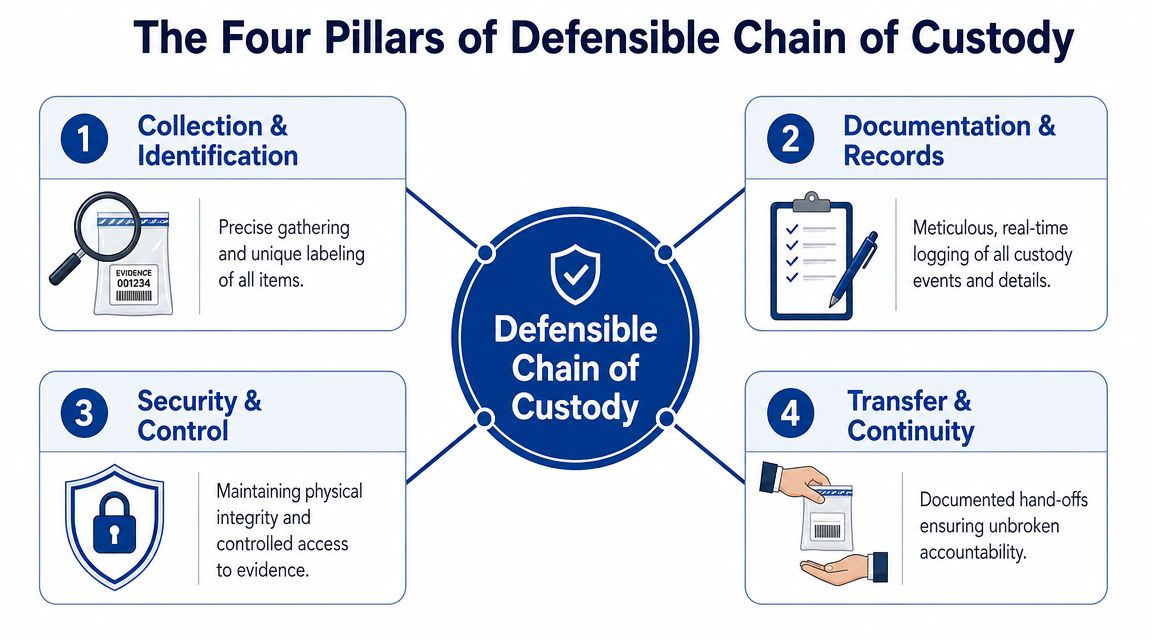
Roles and authorization
Custody starts with deciding who is allowed to do what.
At a scene with bodily fluids, possible evidence, and anxious stakeholders, informal help creates formal problems. A supervisor should control access. Designated technicians should collect, package, and label material. The receiving party should acknowledge each handoff. One person should own the records, even if several people contribute photos, manifests, and notes.
That structure protects more than admissibility. It protects the property owner from later disputes about who removed an item, who approved disposal, or why a restricted area was entered before release. In practice, speed matters. So does discipline. The best crews do not let urgency turn into freelancing.
Unbroken documentation
Every custody decision needs a record that can be followed from first contact to final outcome.
For biohazard remediation, that record often has to answer broader questions than a pure forensic chain would. Insurers may want proof of what was removed and why. Health and safety reviewers may want to confirm handling methods. Counsel may need to show that contaminated material was controlled from collection through transport and disposal. Industries that work under strict documentation rules follow the same principle, even when the materials differ, as shown in the ReachLex guide to drug precursor rules.
Three record points usually determine whether the file holds up under scrutiny:
| Record element | What it should show | Why it matters |
|---|---|---|
| Collection entry | Unique identifier, date, time, exact location, handler | Connects the item or waste stream to a specific room and event |
| Transfer entry | Sender, recipient, purpose, seal status, time | Shows continuity and reduces disputes during handoff |
| Final disposition | Lab transfer, secure storage, treatment, or destruction record | Proves the chain was closed and the material did not disappear into an undocumented process |
If a seal is replaced, the reason should be logged. If an item is repackaged for safety, that change should be logged. If access is granted after hours, that access should be logged.
Secure containment
Physical control matters as much as paperwork.
Containment has to match the material. Saturated textiles need leak-resistant packaging. Sharps need rigid puncture-resistant containers. Liquids, trace samples, and regulated waste each have different handling requirements, and crews need to apply them consistently under field pressure. The infection-control side of custody is inseparable from the legal side, especially where exposure risk is high. Property owners who want a clearer picture of that field discipline should review bloodborne pathogens and universal precautions.
There is a real trade-off here. In a perfect forensic setting, every item might be isolated with maximum preservation in mind. In active remediation, the team also has to stop exposure, protect occupants, and keep the site from becoming less safe while waiting on ideal conditions. Defensible custody means making those calls deliberately, then documenting why the packaging and handling method fit both the hazard and the circumstances.
Verified disposition
The chain ends only when the final destination is confirmed and supported by records.
That may mean release to law enforcement, delivery to a laboratory, placement into locked temporary storage, or disposal through an authorized medical or biohazard waste stream. Each path needs proof. A signed manifest, receipt, intake confirmation, destruction record, or release document closes the file. Without that last step, the property owner is left exposed to the hardest question in any review: what happened after the material left the room?
Strong custody work stays intact because every handoff is controlled, every container matches the hazard, and every endpoint is documented.
Mastering Documentation and Digital Logging
Most custody failures don't start with obvious tampering. They start with incomplete records.
A missing signature. A photo saved to the wrong phone. A file uploaded to a shared folder with no access log. A label that says "hallway sample" instead of identifying exactly what was collected and from where. Those aren't small errors when a claim, inquiry, or legal review begins.
What every custody record needs
Whether you're using a paper form, tablet-based platform, or evidence management system, the record has to identify the item and reconstruct its life cycle. NIST defines chain of custody around tracking handlers, dates and times, and the purpose of transfers, and modern guidance warns that missed logging and poor verification can damage admissibility and credibility, especially in mixed workflows, as noted in the NIST chain of custody glossary.
A practical custody log should include:
Checklist for a defensible entry
Unique item ID
Collection date and time
Exact collection location
Name of the person who collected it
Description of the item or material
Condition at collection
Packaging method and seal status
Each transfer with date, time, sender, recipient, and purpose
Storage location and access notes
Final disposition, including transfer, analysis, or disposal
The most reliable logs are boring to read. That's a good sign. It means they are precise, consistent, and free of guesswork.
Paper works. Hybrid often doesn't.
Paper logs still work well in the field when power, connectivity, or weather conditions make digital entry awkward. A technician can write, sign, and maintain physical control immediately. The weakness is transcription errors later, illegible handwriting, and forms that get separated from containers.
Digital systems solve some of that. They improve legibility, centralize records, and can document timestamps and controlled access. But digital convenience creates its own risk if the platform isn't managed carefully. Mixed paper-digital systems are where many teams get into trouble because one action happens in the room and another gets entered later, leaving a gap.
A useful perspective to consider is:
- Paper-first systems are durable in the moment but vulnerable during later consolidation.
- Digital-first systems are efficient when disciplined but fragile if users bypass the workflow.
- Hybrid systems are often the riskiest unless the organization has a strict reconciliation process.
For readers who deal with heavily documented compliance environments, the ReachLex guide to drug precursor rules is a helpful reminder that defensible handling systems live or die on record quality, not on intentions.
Phones and cloud folders need rules
Photos are often necessary. They document room condition, item placement, package seals, and transfer status. But a photo taken on a personal phone and later texted to a supervisor is not a sound custody workflow.
The same goes for cloud storage. If multiple people can upload, rename, download, or delete files without controlled logging, you don't have a secure evidence record. You have a convenience folder.
A stronger field policy usually answers these questions before a scene ever occurs:
- Which devices are approved: Company-managed devices are easier to control than personal phones.
- How files are named: Consistent naming prevents confusion during review.
- Who can access images and logs: Access should be limited and auditable.
- How transfers are documented: Uploading a file is still a custody event.
- How scene partners coordinate: Responders, coroners, and property representatives need aligned records, especially in multi-party incidents like those described in how 360 Hazardous works with first responders coroners property managers.
If the documentation process can't answer who did what, when, where, and what changed, it won't hold up well under scrutiny.
Secure Packaging Transport and Storage Protocols
Packaging, transport, and storage are where the physical side of custody either supports the paperwork or exposes it.
A strong log says an item was collected at a certain time and placed into secure containment. A strong field process ensures that statement is accurate in practice.
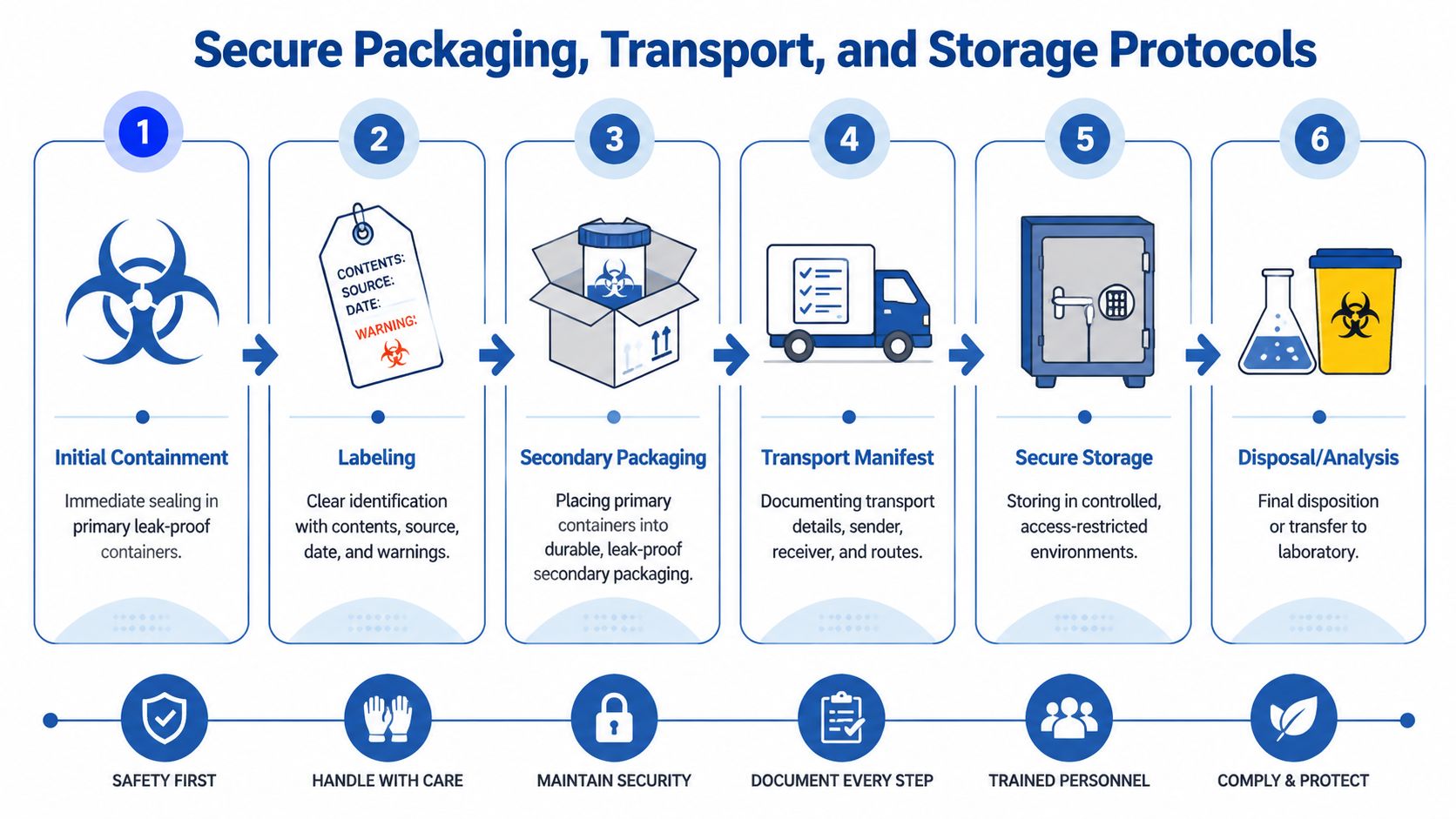
From scene collection to sealed containment
Take a common remediation example. A technician recovers contaminated absorbent material from a room after law enforcement has released the scene. The first decision is not paperwork. It's containment.
The material has to go into packaging appropriate for the hazard. That may involve a leak-resistant primary container, a sealed secondary barrier, warning labels, and clear item identification. If sharps are present, they move into puncture-resistant sharps containers, not improvised packaging. If biological samples must be preserved for transfer or review, storage conditions need to be maintained and documented.
The physical handling should mirror the written chain:
- Initial containment: Seal the material immediately in the correct primary container.
- Clear labeling: Identify contents, source area, date, and handler.
- Secondary protection: Use a second durable barrier when leakage or contamination spread is a risk.
- Seal integrity: If a package is opened later, the reason and resealing event must be logged.
Transport isn't just moving a box
Transport is where small organizations often make avoidable errors. A sealed package gets loaded into a general-use vehicle. No transport manifest is completed. The receiving party signs later from memory. That weakens the chain and can also create a safety problem.
A better transport process keeps the package, manifest, and receiving plan aligned. The driver or transferring technician knows what is being moved, where it is going, and who is authorized to receive it. If special handling is needed, including temperature-sensitive storage for biological material, that requirement must be built into the route and documented.
This walkthrough helps visualize what a disciplined handling sequence looks like in the field:
Storage and final handling
Storage needs to be restricted, logged, and appropriate to the material. Unsecured closets, open utility rooms, and shared maintenance areas are not defensible storage locations. People enter them for too many unrelated reasons, and access control disappears.
A sound storage setup usually includes:
| Storage control | What good practice looks like |
|---|---|
| Restricted access | Only authorized personnel can enter |
| Entry logging | Each access event is recorded |
| Material segregation | Biohazardous contents are separated from routine supplies |
| Condition control | Storage conditions match the material's preservation needs |
| Disposition tracking | Nothing sits without a documented next step |
For regulated removal and destruction, the waste side of the process matters as much as the evidence side. Property owners often underestimate how important disposal manifests and receiving records become later, especially in claims and compliance reviews. That is why biohazard waste disposal should never be treated as a generic hauling task.
A defensible custody trail is easiest to maintain when the package, the label, the manifest, and the storage log all tell the same story without contradiction.
Common Pitfalls That Compromise Custody
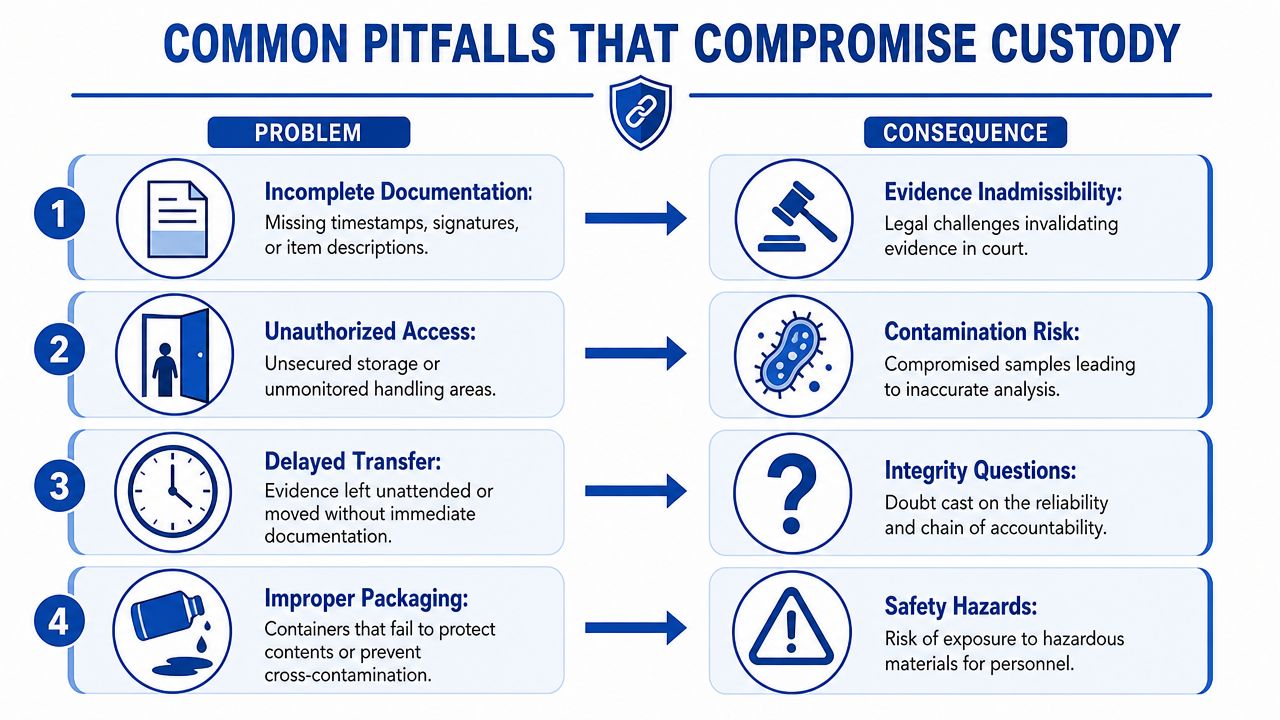
Most broken chains don't collapse because of sabotage. They collapse because someone assumed the process was simple.
That assumption causes trouble in every setting, but it is especially risky in biohazard remediation because errors can trigger both legal questions and exposure concerns. Below are the failures that show up again and again.
The unsigned handoff
A technician finishes late. Another employee takes the package for morning delivery. Nobody records the transfer at the time.
Now there is a gap. Even if both employees later agree on what happened, the record doesn't show continuous control. That can create doubts about where the item was, who accessed it, and whether conditions changed before delivery.
The vague label
The package says "sample from office" or "items from bedroom."
That description won't help much later. Which office? Which area of the room? Which item inside the bag? Vague labels invite confusion, especially when a scene produces multiple containers or when questions arise weeks later during an insurance or legal review.
A strong label should distinguish one item from another without requiring memory to fill in the blanks.
The broken seal with no explanation
Sometimes a package must be opened. That isn't automatically a problem. The problem is opening it without recording who broke the seal, why it was opened, when it happened, and how it was resealed.
When a seal changes and the paperwork doesn't, reviewers usually assume the documentation failed before they assume the opening was harmless.
The unsecured storage room
This scenario is more common than people think. Materials get set in a janitorial closet, back office, or garage "just temporarily." The room is accessible to cleaners, contractors, supervisors, or family members.
That doesn't just weaken custody. It creates an exposure risk. In trauma and contamination events, unauthorized access can spread contamination, damage personal property, or trigger privacy failures. That is one reason the risks of attempting to clean a crime scene myself are far broader than typically expected.
The timeline gap nobody notices until later
This is the quietest failure. Collection is documented. Final disposal is documented. But the interval between those two points is thin or missing.
When did the item leave the site? Where was it held? Who had interim access? Was refrigeration maintained for a biological sample? Were there any changes in packaging? If the file can't answer those questions, you are asking others to trust a process they cannot see.
Here is a simple test property owners can use when reviewing any custody packet:
- Can you identify every handler? If not, accountability is incomplete.
- Can you follow the timeline without guessing? If not, continuity is weak.
- Do the labels match the logs and manifests? If not, reconciliation failed.
- Is final disposition documented clearly? If not, the chain may still be open on paper.
- Would an outside reviewer understand the file without verbal explanation? If not, the documentation isn't strong enough.
People often think professionalism shows up in the cleanup itself. It does. But it also shows up in whether the records can withstand scrutiny after the room is restored.
Partnering with Professionals for Guaranteed Compliance
Chain of custody procedures only work when documentation, containment, transfer, storage, and disposal all operate as one disciplined system. If one part slips, the rest of the record becomes harder to defend.
That matters because biohazard scenes rarely involve a single audience. A property owner may need to satisfy law enforcement, insurance carriers, internal risk teams, public health expectations, and family or tenant concerns at the same time. Each group is asking a different question, but all of them depend on the same thing. A trustworthy record of what happened.
What professional oversight changes
Trained teams don't just remove contamination. They control scene access, keep handling limited to authorized personnel, maintain item and waste tracking, and preserve the records needed after the immediate crisis passes. They also understand the practical balance between preserving what should remain untouched and moving quickly on what must be contained for safety.
That balance is difficult for untrained staff or distressed family members to manage correctly. Even well-intended actions can create new liability, especially when digital photos, temporary storage, or disposal decisions are made without a formal process.
For property owners, the main benefit of expert help is peace of mind. You're not trying to learn a high-stakes legal and safety process while standing in the middle of a traumatic scene. You're relying on people who already know how to protect the site, the occupants, the documentation, and your liability position. That is why why hiring certified biohazard professionals matters for your safety is not just a service question. It's a risk-management decision.
When the scene is sensitive, time matters. So does doing it right the first time.
If you need calm, compliant help after a traumatic event, 360 Hazardous Cleanup provides around-the-clock biohazard remediation with the documentation, discretion, and professional handling these situations demand. Their team can help property owners, facility managers, and families protect health, reduce liability, and move forward with confidence.