A search incident to arrest is a well-established exception to the Fourth Amendment's warrant requirement that allows police to search a person and the area within that person's immediate reach after a lawful arrest to protect officer safety and prevent the destruction of evidence. It has been part of American law since 1914, and it remains one of the most commonly used warrant exceptions in everyday policing.
If you're reading this because an arrest just happened at your home, rental property, warehouse, clinic, or job site, the legal question usually turns practical very quickly. Can officers search the room? The car? A bag on the floor? And once the police are done, when is the scene safe to enter, clean, or reopen?
Those questions matter because a search changes the condition of a scene. Items get moved. Containers get opened. Evidence may be collected. In trauma scenes or violent incidents, there may also be bloodborne pathogen risks, damaged materials, and contamination concerns that remain long after the arrest itself.
An Introduction to Search Incident to Arrest
When police arrest someone on your property, they don't always need a separate warrant to conduct a limited search right then and there. That authority is called search incident to arrest, often shortened to SITA.
In plain language, it means officers can search the arrestee and the area the arrestee could immediately reach at the time of arrest. The legal idea sounds narrow because it is supposed to be narrow. But in real-world settings, especially homes, vehicles, offices, and industrial spaces, people often struggle to tell where that line is.
This doctrine isn't a rare technicality. According to the Ninth Circuit jury instructions discussion of search incident doctrine, searches incident to arrest account for approximately 80 to 90% of all warrantless police searches, making it the most frequently invoked warrant exception in U.S. criminal cases. The same source notes that in biohazard contexts, these searches often uncover evidence at crime scenes, creating the need for remediation under OSHA 29 CFR 1910.1030 in tens of thousands of U.S. trauma scenes yearly.
For property owners and first responders, that frequency matters. The more often this doctrine appears, the more likely it is to affect a rental turnover, a workplace incident response, a post-arrest building closure, or the handoff between law enforcement and a crime scene cleanup team.
Why people get confused
Most confusion comes from three assumptions that aren't always true:
- “An arrest means police can search everything nearby.” They can't.
- “If it happened on my property, I can start cleaning once the person is gone.” Not necessarily.
- “If officers touched it, it must be legally searchable.” That also isn't necessarily true.
Practical rule: An arrest can trigger a search, but it doesn't erase constitutional limits or scene-safety obligations.
Understanding what is search incident to arrest helps you protect two things at once. The legal integrity of the case, and the physical safety of everyone who enters after law enforcement leaves.
The Fourth Amendment and Warrant Exceptions
The Fourth Amendment protects people against unreasonable searches and seizures. The basic rule is simple. Police usually need a warrant before they search private areas.
That doesn't mean every search requires a judge's approval in advance. Courts have recognized several exceptions for situations where waiting could create immediate problems. Search incident to arrest is one of those exceptions, but it's justified by specific concerns, not by convenience.
Why this exception exists
The Supreme Court tied this doctrine to two practical risks:
Officer safety
An arrestee may have a weapon on their body or within reach.Evidence preservation
An arrestee may be able to hide, destroy, or discard evidence in the moments surrounding the arrest.
Those two reasons are the heart of the doctrine. If neither rationale fits the facts, the legal basis for the search gets weaker.
A useful overview of how these doctrines fit into everyday criminal procedure appears in Brian Hansford Law's guide to common search warrant exceptions in GA. It helps non-lawyers see that search incident to arrest is only one exception among several, and each one has its own rules.
Why the distinction matters after the arrest
For scene coordination, the constitutional rule isn't abstract. It affects who can enter, what can be touched, and when remediation can start. If officers are still lawfully processing the immediate arrest area, outside personnel usually need to wait. If the search has exceeded its lawful scope, that can trigger evidence challenges later.
Property owners and responders often benefit from understanding how legal and operational roles separate during this stage. A practical example of that handoff appears in this overview of how cleanup teams collaborate with law enforcement and first responders.
The warrant rule protects privacy. The exception exists to manage immediate danger and fragile evidence. It doesn't create open-ended authority to search an entire property.
That last point is where many disputes begin. A lawful arrest can justify a limited search. It doesn't automatically justify a broad one.
Defining the Scope of a Lawful Search
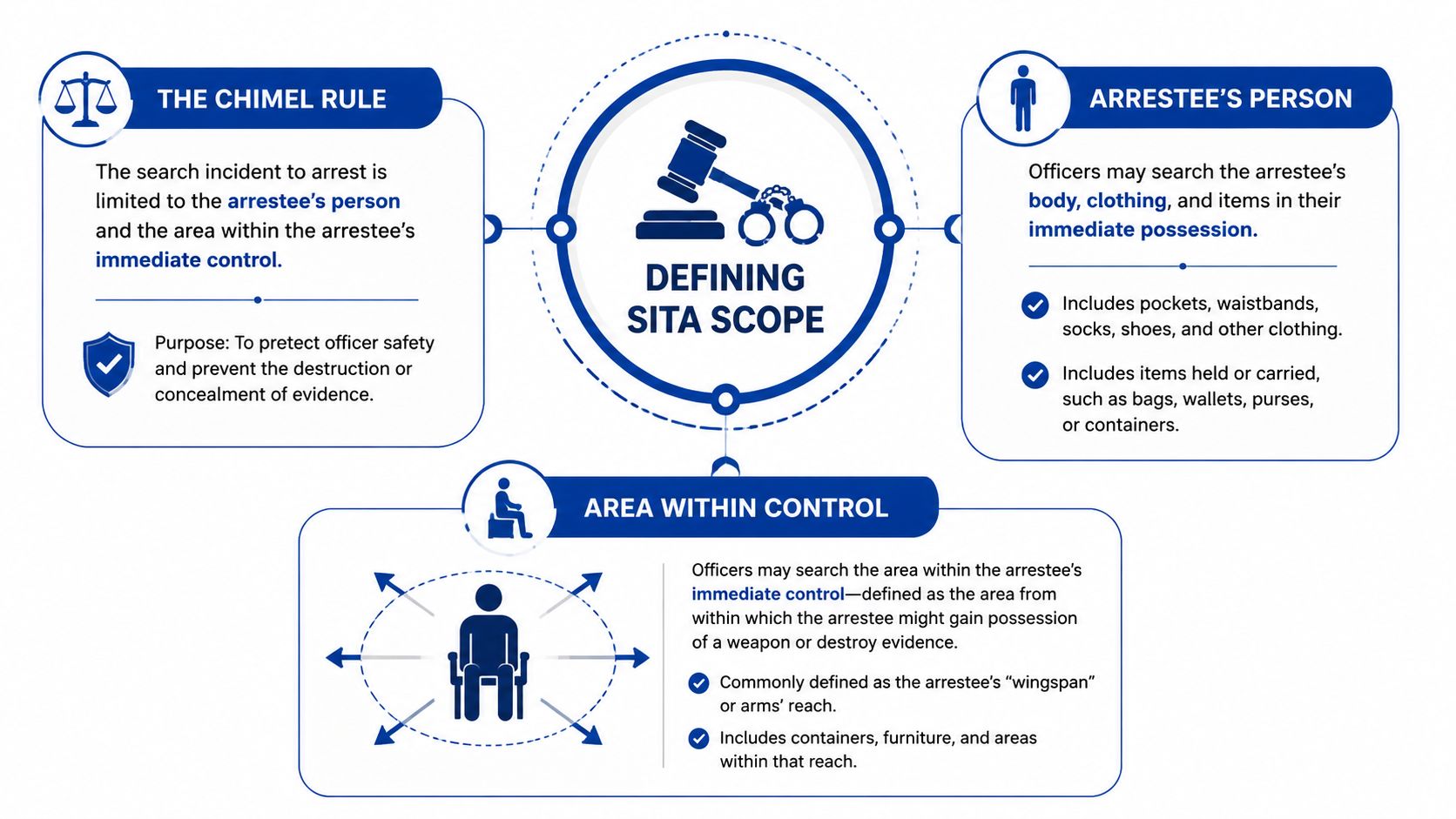
The most important rule for understanding what is search incident to arrest comes from Chimel v. California. Lawyers often call it the immediate control rule. Many officers, trainers, and judges explain it more memorably as the wingspan or grab area rule.
That phrase helps because it asks a practical question. What could the arrestee realistically reach at the time of arrest?
What usually falls inside the lawful area
A valid search incident to arrest generally includes the arrestee's person and the space close enough for immediate access. According to the Wikipedia summary of searches incident to a lawful arrest, the search must occur “roughly contemporaneously with the arrest” and is limited to the arrestee's person and the “immediate control” zone where they could access weapons or destroy evidence.
In everyday terms, that can include:
- Clothing and pockets if officers are searching the person directly after arrest
- A purse, bag, or item being carried at the time of arrest
- A nearby surface or seat area if the person could have reached it immediately
- Containers within arm's reach if they could hide a weapon or evidence
What usually falls outside the lawful area
The same source notes that a vehicle trunk search would likely be unreasonable under this doctrine, and so would a search conducted 30 minutes after an arrestee is secured in a patrol car. That gives readers a useful boundary. Search incident authority is tied to immediacy, not to a general desire to keep looking.
Here's a simple comparison:
| Area or item | More likely lawful under SITA | More likely not lawful under SITA |
|---|---|---|
| Person's pockets | Yes | |
| Bag in hand or within arm's reach | Yes | |
| Passenger-seat area within reach at arrest | Often | |
| Locked trunk | Yes | |
| Another bedroom or office down the hall | Yes | |
| Search long after the person is secured | Yes |
A state-specific explainer on understanding Minnesota police search authority is also helpful for readers trying to compare how these general constitutional rules show up in common vehicle-stop scenarios.
A short visual explanation can make this easier to picture:
Why timing matters as much as distance
People often focus on space and forget timing. But timing is part of the doctrine. The search has to be tied closely enough to the arrest that the officer-safety and evidence-preservation reasons still make sense.
If the arrestee is handcuffed, removed, and secured, the argument for searching broader areas starts to weaken fast. That's why a lawful search incident to arrest is not just about where the item was. It's also about when the search happened.
If the person can't reach the item anymore, officers usually need some legal basis other than search incident to arrest.
For families and managers, this matters after the police leave. The lawful search area may be relatively small, but the cleanup area may be larger because contamination doesn't follow constitutional boundaries. If you're trying to understand what comes after that law-enforcement window closes, this discussion of life after the police leave a scene can help frame the next steps.
Key Legal Limits and Landmark Court Cases
The law of search incident to arrest didn't appear all at once. It developed through court decisions, and those cases matter because each one drew or redrew the line on what officers may do without a warrant.

Weeks, Chimel, and the narrowing of broad searches
The doctrine was established in Weeks v. United States (1914). Later cases shaped its limits. Chimel v. California (1969) rejected the idea that an arrest inside a home automatically justified a broad search of the residence. Instead, it confined the search to the person and the area of immediate control.
That shift mattered because earlier cases had allowed far broader rummaging. Chimel pulled the doctrine back toward its stated justifications. Safety and preservation of evidence. Not convenience. Not curiosity.
Vehicles after Arizona v. Gant
Vehicle searches caused some of the biggest confusion for years. Before Arizona v. Gant (2009), New York v. Belton (1981) had been read as a broad rule allowing officers to search much of a car after arresting a recent occupant. According to the Electronic Frontier Foundation's review of search incident to arrest doctrine, Gant significantly narrowed that authority.
Under Gant, officers may search a vehicle incident to arrest only if:
- The arrestee is within reaching distance of the passenger compartment at the time of the search, or
- It is reasonable to believe the vehicle contains evidence of the offense of arrest
The EFF summary also notes that some circuits reported a 30 to 40% drop in upheld vehicle incident searches after Gant. That tells you something important. Courts did not treat Gant as a minor clarification. They treated it as a meaningful limit.
A simple before-and-after comparison
| Rule | Practical effect |
|---|---|
| Belton | Broad authority to search vehicle interiors after arrest of a recent occupant |
| Gant | Search allowed only if access remains possible or evidence of the arrest offense may be in the vehicle |
This is one area where property owners and responders can get tripped up. People see an arrest near a vehicle and assume the whole vehicle becomes searchable. That isn't the current rule.
Case takeaway: A lawful arrest near a car doesn't automatically open the whole car to a warrantless search.
What about cell phones
Modern readers usually ask the next obvious question. What about a phone found in the person's pocket or hand?
As a matter of current constitutional law, courts treat digital data differently from a physical container because of the privacy interests involved. In practice, officers may seize the phone during an arrest, but the digital contents generally require a warrant to search. That distinction is critical for facility incidents involving employee devices, hospital settings, or workplace investigations where phones may contain photos, messages, access logs, or operational records.
Why these cases matter to scene management
For non-lawyers, landmark cases are useful because they show where overreach often happens:
- Homes can't be broadly searched just because an arrest occurred inside.
- Vehicles are no longer covered by the old automatic-search assumption.
- Digital devices raise separate privacy issues.
That matters in post-incident coordination. If a search is later challenged, questions about movement of items, access to rooms, and handling of contaminated materials can become part of the factual record. Property stakeholders should preserve records of who entered, what areas remained restricted, and when remediation began. This overview of laws and regulations governing crime scene cleanup gives useful context on that operational side.
Implications for Property Owners and Scene Safety
Once the arrest and immediate police activity end, the property owner's problem often begins. The legal event may be over, but the site may still contain blood, bodily fluids, drug residue, damaged furnishings, sharps, chemicals, fingerprint dust, broken glass, or disturbed personal items.
Why commercial properties face special complications
In houses and apartments, people usually understand the rough idea of a room-based search. In warehouses, plants, clinics, and maintenance yards, the boundaries are murkier. The Justia discussion of search incident to arrest and commercial-property questions notes that in commercial properties the “immediate control” area can be ambiguous, especially around large machinery, lockers, and industrial work zones.
That source also describes a 2025 report of a 22% increase in workplace arrests involving biohazards and notes that delays in securing and remediating these scenes can cost businesses over $10,000 per day in operational losses. Even if you set the legal issue aside, those numbers explain why facility managers need clear entry protocols and fast decisions once police release a scene.
What property owners should do after police activity
The safest response is usually structured, not improvised.
Confirm release status
Don't assume a scene is cleared because the arrest is over. Ask whether law enforcement has released the space for reentry or remediation.Limit access
Keep employees, tenants, residents, and vendors out of the affected area until hazards and evidence concerns are addressed.Document conditions carefully
Note visible contamination, damaged barriers, and the rooms or zones that were restricted. Avoid moving items unless directed by the proper authority.Treat biohazards as regulated waste issues
Blood and bodily fluids can trigger OSHA obligations and safe-handling requirements. Standard janitorial work is not the same as biohazard remediation.
Why improper cleanup creates legal and safety risk
When untrained staff clean too early, they can do two kinds of damage at once. They can destroy or disturb material that may still matter to the case, and they can expose themselves to pathogens or hazardous substances.
A scene can be legally released yet still be physically unsafe.
That distinction is one of the biggest misunderstandings I see in liaison work. Law enforcement release answers one question. It does not answer all of the health, waste-handling, restoration, and liability questions that follow.
Property owners who need to understand those obligations in practical terms should review guidance on biohazard cleanup and legal duties after contamination. The short version is simple. If the event left hazardous biological contamination behind, regular maintenance staff shouldn't be asked to absorb that risk.
Frequently Asked Questions About Your Rights and Property
Can police search my whole house because someone was arrested there
Usually, no. Search incident to arrest is limited. It applies to a custodial arrest, not just a stop or citation, and the search is constrained to the person and containers within arm's reach where weapons or evidence could be concealed, as explained in the VCCCD training material on searches incident to arrest. A general search of the whole house usually requires some other legal basis, such as a warrant or a different exception.
Does a traffic citation allow a search incident to arrest
Not by itself. The doctrine requires a custodial arrest, meaning the person is taken into official custody, not merely cited and released.
Can officers use a minor arrest as an excuse to look for unrelated contraband
They aren't supposed to. The same VCCCD material states that sham arrests used as a pretext to search for unrelated contraband are illegal, and evidence found that way would be inadmissible.
If a search was illegal, what happens to the evidence
In general, illegally obtained evidence may be challenged and may be excluded from court. For property owners, the practical lesson is different. Don't try to sort out legality by reentering, cleaning, or moving things on your own. Preserve the condition of the area as best you can until the proper handoff occurs.
What should I do if an arrest and search happened on my property
Use a calm checklist:
- Ask whether the scene is released
- Keep others out of the affected area
- Avoid touching items that may be evidence or contaminated
- Record what areas were blocked off
- Arrange professional assessment if blood, bodily fluids, drug residue, or other hazards are present
Am I responsible for making the property safe afterward
Yes, in practical terms. Once authorities release the scene, the owner, manager, or responsible party usually has to address any remaining contamination, access restrictions, and habitability or workplace-safety concerns. That responsibility shouldn't be handed to untrained staff or family members.
If the arrest is over but contamination remains, your next job isn't investigation. It's safe, compliant recovery.
If you're dealing with the aftermath of an arrest, trauma event, unattended death, or other contaminated scene, 360 Hazardous Cleanup provides 24/7 professional biohazard remediation with a trauma-informed, compliance-focused approach. Their team helps property owners, managers, families, insurers, and first responders move from scene restriction to safe recovery with discretion, proper documentation, and regulated handling of hazardous materials.