When looking into what exhumation is, it's usually for more than casual interest. A family may be considering moving a loved one closer to home. A cemetery or property authority may have contacted you about a formal process. In some cases, an investigator, coroner, or court may be involved. Whatever brought you here, it's normal to feel unsettled.
Exhumation means the careful and lawful removal of human remains from a grave, crypt, niche, or other place of burial. That simple definition helps at first, but it leaves out the part that most people don't expect. Exhumation isn't only a legal matter. It's also a sensitive site operation with health, documentation, and handling risks that have to be managed correctly from the first phone call to the final disposition of the remains.
Families often get stuck on the same questions. Is this allowed? Who has authority? What happens at the gravesite? Can there still be hazards after burial? Who is responsible for safety, privacy, and cleanup? Those are the right questions to ask.
What helps most is understanding that exhumation is a structured process. People don't decide to open a burial site and proceed without authorization. The work typically involves permits, cemetery coordination, official oversight, transportation planning, and careful handling of remains and surrounding materials. It also requires respect for grieving families and for the dignity of the deceased.
Introduction A Guide for Difficult Decisions
Exhumation is often encountered during difficult circumstances. A parent dies in one state, but years later the family has moved. A spouse wants to be buried together with their partner. A coroner needs answers that weren't available at the time of death. Sometimes the issue isn't family-driven at all. It may involve a legal investigation, a cemetery redevelopment project, or the need to identify remains.
That mix of grief, paperwork, and uncertainty can make the subject feel overwhelming. People often expect a straightforward answer and then discover a process that touches law, public health, forensic practice, and family relationships all at once.
A plain-language definition helps. Exhumation is the formal and respectful removal of human remains from their place of burial. It may be followed by examination, identification, transfer, reburial, or cremation, depending on the reason the exhumation was approved.
What confuses many readers is that exhumation sounds like a single act. In reality, it's a chain of decisions and responsibilities. Someone must have authority to request it. A regulator, court, coroner, or cemetery authority may need to approve it. Professionals must manage the physical recovery safely. Records have to be accurate. If the matter has legal significance, evidence handling has to stand up under scrutiny.
Exhumation is one of those procedures where the quiet details matter most. Consent, documentation, site control, and respectful handling aren't extras. They're the foundation of doing it properly.
There's also a human side that shouldn't be lost in technical language. Families may relive grief during the process. Property owners may worry about liability. Officials may need the work completed carefully but without drawing public attention. All of that is part of the reality.
When people ask what exhumation is, they're usually also asking whether it can be done safely, legally, and respectfully. The answer is yes, but only when the process is treated with the seriousness it deserves.
Understanding Exhumation as a Regulated Process
People sometimes picture exhumation as little more than opening a grave. That's the part you can see, but it's not the part that defines the process. In practice, exhumation is a regulated recovery event.
According to an Othram explainer on forensic exhumation, exhumation is not just "digging up a body." It usually requires formal authorization, and the recovery team must preserve chain of custody, document the burial context, and plan for a post-recovery report and possible reinterment because evidentiary value depends on the remains and burial environment being handled in a legally defensible way.
Why the process is so tightly controlled
A useful way to think about exhumation is as a reverse funeral. A funeral brings a person to a place of rest with ceremony, records, transportation, and designated people in charge. Exhumation works in the opposite direction, but it still demands planning, authority, and dignity.
Several concerns drive that control:
- Respect for the deceased: Burial sites aren't disturbed casually. The law and cemetery procedures exist in part to protect dignity.
- Protection of evidence: If the exhumation has forensic value, even small mistakes in handling can affect later findings.
- Public health safeguards: Soil, containers, remains, and surrounding materials may need controlled handling.
- Accurate records: Officials need to know who authorized the work, who attended, what was recovered, and where the remains went next.
These principles are also consistent with broader biohazard remediation laws and regulations, where documentation and compliant handling are inseparable from safety.
What happens at the site matters as much as the paperwork
When families hear "permit approved," they sometimes assume the hard part is over. Legally, that's only the beginning of the physical operation. The recovery team still has to approach the site in a controlled way.
That usually means attention to:
| Site concern | Why it matters |
|---|---|
| Burial context | The position of remains, container condition, and surrounding soil may be important |
| Chain of custody | If legal questions exist, every transfer must be documented |
| Controlled access | Unnecessary foot traffic can affect safety, privacy, and evidence integrity |
| Post-recovery planning | The process isn't complete until transport, reporting, and final disposition are arranged |
Practical rule: If an exhumation can't be documented and defended afterward, it wasn't managed properly in the first place.
This is why unauthorized disturbance of a burial site is entirely different from exhumation. One is a violation. The other is a supervised legal procedure.
Common Reasons for Exhuming a Body
The reason for an exhumation shapes almost everything that follows. It affects who can request it, which authority must approve it, how the site is managed, and what happens after the remains are recovered.
Some requests come from families. Others come from courts, coroners, or public authorities. Many people are surprised to learn that an exhumation can move forward even when the family didn't initiate it.

Family and personal reasons
These are the situations commonly thought of first. A family may want to relocate a loved one to a different cemetery, reunite relatives in a family plot, or carry out final wishes that couldn't be fulfilled at the time of burial.
Common examples include:
- Relocation after a move: Families often want a burial place closer to where surviving relatives now live.
- Reuniting family members: A spouse may wish to be buried alongside a partner in one location.
- Change in memorial plans: Some families later decide on cremation or another form of final placement, if the law allows it.
These cases are highly personal, but they still require formal approval and professional coordination.
Legal and forensic reasons
Some exhumations happen because unanswered questions remain. The purpose may be to identify remains, re-examine the circumstances of a death, or recover evidence for a legal matter.
An EBSCO overview of exhumation in forensic investigations notes that exhumation is often used beyond family requests, including legal inquiry, suspicious deaths, concealed burials, and even mass graves, where soil, artifacts, and insects can help determine manner and time since death. The same source also notes that authorities may order exhumations for scientific investigations or the redevelopment of closed cemeteries.
That answers a question families often ask: Why would a body be exhumed if the family didn't request it? Because in some situations, the law, a coroner, or another authority has a duty to investigate, identify, or manage the burial site for broader public reasons.
Public, civic, and site-management reasons
There are also cases where the issue is neither family preference nor criminal inquiry. A cemetery may be closing. A redevelopment project may affect old burial grounds. Historical or humanitarian work may require formal recovery and identification.
These cases can involve several overlapping interests at once:
- Public administration: A cemetery authority or municipality may need to address land use or closed cemetery conditions.
- Scientific or historical work: Recovery may support identification or documentation.
- Property and safety concerns: Burials can't be moved informally because the site itself may become part of the official record.
A short comparison can help:
| Reason category | Typical driver | Main concern |
|---|---|---|
| Family request | Relocation or reburial | Consent, dignity, logistics |
| Forensic inquiry | Investigation or identification | Evidence, documentation, chain of custody |
| Public or civic need | Redevelopment or official action | Compliance, recordkeeping, site management |
People often begin by asking what exhumation is. The more practical question is often this: Why is this exhumation happening? Once that is clear, the rest of the process becomes easier to understand.
The Legal Path Permits and Authorities
The legal side of exhumation is usually the most intimidating part for families and property representatives. That's understandable. The process involves multiple decision-makers, and those decision-makers may come from different systems such as cemetery management, public health, vital records, law enforcement, or the courts.
The key point is simple. No lawful exhumation starts with excavation. It starts with authority.
Who may authorize an exhumation
The answer depends on jurisdiction and on the reason for the request. In broad terms, authorization may come from:
- A court, when there is a dispute or legal proceeding
- A coroner or medical examiner, when a death investigation requires it
- A health authority, when public regulation requires formal approval
- The lawful next of kin or person with legal authority, when the request is family-driven and local law permits it
- The cemetery or burial authority, which may have its own approval requirements before any work is scheduled
For readers trying to understand state-level variation, a practical starting point is this guide to Texas burial laws, which shows how burial and disposition rules can differ by jurisdiction.
What official oversight can look like
A clear example comes from New South Wales, Australia. The New South Wales Health guidance on exhumation explains that under the Public Health Regulation 2022, the Secretary may approve exhumations, that approval is valid for three months unless a different period is specified, exhumation may also be ordered by the Coroner, and an Authorised Officer or Ministry of Health staff member must be present during the procedure.
That example matters because it shows how exhumation is treated in modern practice. It's not a private arrangement conducted solely between a family and a cemetery. It is often a matter of formal public oversight.
Before site work begins, teams commonly have to coordinate with the same kinds of partners described in work with first responders, coroners, and property managers, where roles and handoffs must be clear before anyone enters a sensitive scene.
Here is the embedded video resource referenced for this topic:
What documents and coordination usually involve
Requirements vary, but the legal path often includes several layers at once rather than a single form.
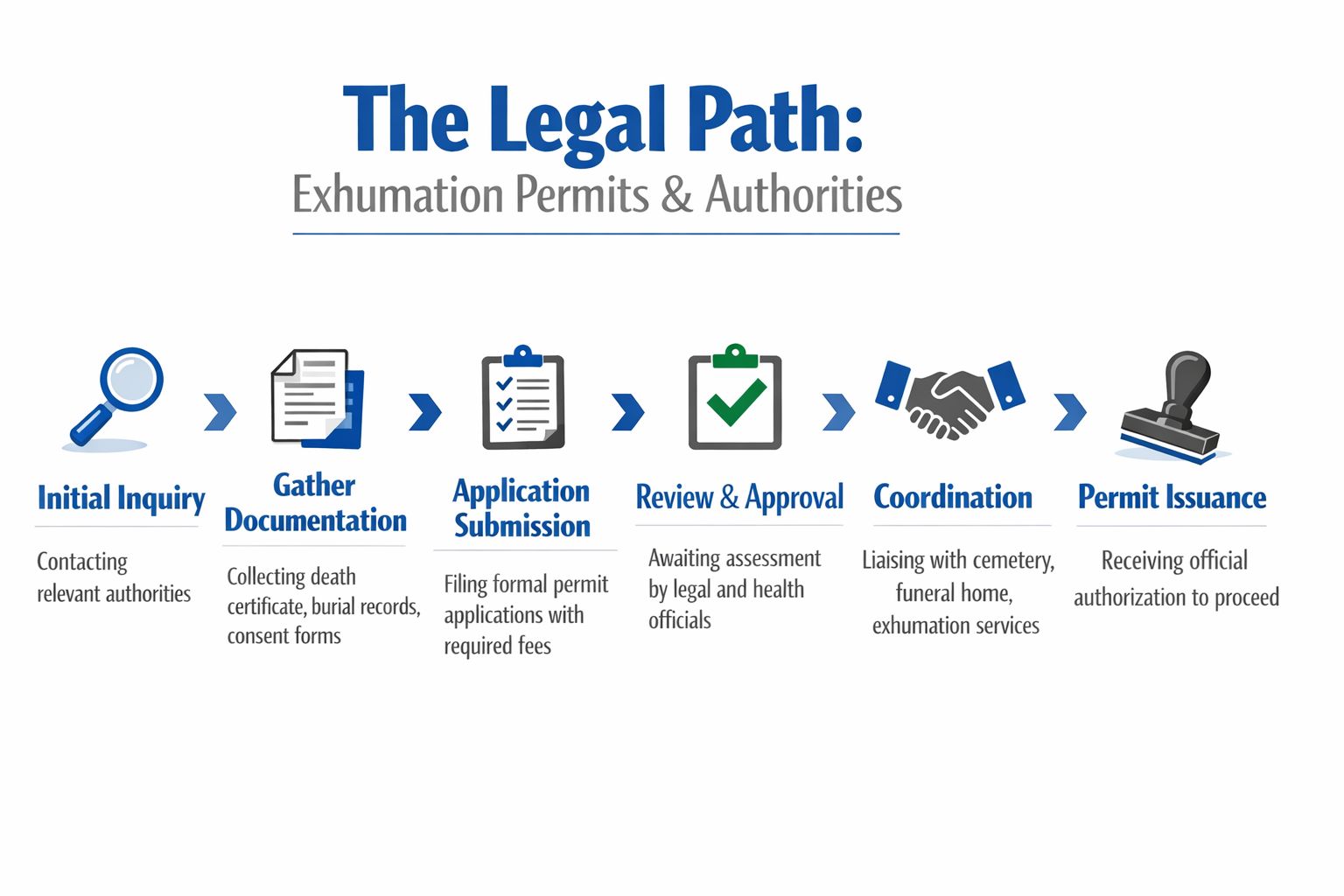
A typical sequence looks like this:
- Confirm legal standing so the correct person or authority makes the request.
- Locate burial records and cemetery documentation.
- Apply for permits or formal approval from the relevant health or civil authority.
- Coordinate scheduling with cemetery management and any required officials.
- Arrange transportation and final disposition so there is a lawful destination after recovery.
A permit doesn't just allow the remains to be removed. It creates the legal trail showing who approved the action, under what authority, and what must happen next.
People often hope there is one office that handles all of this. Usually there isn't. Exhumation succeeds when the legal, operational, and site-safety pieces are coordinated together.
Health and Biohazard Safety The Unseen Risks
This is the part many people don't think about until very late. Exhumation is not only a legal and emotional event. It is also a biohazard management event.
Buried remains change over time, but they don't become irrelevant to safety. Soil may be affected. Burial containers may have deteriorated. Materials in and around the grave may require controlled handling. If there is any forensic interest, the same site that presents health concerns may also contain important evidence.
Why exhumed remains still require expert handling
A peer-reviewed 2023 medical review on exhumation toxicology notes that even in cases with a large postmortem interval, specimens such as blood or plasma, hair, liver, and brain may still be used for analysis, and common analytical methods include TLC, CE, GC, HPLC, and UHPLC. The same review emphasizes that postmortem redistribution of drugs and poisons increases with time after death, making interpretation more difficult as decomposition progresses, and it discusses a real case involving toxicological issues after exhumation more than two years after death.
For a family, the scientific detail may feel far removed from the immediate concern. The practical takeaway is straightforward: remains are not inert, and neither is the burial environment. That means skilled handling is necessary for both safety and evidentiary reasons.
What the site team has to control
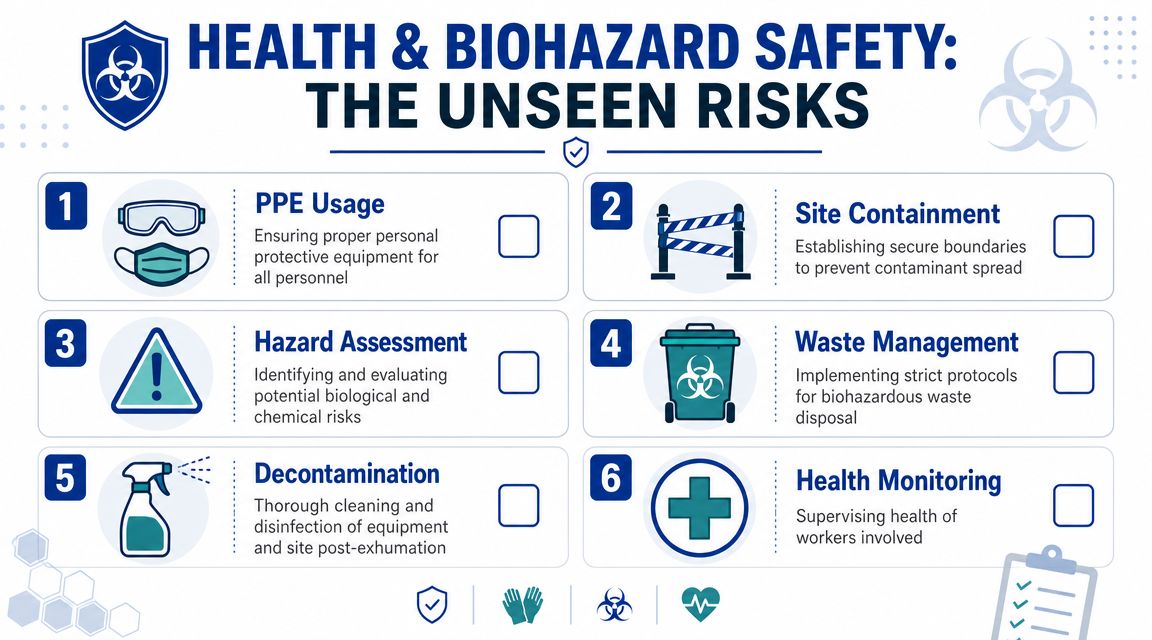
At ground level, safety isn't just about wearing gloves. It involves a layered approach to exposure control and contamination prevention.
That often includes:
- PPE selection: Gloves, respiratory protection, eye protection, protective suits, and footwear have to match site conditions and task exposure. General personal protective equipment guidelines can help readers understand the purpose of each layer, but exhumation work requires job-specific decisions.
- Controlled boundaries: The work area should be limited to authorized personnel so there is less risk of cross-contamination and less chance of disrupting evidence or privacy.
- Handling of affected materials: Soil, damaged containers, absorbent materials, and disposable protective items may require regulated disposal pathways.
- Decontamination procedures: Equipment and work surfaces need a clear entry, exit, and cleaning process.
A related concern is pathogen awareness. Teams dealing with bodily fluids and contaminated environments need to understand common bloodborne pathogens and the controls used to reduce exposure risk during recovery and cleanup work.
Why this is never a DIY task
Exhumation can tempt people into focusing only on the visible objective. Open the grave, move the remains, close the grave. That mindset misses the operational reality.
A professionally managed exhumation has to answer questions like these:
| Safety issue | Why professional oversight matters |
|---|---|
| Potential biological exposure | Workers need training, PPE, and controlled procedures |
| Contaminated surrounding material | Soil and burial contents may require special handling |
| Cross-contamination risk | Tools, clothing, vehicles, and pathways can spread material if unmanaged |
| Public exposure and privacy | The site must be secured from unnecessary access |
| Post-operation cleanup | Equipment and affected surfaces need proper decontamination |
Field reality: The grave isn't the only concern. Every person, tool, container, and transport surface that enters that space becomes part of the safety plan.
Families shouldn't have to manage these issues themselves. Neither should cemetery staff who aren't equipped for biohazard control. When exhumation is handled correctly, people protect the deceased, the living, and the integrity of the process at the same time.
Navigating Cultural and Ethical Considerations
Even when an exhumation is legally approved and operationally sound, it can still go badly if the human side is ignored. Burial carries religious meaning, family memory, and personal identity. Disturbing a final resting place can feel painful even when everyone agrees it's necessary.
Different communities approach exhumation in different ways. Some families want clergy present. Some want a very small circle of attendees. Some don't want to witness the recovery at all but still want assurance that it will be done with dignity. Others need detailed communication because uncertainty is harder for them than the facts.

Respect means more than politeness
Ethical handling begins long before the site is opened. It starts with asking the right questions.
For example:
- Are there religious practices that affect timing or handling?
- Who in the family needs updates, and who should be shielded from graphic detail?
- Will the remains be reburied immediately, examined, or transported elsewhere?
- How can privacy be preserved at the cemetery or property?
These aren't soft concerns. They shape how professionals schedule, communicate, secure the site, and interact with relatives and officials.
Families remember tone as much as procedure. A technically correct process can still deepen harm if the people involved aren't respectful.
Privacy and discretion matter
Exhumation can attract unwanted attention if it isn't managed discreetly. Neighbors may notice activity. Cemetery visitors may ask questions. Staff may unintentionally share information too broadly. In high-stress circumstances, privacy becomes part of compassionate care.
This is why ethical practice includes controlled communication, limited site access, and discretion in transportation and scene management. It reflects the same values discussed in the ethics of biohazard cleanup and compassionate professionalism, where dignity isn't treated as separate from technical work.
When families disagree
Ethical complexity often increases when relatives don't share the same view. One person may see exhumation as an act of care. Another may see it as a violation of rest. Professionals can't solve family grief, but they can avoid making it worse.
Good practice usually looks like this:
- Clear authority: Follow the legally recognized decision-maker and documented approvals.
- Measured communication: Explain what will happen without using blunt or sensational language.
- Consistent respect: Refer to the deceased as a person, not as a problem to be managed.
- Boundary discipline: Keep unnecessary spectators and unauthorized parties away from the operation.
Exhumation is one of the clearest examples of how professionalism and empathy have to work together. One without the other isn't enough.
Practical Next Steps for Families and Professionals
If you're facing a possible exhumation, don't try to solve everything in one conversation. Start with the decision path, then build the operational plan around it.
A manageable sequence usually looks like this:
- Speak with the key family members or decision-makers first. Clarify the reason for the request and identify whether there is agreement or conflict.
- Contact the cemetery, funeral director, legal counsel, or relevant authority. The right first call depends on whether the matter is personal, forensic, or administrative.
- Gather records early. Burial records, death documentation, plot information, and any prior written instructions can prevent delays later.
- Ask direct questions about site safety and handling. Don't assume the physical recovery is routine just because the paperwork seems straightforward.
- Prepare for emotional strain. Even when the decision is right, the process can reopen grief.
- Use experienced funeral coordination when final disposition is involved. Families often benefit from guidance from professionals such as funeral directors familiar with complex handling and transport.
A final point matters most. Exhumation is complex for good reason. The layers of authority, safety controls, and documentation are there to protect everyone involved and to preserve dignity from start to finish.
If you're navigating this now, slow the process down enough to make informed decisions. The right professionals can manage the technical, legal, and safety details so families and officials can focus on the decisions only they can make.
If you need discreet, compliant guidance around a biohazard-sensitive recovery, 360 Hazardous Cleanup provides trauma-informed support for families, property owners, facilities, and officials dealing with complex scenes. Their team helps manage high-risk environments with respect, privacy, and strict attention to safe handling standards.