
Most trauma scene cleanup technicians earn about $40,000 to $80,000 per year, and the U.S. Bureau of Labor Statistics reported a median annual wage of $43,900 for hazardous materials removal workers, the broader category that includes crime scene and biohazard cleanup. That range is wide because this work is not routine labor. Pay rises with specialization, overtime, on-call availability, and the ability to handle difficult scenes safely and compassionately.
If you're reading this, you're probably in one of two places. You're either considering whether this field can support a real career, or you're trying to understand why trained trauma cleanup professionals are compensated the way they are. Both questions deserve a direct answer.
A trauma scene cleanup salary reflects much more than mopping, hauling, or disinfecting. Technicians step into spaces where bloodborne pathogen exposure, regulatory risk, family grief, and time pressure all exist at once. They need technical discipline, emotional steadiness, and the judgment to know when material can be restored and when it must be removed, packaged, documented, and disposed of under the proper protocols.
That's why the compensation conversation has to stay grounded in responsibility. The people who do this work aren't only cleaning a scene. They're protecting occupants, reducing liability, supporting families in crisis, and restoring a site so others don't have to confront the physical aftermath themselves. For people exploring the field, biohazard remediation career paths at 360 Hazardous Cleanup give a useful sense of the professionalism and readiness the role requires.
The Real Picture of a Trauma Scene Cleanup Salary
A realistic trauma scene cleanup salary starts with the national benchmark, but it shouldn't end there. The broad labor category is useful because it captures the hazardous nature of the work. According to salary data summarizing the U.S. Bureau of Labor Statistics baseline and 2026 industry guides, the median annual wage is $43,900, the lowest 10% earn less than $28,350, and the highest 10% earn more than $76,080. The same source notes that independent salary guides in 2026 commonly place crime scene cleanup work around $40,000 to $80,000 per year, with hourly pay often in the mid-$20s to mid-$30s.
Why the range is so broad
This is one of those jobs where the spread matters as much as the midpoint.
A technician who handles basic assignments under close supervision won't command the same pay as someone who can walk into a decomposed-remains scene, build a containment plan, select the right PPE, manage regulated waste, communicate with an insurer, and finish documentation without creating compliance problems for the property owner.
Practical rule: In trauma and biohazard cleanup, higher pay usually follows trust. The more risk a company can safely put in your hands, the more value you create.
What the salary represents
The salary also reflects a burden many outsiders don't see.
- Safety responsibility: Teams work around blood, bodily fluids, sharp hazards, and contaminated structural materials.
- Emotional resilience: Families, tenants, staff, and first responders may still be processing shock when the cleanup begins.
- Regulatory accountability: Mistakes in containment, transport, or disposal can create legal and health consequences.
- Urgency: Calls often come after hours, on weekends, and during moments when a property can't sit untouched.
That combination is why this field attracts people who want meaningful work, not just any job. A trauma scene cleanup salary is compensation for being reliable in circumstances few are willing to face.
Understanding the National Salary Benchmarks
Pay becomes easier to understand when you stop looking for one number and start looking at responsibility levels. According to Housecall Pro's crime scene cleaner salary guide, typical annual earnings are $40,000 to $80,000, with entry-level roles around $35,000 to $50,000, mid-level roles at $50,000 to $70,000, and experienced technicians or supervisors at $70,000 to $90,000+.
Trauma Scene Cleanup Salary by Experience Level 2026
| Experience Level | Typical Annual Salary Range | Key Responsibilities |
|---|---|---|
| Entry-level technician | $35,000 to $50,000 | Assists on jobs, follows site lead direction, handles setup and breakdown, wears and doffs PPE correctly, learns decontamination workflow and waste handling procedures |
| Mid-level technician | $50,000 to $70,000 | Manages routine scenes with less supervision, scopes contamination more accurately, documents work, communicates with clients on process, helps train newer crew members |
| Experienced technician or supervisor | $70,000 to $90,000+ | Leads crews, manages complex or sensitive scenes, oversees compliance and chain of custody issues where relevant, coordinates with adjusters or property stakeholders, reduces operational risk |
What entry-level really means
Entry-level doesn't mean easy. It means supervised.
A new technician still has to show up ready to work in respirators, protective suits, gloves, and eye protection. They have to follow contamination boundaries, understand why porous materials may need removal, and accept that rushing causes mistakes. In reputable operations, entry-level staff are not sent into sensitive scenes without oversight because improper cleanup can harm people and expose the company and the client to serious problems.
What changes at mid-level
Mid-level pay usually follows reliability. At this stage, a technician can be trusted with more than labor.
They know how to read a room quickly. They recognize where contamination may have migrated, how odor behaves in enclosed spaces, and when a scene requires a broader removal plan. They also become more useful to clients because they can explain the process calmly, not just perform the physical work. That matters on professional crime scene cleanup jobs where discretion, documentation, and site control matter as much as the cleanup itself.
The best mid-level technicians don't just finish tasks. They lower uncertainty for everyone around them.
What senior pay covers
Senior pay is tied to judgment under pressure.
Supervisors and highly experienced technicians carry the scenes that can go wrong. They make decisions about crew safety, workflow, contamination control, and client communication. They often handle the jobs where emotions are highest and timelines are shortest. When a company pays more for that role, it's paying for fewer errors, safer execution, and better outcomes for the people affected.
Key Factors That Influence Trauma Cleanup Pay
Some technicians stay close to the lower end of the range. Others steadily move upward. The difference usually comes from stackable capabilities. Just as a pilot adds new ratings, each credential or proven skill expands the type of mission the employer can trust you to handle.
A simple visual makes that easier to see.
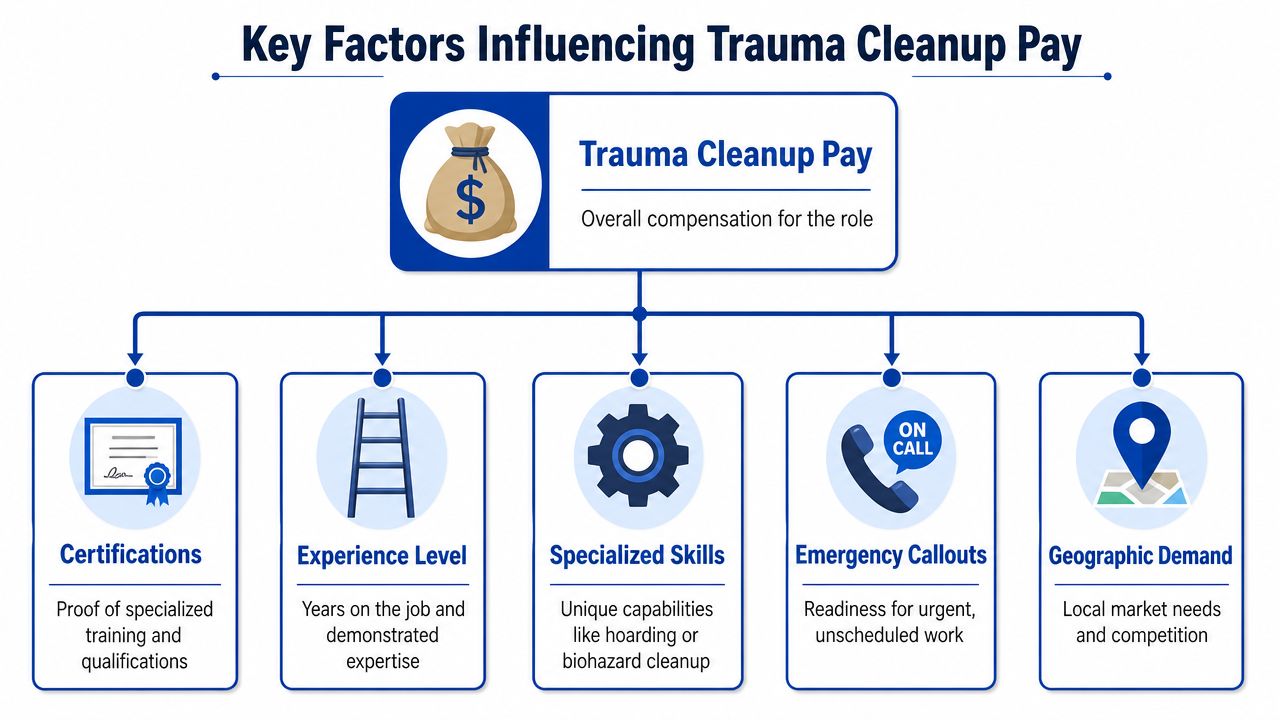
Certifications increase trust
In this field, certifications aren't decorative. They tell an employer that you understand hazard recognition, PPE, contamination control, and regulated workflow at a level that can protect both the crew and the client.
When technicians pursue specialized education, they become more deployable on difficult assignments. That's one reason employers invest in training and certifications for trauma biohazard and environmental cleanup professionals. The practical effect is straightforward. The more scenes you can handle correctly, the stronger your position for higher compensation.
Specialized scenes pay differently
Not every trauma cleanup assignment demands the same skill set.
A contained blood cleanup in a hard-surface environment is one thing. A scene involving decomposition, heavy odor migration, compromised subflooring, or complex personal property decisions is another. Technicians who can operate in those conditions without losing control of safety or documentation become much more valuable.
Here are the pay-shaping differences employers look at:
- Scene complexity: Technicians who can assess hidden contamination and choose the correct removal scope are harder to replace.
- Emotional intensity: Some scenes require exceptional composure because families, neighbors, tenants, or staff are nearby and distressed.
- Regulated handling: Jobs involving more demanding waste segregation, packaging, and documentation require stronger discipline.
- Property type: Multi-unit housing, commercial sites, healthcare spaces, and industrial settings often require tighter coordination.
For readers who want a broader look at the work itself, this video gives useful context on the realities of the profession.
Availability changes earnings
On-call availability is one of the clearest separators in this industry. Many providers need technicians who can respond when a property is released after an investigation or when a facility needs fast remediation before occupants return.
That doesn't suit everyone. Some people want predictable daytime work and minimal emergency disruption. Others are willing to take late-night callouts, weekend dispatches, and extended shifts. The second group usually has stronger earning potential because emergency response work depends on readiness.
A company can train for many things. It can't manufacture dependability at 2 a.m.
How Location and Employer Type Affect Your Salary
Where you work changes what employers can pay, what clients expect, and how difficult each job is to perform compliantly. Local cost structures matter. So do dispatch volume, travel patterns, disposal logistics, labor competition, and the type of buildings in the service area.

According to ZipRecruiter's New Jersey salary page, which also aligns with cited metro comparisons such as Chicago, New Jersey averaged $49,891 per year or $23.99 per hour in June 2026, with a majority pay band of $42,100 to $57,400. The same verified data notes that Chicago averages about $50,664 per year or $24.36 per hour, which shows how major metro areas often land in similar wage territory when operational demands are high.
Why urban markets often pay more
Dense markets don't just have more buildings. They tend to have more complexity.
Parking restrictions, vertical access, shared-wall exposure concerns, tenant coordination, after-hours building rules, and stricter documentation expectations all make jobs slower and more demanding. In commercial and multifamily environments, property managers also need providers who understand liability, resident communication, and turnover pressure. That's why many stakeholders rely on resources covering biohazard cleanup for property managers and tenant liability concerns before choosing a remediation partner.
Large employer versus small company versus owner-operator
Salary also changes with the business model behind the work.
| Employer Type | What usually helps | What usually limits pay |
|---|---|---|
| Established remediation firm | More structured training, steadier dispatch, stronger compliance systems, team support on difficult jobs | More formal scheduling and operating procedures |
| Small local company | Potential for broader hands-on exposure, faster responsibility growth | Less infrastructure, fewer benefits, thinner backup on large or complex scenes |
| Owner-operator | More control over pricing, schedule, and job selection | Higher overhead, more legal exposure, responsibility for compliance, sales, equipment, and staffing |
The highest possible earnings don't always come with the highest stability. A larger operation can offer consistency, better field support, and clearer advancement. A smaller outfit may give ambitious technicians faster experience, but not always with the same guardrails. Owner-operators can earn more in strong markets, yet they also carry every operational risk themselves. In trauma cleanup, that risk isn't theoretical. One mistake in handling or documentation can become expensive very quickly.
Beyond the Base Salary Overtime Benefits and Growth
Annual salary tells only part of the story. Emergency response work often changes total compensation because the week doesn't end neatly at five o'clock. A technician may start a regular shift, then get called to a released scene that must be stabilized before morning occupancy. Another may stay late because porous materials need to be removed, packaged, and documented before a unit can be secured.
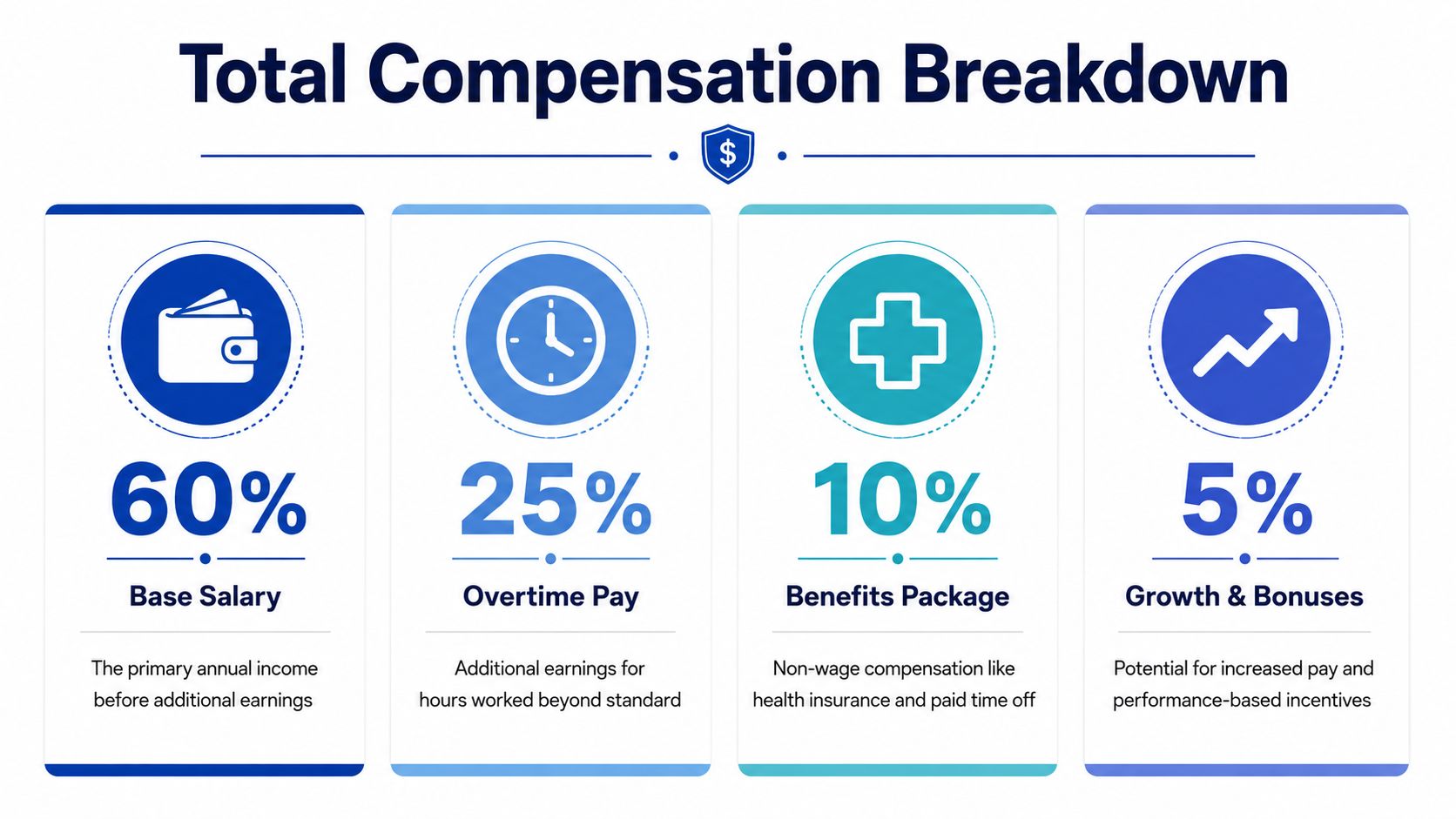
The verified market data notes that in Chicago salary reporting tied to 24/7 dispatch demands, where the average is $24.36 per hour, overtime and on-call pay can substantially increase annual take-home earnings beyond base salary because emergency calls don't arrive on a predictable schedule.
What total compensation actually includes
A strong compensation package usually blends pay with support systems that make the job sustainable.
Some employers focus narrowly on hourly wages. The better ones think in terms of total employment value. If you want a plain-language refresher on what belongs in a complete offer, Go Hires explains total compensation packages in a way that job seekers can apply across industries.
In trauma and biohazard work, total compensation often includes:
- Overtime opportunities: Emergency scenes and after-hours releases can add substantial earnings beyond base pay.
- On-call structures: Availability has value because the company needs a response-ready roster.
- Paid training: Certifications and field instruction can increase future earning power.
- Benefits and leave: Health coverage and time off matter in a physically and emotionally demanding profession.
A realistic monthly picture without pretending every month is the same
There is no honest “average month” in this trade. Some months are steady and controlled. Others are disrupted by nights, weekends, and emotionally heavy calls.
What matters is the pattern. A technician with a moderate base salary may take home meaningfully more during busy periods if they accept callouts and overtime. A technician at the same base rate who declines emergency availability may earn less, but preserve a more predictable routine. Neither choice is wrong. The trade-off is personal.
The paycheck often follows the schedule you're willing to live with.
Growth beyond field work
Not everyone stays a field technician forever.
Some people move into crew leadership, estimating, quality assurance, training, or operations. Others become the person who can calm a family, coordinate with an adjuster, and still keep the site compliant. That's where non-wage growth matters. Employers that pay for development are often building future supervisors, not just filling today's shift.
One example in the market is 360 Hazardous Cleanup, which performs trauma scene cleaning, crime scene cleanup, unattended death cleanup, hoarding cleanup, and broader hazmat and environmental services. For technicians, exposure to a wider mix of assignments can build judgment that eventually supports higher-level roles.
Advancing Your Career in Biohazard Remediation
The technicians who build durable careers in this field usually do a few things well, over and over. They stay teachable. They don't cut corners when they're tired. They learn how to speak to people in crisis without becoming cold or performative. And they become the person a dispatcher trusts when the job is difficult, sensitive, or time-critical.
What actually helps you move up
Career growth in biohazard remediation isn't mysterious. It's earned through credibility.
- Build range: Learn to handle different environments, not just the easy or familiar ones.
- Protect your judgment: Fatigue, overconfidence, and rushed assumptions cause mistakes long before equipment does.
- Strengthen documentation habits: Good notes, photos, disposal records, and communication protect everyone involved.
- Become reliable under stress: Employers remember who can respond calmly and follow process when a family, manager, or adjuster is standing nearby.
- Keep learning: Training compounds over time. So does field experience on varied scenes.
If you're researching adjacent opportunities to compare where restoration careers can lead, damage restoration job openings from AMPM Restoration Services can give you another view of how the broader remediation world structures career paths.
Common questions from job seekers and clients
Do you need a degree to work in trauma cleanup
Usually, what matters more is trainability, safety discipline, emotional steadiness, and the ability to follow regulated procedures under supervision. A degree can help in some management paths, but field credibility is built on competence and consistency.
Is the emotional toll real
Yes. Anyone speaking truthfully about this work should say that clearly.
The best technicians learn how to stay compassionate without carrying every scene home with them. Good employers support that balance through team culture, realistic staffing, and leadership that treats mental strain as part of the job, not a weakness.
Why does hiring a certified team matter to a property owner or family
Because improper cleanup leaves risk behind. It can leave contamination in porous materials, create disposal problems, and expose families or staff to both physical and emotional harm. Professional standards exist for a reason. The work has to be done safely, discreetly, and with documentation that stands up if questions arise later.
What does advancement look like after entry-level work
For many technicians, the next step is leading portions of a job, mentoring newer staff, and handling more communication. From there, some move into supervision or operations. A detailed look at the role and responsibilities of a crime scene cleaner helps clarify what that progression looks like in practice.
A trauma scene cleanup salary makes the most sense when you view it as payment for disciplined work in unstable conditions. The strongest earners usually aren't the flashiest people in the room. They're the ones who can be trusted with the hardest assignments, the most sensitive conversations, and the strictest compliance expectations.
When families, property managers, healthcare facilities, and public agencies need a team that handles biohazard remediation with safety, discretion, and compassion, 360 Hazardous Cleanup provides 24/7 support for trauma scenes, crime scenes, unattended deaths, hoarding conditions, and other hazardous environments. If you need help now, or you're evaluating what professional remediation should look like, their site is a practical place to start.