If you're searching for a professional organizer for hoarders, you're probably already past the point of casual decluttering. A room may be unusable. Family members may be arguing about what to do next. A landlord, case manager, or facility staff member may be trying to decide whether this is still an organizing problem or a safety problem.
That distinction matters.
In hoarding situations, the wrong first step can make everything harder. A standard cleaner may push too fast. A well-meaning relative may remove belongings without consent and trigger panic or shutdown. And in severe cases, an organizer may walk into conditions that include mold, pest activity, human or animal waste, or blocked exits. At that point, the work is no longer just about clutter. It becomes a health and compliance issue.
A skilled organizer can be an essential part of recovery. But knowing where their role ends, and where a certified biohazard remediation team must take over, is what protects people, property, and long-term outcomes.
Understanding the Role of a Hoarding Organizer
A professional organizer for hoarders does more than tidy a home. They work inside a complicated mix of attachment, avoidance, shame, indecision, and habit. Their job is to help a person sort safely, make decisions at a tolerable pace, and build systems that can hold after the session ends.

The field is growing because the need is real. According to Coherent Market Insights' professional organizer market analysis, the global professional organizer market is projected to grow from USD 13.28 billion in 2026 to USD 21.42 billion by 2033, with residential organizing holding 39.1% market share in 2026. That projected growth reflects broader recognition that clutter-related disorders require specialized help.
What a specialized organizer actually does
A hoarding-focused organizer usually works in a deliberate, client-centered way. They don't treat the person like the problem. They treat the environment as something that has become unsafe, overwhelming, or unmanageable, and they help restore function step by step.
Their work often includes:
- Assessment of the space: They look at access, volume, room use, and day-to-day barriers.
- Sorting support: Items may be grouped into keep, discard, or unsure categories.
- Decision coaching: They help the client avoid endless rehandling of the same objects.
- System building: They assign a clear home for items that remain.
- Maintenance routines: They teach repeatable habits such as mail handling or daily reset tasks.
This is very different from a maid service or a junk-out crew. General cleaning focuses on surfaces. Standard organizing focuses on efficiency. Hoarding work focuses on behavior, distress tolerance, and sustainable change.
Practical rule: If the person needs help making decisions and tolerating letting go, you need more than a cleaner.
What they are not hired to do
A specialized organizer is not there to shame, force, or perform an extreme one-day clear-out. Fast, involuntary cleanouts may create a visible result, but they often damage trust and can make future cooperation harder.
They also aren't automatically qualified to manage dangerous contamination. If you're still trying to determine whether you're dealing with heavy clutter or a true hoarding condition, this guide on clutter vs hoarding can help frame the difference.
In the right setting, the organizer becomes a steady partner. They help the person regain function. They create a livable path forward. But that only works when the site is safe enough for organizing work to happen in the first place.
When an Organizer Is Not Enough
Some sites are beyond the scope of organizing from the moment the door opens. You may smell ammonia, decomposition, rot, or sewage. You may see rodent droppings, insect activity, mold growth, or piles that have blocked exits and collapsed onto heat sources. In these conditions, a compassionate approach still matters, but safety comes first.
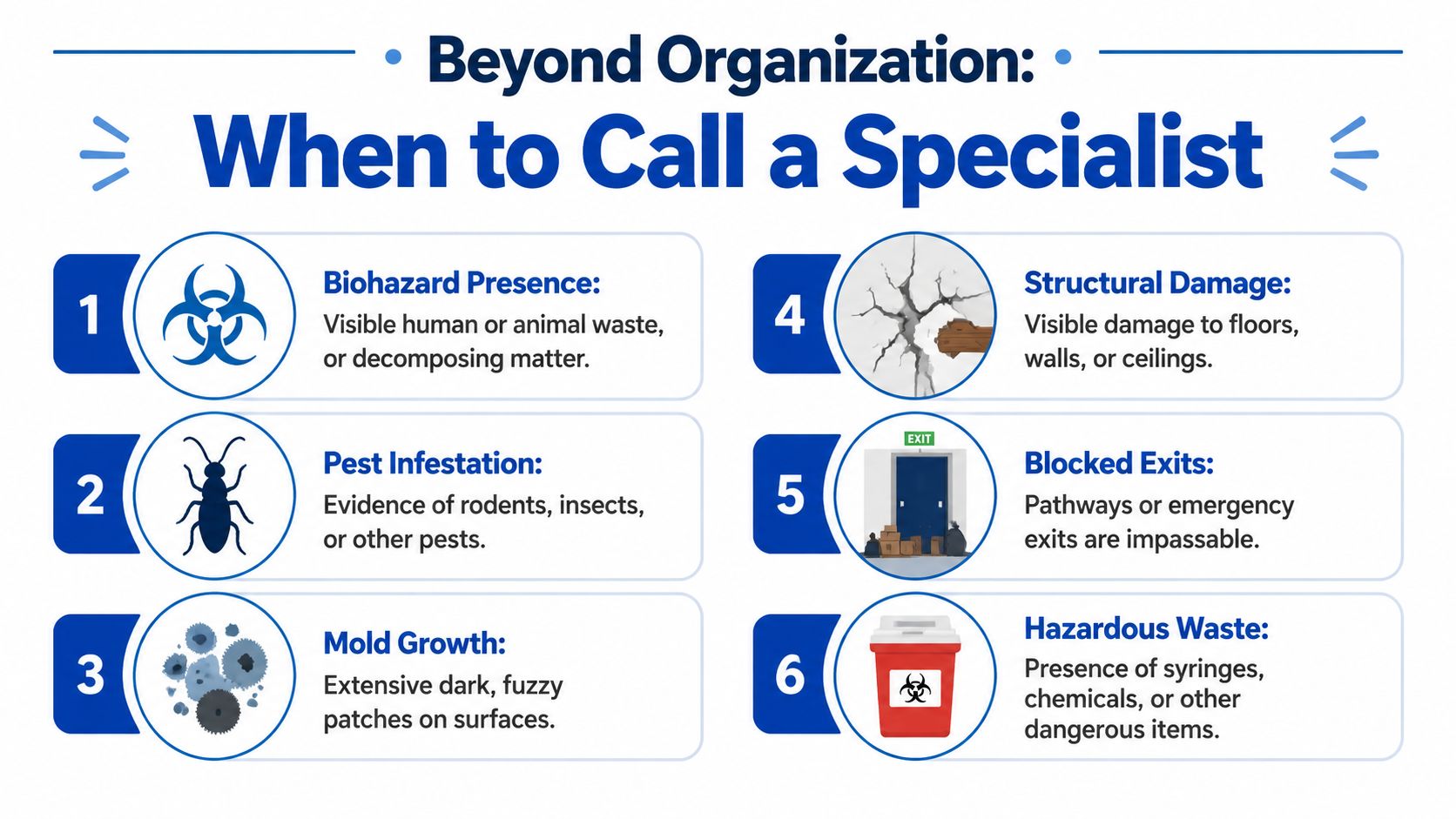
The practical line is simple. If the site contains contamination that can expose people to pathogens, airborne hazards, sharps, or structural danger, the work has moved into biohazard remediation.
Conditions that change the response
An organizer may be excellent at coaching a client through paper piles, clothing overflow, or overfilled storage areas. They shouldn't be expected to remediate environments that include:
- Human or animal waste: Feces, urine saturation, soiled bedding, or waste tracked through the home.
- Pest infestation: Rodents, roaches, flies, fleas, or nesting materials inside clutter.
- Visible mold: Broad growth on walls, belongings, HVAC surfaces, or damp debris.
- Sharps or drug paraphernalia: Needles, lancets, broken glass, or unknown containers.
- Structural instability: Soft floors, damaged stairs, overloaded rooms, or ceilings affected by leaks.
- Blocked egress: Doors, windows, hallways, and stairwells that can't be used in an emergency.
These aren't edge cases. According to this hoarding hazard overview, the CDC reports that up to 70% of severe hoarding sites contain biohazards such as Hantavirus or leptospirosis, while fewer than 10% of organizers hold hazmat certifications. The same source notes that scenarios with a Clutter Image Rating above 7 often require professional biohazard remediation for safety and compliance.
Why this transition can't be improvised
When severe contamination is present, the risks affect more than the resident. Family members, building staff, maintenance workers, neighbors, case managers, and organizers can all be exposed. Disturbing contaminated materials without the right controls can spread particulates and pathogens into clean areas.
A proper response usually requires trained handling, containment, regulated waste procedures, protective equipment, and cleaning methods matched to the hazard. It may also require documentation for landlords, insurers, healthcare facilities, or property managers.
An organizer helps decide what stays. A remediation team makes the environment safe enough for any decision-making to continue.
If you're evaluating vendors for a severe situation, this resource on hoarder cleanup companies is useful because it frames what to look for when health risk, liability, and discretion all matter.
Six signs you should stop organizing and call a specialist
- The odor suggests contamination, not just clutter. Strong urine, sewage, decomposition, or ammonia odors point to more than disorganization.
- The floor can't be safely reached or trusted. If pathways are unstable, hidden, or soft underfoot, injury risk rises immediately.
- There are active pests. Droppings, carcasses, nesting, or swarming insects turn the project into a sanitation issue.
- Personal protective equipment would be necessary to enter safely. If gloves alone don't feel adequate, treat that as a warning.
- Residents have health vulnerabilities. Older adults, children, and immunocompromised occupants need a more controlled response.
- The building itself may be affected. Shared walls, HVAC systems, leaks, and neighboring units can turn one apartment or room into a broader property problem.
The mistake families make most often is trying to push through because they want quick relief. In severe hoarding, speed without hazard control usually creates a second problem on top of the first.
How to Find and Vet a Qualified Professional
Hiring the right organizer isn't about finding the cheapest hourly rate or the first person who says they handle clutter. Hoarding work is specialized. It asks for patience, boundaries, clinical awareness, and the judgment to recognize when the environment is no longer appropriate for organizing alone.
Costs reflect that difference. According to Clutter B Gone's overview of hoarding behavior and professional organizing, hoarding remediation projects average $2,000 to $15,000, with hourly rates of $50 to $150, compared with $528 for a standard organization job. The same source notes that professionals often use tools such as the Clutter-Hoarding Scale to assess risk and tailor the approach.
Start with fit, not promises
A good consultation should feel calm, specific, and realistic. Be cautious of anyone who promises a complete reset in a single push or treats emotional resistance as stubbornness that needs to be overcome.
Look for professionals who can explain:
- how they pace sessions
- how they handle indecision and repeated re-sorting
- when they pause work for safety reasons
- whether they collaborate with therapists, case workers, or property stakeholders
- how they document progress and setbacks
The best answers usually sound measured, not dramatic.
Questions to ask before hiring
Use this list during consultations and compare answers side by side. If you also need a remediation provider at any point, this checklist of top questions to ask before hiring a cleanup company can help you evaluate the safety side of the response.
| Question | Why It Matters | Look for This Answer |
|---|---|---|
| What experience do you have with hoarding cases specifically? | General organizing experience isn't the same as hoarding work. | They describe repeated work in hoarding environments and speak comfortably about resistance, pacing, and relapse risk. |
| How do you approach a client who struggles to decide? | Decision paralysis is central in many hoarding situations. | They mention structured sorting, limited categories, and methods such as O.H.I.O. without sounding rigid or punitive. |
| How long are your sessions? | Overly long sessions can increase distress and shutdown. | They favor manageable sessions and can explain why pacing matters. |
| What happens if you encounter mold, waste, pests, or sharps? | This is the key boundary question. | They stop, explain the hazard, and refer to qualified remediation rather than trying to handle it informally. |
| Do you work with therapists, social workers, or family members? | Long-term success often depends on coordination. | They have a clear process for communication and know how to protect dignity while keeping everyone aligned. |
| How do you assess severity at the start? | You need someone who can distinguish inconvenience from risk. | They use a recognized tool such as the Clutter-Hoarding Scale and explain what they look for. |
| What does maintenance look like after the main project? | A cleanout without follow-through often falls apart. | They offer routines, follow-up sessions, and practical habit-building strategies. |
| Are you insured, and what limits do you set on your work? | Insurance and scope protect both sides. | They can describe coverage, contracts, and the situations they won't take on alone. |
Answers that should make you pause
Some responses are warning signs even if the person seems kind.
Red flag: “We'll just get it all out fast and deal with feelings later.”
That approach may work for ordinary downsizing. It usually backfires in hoarding cases. Other concerns include refusal to work with clinicians, no safety screening, dismissing contamination concerns, or framing the client as lazy or noncompliant.
A qualified organizer should balance empathy with limits. They don't need to be a therapist, but they do need to understand that force rarely produces lasting change.
Coordinating with Mental Health Professionals
Decluttering can improve access, sanitation, and basic function. It doesn't automatically treat hoarding disorder. That distinction is one of the most important things families and facilities can understand before work begins.

According to Design Organized's hoarding resources page, a 2023 IOCDF study found that only 25% of hoarding interventions succeed long-term without combined therapy and organizing, and interventions using organizers alone can see relapse rates as high as 60% within six months. That tracks with what practitioners often observe on the ground. Removing volume is one task. Building the capacity to tolerate decisions, loss, and change is another.
How the organizer and therapist support different parts of the problem
The therapist addresses the underlying beliefs, anxiety, avoidance, grief, trauma, or compulsive patterns that keep accumulation going. The organizer handles the physical behavior in the home: sorting, categorizing, assigning homes, and practicing repeatable routines.
Used together, these roles reinforce each other.
- The therapist helps the person understand why letting go feels threatening.
- The organizer turns that insight into action inside the living space.
- Family members learn where support helps and where pressure harms.
That coordination matters even more when the client has overlapping symptoms or diagnoses. If you're trying to understand how personality style, compulsive traits, and obsessive symptoms can look similar while requiring different support, this article on understanding obsessive compulsive personality disorder vs OCD gives useful context.
What coordinated care looks like in practice
A workable team plan is usually simple, not elaborate. The therapist and organizer don't need constant meetings. They need shared goals, clear consent, and agreement on how the pace will be managed.
That often means:
- the therapist helps define target areas and emotional triggers
- the organizer reports practical sticking points, with permission
- the client practices skills between sessions
- family members stop making surprise cleanout attempts
- everyone agrees on what counts as progress
Progress may look modest from the outside. A clear stove, a usable bathroom, and one safe exit can be more meaningful than removing a large volume quickly.
This short video gives a useful visual reference for the human side of those conversations and why pacing matters.
For organizations building a broader support response around high-risk occupants or residents, this overview of how 360 collaborates with mental health crisis support organizations is helpful because it shows how cleanup decisions and mental health coordination can intersect during a crisis.
What doesn't work
The least effective model is isolated decluttering with no therapeutic support, no follow-up, and no agreement about what happens after the visible cleanup. That often leaves the person feeling exposed, ashamed, or defensive. It may produce a cleaner room, but not a stable outcome.
The Cleanup Process What to Expect
Many individuals expect a hoarding project to begin with hauling things out. In a well-run process, it usually begins with slowing down enough to make the next step safe.
A typical case starts with an assessment of access, hazards, and priorities. Can the resident reach the bathroom safely? Is the stove blocked? Are exits usable? Is there spoiled food, pest activity, or contamination that requires a specialist before organizing can continue? Once those questions are answered, the team can decide whether the first workday is about sorting, remediation, or both in sequence.
The early sessions
At the start, the organizer usually doesn't tackle the most emotionally loaded possessions first. They often begin with lower-stakes material such as obvious trash, expired food, duplicate containers, or broken items. That gives the client a chance to practice decision-making without immediately hitting the hardest attachments.
A common method is to use a few simple categories such as keep, discard, and unsure. Another is the O.H.I.O. principle, short for Only Handle It Once, which encourages a final decision when an item is first picked up instead of putting it into a new pile to revisit repeatedly.
Small wins matter. A cleared chair, safe walkway, or usable sink can reduce overwhelm and make the next session possible.
The middle phase
At this point, many families get impatient. The room may still look crowded, but important work is happening. The client is learning how to sort by category, tolerate discomfort, and assign a home for what remains.
According to the IOCDF information for professional organizers, complete programs that combine CBT and in-home organizing achieve success rates of around 70%. The same source notes that gradual decluttering over 26 sessions can help build distress tolerance, and skills training can lead to a 66% reduction in new acquisitions.
In practice, that means the process is usually paced over time. It isn't a single dramatic event. It's repeated exposure, practical routines, and a lot of respectful repetition.
Where the family helps, and where it hurts
Families often want to help by pushing momentum. Sometimes that helps. Often it doesn't.
Useful involvement includes:
- Providing logistics: dumpsters, donation drop-offs, access, paperwork, scheduling.
- Protecting agreements: no surprise cleanouts, no removing boxed items behind the person's back.
- Supporting new routines: helping maintain mail sorting, trash removal, or entryway reset systems.
Less helpful behavior includes arguing over item value, threatening eviction without a plan, or turning every session into a referendum on the person's character.
If the site includes unsanitary conditions, blocked areas, pest contamination, or other health hazards, the process may need a remediation phase before traditional organizing can continue. This overview of hoarding cleanup for unsanitary and unlivable conditions helps explain what that transition can involve.
The final stage
The end of the active cleanup isn't the end of the work. The final stage is maintenance. That means clear storage zones, visible labels, realistic container limits, and follow-up support when accumulation starts to return.
The best outcomes don't come from forcing a home to look perfect. They come from restoring safety, function, and enough structure that the person can keep going.
Creating a Safe and Sustainable Path Forward
A hoarding situation rarely has a single solution. It usually needs the right sequence.
The organizer addresses decision-making, sorting, and household systems. The therapist addresses the beliefs and distress that drive keeping and acquiring. The remediation team steps in when contamination, pests, waste, mold, or other hazards make the environment unsafe for ordinary organizing work. Knowing which problem you're solving at each moment is what prevents costly mistakes.
That also keeps the response humane. People living with hoarding disorder don't need spectacle or punishment. They need boundaries, safety, and a process that respects dignity while still confronting real risks. For families dealing with less hazardous accumulation after safety has been restored, practical guidance like these tips for downsizing your house can be useful as a separate, lower-intensity resource.
The most effective path is usually not the fastest visible cleanout. It's the one that restores safe access, deals with contamination properly, supports treatment, and creates habits the person can maintain. If you're hiring a professional organizer for hoarders, ask one question early and ask it clearly: when do you stop, and who do you call when the site isn't safe?
That answer tells you a lot.
A competent team knows the line between clutter and contamination. They don't blur it to keep the job. They protect the client, the property, and everyone else involved by making the handoff at the right time.
When a hoarding situation includes biohazards, blocked exits, pest contamination, or unlivable conditions, 360 Hazardous Cleanup provides the certified, discreet remediation support needed to make the environment safe again. Their team handles high-risk scenes with compassion, regulatory care, and respect for the people affected, so families, property managers, and care teams can move forward with a safer plan.