You've cleaned the room twice. You opened the windows. You changed the trash, washed the fabrics, sprayed the air freshener, and for a few hours it seemed better. Then you walk back in and the smell is still there, or worse, it's settled into the walls, the flooring, or the HVAC airflow. That's the point where you stop asking how to cover it up and start asking a harder question: how do you get rid of it for good?
That question matters because permanent odor removal isn't one job. It's a diagnostic process. A pet accident, smoke residue, sewage intrusion, mold growth, and a biohazard scene can all create “bad smells,” but they don't behave the same way and they should never be treated the same way. What works for a nuisance odor can fail completely in a trauma scene or contaminated property.
In practice, the difference comes down to source, chemistry, material penetration, and safety. Some odors are unpleasant but relatively straightforward. Others signal protein residue, infectious risk, or contamination that has moved into drywall, wood, subflooring, or HVAC components. In those cases, the odor is only the symptom. The actual problem is what's still present in the structure.
Beyond Masking The Problem of Lingering Odors
A lingering odor creates a particular kind of stress because it feels personal and invasive. It follows you from room to room, attaches itself to clothing and furniture, and can make a home or workplace feel unsettled even when everything looks clean.
Why masking fails
Air fresheners, scented cleaners, candles, and plug-ins can change what you notice first. They don't remove the material causing the smell. If odor molecules are still coming from carpet backing, wall cavities, porous wood, bodily fluid residue, soot, or microbial growth, the smell will keep returning.
That's why people often describe a property as “fine for a day, then bad again.” The odor wasn't eliminated. It was only covered.
Practical rule: If the smell returns after ventilation, basic cleaning, or fragrance products, assume there's still a source in the structure or the air path.
Odor problems often involve air quality, not just smell
Many property owners focus on the odor itself and miss the broader indoor environment. Ventilation, filtration, and how contaminants move through a building all affect whether a smell lingers or spreads. If you're trying to understand how airflow can worsen or sustain a problem, this overview of Grand Rapids indoor air quality is a useful companion resource.
The more serious issue is that some odors should never be treated as a household cleaning problem at all. A smell tied to decomposition, bodily fluids, sewage, or microbial contamination needs a controlled remediation approach, not a stronger fragrance or a retail deodorizer. That's also why so many high-risk scenes go wrong when people try to handle them informally instead of understanding why DIY isn't the way to go in professional biohazard cleanup.
What permanent odor removal actually means
Permanent odor removal means the odor source is physically removed, chemically neutralized where appropriate, and prevented from re-entering the air. In severe cases, it also means isolating or sealing materials that can't be fully restored.
That standard is higher than “smells better.” It means the environment is being brought back to a condition where residue, contamination, and odor recurrence are addressed together. For routine smells, that may be straightforward. For biohazard-related odors, it requires an entirely different level of control, safety, and verification.
The Four Foundational Principles of Odor Elimination
There's a reason many odor problems keep coming back. People jump to the middle of the process. They spray, fog, diffuse, ventilate, or scrub one visible area while the actual source remains in place.
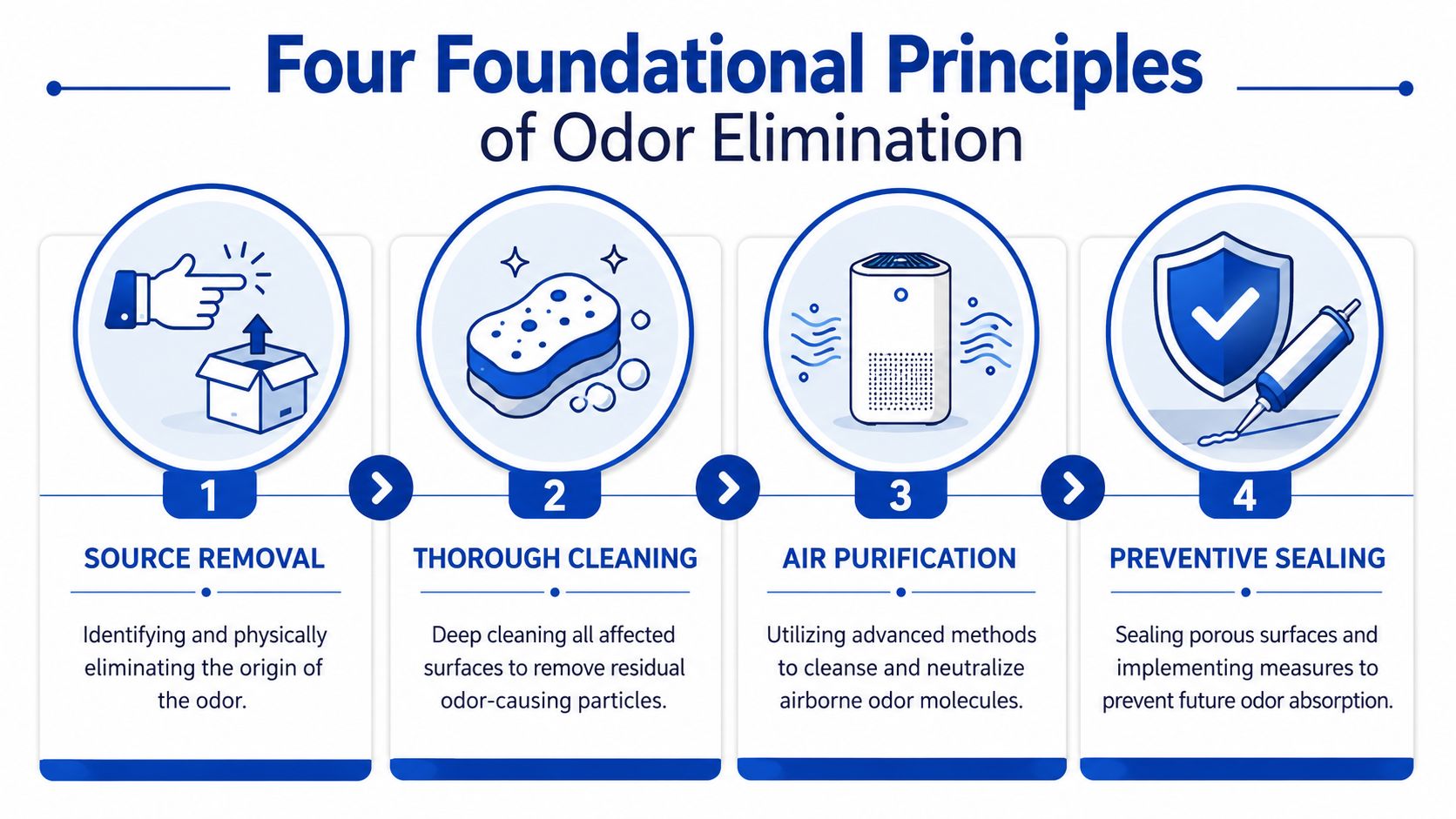
The reliable framework is straightforward: source removal, surface cleaning, deodorization, and sealing. According to BioCycle's overview of odor management, those four principles offer a reliable path to permanent odor elimination when properly executed, and common failures come from relying on dilution alone or deodorizing before source removal.
Source removal comes first
If you leave the origin in place, every other step becomes temporary. That source might be spoiled material, hidden moisture damage, smoke residue, pet contamination in padding, sewage intrusion, or biological residue in porous surfaces.
Weeding a garden illustrates the principle. If you cut the leaves and leave the root, the problem returns. Odor behaves the same way.
Cleaning removes the residue left behind
After the source is identified, affected surfaces need deep cleaning. Many people, however, underestimate the task. Odors rarely sit only in the air. They settle into dust, films, fabrics, drywall texture, grout lines, subfloors, and HVAC pathways.
A proper cleaning phase strips away the residue that keeps feeding the smell back into the space. If that residue remains, deodorization products may briefly suppress the smell, but it will re-emit.
Deodorization has a role, but not as a shortcut
Professional deodorization can be useful when it follows source removal and cleaning. At that point, the goal is to neutralize what remains in the air and in difficult-to-reach material layers.
What it can't do is compensate for skipped steps. Using odor-counteractant products too early is like painting over rust. The surface may look better for a while, but the deterioration underneath keeps going.
A room doesn't become odor-free because it smells different. It becomes odor-free when the material producing the odor is gone or permanently contained.
Sealing is often the difference between “better” and “done”
Some residues penetrate beyond practical cleaning depth. Smoke can move into structural cavities. Biological contamination can soak into unfinished wood or concrete. In those conditions, sealing or encapsulation becomes part of the permanent fix.
This is the step many generic guides leave out, even though it often determines whether the result lasts. If you want to see how this connects to healthier building conditions over time, this piece on how professional decontamination improves indoor air quality long term adds helpful context.
Diagnosing the True Source of the Odor
Before anyone reaches for a machine or a cleaner, the primary work starts with pattern recognition. Odors have clues. They intensify with humidity, fade when air movement changes, attach to one room, follow an HVAC cycle, or emerge only after the building has been closed up.
The first distinction to make is whether you're dealing with a nuisance odor or a biohazard-related odor. That isn't a marketing distinction. It changes the entire remediation plan.
Nuisance odors versus biohazard odors
Nuisance odors usually come from everyday sources such as cooking residue, smoke, pet accidents, stale moisture, trash leakage, or minor organic buildup. They can still be stubborn, especially when they've penetrated porous materials, but they don't automatically indicate infectious material or regulated cleanup conditions.
Biohazard-related odors are different. They may involve bodily fluids, decomposition, trauma residue, sewage, or contaminated materials that require controlled handling. The underlying chemistry is often more complex, and the risk isn't limited to smell.
A key distinction appears in Azuna Fresh's discussion of home odor elimination science, which notes that biohazard scenarios involve protein-based residues that ozone alone cannot fully oxidize without enzymatic bio-remediation, and that 45% of biohazard odor complaints recur after improper cleaning.
Questions that narrow the cause
Ask a few specific questions before assuming you know the source:
- When did it start: A sudden onset points toward an event. That could be a leak, spill, appliance failure, dead pest, sewage backup, or trauma incident.
- Does weather affect it: If humidity makes the smell stronger, porous materials may be holding contamination.
- Is it tied to HVAC use: If the odor increases when the system runs, contamination may be in ducts, filters, coils, or connected rooms.
- Does one surface hold the smell: Carpet, drywall, baseboards, wood trim, and upholstered furniture often reveal where the odor has absorbed.
- Have repeated cleanings failed: Recurrence after multiple attempts usually means the source hasn't been reached or the wrong method is being used.
How professionals tell surface contamination from structural penetration
Odors that sit on a surface usually respond to cleaning. Odors that have moved into building materials behave differently. They return after cleaning dries, become stronger when the space heats up, and seem impossible to “locate” because the whole room smells affected.
A few common signs point toward penetration:
| Sign | What it often suggests |
|---|---|
| Odor returns after cleaning | Residue remains below the surface |
| Smell worsens with humidity | Porous materials are holding contamination |
| One room affects adjacent rooms | Air transfer or hidden cavity contamination |
| Flooring smells stronger than walls | Pad, subfloor, or concrete absorption |
| Odor persists with no visible stain | Hidden source inside wall, beneath flooring, or in contents |
If microbial growth is even a possibility, the visual and odor clues can overlap with moisture damage. In those situations, it helps to understand the warning signs of black mold on walls, because what people describe as “musty odor” sometimes points to a larger contamination issue.
If you can't identify the source, or if the smell involves bodily fluids, sewage, or decomposition, stop treating it like a housekeeping problem. At that point, diagnosis matters more than deodorizing.
Professional Remediation Methods and Technologies
Professional odor work uses a toolkit, not a miracle machine. The right method depends on what caused the smell, where it traveled, what materials absorbed it, and whether the site is safe to occupy during treatment.
One reason property owners get frustrated is that retail advice treats every tool as if it works the same way. It doesn't. Some methods remove airborne particles. Some penetrate porous materials. Some oxidize. Some encapsulate. Some should never be used around occupants.
What each tool is actually for
Here's how several common professional methods differ in practice:
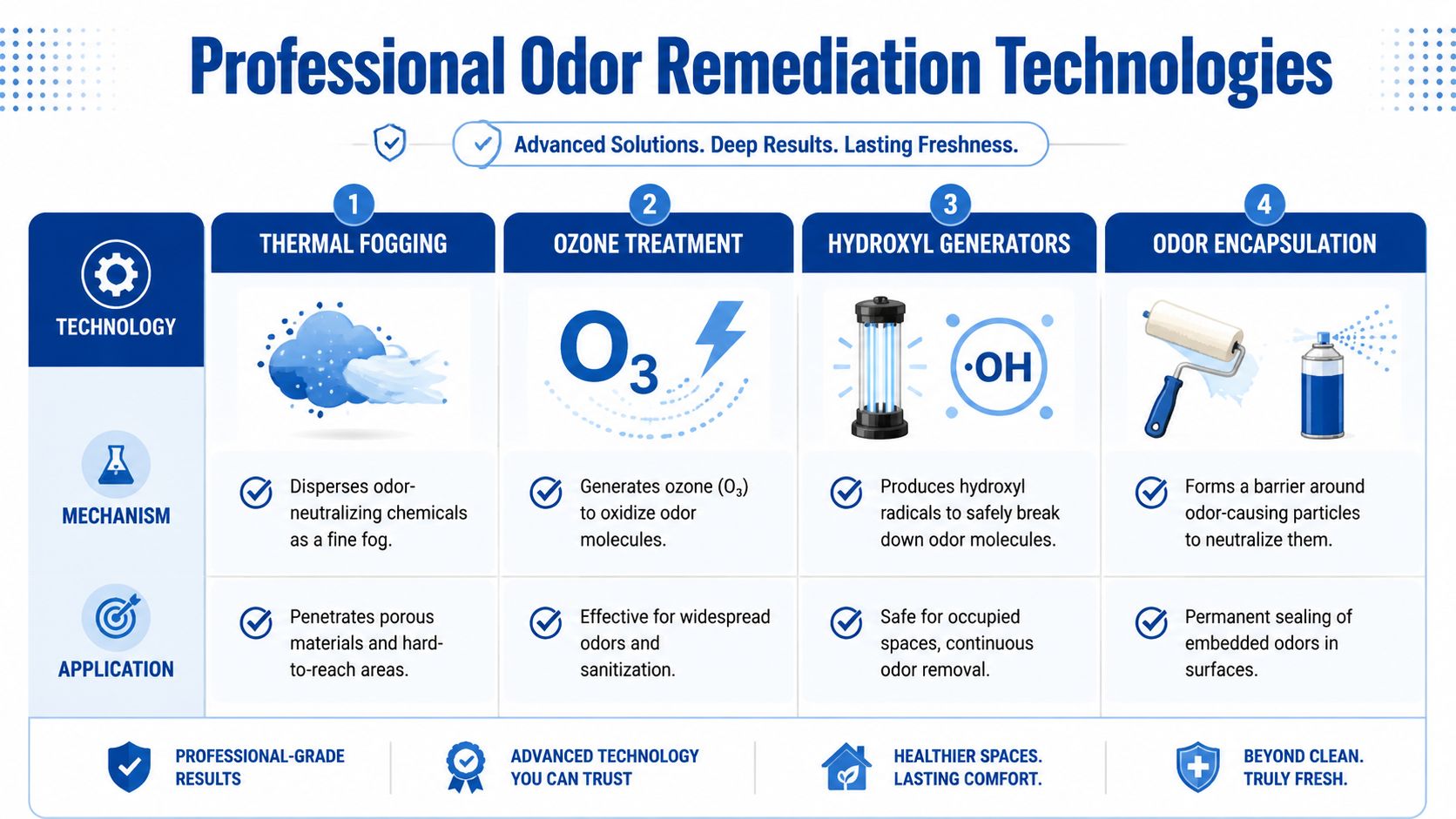
| Method | What it does | Where it helps | Main limitation |
|---|---|---|---|
| Thermal fogging | Carries deodorizing chemistry into small spaces and porous areas | Smoke and other odors that penetrated hidden layers | Won't replace cleaning or source removal |
| Hydroxyl generation | Breaks down odor compounds over time | Spaces that need ongoing treatment with careful occupancy considerations | Slower than direct source removal |
| HEPA-filtered air scrubbing | Removes airborne particulates and improves air quality | Fire residue, dust, bioaerosols, and circulating contaminants | Doesn't solve embedded structural odor alone |
| Encapsulation or sealing | Traps residual odor in materials that can't be fully restored | Drywall, wood, subfloors, and other porous components | Must follow cleaning and prep, not replace them |
A broader look at how decontamination technology has advanced in the last 5 years helps explain why modern remediation combines these tools instead of relying on one.
Ozone is not the cure-all many people think it is
Ozone machines get a lot of attention because they sound powerful. Their actual performance is more limited, and safety concerns are more serious. The EPA's guidance on ozone generators states that ozone is generally ineffective at removing many odor-causing chemicals at concentrations that meet public health standards, and that it can create irritating and corrosive byproducts. The same EPA guidance also notes that ozone often masks odors with its own scent rather than permanently eliminating the source.
That matters because many people rent or buy ozone devices expecting a final solution. In occupied spaces, that can be a poor and unsafe choice. In professional work, ozone isn't treated as a default answer. It's treated with caution, and never as a substitute for proper removal, cleaning, and containment.
A useful visual explanation of common odor treatment approaches appears below.
Sealing is often what makes the result last
A major blind spot in consumer advice is the assumption that oxidation or fogging alone creates permanence. In many real jobs, especially after smoke, decomposition, or deep organic contamination, the structure itself has absorbed odor. Cleaning may remove most of it, but not all of it.
When that happens, encapsulation becomes part of the permanent answer. A properly selected sealant creates a barrier so residual odor compounds in drywall, framing, or subfloors can't keep migrating back into the air. This is less dramatic than a machine treatment, but it's often the step that prevents the smell from returning.
Field reality: The best technology is the one that matches the contaminant, the material, and the safety conditions of the site. The wrong machine used confidently still produces a poor result.
Safety Compliance and the Hidden Dangers of DIY
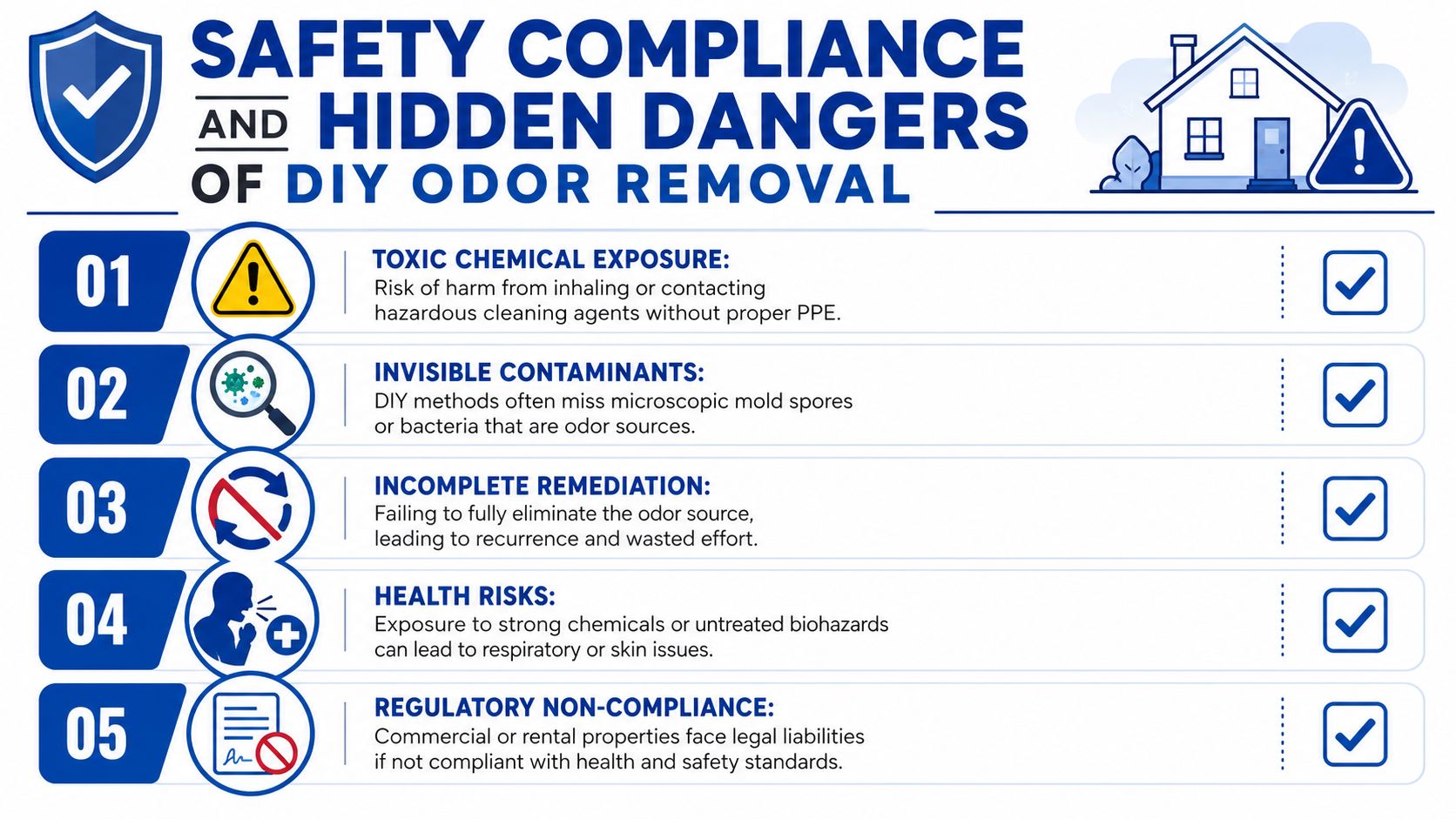
Odor problems tempt people into improvising. They mix stronger chemicals. They scrub without respiratory protection. They drag contaminated materials through clean areas. They run fans that spread particles into adjacent rooms. The odor may feel like the emergency, but the larger danger is what those actions can release or redistribute.
That risk becomes unacceptable in a biohazard environment. Once bodily fluids, trauma residue, sewage, or infectious materials are involved, cleanup isn't just cleaning. It becomes a regulated exposure issue.
What DIY efforts often miss
The biggest hidden problem is cross-contamination. A person may wipe a visible surface and assume the hazard is reduced, while contaminated droplets, dust, or aerosols move to hallways, vents, tools, clothing, or disposal bags.
Another problem is chemistry. Bleach is one of the most misunderstood products in cleanup work. People assume stronger smell means stronger disinfection or deodorization. It doesn't work that way, and incorrect use can create its own hazard. If you need a plain-language refresher on handling precautions, Safety Space's bleach SDS advice is a practical reference.
Compliance is not optional in biohazard cleanup
The legal and safety standard rises sharply in scenes involving blood or potentially infectious materials. OSHA's Bloodborne Pathogens Standard requirements summarized here make clear that biohazard cleanup workers must follow 29 CFR 1910.1030, use exposure control plans, receive mandatory training, and be supplied with appropriate PPE to prevent exposure.
That isn't paperwork for its own sake. It reflects how easily a poorly handled scene can expose workers, occupants, maintenance staff, vendors, or future tenants.
Why professionals build containment first
In higher-risk odor cases, the first priority often isn't deodorization. It's control. Teams establish barriers, isolate the work area, and manage airflow so contamination doesn't migrate during removal and cleaning. Negative pressure and engineering controls matter because they prevent the cleanup process itself from spreading the problem.
For property owners, this is also a liability issue. In a rental, facility, clinic, or commercial building, a bad DIY response can turn one affected area into several. If you want a clearer view of the regulatory side, this overview of OSHA and biohazard cleanup compliance and safety standards is worth reviewing.
A property isn't safe because it smells cleaner. It's safe when contamination has been removed, controlled, and handled under the right protective and disposal standards.
When to Call a Professional Remediation Expert
Some odor problems are manageable with normal cleaning and common sense. Others cross a line where continued DIY effort only delays the necessary fix. Knowing where that line is can save time, money, and unnecessary exposure.
Red flags that mean stop trying to handle it yourself
Use this checklist plainly:
- The odor has no obvious source: If you can smell it but can't find it, hidden contamination is possible.
- The smell follows a traumatic event or unattended death: This should be treated as a biohazard scene, not a household odor problem.
- Repeated cleaning hasn't worked: Recurrence usually means the source remains in materials, air pathways, or concealed spaces.
- Sewage, bodily fluids, or suspected infectious material are involved: These conditions require controlled cleanup and disposal.
- The odor is tied to widespread mold or chronic moisture: Smell alone won't tell you how far contamination has traveled.
- Occupants report irritation or the building feels unsafe: At that point, health protection matters as much as odor removal.
Professional work includes verification, not just treatment
A key difference between ordinary cleaning and remediation is post-work confirmation. According to Advanced DRI's biohazard cleanup standards summary, post-remediation verification requires surface and air sampling to meet quantitative thresholds, including fungal spore counts not exceeding outdoor ambient levels and no detection of specific pathogens. That's what separates a space that seems improved from one that has documented contamination control.
This matters for homeowners, but it matters even more for landlords, healthcare settings, commercial facilities, and insurance-related claims. Documentation and defensible cleanup standards protect everyone involved.
How to choose the right kind of help
Not every contractor understands odor at the remediation level. If you're evaluating providers for a serious property issue, a practical guide to vetting home service professionals can help you ask better questions about training, scope, and accountability.
Look for a team that can explain the source, the containment plan, the cleaning sequence, the deodorization method, whether sealing is needed, and how they verify success. If they only talk about spraying, fogging, or “getting the smell out,” keep asking questions.
A stubborn odor can make a property feel impossible to recover. It usually isn't. But permanent odor removal only happens when the response matches the source, the materials, and the safety risk involved. In nuisance cases, that may mean disciplined cleaning and targeted treatment. In biohazard cases, it means professional remediation with controls, compliance, and proof that the space is safe to re-enter.
When odor problems involve trauma, bodily fluids, decomposition, sewage, hoarding, mold, or other hazardous contamination, the right response needs more than deodorizing. 360 Hazardous Cleanup provides compassionate, regulation-focused biohazard remediation with the discretion, urgency, and technical care these situations require. If you need a team that can assess the source, contain the risk, remediate the contamination, and help restore the property safely, they're available to help.