
A strange smell after a basement leak can sit in the back of your mind for weeks. The drywall looks dry. The carpet feels normal. But every time you walk downstairs, something still seems off.
That uncertainty is what sends many Sioux Falls property owners searching for answers. Not because they want a lab report for its own sake, but because they need to know whether they're dealing with normal background mold, a hidden moisture problem, or a condition that calls for controlled cleanup.
When to Consider Mold Testing for Your Sioux Falls Property
A lot of people assume mold testing is the first step every time. It isn't.
South Dakota guidance says the state does not provide mold sampling services, so property owners who need testing must hire an environmental contractor. The same guidance also says testing isn't recommended as a first step when mold is visible, because visual inspection and musty odors are more reliable indicators than air sampling. It also notes that wet materials should be dried within 48 hours or removed to prevent growth, based on CDC guidance in the same resource. You can review that state guidance on the South Dakota Department of Health mold page.
Situations where testing makes sense
Testing becomes valuable when the problem is less obvious than a patch of visible growth on drywall. In practice, that usually means one of a few situations:
- Hidden moisture is suspected: You smell mold, but you can't see where it's coming from.
- The scope is unclear: You know there's water damage, but you don't know how far contamination extends.
- Documentation matters: A property transaction, insurance file, tenant dispute, or facility record may require objective findings.
- You need a baseline before cleanup: A written protocol can help separate guesswork from a controlled remediation plan.
That difference matters. If mold is plainly visible, the urgent issue is usually removal and moisture correction, not paying for sampling that tells you what your eyes and nose already confirmed.
Practical rule: Test when you need to answer a decision question. Don't test just to prove that mold exists when the building already tells you it does.
Why Sioux Falls properties can be confusing
In Sioux Falls, a mold concern often starts upstream with water management. Overflowing gutters, poor drainage, roof runoff, and foundation moisture can all feed indoor humidity and hidden wet areas. If you're trying to track where recurring moisture may be starting outdoors, Prime Gutterworks' gutter cleaning guide is a useful read because it explains how neglected gutter systems can push water where it doesn't belong.
Indoor concerns after leaks or floods can also linger longer than expected. This overview of hidden mold after water damage is worth reading if your property looks dry now but still smells wrong.
The main takeaway is simple. Mold testing is not a universal first move. It's a targeted tool for situations where uncertainty is the primary problem.
Key Warning Signs That Point to a Hidden Mold Problem
Some mold problems announce themselves. Many don't.
If you manage a home, office, rental, clinic, or warehouse, the early clues are often indirect. You notice a smell in one corner of the building. People complain that a room feels stuffy. A water event happened months ago, but one wall still seems colder than the others.
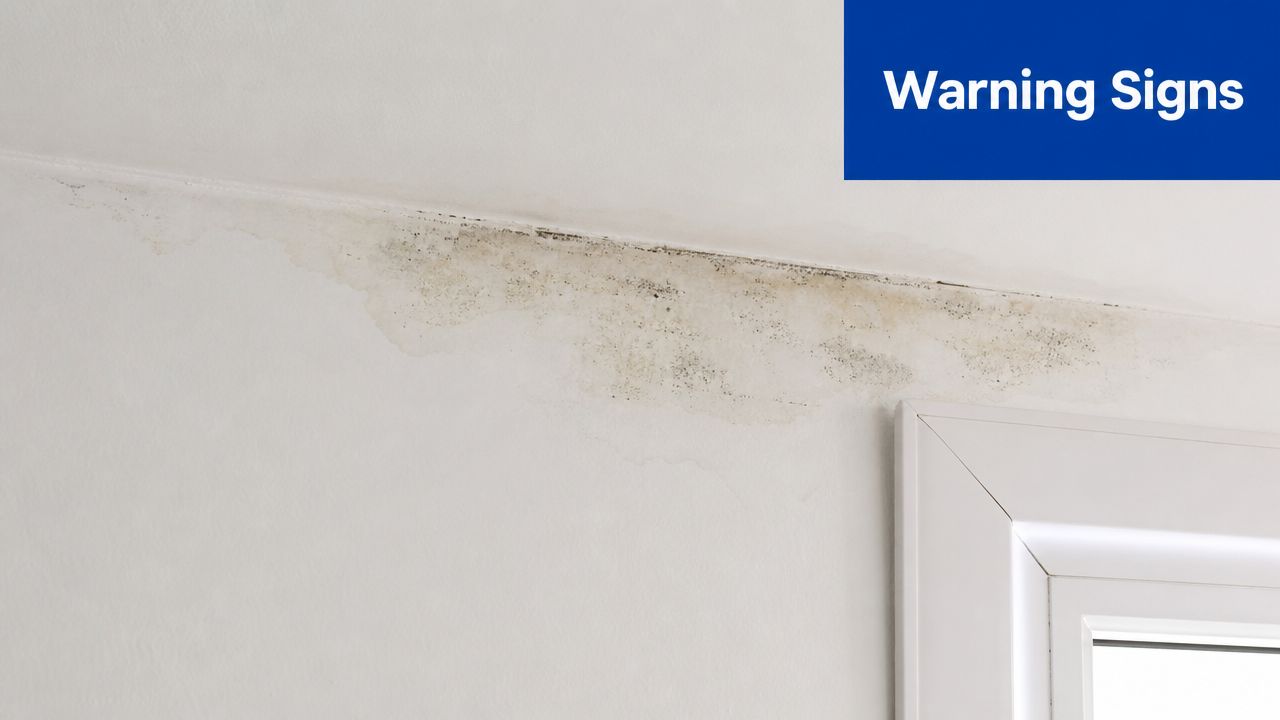
Clues your building may be giving you
The strongest warning signs usually fall into a few categories:
- Persistent musty odor: If a room smells earthy, stale, or damp even after cleaning, something may be active behind finishes or inside a wall cavity.
- Past water intrusion: Roof leaks, plumbing failures, sump issues, appliance overflows, and seepage all create conditions mold likes.
- Repeated staining or bubbling materials: Drywall seams, baseboards, ceiling corners, and window surrounds can reveal recurring moisture.
- Localized complaints: If one office, unit, or bedroom consistently feels worse than the rest, the issue may be isolated but real.
- Unexplained indoor air quality concerns: Occupants may report irritation or discomfort that improves when they leave the space.
Visible growth counts too, of course. If you already see discoloration or spotting, testing may help define the extent of contamination, but the larger issue is identifying what's staying wet.
Triggers that deserve professional attention
A hidden problem is more likely when the concern follows an event. Think in terms of building history, not just what you can see today.
- After a leak that seemed minor: Small leaks behind a refrigerator line, around a toilet seal, or under a sink can continue long after the obvious water is gone.
- After storm-related intrusion: Wind-driven rain, ice damming, roof flashing failure, or clogged drainage paths can feed concealed moisture.
- Before buying or leasing a property: A musty basement, recently painted wall, or renovated lower level may justify a more careful inspection.
- In multifamily or commercial settings: Shared walls, stacked plumbing, and HVAC distribution can move moisture and spores in ways that aren't obvious from one room alone.
If you're seeing dark spotting on wall finishes, this guide on black mold on walls can help you understand what surface signs may and may not mean before you disturb the area.
A short visual overview can also help you recognize common problem conditions before you schedule an inspection.
A hidden mold issue usually starts as a moisture issue. The mold is the symptom. The building condition is the cause.
The Professional Mold Testing Process Explained
A proper mold investigation should feel methodical, not mysterious. The goal isn't to “take a sample and hope.” The goal is to answer three practical questions: Where is moisture coming from, what materials are affected, and does the sampling support what the building conditions suggest?
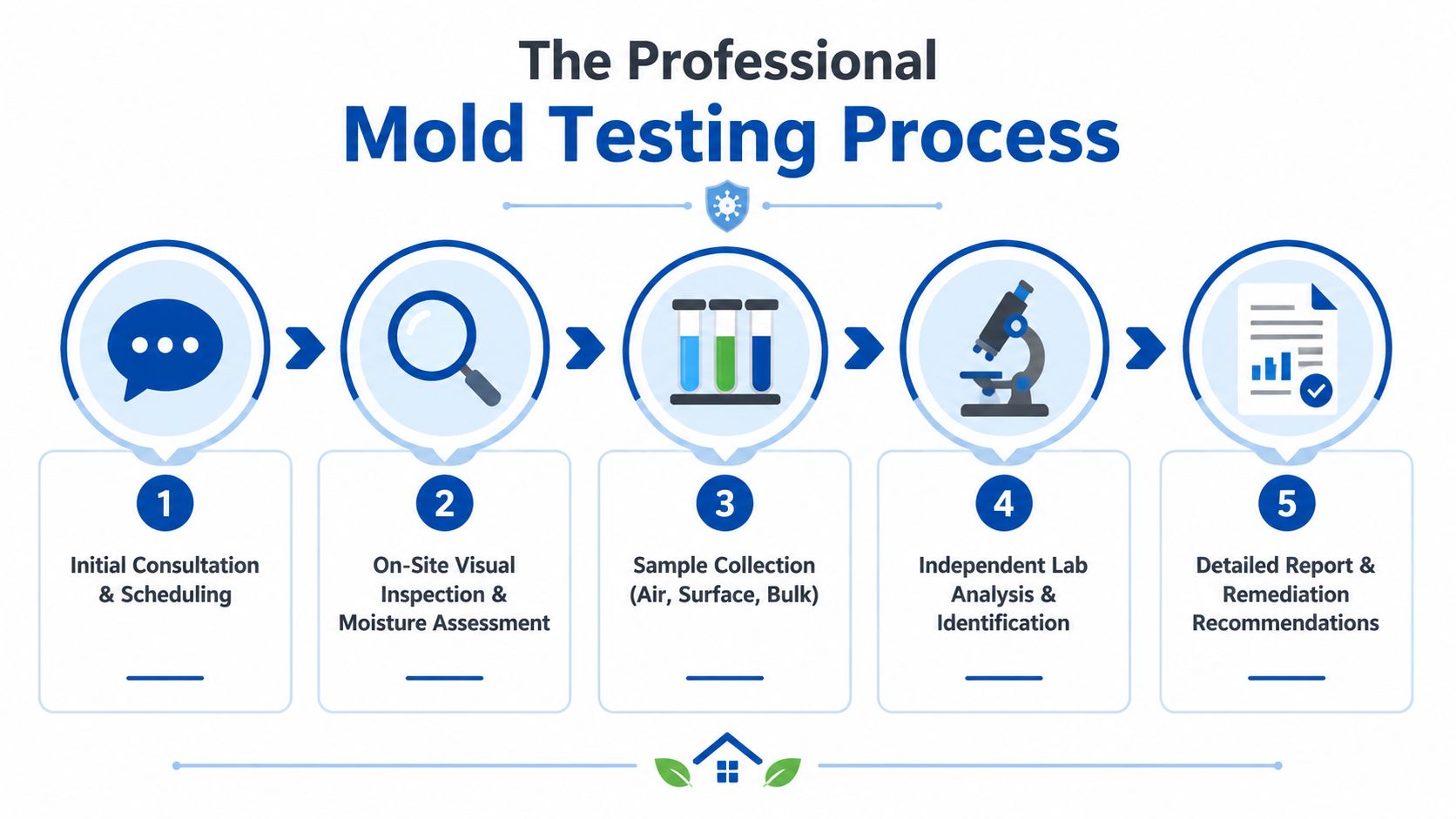
Step one starts before any sample is taken
The first part of the visit is usually a conversation. A good inspector wants to know what happened, when the odor started, whether there was a plumbing or roof event, and which rooms seem affected. That history guides the inspection far better than random testing ever will.
From there, the inspection moves into the physical space. Moisture meters, temperature and humidity observations, and a careful visual review help map likely problem zones. At this point, experienced inspectors often separate a minor localized issue from a building-wide concern.
Why air testing alone often misses the point
Air sampling is useful, but it has limits. It captures a snapshot of the air at that moment. It does not reliably tell you where the source is by itself.
Best-practice guidance says a strong workflow combines visual moisture mapping with air and surface sampling, because airborne spore data alone can't localize a source. It also notes that inspections should include indoor and outdoor comparison samples, plus targeted swab or tape-lift samples from suspect materials, with interpretation tied back to visible growth and moisture intrusion. That guidance is outlined in this independent mold inspection reference.
Here's a practical perspective:
| Testing method | What it helps answer | What it doesn't do well alone |
|---|---|---|
| Air sample | What's circulating in the air now | Pinpoint hidden growth source |
| Surface sample | What's present on a specific material | Show building-wide airborne conditions |
| Moisture mapping | Where wet conditions may be feeding growth | Identify mold species by itself |
What a careful sampling plan looks like
A thoughtful inspector doesn't sample every room blindly. Sampling should follow the evidence.
That may include:
- Outdoor control sampling to understand normal background conditions on the day of testing.
- Indoor air samples in areas of concern and, when needed, in unaffected comparison areas.
- Swab or tape-lift samples from suspicious surfaces to identify what's growing there.
- Bulk material sampling when a damaged item needs laboratory identification as part of a larger protocol.
Good testing doesn't chase data points. It builds a defensible explanation for what's happening in the building.
What happens after cleanup
Testing also has a role at the end of the job. The same independent guidance notes that post-remediation clearance should verify both no visible mold and air samples within acceptable ranges. That matters because successful remediation isn't just about lowering spore counts for a day. It's about confirming that contamination was removed and the moisture driver was addressed.
For larger or regulated environments, this usually means a written scope, controlled work practices, and documented verification before normal occupancy resumes.
How to Decode Your Mold Test Results
Many property owners get stuck at this point. They receive a lab report with species names, sample locations, and technical terms, then try to decide whether the results are alarming or ordinary.
The first thing to understand is simple. Mold spores exist everywhere. A report that detects mold is not automatically bad news. What matters is the pattern.
The outdoor sample matters more than most people realize
An outdoor control sample gives context. If outdoor air already contains a normal mix of spores, some of those same types may appear indoors. That alone doesn't prove indoor growth.
The concern rises when indoor results are out of line with what's outside, or when the indoor mix points to moisture-driven amplification in a specific area. The report has to be read as a comparison, not as an isolated list of mold names.
What “elevated” really means in practice
In colder climates and seasonally humid spaces, interpretation gets more nuanced. Guidance focused on real-world indoor air quality conditions in Sioux Falls and eastern South Dakota points out that recurring questions often come from basements, crawlspaces, multi-unit buildings, and spaces with moisture or ventilation issues. It also notes that the fundamental decision question is not merely “Was mold found?” but whether the findings indicate a building failure, hidden leak, humidity problem, or recurrence risk. That perspective is summarized in this regional indoor air quality reference.
That's why a report has to be read alongside the building story:
- A modest indoor finding with no moisture signature may suggest normal background variation.
- A stronger indoor finding near a known leak path may support active growth behind finishes.
- Repeated findings in lower levels or utility-adjacent rooms often point back to humidity control, drainage, or ventilation rather than a one-time event.
Don't overreact to a mold name alone
Property owners often search one mold name online and panic. That usually makes the situation harder, not clearer.
A laboratory report should be interpreted with questions like these:
- Is the indoor sample materially different from the outdoor sample?
- Were suspect materials also positive on surface testing?
- Did the inspector document moisture intrusion, high humidity, or ventilation concerns?
- Do the results line up with odor, staining, occupant complaints, or prior water events?
A mold report is only useful when it answers a building question. Without moisture context, the numbers can mislead people in both directions.
If you want a broader prevention lens after you receive results, this resource on understanding mold prevention and reducing health risks is a practical next read.
A simple way to think about your report
Use this lens when reviewing findings with a professional:
| Report pattern | Likely interpretation | Next question |
|---|---|---|
| Indoor similar to outdoor | May reflect normal background conditions | Is there still a moisture issue that needs correction? |
| Indoor higher than outdoor | Possible active indoor amplification | Where is the moisture source? |
| Surface positive in suspect area | Confirms mold on that material | Is removal or cleaning appropriate for that material? |
| Post-cleanup results acceptable with no visible mold | Cleanup may have achieved its goal | Has the moisture source also been corrected? |
The report should reduce uncertainty. If it doesn't, the explanation is incomplete.
Your Action Plan After Mold Testing
Once the results are in, the next move depends on whether the findings point to a manageable moisture-control issue or active contamination that requires structured remediation.
In the Sioux Falls market, turnaround speed matters. One local provider advertises initial results in 2 to 3 days, and a local directory notes that mold removal commonly takes 1 to 5 days in straightforward cases but can extend to several weeks when contamination is severe. The same local market guidance also points to keeping indoor humidity below 60% for prevention after testing and remediation. Those operational benchmarks are summarized by Mold Testing SD.
If results look normal or near background
A “normal” result doesn't mean you should ignore building conditions. It means widespread contamination may not be supported by the evidence right now.
The right response is usually targeted prevention:
- Correct small moisture defects: Drips, seepage, and condensation problems don't stay small for long.
- Control humidity: Keep indoor humidity below 60% as recommended in the local guidance above.
- Improve air movement where needed: Storage rooms, lower levels, and utility spaces often need better ventilation practices.
- Monitor problem zones: Recheck areas that have a history of leaks, odor, or seasonal dampness.
If results show elevated contamination
People often get into trouble by trying to “spray and forget.” Significant mold growth isn't just a cleaning task. It's a contamination-control job.
Professional remediation should address:
- Containment so disturbed material doesn't spread contamination into unaffected areas.
- Removal or cleaning of impacted materials based on condition and porosity.
- Source correction so the same moisture pathway doesn't reactivate growth.
- Verification that visible contamination is gone and the environment is suitable for normal use.
For property owners evaluating next steps, mold remediation that protects health and property gives a practical overview of what a controlled process should include.
One option available to local owners is 360 Hazardous Cleanup, which provides mold remediation services as part of broader environmental mitigation work. In any provider you consider, the important thing is that the work plan addresses containment, safety, documentation, and moisture correction rather than just surface treatment.
If the moisture source stays in place, the mold problem is on pause, not solved.
The best post-test action plan is the one that matches the actual level of risk. No overreaction. No denial. Just a clear decision based on the evidence.
How to Choose a Qualified Mold Professional in Sioux Falls
Not every company approaches mold with the same level of discipline. Some firms are strong at cleaning but weak on diagnosis. Others can collect samples but don't explain what the results mean for the building. When you're hiring for mold testing services in Sioux Falls, the difference shows up in the questions they ask and the process they follow.
For Sioux Falls specifically, the local array of providers includes third-party mold testing and consulting firms listed in state resources. That matters because an independent assessment can reduce conflict-of-interest risk when the same company isn't also performing abatement. State-listed and neutral references also note that inspectors may use moisture meters, temperature and humidity checks, ventilation assessment, and rapid microscopy to identify drivers such as hidden water damage, high humidity, or HVAC-related distribution patterns. That local context appears in South Dakota's environmental directory and black mold services listing.
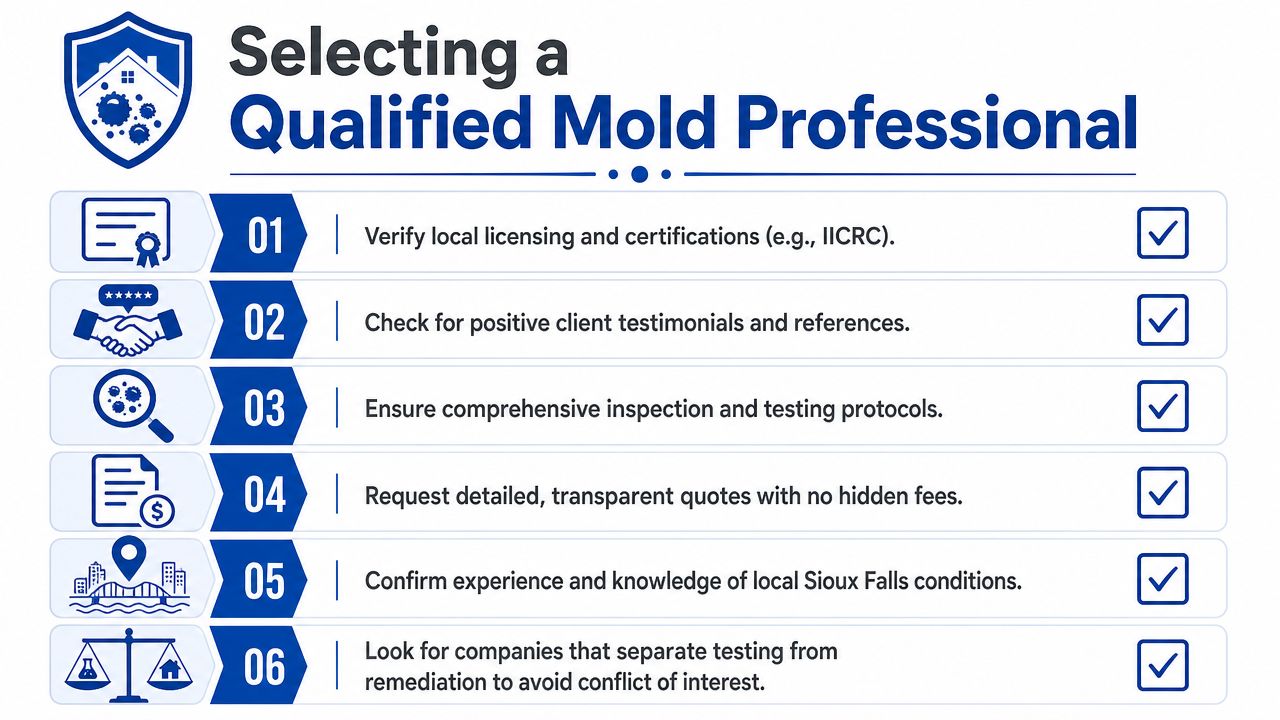
Questions worth asking before you hire
A reliable provider should be comfortable answering direct questions. Ask things like:
- How do you investigate moisture, not just mold? A useful inspection ties findings back to leaks, humidity, ventilation, or drainage conditions.
- Do you use third-party laboratory analysis when sampling is taken? Clear chain of custody and independent analysis help support defensible results.
- How do you decide where to sample? Random testing is a warning sign. Good testing follows observed risk.
- What does your written reporting include? You want findings, interpretation, and practical recommendations, not just raw lab sheets.
Signs of a stronger process
A qualified professional usually has a process that feels structured from the start. Look for evidence of the following:
| What to look for | Why it matters |
|---|---|
| Moisture-focused inspection | Mold problems are driven by water and humidity, not by spores alone |
| Clear scope of work | Defines what's being inspected and why |
| Independent interpretation | Reduces pressure to oversell remediation |
| Documentation and photos | Helps with decision-making, records, and follow-up |
| Local experience | Climate, basements, and building types affect how problems show up |
A helpful screening resource is this checklist of questions to ask before hiring a cleanup company.
The right contractor should make the situation easier to understand. If the process feels vague, the results probably will too.
Be careful with bundled incentives
There's nothing necessarily wrong with a company offering both testing and remediation. But whenever the same firm diagnoses the problem and profits from a larger cleanup scope, you should ask how it manages that conflict. Independent testing, or at least clear ethical separation between assessment and abatement, protects the property owner.
That's especially important in commercial settings, healthcare environments, rental disputes, and real estate transactions where documentation quality matters as much as the cleanup itself.
Taking Control with Confidence and Clarity
Mold testing should do one thing above all else. It should replace uncertainty with a clear decision.
For some Sioux Falls properties, that decision is simple moisture control and monitoring. For others, the testing points to a hidden building issue that needs containment, removal, and verification. Either way, the value isn't in collecting a sample. The value is in understanding what the result means for your property, your occupants, and your next step.
If you're also comparing broader indoor air quality concerns in other climates, this overview of Mesa indoor air quality offers a useful outside-market perspective on how comfort, ventilation, and contaminant control often connect.
When the situation feels confusing, a calm and well-documented process makes all the difference.
If you need help evaluating mold concerns, interpreting test results, or planning safe next steps, 360 Hazardous Cleanup can help you assess the situation, understand the risk, and move forward with a clear remediation path.