Skunk smell can last anywhere from 48 to 72 hours outdoors with good airflow to 1-3 months in a commercial warehouse if contamination is left untreated, and in some situations untreated odor can persist for months or even years. The timeline depends almost entirely on what got hit, how porous it is, whether the odor entered ventilation, and how quickly the right cleanup method starts.
If you're dealing with this right now, you already know the problem isn't just that the smell is bad. It moves, it sticks, and it seems to come back after you think it's gone. That's especially true in office buildings, apartment corridors, loading areas, mechanical rooms, vehicles, and any property where air circulation carries odor farther than the original spray zone.
For homeowners, the immediate concern is comfort. For property managers and facility operators, the issue expands fast. Complaints spread across units, occupied spaces become difficult to use, and a localized wildlife incident turns into a building-wide remediation problem. Knowing how long does skunk smell last helps, but the more useful question is why the odor behaves so differently from one surface to another and what removes it.
The Lingering Question After a Skunk Encounter
A skunk incident usually starts with confusion. Someone notices a strong sulfur-like odor near an entry door, in a parking area, around a loading dock, or drifting through vents. Then the phone calls start. Tenants think there's a gas issue. Staff open windows. Someone wipes down the obvious surfaces. Hours later, the smell is still there.
That happens because skunk odor isn't a simple airborne nuisance. It's a contaminant that can settle on hard surfaces, absorb into soft materials, and travel through a structure in ways that aren't obvious at first. In a single-family home, that's frustrating. In a multi-unit property or commercial building, it can affect occupant comfort, operations, and indoor air quality all at once.
Many readers searching how long does skunk smell last are really asking a broader question: Is this something that will fade on its own, or am I looking at a bigger remediation issue? The answer depends on the surface, the airflow, and whether the spray reached fabrics, vehicles, ductwork, or enclosed areas with lingering humidity.
The strongest odor doesn't always mark the full contamination zone. In buildings, the source area and the complaint area are often different.
This is why response needs to be methodical. Opening windows may help with light outdoor odor, but it won't solve contamination that has settled into porous material or moved through mechanical systems. If indoor air concerns are part of the problem, this overview of how professional decontamination improves indoor air quality long-term helps explain why odor control and air quality restoration have to be handled together.
The good news is that skunk odor does follow patterns. Once you understand the chemistry and where the residue has spread, the timeline becomes much easier to predict.
Why Skunk Odor Is So Uniquely Persistent
A skunk release in a parking area or near a loading dock can turn into an indoor air problem fast. Property managers often notice the first complaints far from the actual spray site, especially once odor moves through corridors, service spaces, or mechanical systems.
Skunk odor persists because the residue is chemically stubborn. The compounds in the spray do not behave like an ordinary bad smell that airs out. They adhere to surfaces, sink into porous materials, and can reactivate after partial cleaning.
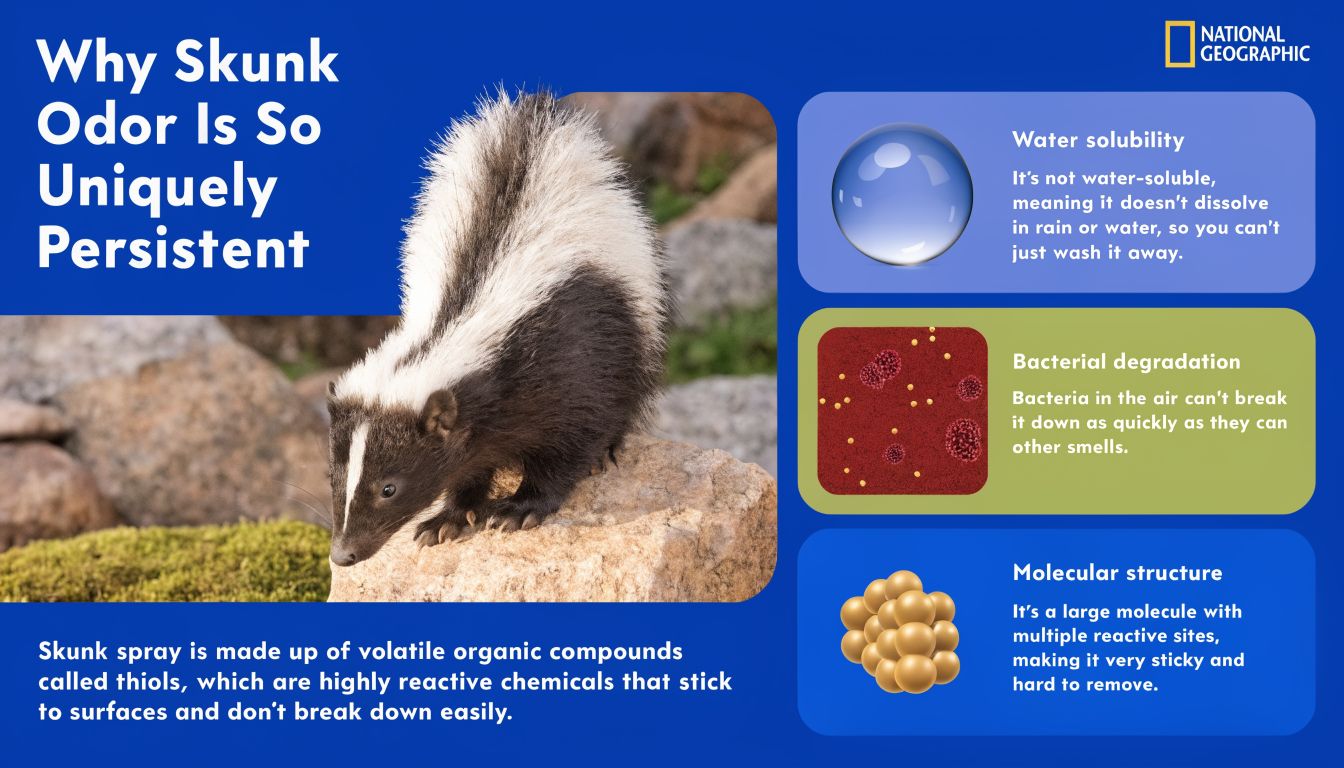
Thiols cling and thioacetates reactivate
The main odor compounds act more like an oily contaminant than a simple airborne nuisance. Once they land on siding, carpeting, upholstered furniture, ceiling tile, duct insulation, or unfinished wood, they bond to the material and keep releasing odor.
Moisture makes the situation harder to control. Thioacetate compounds can convert back into strong-smelling sulfur compounds when they come into contact with water or humid air. That is why a hallway, unit, office, or retail space may seem better after cleanup, then smell strong again after mopping, rain, or an HVAC cycle. The odor did not return from nowhere. Residue remained in place and reactivated.
I see this mistake often in larger buildings. Staff clean the visible area, add fragrance, and assume the issue is handled. Then the air handler runs, humidity rises, and complaints restart.
Porous materials and airflow extend the problem
Non-porous surfaces are usually more manageable because contamination stays near the surface. Porous materials are a different job entirely. Drywall, insulation, carpet pad, acoustic panels, soft seating, paper goods, stored inventory, and some duct materials can absorb skunk residue below the top layer, where casual cleaning will not reach it.
In commercial and multi-unit settings, airflow changes the scope of the loss. A discharge near an outdoor intake, under a storefront entry, inside a garage, or beside shared ductwork can spread odor well beyond the original contact point. That changes both the cleanup plan and the timeline. The work is no longer limited to one surface or one room.
Effective remediation starts with source mapping, material assessment, and containment. That same method is used in the science behind biohazard decontamination and how 360 Hazardous restores safety, where the goal is to identify what penetrated, what spread, and what must be neutralized instead of masked.
Practical rule: If the smell drops, then returns when humidity rises or the HVAC turns on, contamination is still present.
That persistence is what makes skunk odor so disruptive in businesses, apartment buildings, and shared-use properties. The smell is not just strong. It is adhesive, reactive, and very good at finding places standard cleaning misses.
Skunk Smell Duration in Different Scenarios
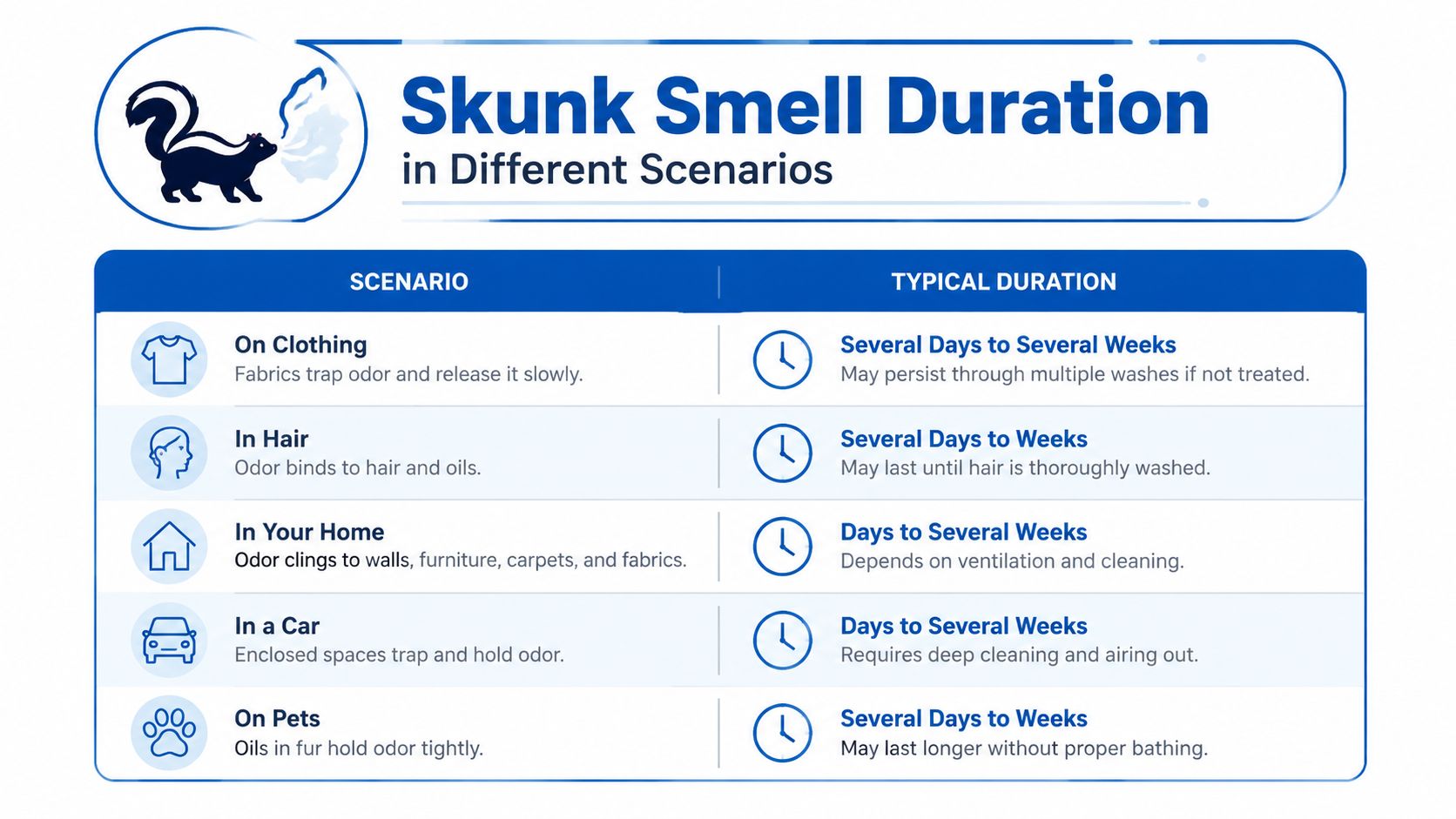
A property manager usually asks the same question within the first hour: how long is this building going to smell? The honest answer depends on where the spray landed, what absorbed it, and whether the first cleanup helped or spread it. In practice, light exposure can clear fairly quickly, while trapped contamination in porous materials or mechanical systems can linger for weeks. If no one identifies and removes the actual source, the odor can hang on for months.
Outdoor areas
Open-air contamination usually resolves fastest. Patios, walkways, exterior walls, and parking areas often improve within a few days if the spray stayed on hard surfaces and air movement is good.
The timeline changes when odor settles near loading docks, recessed entries, dumpster enclosures, outdoor dining areas, or fresh-air intakes. Those locations hold odor longer and create a business problem, not just a nuisance. Staff and tenants keep reporting a "new" smell because air is carrying the same residue back through the property.
Pets and people
Direct spray on a pet or a person can often be reduced quickly with proper deodorizing treatment, but that does not mean the incident is over. The bigger issue in apartments, hotels, veterinary clinics, and shared vehicles is transfer. A dog runs through a lobby, shakes off in an elevator, then lies on carpet or fabric seating. The animal improves first. The building does not.
Clothing, shoes, leashes, carriers, blankets, and mop heads also spread residue from one area to another. That secondary contamination is one reason odor complaints continue after the original encounter seems resolved.
Interiors, fabrics, vehicles, and HVAC
Indoor timelines are longer because enclosed spaces trap odor and porous contents hold it below the surface. Carpet pad, upholstered panels, cubicle fabric, stockroom contents, vehicle interiors, and insulation can all retain skunk compounds after the air itself seems better.
HVAC contamination is where commercial losses become difficult. If spray reaches an intake, rooftop unit area, garage exhaust path, or return-air route, odor can cycle through multiple suites or floors. I have seen a single exterior discharge create complaints in offices that never had direct contact with the animal.
A practical comparison helps:
| Scenario | Typical duration |
|---|---|
| Light outdoor odor on exposed hard surfaces | A few days |
| General contamination with prompt, thorough cleaning | Several days to a few weeks |
| Direct odor on a pet without prompt treatment | Can linger for weeks |
| Cars, fabrics, soft contents, or ventilation components | Often lasts weeks and may return intermittently |
| Severe untreated contamination in enclosed or porous areas | Can persist for months |
The longest timeline usually comes from the hardest-hit material, not the first area people noticed. If one return vent, carpet pad, fabric partition, or vehicle cabin still holds residue, occupants will assume the whole property is still contaminated.
That is why scheduling cannot be based on first impressions alone. Initial cleaning may be quick, but full odor resolution depends on how many reservoirs are involved, much like the scope-based timelines described in how long biohazard cleanup takes.
Understanding the Health and Safety Considerations
Skunk odor isn't just unpleasant. It can create immediate occupant discomfort and complicate building safety decisions. According to this summary of skunk odor spread and exposure effects, skunk spray can travel up to 18 feet on windy days, can affect multiple rooms and HVAC systems, and may cause watery or burning eyes and shortness of breath.
Why exposure becomes a building issue
The first risk is direct irritation. People near the release zone may experience eye and respiratory symptoms right away. In workplaces, healthcare spaces, and multi-unit properties, that means complaints can come from people who were never close to the animal itself. They were close to the airflow path.
The second risk is spread through handling. Someone moves contaminated mats. Another person vacuums soft seating. Housekeeping mops the floor with water. Maintenance replaces a filter without checking whether odor has settled in nearby ductwork. Each of those actions can redistribute residue.
Cross-contamination is common
Skunk compounds move easily from one surface to another. A contaminated shoe sole can track odor down a corridor. A sprayed pet can transfer residue into a car, then into a lobby, then into an apartment. In commercial spaces, rolling carts, fabric partitions, and return-air pathways create the same problem.
Warning signs that the issue has spread beyond one spot include:
- Recurring odor after cleaning: The smell drops briefly, then returns.
- Complaints in separate rooms: People in different areas notice it at the same time.
- HVAC-linked patterns: The odor gets stronger when the system starts or humidity rises.
- No clear source at nose level: Airborne movement has displaced the obvious origin.
For facilities with vulnerable occupants, response should be cautious. That includes healthcare settings, behavioral health environments, elder care, and any workplace where respiratory irritation creates operational concerns. The broader principles around airborne spread and exposure control are similar to those discussed in airborne risks in biohazard environments.
If people are reporting eye irritation or shortness of breath, the problem has moved beyond “bad smell” and into exposure management.
That doesn't mean every skunk incident is dangerous at the same level. It does mean cleanup decisions should account for occupants, air handling, and contamination transfer, not just odor intensity.
Evaluating DIY Solutions and Their Limitations
Most DIY advice starts with good intentions and ends with mixed results. Some home methods can help in very limited situations, especially on fresh contamination on pet fur or small washable items. But once odor gets into porous materials or enclosed systems, the gap between “smells a bit better” and “properly remediated” becomes obvious.
What helps and what doesn't
Tomato juice has survived for years as folk advice, but it doesn't neutralize the underlying compounds. At best, it masks odor temporarily and overwhelms your sense of smell. That's not the same as removing contamination.
Peroxide-based mixtures are more useful. They can improve fresh odor on fur and some washable surfaces because they target the compounds instead of covering them. But even that approach has limits. It can discolor fabrics, affect finishes, and fail to penetrate deep contamination in drywall, carpet backing, insulation, or duct interiors.
Where DIY usually breaks down
DIY efforts are most likely to fail in these situations:
- Large affected areas: A hallway, office suite, warehouse bay, or common area needs more than spot treatment.
- Soft and porous materials: Carpet pad, insulation, acoustic material, and upholstery keep odor below the surface.
- Mechanical spread: Once ventilation has carried odor, cleaning one room won't solve the building.
- Repeated wet cleaning: Water and humidity can reactivate odor rather than resolve it.
A lot of people also make the problem larger by cleaning too broadly too soon. They scrub visible surfaces before isolating affected materials, then circulate air through the space, then wash contaminated textiles with unrelated laundry. The result is a wider contamination footprint.
Surface cleaning can reduce the first wave of odor while leaving the source intact. That's why DIY often creates false confidence in the first day, followed by frustration after.
When people ask whether they can handle the issue themselves, the central question is scale. A fresh outdoor pet exposure is one category. A sprayed stairwell, vehicle interior, office floor, or air-handling system is another. The risks of incomplete cleanup are similar to the broader concerns outlined in why DIY biohazard cleanup is a serious health risk, where contamination spread often comes from well-meaning but insufficient methods.
When Professional Odor Remediation Is Necessary
At 6 a.m., a property manager opens a mixed-use building and gets hit with skunk odor in the lobby, one stairwell, and two tenant suites. By 8 a.m., occupants are calling from different floors. At that point, the question is no longer whether the smell is unpleasant. The question is whether the contamination has entered shared air, porous finishes, or tenant spaces in a way that will keep disrupting the building.
Professional remediation becomes necessary when the odor problem has moved beyond a single, isolated cleanup point. In homes, that might mean a crawlspace, attached garage, or a dog that ran through several rooms before anyone could contain it. In commercial properties and multi-unit buildings, the threshold is lower because one source can affect many occupants, trigger complaints, and create real business interruption.
Clear signs it's time to escalate
Bring in a remediation team if any of these conditions are present:
- Odor has entered HVAC components: Supply ducts, returns, rooftop units, and air handlers can distribute odor far beyond the original spray zone.
- More than one room, suite, or unit is affected: That usually means the problem needs source tracing, not more general cleaning.
- The property has shared occupancy: Offices, apartment buildings, retail centers, hotels, and warehouses have added pressure from tenants, staff, customers, and lease obligations.
- Vehicles, fleet units, or enclosed equipment are contaminated: Soft interiors, cabin filters, and tight compartments hold odor in ways surface wipes will not fix.
- The smell drops, then comes back: That pattern usually points to residue left in porous material, hidden cavities, or mechanical systems.
In practice, I treat recurring odor complaints in commercial space as a building problem first and a cleaning problem second. If a stairwell, loading area, hallway, or return vent was involved, the goal is to identify the full contamination path before crews start applying products. Otherwise, the building keeps recontaminating itself.
What professionals do differently
Professional odor work starts with inspection and containment. Crews determine where the skunk spray landed, what materials absorbed it, how air movement carried it, and whether any sections need to be isolated to protect occupants and unaffected spaces.
Then the treatment plan gets more selective. Hard surfaces, carpeting, insulation, ceiling tile, upholstery, and duct-lined components do not respond the same way. Some materials can be cleaned and neutralized. Others continue to off-gas and are better removed and replaced. That trade-off matters in office suites, common areas, and tenant improvements where time, cost, and downtime all matter.
Common professional methods include:
- Targeted oxidizing or neutralizing agents: Chosen for the affected material and applied where odor compounds are present.
- Thermal fogging or similar distribution methods: Useful for voids, wall cavities, and other areas that cannot be reached by hand cleaning alone.
- Controlled ozone use in unoccupied spaces: Reserved for appropriate conditions, with strict re-entry protocols and material considerations.
- Airflow control and filtration: Used to keep odor from spreading during the cleanup process and to improve indoor air conditions afterward.
- Selective demolition: Removal of pad, insulation, ceiling materials, or other porous contents when cleaning will not stop continued odor release.
Vehicle odor is its own category. If part of the incident involves a car, van, or work truck, this guide to diagnosing common causes of vehicle odors can help separate skunk contamination from unrelated interior odor issues.
Early professional involvement often reduces total disruption, especially in businesses and multi-unit properties. It also helps with documentation for property records and insurance conversations, which can support cost recovery when the policy and loss circumstances allow.
If a skunk incident has affected your home, vehicle, rental unit, office, warehouse, or shared building systems, 360 Hazardous Cleanup can assess the contamination, explain the safest next steps, and provide discreet, compliant remediation support. Their team is available 24/7 and understands how to handle odor events that involve occupancy concerns, indoor air issues, insurance coordination, and time-sensitive property recovery.