A call comes in before sunrise. A tenant has reported a chemical odor in a storage room. A maintenance supervisor has found stained drywall after an unattended death. A clinic manager is staring at a shut-down treatment room, wondering whether the problem is a cleaning issue, a waste issue, or a reportable exposure issue.
In moments like that, individuals don't need a lecture on environmental law. They need a clear path. They need someone who can tell the difference between a spill that needs containment, a biohazard that demands regulated handling, and a deeper site condition that could trigger sampling, permits, and long-term monitoring.
That's where environmental remediation consulting matters. At its best, it isn't just technical advice. It's organized decision-making under pressure. It brings together field assessment, hazard control, regulatory judgment, waste management, and documentation that can stand up to insurer, agency, and legal review.
For property owners and facility managers, the hardest part is often the overlap. Traditional environmental work tends to focus on soil, groundwater, and long-horizon cleanup. Biohazard and hazmat emergencies move much faster. The right consultant has to work in both realities at once, handling the immediate risk today without creating a larger compliance problem next month.
Navigating an Environmental Crisis
The first hours after a contamination event are usually messy in a very practical way. People are asking whether the area is safe to enter. Operations may be partially shut down. Someone wants photos for insurance. Someone else wants everything cleaned immediately. Those instincts are understandable, but hurried action often creates new liability.
A strong response starts by slowing the situation down just enough to control it. The site gets isolated. Occupant movement is managed. Potential exposure pathways are identified. If the issue involves bodily fluids, chemical residues, wastewater, or unknown materials, the priority is preserving safety and evidence while determining what kind of remediation is needed.
That distinction matters. A trauma scene inside an office suite doesn't follow the same path as diesel contamination beneath a loading area. An industrial accident with bloodborne exposure concerns isn't managed the same way as a legacy solvent plume. The early consultant role is to sort those categories fast, then match the response to the actual hazard instead of the most visible one.
When indoor conditions are uncertain, temporary measures can help support building use after the scene is stabilized. In some facilities, managers also look at resources on Purifiers for home and business while deciding how to improve air handling in occupied spaces. That doesn't replace remediation, but it can be part of a broader recovery plan after the source is controlled.
Practical rule: If you don't yet know what the material is, treat the space as a controlled hazard area, not a housekeeping problem.
Urgent situations also need a response structure that won't fall apart once regulators, insurers, or landlords get involved. That usually means documenting conditions at intake, preserving a chain of decisions, and bringing in teams that can transition from emergency containment to regulated cleanup without changing direction midstream. For time-sensitive incidents, an emergency hazmat response team often becomes the bridge between immediate scene control and the longer remediation process.
What reassures people most isn't technical jargon. It's calm sequencing. Secure the area. Identify the hazard. Protect people. Control spread. Document what happened. Then build the cleanup plan around facts instead of assumptions.
What Does a Remediation Consultant Actually Do
Most clients first see the consultant at the point of confusion. The site smells wrong, looks wrong, or has already triggered a complaint, injury concern, or insurance notice. The consultant's job is to turn that uncertainty into a defensible work plan.
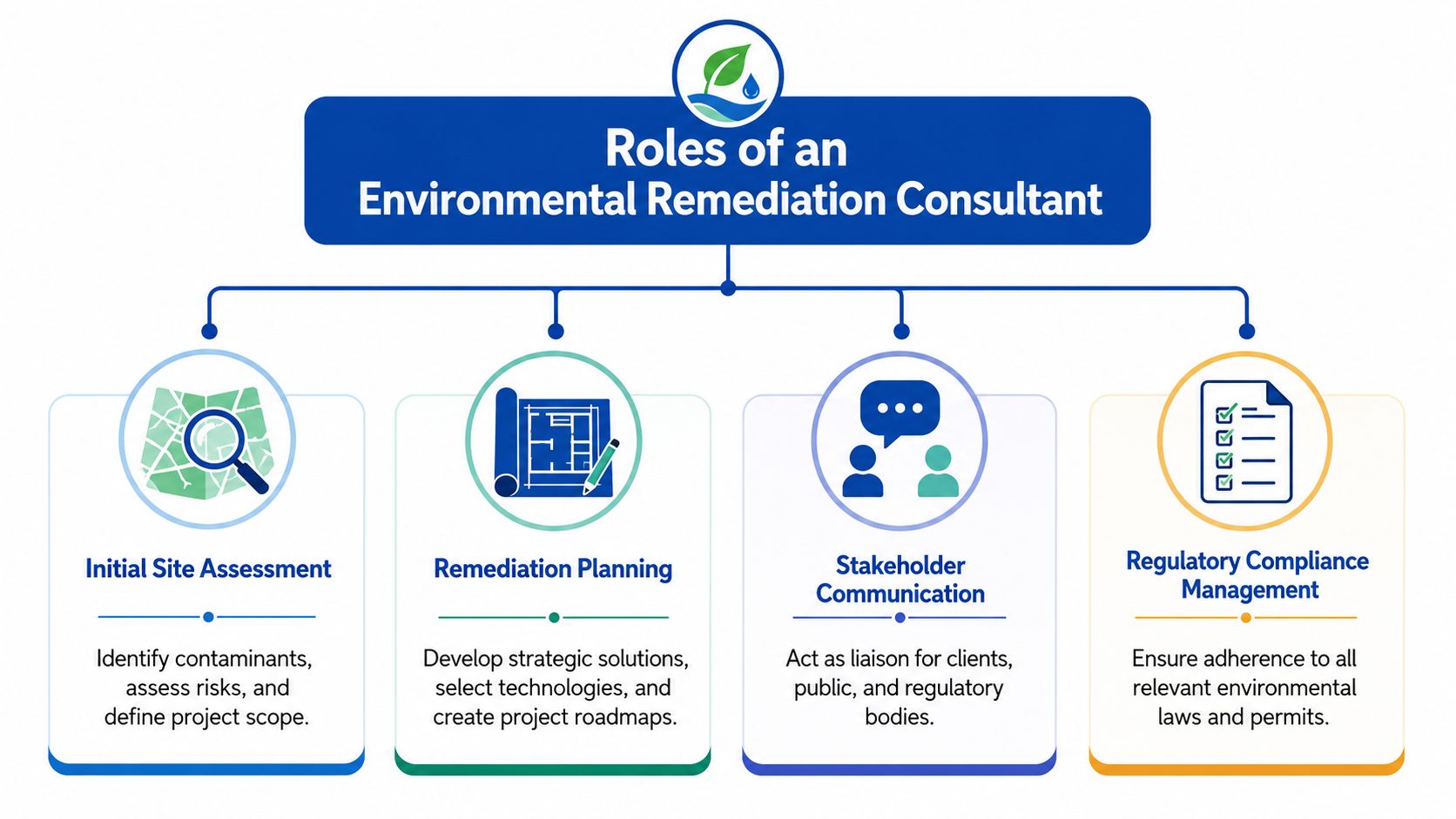
Initial assessment and diagnosis
Think of the first site assessment as a doctor's diagnostic exam for a property. No competent physician prescribes treatment before asking what happened, where it happened, how long it has been developing, and who may have been exposed. A remediation consultant works the same way.
They gather records, inspect the scene, identify likely contaminants, and determine where those contaminants may have traveled. On a soil and groundwater site, that might involve reviewing historic operations, drainage features, utility corridors, and prior reports. In a biohazard event, it may involve tracing splash zones, porous material impact, HVAC interaction, wastewater handling, and access routes used by occupants and first responders.
Building the Conceptual Site Model
The core product of early consulting work is the Conceptual Site Model, or CSM. It's the working map of how contamination began, where it is now, who or what could be affected, and which pathways matter most. If that model is wrong, the cleanup plan can fail even when the field crew performs perfectly.
Registered Environmental Consultants are legally required to ensure remediation documents, plans, and timing meet strict technical standards, and the heart of that responsibility is continual updating of the CSM because plume migration or a newly identified sensitive receptor can unravel an approved strategy, as outlined in the North Carolina REC rule.
A useful CSM usually answers questions like these:
- What is the source: A one-time release, repeated operational loss, decomposition event, drainage failure, or unknown legacy condition.
- Where has it migrated: Surface materials, subfloor assemblies, shallow soils, utility chases, groundwater, or indoor air pathways.
- Who could be affected: Occupants, technicians, neighbors, patients, maintenance staff, or future site users.
- What changes the plan: Rainfall, building occupancy, demolition limits, odor concerns, medical privacy, or agency reporting thresholds.
For occupied buildings, consultants often coordinate with mechanical contractors and facility teams to understand whether ventilation is spreading a problem. When indoor conditions are part of the concern, practical references on Mesa indoor air quality can help managers think through filtration, airflow, and room-use decisions while the formal assessment is underway.
A good consultant doesn't just tell you what was found. They tell you what it means, what it can affect next, and what must happen before anyone starts tearing materials out.
Planning, communication, and compliance
Once the model is solid enough, the consultant translates it into action. That includes selecting cleanup methods, sequencing subcontractors, coordinating sampling, and preparing the documentation that agencies and insurers expect.
Just as important, the consultant acts as interpreter. Property owners need plain language. Regulators need complete records. Insurance adjusters need scope clarity. Facility leadership needs to know whether they can reopen, isolate, or phase work. The consultant sits at the center of those conversations and keeps them aligned.
From Remediation Plan to Actionable Steps
A written remediation plan only helps if it turns into controlled field work. Once the investigation phase ends, the project becomes operational. Equipment arrives, permits are checked, waste streams are defined, and the site moves from theory to execution.
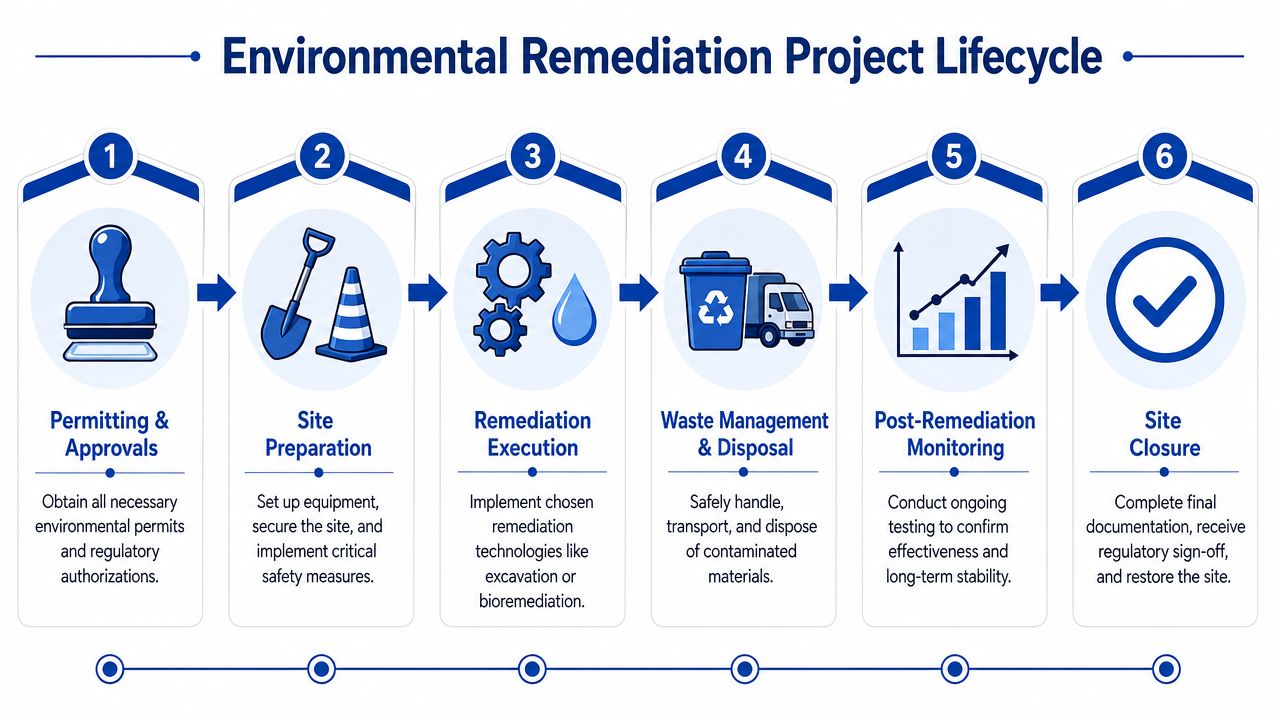
What happens after the plan is approved
The sequence is usually straightforward, even when the job itself is complicated.
- Permits and approvals are confirmed. Many owners underestimate the process at this stage. A permit isn't paperwork for its own sake. It defines what can be moved, treated, discharged, transported, or left in place.
- The work area is prepared. Contractors establish exclusion zones, staging areas, decontamination points, and traffic controls. In occupied facilities, they also build a separation plan so normal operations don't cross into active remediation.
- The remedy is implemented. That may mean excavation, removal of porous building materials, decontamination, pumping, treatment, encapsulation, or long-term control measures.
- Waste is profiled and shipped correctly. Every container, manifest, and destination matters.
- Verification and monitoring follow. The cleanup isn't done when debris leaves the site. It's done when testing, inspection, and documentation show that the objective has been met.
Waste handling is where compliance becomes real
The disposal phase is one of the easiest places for an unqualified provider to make a serious mistake. The Resource Conservation and Recovery Act governs proper disposal of hazardous waste by requiring permits for handling and transport, and the Clean Water Act prohibits releasing biohazardous materials into water sources and requires wastewater to be properly treated before disposal, as summarized in this discussion of RCRA and Clean Water Act waste rules.
That legal structure affects routine field decisions:
| Project task | What has to happen |
|---|---|
| Containerizing waste | Materials must be segregated and packaged according to the waste stream |
| Moving waste off site | Transport has to follow permit and manifest requirements |
| Managing wastewater | Liquids can't simply be discharged because cleanup generated them |
| Closing the job | Records must show where materials went and how the site was verified |
For projects involving impacted fill, leaking drums, or stained outdoor areas, the field scope may expand beyond surface cleanup into soil removal, confirmation sampling, and restoration. In those cases, a guide to contaminated soil remediation helps owners understand why excavation is only one part of the process.
Oversight keeps the project from drifting
Many troubled jobs don't fail because the selected remedy was impossible. They fail because no one actively managed field changes. Unexpected utilities appear. Waste volumes differ from assumptions. Odors migrate to occupied areas. Rain enters an excavation. A neighboring tenant complains.
Field reality: The cleanup plan should be stable, but the execution details almost always change. Good oversight catches those changes early and records them properly.
That is why the consultant's role continues during active work. Someone has to verify that the remedy still matches site conditions, that subcontractors are following the approved sequence, and that each adjustment is documented before it becomes a dispute.
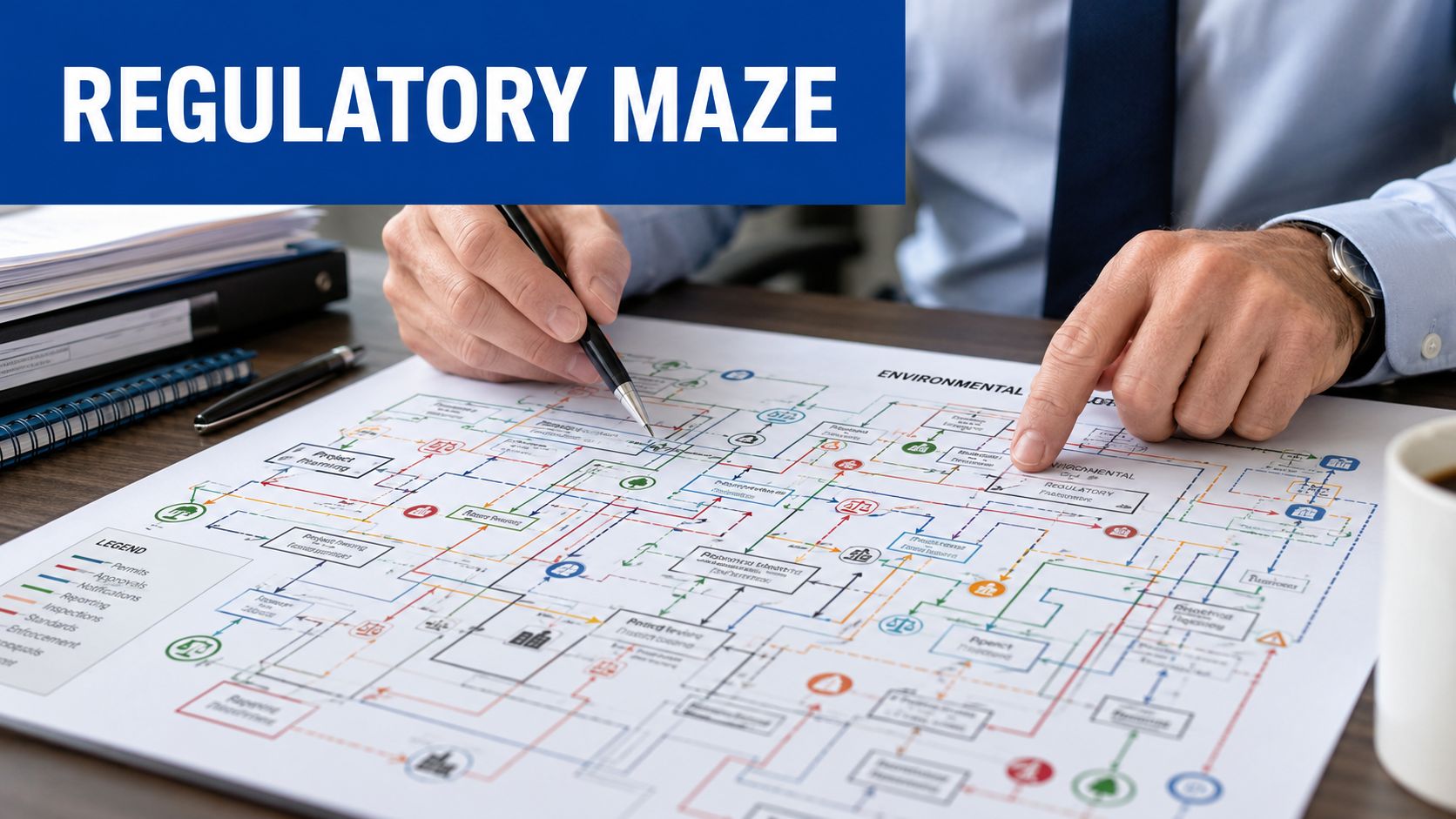
Navigating the Maze of Environmental Regulations
Most regulations affecting remediation work were written because people got hurt, contamination spread, records were poor, or waste was mishandled. Once you view compliance through that lens, the rules stop looking bureaucratic and start looking protective.
Worker safety rules are not optional
For biohazard and trauma-related events, the first compliance issue is often worker exposure. OSHA requires every employer with potential bloodborne pathogen exposure to maintain a written Exposure Control Plan identifying at-risk roles, safety procedures, and post-exposure steps, and it must be reviewed and updated annually under 29 CFR 1910.1030, as explained in this overview of the OSHA Exposure Control Plan requirement.
That single requirement tells you a lot about what a professional operation should look like. Teams shouldn't be improvising PPE decisions, decontamination methods, or exposure reporting in the field. They should be working from a documented program that has already defined those actions before the phone rings.
Emergency roles require different training levels
The law also distinguishes between workers who defend a scene and workers who take offensive action to stop or control a hazardous release. Under the OSHA HAZWOPER standard, responders in an offensive role during declared hazardous substance emergencies must complete 24 hours of training equivalent to the hazardous materials technician level, while defensive first responders require 8 hours of training, according to OSHA's HAZWOPER interpretation on emergency response training.
That matters for hiring. It means “general cleaning experience” is not the same thing as emergency remediation competence. If a provider is expected to enter a scene, control a hazardous release, manage contaminated materials, and protect downstream occupants, training thresholds become part of your risk analysis.
Compliance protects operations as much as people
For facility managers, the practical consequences of non-compliance are immediate:
- Work stoppages: Agencies, landlords, or internal safety officers can halt a project that lacks proper controls.
- Insurance friction: Carriers often scrutinize scope, training, and documentation when a claim involves contamination.
- Evidence problems: In trauma, industrial, or death-related scenes, poor handling can complicate related investigations.
- Reopening delays: You can't confidently return a room, unit, or building to service without records that support the decision.
A formal environmental compliance assessment is often the fastest way to identify those gaps before they become a notice of violation, a denied claim, or a second cleanup.
Compliance should reduce uncertainty. If the process is making the site more confusing, the management structure is wrong.
Understanding Remediation Costs and Timelines
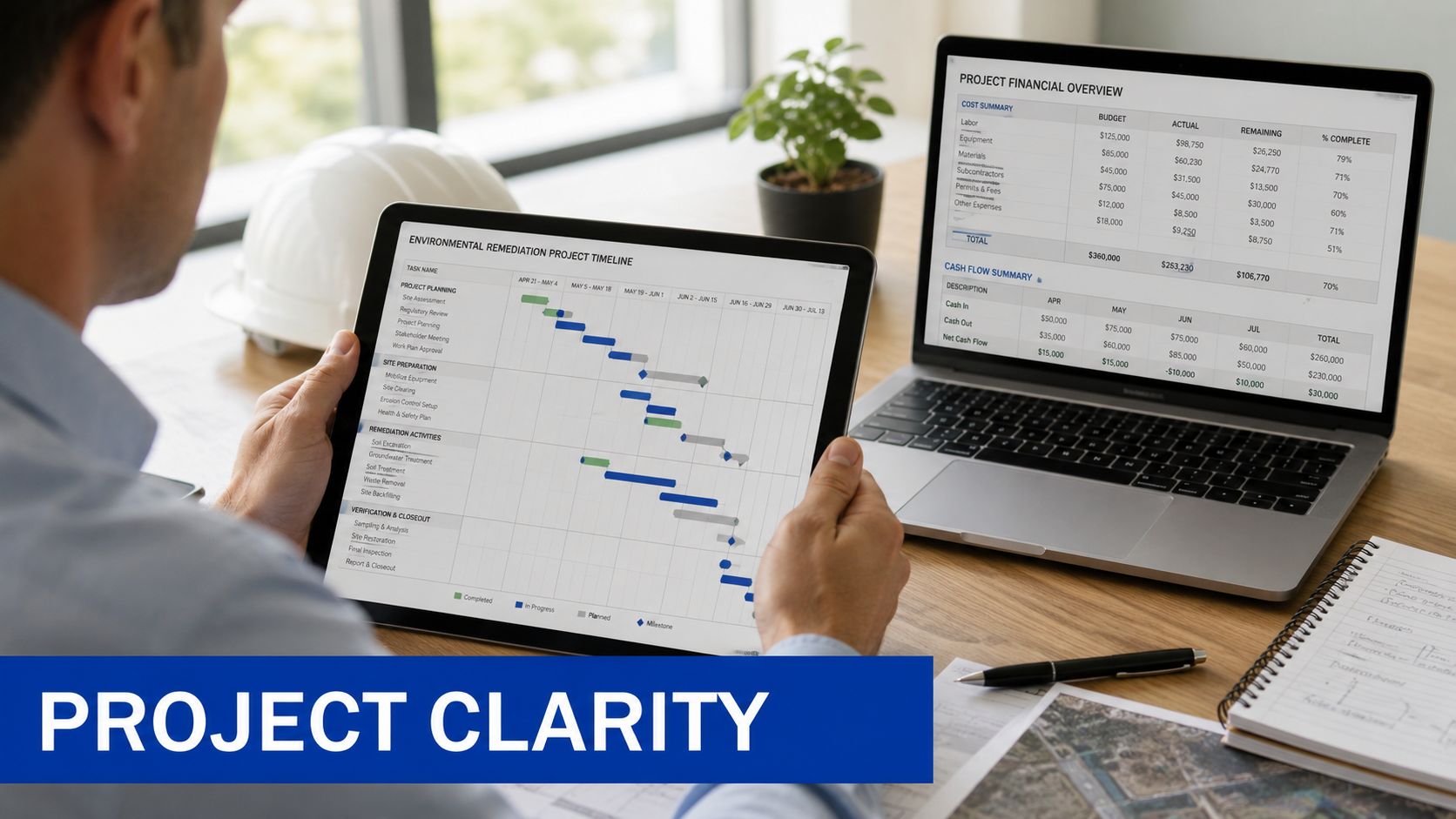
Cost questions usually arrive early, and for good reason. Owners need to know whether they're facing a short operational disruption, a capital project, or a long-term management obligation.
What actually drives price and duration
The biggest cost driver is usually not the contaminant itself. It's the combination of extent, accessibility, and regulatory pathway.
A contained event inside one room may require specialized removal, cleaning, clearance, and waste disposal, but still remain operationally simple. A release that reaches wall cavities, slab cracks, utility trenches, or groundwater becomes a very different project. The same is true when work has to happen around active patients, tenants, manufacturing lines, or public entry points.
Timeline follows the same logic. Delays often come from approvals, access restrictions, off-site disposal coordination, and the need to verify that the remedy worked. Even a technically modest cleanup can stretch if the site stays occupied or if multiple parties need to sign off on each step.
A clear estimate should separate at least these categories:
- Investigation scope: Sampling, inspection, records review, and hazard mapping
- Active cleanup work: Labor, containment, equipment, and treatment or removal methods
- Waste management: Packaging, transport, manifests, treatment, and disposal
- Verification and reporting: Clearance testing, final documentation, and agency or insurer submissions
For owners trying to prepare financially before authorizing work, this overview of a transparent biohazard cleanup quoting process is useful because it shows how responsible contractors break down scope rather than hiding uncertainty inside one broad number.
When “leave it in place” costs more
One of the least understood paths in remediation is the Technical Impracticability waiver, often shortened to TI. It allows contamination to remain in place only when the remediator proves no currently available technology can meet the standard and further cleanup would be futile or cause unacceptable collateral damage.
A TI waiver is not a shortcut. It often requires a Remedial Action Permit, engineering controls, biennial certifications, and potentially decades of monitoring, making it typically more expensive upfront and longer-tailed than conventional remedies, as discussed in this explanation of Technical Impracticability waivers.
That changes the financial conversation in a major way. Some sites can't be excavated because of highways, rail corridors, buried infrastructure, dense non-aqueous phase liquids in low-permeability soils, or the risk of causing greater ecological damage during aggressive removal. In those cases, the cheapest-looking option on day one may produce the longest compliance obligation.
Here's a helpful reality check before approving any long-term plan.
The most honest answer on timing
No experienced consultant should promise a universal timeline. The credible answer is narrower and more useful: define what can happen immediately, what depends on lab data or approvals, and what will remain under monitoring after field crews leave.
That kind of transparency helps owners plan staffing, tenant communication, insurer coordination, and reopening decisions without false certainty.
How to Select the Right Remediation Partner
Choosing a remediation partner is one of the few decisions that affects every other outcome on the job. The wrong team can slow containment, confuse reporting, mishandle waste, and leave you arguing over scope while the property remains impaired.
The selection risk is not theoretical. 40% of contaminated site projects face delays due to poorly matched consultants, according to this discussion of consultant selection error and project delays. For owners, adjusters, and property managers, that usually means a consultant understood one side of the problem but not the other. They knew the science but not emergency logistics, or they could dispatch a crew but couldn't manage the compliance trail.
What to verify before you hire
Start with fit, not slogans. A consultant who mainly handles long-term groundwater programs may not be the right choice for an occupied building after a traumatic death. A crew that handles visible scene cleaning may not be equipped for hazardous waste classification, wastewater controls, or multi-agency documentation.
Use a screening checklist that asks direct questions:
- Scope match: Have they handled incidents like yours, in properties like yours, with similar occupancy constraints?
- Credentials and training: Can they explain who will assess, who will supervise, and what training applies to emergency hazardous work?
- Waste pathway: Do they have a clear process for packaging, transport, treatment, and final disposal documentation?
- Insurance coordination: Can they provide the records carriers typically ask for without slowing the field response?
- Discretion: Can they operate in a way that protects privacy, including unmarked vehicles when appropriate?
- Communication habits: Will one person own updates, approvals, and decision logs from intake through closure?
Signs you're talking to the right kind of partner
The best conversations are usually plainspoken. They don't rush to promise a one-size-fits-all solution. They ask about occupants, drains, porous materials, HVAC, access, timing, and prior incidents. They explain what they know, what they don't know yet, and what they need to verify before quoting final scope.
Ask one question early: “If this turns out to be larger than it looks today, how will you expand the response without losing compliance?” The answer tells you whether they've actually managed complex events.
A strong provider should also be comfortable working with families, facility leaders, insurers, law enforcement, and maintenance staff without letting the process become chaotic. That balance matters in emotionally charged events where privacy and speed both matter.
For readers who need a benchmark for what a specialized provider should offer, a professional biohazard remediation company should be able to explain emergency response, regulated waste handling, documentation, and client communication in the same conversation. If those pieces live in separate silos, expect friction later.
What doesn't work
Low-detail proposals are a warning sign. So are vague references to “deep cleaning” when the issue may involve hazardous exposure, regulated waste, or environmental release pathways. Another common problem is a provider who treats every incident as either a janitorial task or a major engineering project. Real remediation work sits in between those extremes more often than clients realize.
The right partner narrows uncertainty. The wrong one adds to it.
Frequently Asked Questions About Remediation
Do I have to report contamination right away
Sometimes yes, sometimes no, and the trigger depends on what was released, where it migrated, and which agency has jurisdiction. The safest first step is to document the condition, restrict access, and get a qualified assessment quickly. Reporting obligations can attach before cleanup starts, so it's risky to assume you can “handle it discretely” without first understanding the hazard.
Can my maintenance team clean up a small incident themselves
Only if the event falls within their training, protective equipment, and legal handling authority. Once there's a credible risk involving bloodborne pathogens, hazardous waste, wastewater, unknown substances, or occupant exposure, this stops being routine maintenance. A fast professional assessment is usually the lowest-risk option.
Will remediation hurt property value
Unmanaged contamination usually creates more value loss than documented remediation does. Buyers, lenders, tenants, and carriers tend to react worst when records are incomplete or the condition appears hidden. A well-documented cleanup can support confidence because it shows the issue was identified, controlled, and closed out properly.
How long before we can reopen the space
That depends on the hazard, the affected materials, and whether the site needs verification testing, odor control, or regulatory sign-off. Some spaces return quickly after removal and cleaning. Others need a phased reopening plan so occupants don't re-enter before the environment is safe.
What should I gather before calling a consultant
Collect incident notes, photos if they can be taken safely, building plans if available, information on who entered the area, and any details on drains, HVAC, or visible spread. Don't disturb the scene just to make it look cleaner. Early conditions often help the consultant choose the right control measures.
What if I need both emergency help and longer-term environmental guidance
That's common. A single event can begin as a trauma or hazmat response and later require waste documentation, structural removal, indoor air review, or subsurface investigation. The best outcome usually comes from engaging a team that can manage the immediate crisis while preserving the technical record needed for the next phase.
When contamination disrupts a property, speed matters, but disciplined response matters more. 360 Hazardous Cleanup provides 24/7 biohazard remediation, trauma scene cleanup, hazmat support, and environmental mitigation services with a strong focus on safety, discretion, regulatory compliance, and compassionate care. If you need a trusted team that can move quickly, document thoroughly, and help you work through both the immediate emergency and the compliance path that follows, they're ready to help.