A lot of contaminated soil problems start with an ordinary project. A groundskeeper digs near a building and hits stained soil. A facility manager ordering a property assessment learns there may be old petroleum impacts near a loading area. A homeowner replacing a fence uncovers debris, odd odors, or a forgotten tank line. In a single afternoon, a routine job turns into questions about safety, liability, cleanup, and whether the problem is bigger than anyone thought.
That uncertainty is real. People often worry about health risks, business disruption, resale value, and whether regulators will get involved. They also worry about making the wrong first move. Those concerns are valid, but the situation is usually more manageable than it first feels.
Contaminated soil remediation is a structured process. Professionals identify what's in the soil, define where it starts and stops, choose the right cleanup method, document the work, and verify that the site meets the required standard for its intended use. Good remediation doesn't rely on guesswork. It relies on sampling, engineering judgment, and careful compliance.
For property owners and facility managers, the most important thing to know is simple: don't ignore the problem, and don't panic. Treat it the same way you'd treat any serious site hazard. Recognize it early, control access if needed, and bring in qualified help. If you're already dealing with a broader safety concern on the property, this guide on how to recognize a biohazard in your home or workplace can help you think clearly about risk identification and next steps.
Discovering a Problem Beneath Your Feet
A commercial property owner once called after a routine paving project exposed dark, odorous soil near an older service area. No one had seen a spill happen. There was no dramatic event. But the stain pattern, location, and smell suggested the soil had been affected for a long time.
That's common. Contamination is often discovered during renovation, due diligence, storm damage, utility work, or a sale. The issue may be recent, but just as often it's historical. Dry cleaners, fueling areas, maintenance shops, industrial operations, old dumping practices, and legacy fill can all leave a footprint below grade.
Why discovery feels overwhelming
The first shock usually comes from not knowing what the finding means. Soil doesn't come with labels. A dark patch might be petroleum, but it could also be something else. Some contamination has no odor at all. Some sites have more than one problem at the same time.
People also tend to jump straight to worst-case scenarios:
- Health fears: Is anyone being exposed right now?
- Project delays: Will construction have to stop?
- Property concerns: Will this affect value or financing?
- Legal stress: Does this trigger reporting or cleanup obligations?
Those are fair questions. They just shouldn't be answered by assumption.
The first phase of a soil problem isn't cleanup. It's figuring out what's actually there.
The practical first response
If contaminated soil is suspected, professionals usually start by slowing the situation down. They gather site history, note current conditions, and determine whether immediate controls are needed. That may mean pausing excavation, limiting access to a work area, or coordinating sampling before more soil gets moved.
This early discipline matters. Once contaminated soil is spread around a site, loaded into mixed piles, or tracked into clean areas, the job becomes harder to define and harder to defend. A careful start protects both safety and documentation.
For most owners, that's the emotional turning point. Once the problem shifts from rumor to investigation, it becomes a project with a path forward.
What Is Contaminated Soil and Why Does It Matter
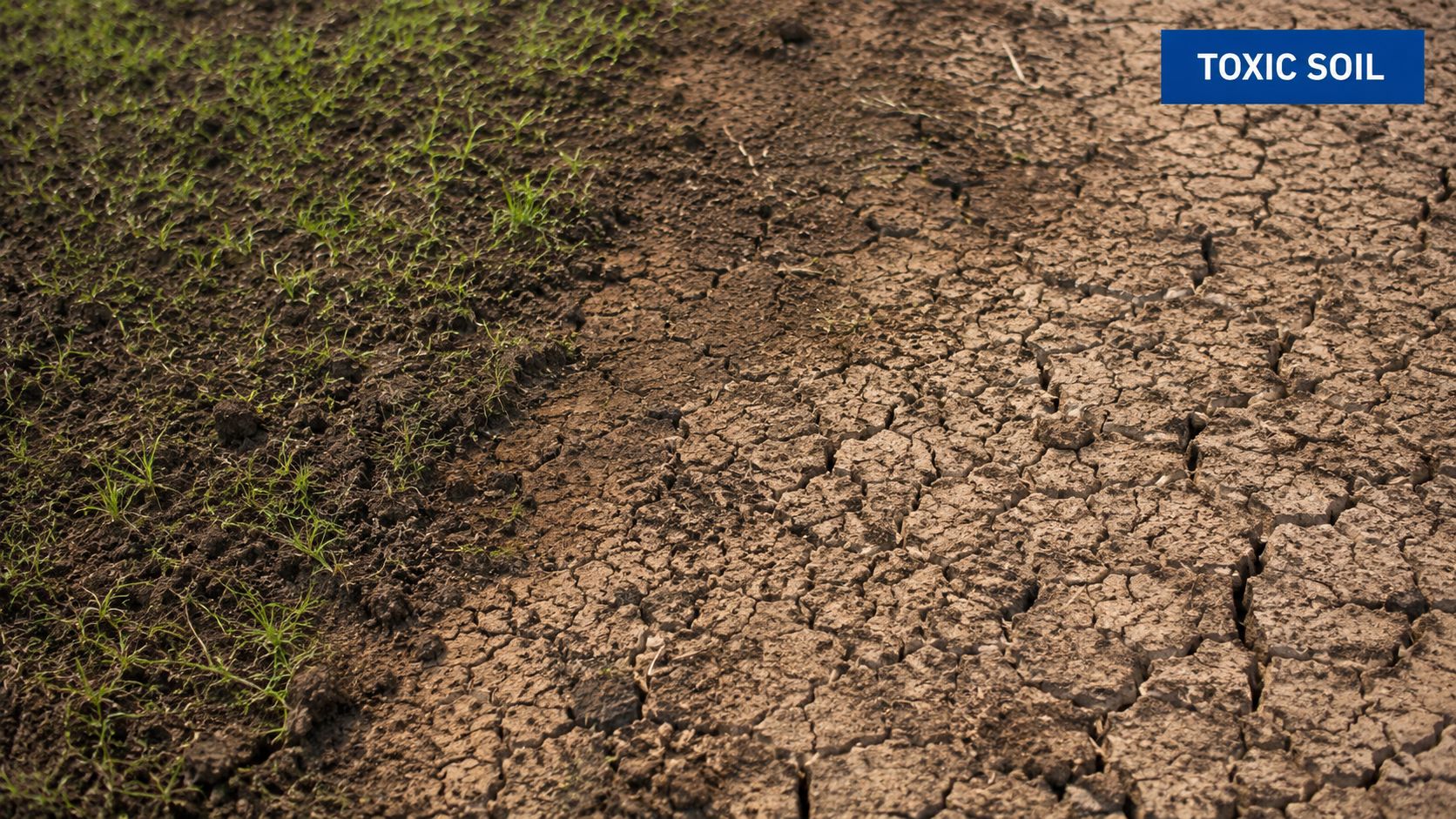
Contaminated soil is soil that contains substances at levels that make it unsafe for people, buildings, groundwater, or the site's intended use. Those substances can come from leaks, spills, industrial activity, waste disposal, pesticides, fill materials, or older land uses that no longer exist on the property.
In plain terms, the soil is no longer just dirt. It has become a medium that can hold, spread, and sometimes release harmful material over time.
How contamination behaves
A useful analogy is a sponge with liquid trapped inside it. Soil can hold contaminants in pore spaces, on particle surfaces, or in pockets at different depths. Rain, groundwater movement, excavation, or vapor migration can move that contamination into surrounding areas.
That's why a soil problem rarely stays just a soil problem. It can affect workers during excavation, create vapor concerns inside structures, migrate toward groundwater, or complicate future renovations and transactions.
Why owners shouldn't ignore it
The consequences aren't only environmental. They're operational and financial too.
- Human exposure: People can come into contact with contaminated soil directly, breathe dust, or be affected by vapors in some cases.
- Property disruption: Construction schedules, leasing plans, and refinancing can all get more complicated.
- Liability: If contamination spreads or isn't handled correctly, the owner may face a more difficult cleanup later.
- Waste handling issues: Soil that's removed from a site often has to be profiled, transported, and disposed of properly. This overview of what qualifies as hazardous waste and how it's disposed of safely helps explain why disposal decisions matter so much.
Not all contaminants behave the same way
One reason contaminated soil remediation can feel confusing is that different contaminants need different strategies. Heavy metals, petroleum hydrocarbons, chlorinated solvents, and emerging contaminants don't move, persist, or respond to treatment in the same way.
A growing example is PFAS, which many owners now hear about during due diligence and regulatory review. EPA's remediation technology descriptions note that emerging contaminants like PFAS are a growing concern, and that states such as New Jersey have created interim soil leachate standards for PFNA, PFOA, and PFOS to protect groundwater, while standards for compounds like GenX were still developing because the science and regulation were still evolving (EPA remediation technology descriptions). That's why a one-size-fits-all cleanup approach often fails.
Practical rule: The question isn't just “Is the soil contaminated?” The real question is “Contaminated with what, where, how deep, and along which exposure pathway?”
Once those answers are clear, the remediation plan starts to make sense.
Common Contaminated Soil Remediation Technologies Explained
A property owner often starts this conversation with one urgent question: “Are you going to have to dig up my whole site?”
Sometimes the answer is yes. Often, it is no. The right remedy depends on what is in the soil, how it behaves, whether it threatens people or groundwater, and what regulators will accept as a protective cleanup endpoint. That is why remediation can look less like one standard service and more like a doctor choosing the right treatment plan after a diagnosis.
The main tools in the remediation toolbox
Each remediation technology solves a different kind of problem. Some remove contaminated soil from the property. Some treat it in place. Some reduce risk by keeping contaminants from moving. A good plan matches the method to the chemistry, the property layout, the future use of the site, and the legal standard the owner must meet.
Here is what the common options mean in practical terms.
Excavation
Excavation is the most direct approach. Crews remove the affected soil and send it for treatment or disposal at an approved facility.
Owners often prefer excavation because it feels decisive. You can see trucks leave, see clean fill come back, and understand that the impacted soil is no longer under your building pad, parking lot, or yard. The tradeoff is disruption. Equipment access, utility clearance, dust control, truck routing, waste profiling, disposal documentation, and site restoration all have to be handled carefully to protect workers, neighbors, and your compliance record.
Excavation is usually a strong fit when the contaminated area is well defined and accessible.
Bioremediation
Bioremediation uses microorganisms to break down certain organic contaminants under the right conditions. EPA's CLU-IN program describes it as the use of microorganisms to degrade organic contaminants in soil, groundwater, sludge, and solids.
This method can work well for petroleum-related impacts and other organics that microbes can digest over time. It works more like a healing process than a construction project. The site may need oxygen, nutrients, moisture control, or other adjustments so those microorganisms can do their job. That makes bioremediation appealing when the contaminant is a good match and the schedule allows for gradual treatment.
If you want a clearer overview of how this method works, this guide on understanding bioremediation as nature's cleanup crew explains the concept in plain language.
Chemical treatment and stabilization
These two methods are related, but they do different jobs.
Chemical treatment uses amendments that react with contaminants and change them into less harmful forms. Stabilization focuses on reducing how easily contaminants can move through the soil. In plain terms, one approach changes the chemistry, while the other helps keep the contamination from spreading.
That distinction matters for owners. If the main concern is preventing migration into groundwater or limiting exposure during redevelopment, stabilization may be a sensible path. If regulators require a reduction in toxicity or mobility, the design has to show that the treatment will hold up under real site conditions, not just in theory.
Soil vapor extraction
Soil vapor extraction is highly effective in the right setting and disappointing in the wrong one. EPA identifies it as a standard technology for volatile and semivolatile organics, and it is most effective when contaminants are highly volatile and located in the unsaturated zone above groundwater (EPA remediation technologies for contaminated sites)).
A simple way to picture it is air movement through the empty spaces between soil particles. The system pulls contaminant vapors out of those spaces for treatment. If the site is dealing with metals or other contaminants that do not readily vaporize, this method will not address the main risk. It is a targeted tool, not a universal fix.
Thermal treatment
Thermal treatment uses heat to destroy contaminants or drive them out of soil so they can be captured and treated. EPA notes that thermal methods are commonly used for soils containing volatile or combustible compounds such as solvents, petroleum hydrocarbons, BTEX, PAHs, and chlorinated pesticides.
This can be a strong option when fast, aggressive treatment is needed and the contaminant profile supports it. It is also one of the more technically demanding choices. Heat delivery, vapor capture, air permitting, energy use, and worker safety all need careful planning. For a property owner, the question is not whether thermal treatment sounds advanced. The question is whether it solves the specific problem in a way regulators will approve and your project budget can support.
Comparing soil remediation methods
| Technology | Best For | Typical Timeline | Key Consideration |
|---|---|---|---|
| Excavation | Clearly defined contaminated areas that need immediate removal | Often immediate once work begins | Requires disposal planning, site access, and restoration |
| Bioremediation | Organic contaminants that microorganisms can degrade | Often gradual | Needs the right site conditions and patience |
| Chemical treatment | Contaminants that respond to reactive amendments | Varies by design and site conditions | Distribution in soil must be carefully engineered |
| Stabilization | Contaminants better immobilized than removed | Varies | Often leaves treated material in place with ongoing management needs |
| Soil vapor extraction | Highly volatile contaminants in the unsaturated zone | Varies | Won't effectively address nonvolatile contaminants |
| Thermal treatment | Solvents, petroleum hydrocarbons, PAHs, and similar heat-responsive compounds | Varies | Higher complexity and strong contaminant match are important |
The best remediation plan protects more than soil. It protects the people who use the property, reduces the chance of future liability, and gives you a defensible path to closure with regulators.
The Remediation Process From Assessment to Closure
A soil problem often becomes real in a single phone call. A lender asks for documentation before closing. A buyer wants proof the site is safe. A regulator requests more information after a complaint or spill report. In that moment, owners usually need the same thing. A clear process that replaces uncertainty with facts, action, and a path to closure.
Stage one and two
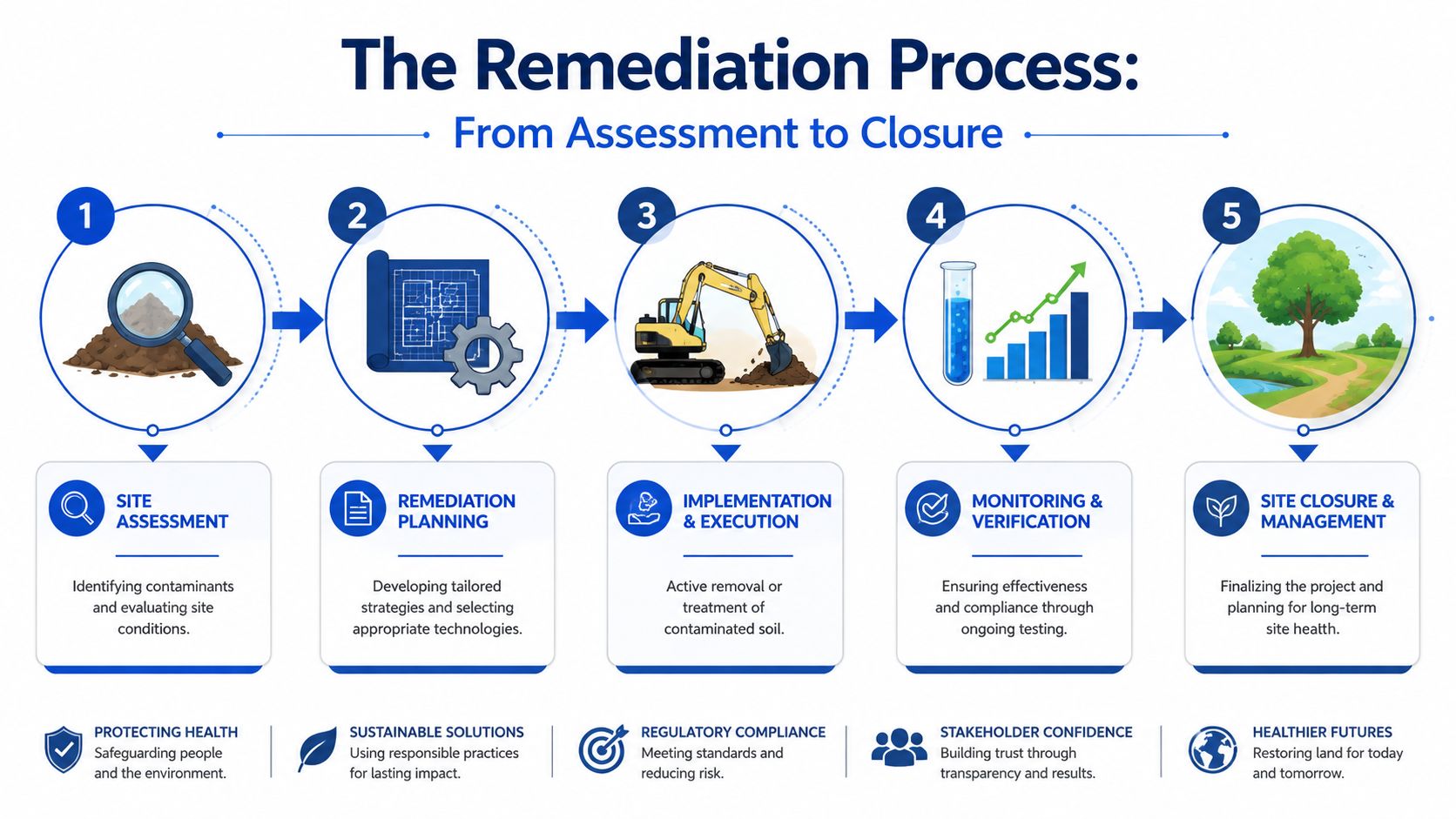
The process starts with site assessment. Your environmental team reviews how the property has been used, what chemicals or wastes may have been present, where utilities and structures sit, and whether there are signs that contamination may have spread beyond one obvious area. They are building the site's history before they disturb a shovel of soil.
Next comes sampling and characterization. This step works like a medical diagnosis. If the testing is too limited or poorly placed, the remedy can target the wrong area, miss deeper impacts, or treat clean soil as contaminated. Good characterization defines three things clearly: what contaminants are present, how far they extend, and whether they pose a risk to people, buildings, groundwater, or nearby property.
For an owner, that detail matters because early mistakes are expensive. They lead to redesigns, extra mobilizations, delayed permits, and uncomfortable questions from regulators or buyers later.
Stage three and four
Once the site is understood, the team develops a remediation plan. That plan sets the cleanup goal, explains the selected remedy, outlines worker and occupant protection measures, and describes how soil will be handled, transported, tested, or left in place under controls. It should also match the site's real-world constraints, such as active operations, tight access, ongoing tenants, or a redevelopment schedule.
Safety planning belongs here too. Firms with OSHA HAZWOPER, EPA, and IICRC training that goes beyond basic compliance are better prepared to protect workers, prevent cross-contamination, and document the job properly.
Then the work moves into implementation. Depending on the approved remedy, crews may excavate soil, place a cap, inject treatment materials, control vapors, segregate stockpiles, or load material for off-site disposal. Field conditions often change once work begins. Old fill appears. Utilities are closer than expected. Contamination extends farther in one direction than boring logs suggested. A disciplined team adjusts without losing control of the project.
Several field practices make that possible:
- Defined work zones: Impacted soil, clean soil, equipment staging, and decontamination areas are kept separate.
- Dust and runoff control: Water, covers, and containment reduce the chance of spreading contaminants across the site.
- Chain of custody and documentation: Samples, manifests, disposal tickets, and daily logs create a record that can stand up to review.
- Clear communication: Owners, consultants, contractors, and regulators stay aligned when conditions change.
That last point is easy to underestimate. Good communication protects schedule, budget, and credibility. It also protects your peace of mind during a stressful project. Even firms focused on effective contractor lead generation know that trust is built through clarity, responsiveness, and proof of competence. Remediation work demands the same discipline, only with far higher stakes.
Stage five
The final stage is verification and closure. After the active work is done, the team collects confirmation samples and compares the results to the cleanup criteria that apply to your site. They also assemble the paper trail: laboratory reports, waste manifests, disposal receipts, figures, field notes, and a summary of what was found and how it was addressed.
Some sites need added care during data review, especially for metals and other constituents that may occur naturally in local soils. The Interstate Technology & Regulatory Council explains that background comparisons should use areas with similar physical, chemical, geological, and biological characteristics, while avoiding disturbed locations and likely contamination sources, and using comparable analytical methods for background and site samples (ITRC soil background guidance). That helps prevent a naturally high result from being mistaken for site-related contamination.
Closure means more than finishing the fieldwork. It means you have a defensible record showing that the problem was investigated properly, addressed with an appropriate remedy, and documented in a way that supports future property decisions.
For many owners, that final report brings genuine relief. It helps with refinancing, sale, leasing, redevelopment, and the simple confidence of knowing the site has been handled responsibly and in line with regulatory expectations.
Understanding Costs Timelines and Regulatory Hurdles
The questions owners ask first are usually the hardest to answer quickly: How much will this cost, and how long will it take? There isn't a single universal answer because contaminated soil remediation is shaped by site-specific variables, not a flat price list.
What drives cost and schedule
Several factors influence the scope:
- Contaminant type: Petroleum, metals, solvents, and PFAS don't behave the same way or require the same remedy.
- Extent of impact: A shallow, well-defined area is very different from a deep or widespread problem.
- Site constraints: Active operations, tight access, utility conflicts, and occupied buildings can slow work.
- Disposal requirements: Removed soil may need profiling, special transport, or facility approval.
- Verification needs: Sampling, reporting, and regulatory review take time even after fieldwork ends.
Some remedies are fast in the field but complex in logistics. Others are less disruptive but unfold gradually over longer periods. The right question isn't only “What's cheapest?” It's “What reaches defensible closure with the least total risk?”
Why regulations matter to your budget
Cleanup standards can change as science improves. A major example is lead. The U.S. EPA tightened residential lead-soil screening levels in 2024 from 400 ppm to 200 ppm, with an even lower 100 ppm screening level used when multiple lead sources are identified. County Health Rankings also notes that a 15-centimeter clean soil cap is among the most effective and lowest-cost approaches for lead-contaminated soil abatement, and that economic models estimate children benefiting from lead abatement may generate future earnings and reduced medical costs worth 2 to 20 times the cost of abatement (lead-contaminated soil abatement interventions).
For owners, the lesson is straightforward. Regulatory targets aren't static. A strategy that seemed acceptable years ago may not match current expectations now.
Compliance is a project control issue
A qualified remediation partner helps you avoid expensive missteps such as under-scoping sampling, selecting the wrong disposal path, or using a remedy that regulators won't accept for closure. Credentials matter here, especially when health and safety, hazardous materials handling, and documentation all intersect. This explanation of why certifications and training matter beyond the basics shows why formal standards aren't just paperwork.
There's also a practical business angle. Owners often need fast, credible communication with stakeholders, tenants, buyers, lenders, and project partners while the remediation path is being defined. Firms that understand clear outreach and trust-building tend to perform better under pressure. This broader resource on effective contractor lead generation is useful because it highlights how good communication systems help service businesses respond quickly and consistently when clients are making high-stakes decisions.
Regulations can feel like friction when you're under deadline. In practice, they're the framework that makes a cleanup defensible.
How to Choose the Right Remediation Partner
When soil contamination is on the table, hiring a general contractor without environmental specialization is risky. This work sits at the intersection of safety, sampling, engineering, waste handling, and regulatory compliance. You need a team that can do more than move dirt.
What to look for first
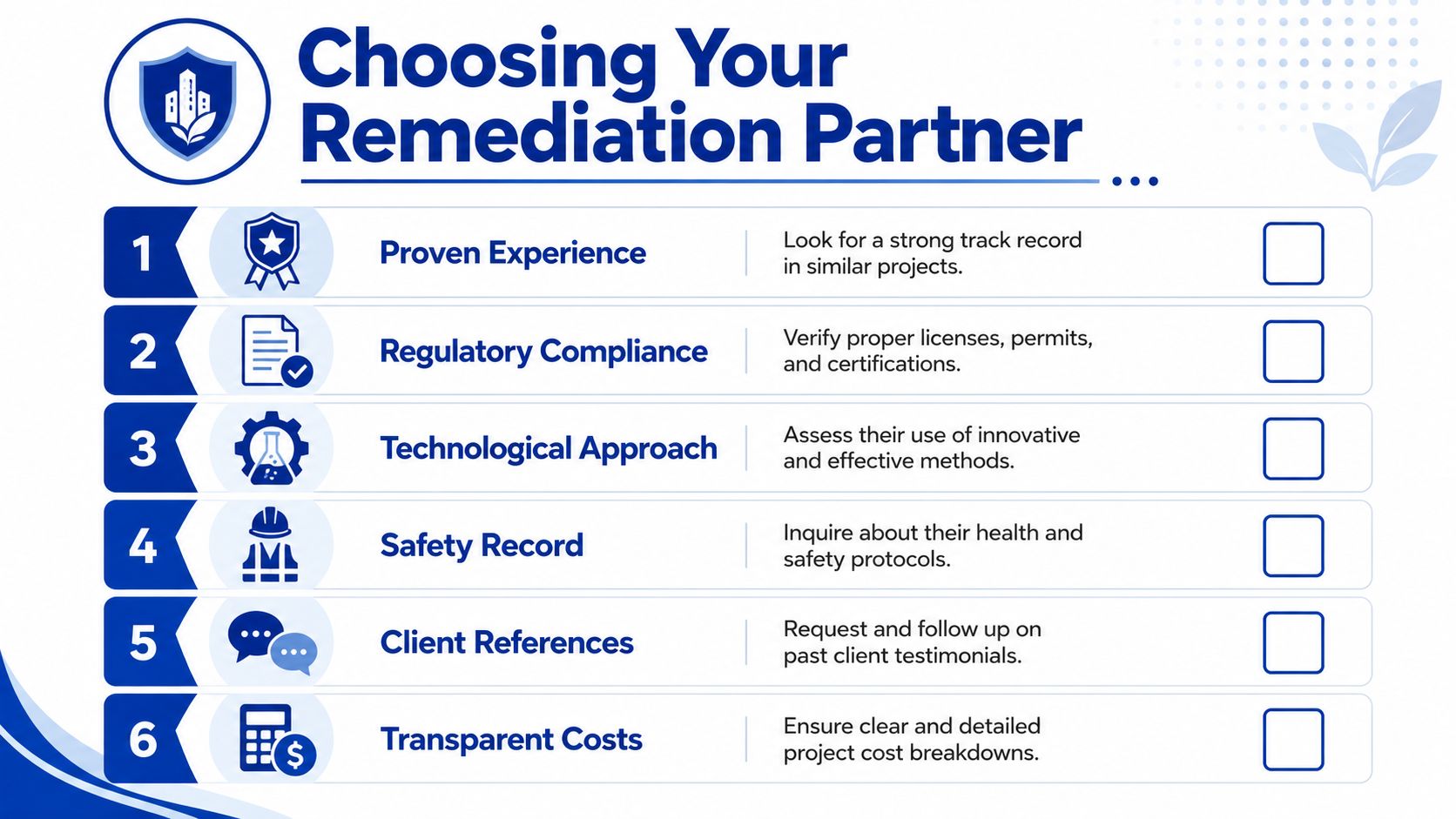
Start with evidence of competence, not just availability.
- Relevant experience: Ask whether they've handled sites with similar contaminants and property conditions.
- Regulatory fluency: They should understand permitting, reporting, waste profiling, and closure documentation.
- Safety systems: Ask how they protect workers, occupants, and adjacent operations during the job.
- Insurance and risk transfer: Pollution liability matters. So does clarity around subcontractors.
- Communication discipline: You want prompt updates, plain-language explanations, and written documentation.
If you're vetting options, this guide on finding and choosing a trusted cleanup partner is a useful framework for evaluating professionalism under stress.
Questions worth asking in the first call
Some of the best screening questions are simple:
- What contaminants do you think are plausible here based on the site history?
- How will you define the horizontal and vertical extent of impact?
- What remedy options do you expect to evaluate, and why?
- How will you separate clean and impacted material on-site?
- What documentation will I receive at the end for closure and future transactions?
A strong partner won't pretend to know every answer before sampling. That's a trust signal.
Trust signal: A qualified remediation firm is willing to say “we need more data before recommending the remedy,” instead of forcing a quick answer that may not fit the site.
What not to reward
Be careful with bids that sound easy because they skip over uncertainty. Low prices can hide missing scope, thin sampling plans, vague disposal assumptions, or weak documentation. Those omissions often resurface later as delays, change orders, or trouble achieving closure.
The right remediation partner brings technical judgment, regulatory discipline, and calm communication. In a stressful situation, that combination is what protects people, operations, and the property itself.
Restoring Safety and Confidence to Your Property
Contaminated soil can feel like a hidden threat because it sits out of sight and raises hard questions fast. But it's a solvable problem when it's approached correctly. The path forward starts with careful assessment, not assumptions.
The most effective owners act promptly and methodically. They document conditions, involve qualified professionals, choose remedies based on contaminant behavior, and insist on verification that can stand up to regulatory and transaction review.
That's the profound value of professional contaminated soil remediation. It doesn't just remove or control a hazard. It restores clarity. It protects health, reduces liability, supports future property use, and gives people confidence that the site is safe to manage, occupy, or transfer.
If you're facing a possible soil contamination issue and need a calm, knowledgeable team to help you assess the hazard and move toward safe, compliant resolution, 360 Hazardous Cleanup can help guide the next steps with professionalism, discretion, and care.