You may be dealing with this right now. A staff member reports a bodily fluid incident in a restroom, a patient room has turned over after an isolation case, or a production area needs disinfection without shutting down the whole facility longer than necessary. The pressure lands on you fast. Keep people safe, avoid cross-contamination, document the response, and make sure the work would stand up to scrutiny later.
That's where many facility managers run into a hard truth. Standard spray-and-wipe cleaning doesn't always reach the surfaces that matter most. Door hardware, chair frames, undersides of fixtures, textured walls, vents, and equipment edges can all create small blind spots. In ordinary janitorial work, that may be inconvenient. In a biohazard or infectious disease setting, it can become a real risk.
Beyond Standard Cleaning A New Era of Disinfection
Electrostatic spraying has moved from a specialty method to a mainstream disinfection tool because it solves a practical problem. Facilities need broader, more consistent surface coverage without relying on a technician to physically wipe every angle by hand.

That adoption trend is visible in the market itself. The global electrostatic disinfectant sprayer market is projected to grow from USD 340.5 million in 2026 to USD 642.8 million by 2033, reflecting wider use across healthcare, commercial, and industrial settings for rapid surface disinfection, according to Coherent Market Insights' electrostatic disinfectant sprayer market analysis.
Why traditional methods can fall short
A mop, trigger bottle, and rag still have their place. They're useful for visible soil, spot treatment, and final detail cleaning. But they depend heavily on line-of-sight application and hand contact. If a worker can't easily reach the backside of a handrail or the lower edge of a workstation, coverage often becomes uneven.
That matters in buildings where contamination doesn't stay neatly on flat surfaces. Healthcare spaces, behavioral health environments, warehouses, offices, schools, and shared amenities all contain objects with corners, seams, and hidden edges. The more complex the geometry, the more likely a simple spray pattern will miss part of it.
Operational reality: Facility risk often comes from the surfaces staff assume were covered, not the ones they know were missed.
Electrostatic spraying is attractive because it addresses that coverage problem directly. It's not just another gadget in a cleaning closet. It's a professional method designed for situations where consistent deposition on many surfaces matters more than speed alone.
Why managers are looking beyond visible cleanliness
Many managers now have to think past appearance and focus on verifiable process. Occupants want reassurance. Leadership wants documentation. Infection prevention teams want a method that supports broader contact across exposed surfaces. In food-adjacent settings, the same mindset applies to allergen control and food safety, where cross-contact and incomplete treatment can create downstream problems.
In healthcare environments especially, surface disinfection has to fit a larger infection prevention strategy, not operate as a standalone promise. That's why many teams pair this technology with established hospital infection control practices, containment protocols, and product-specific disinfectant instructions.
How Electrostatic Spraying Achieves Total Coverage
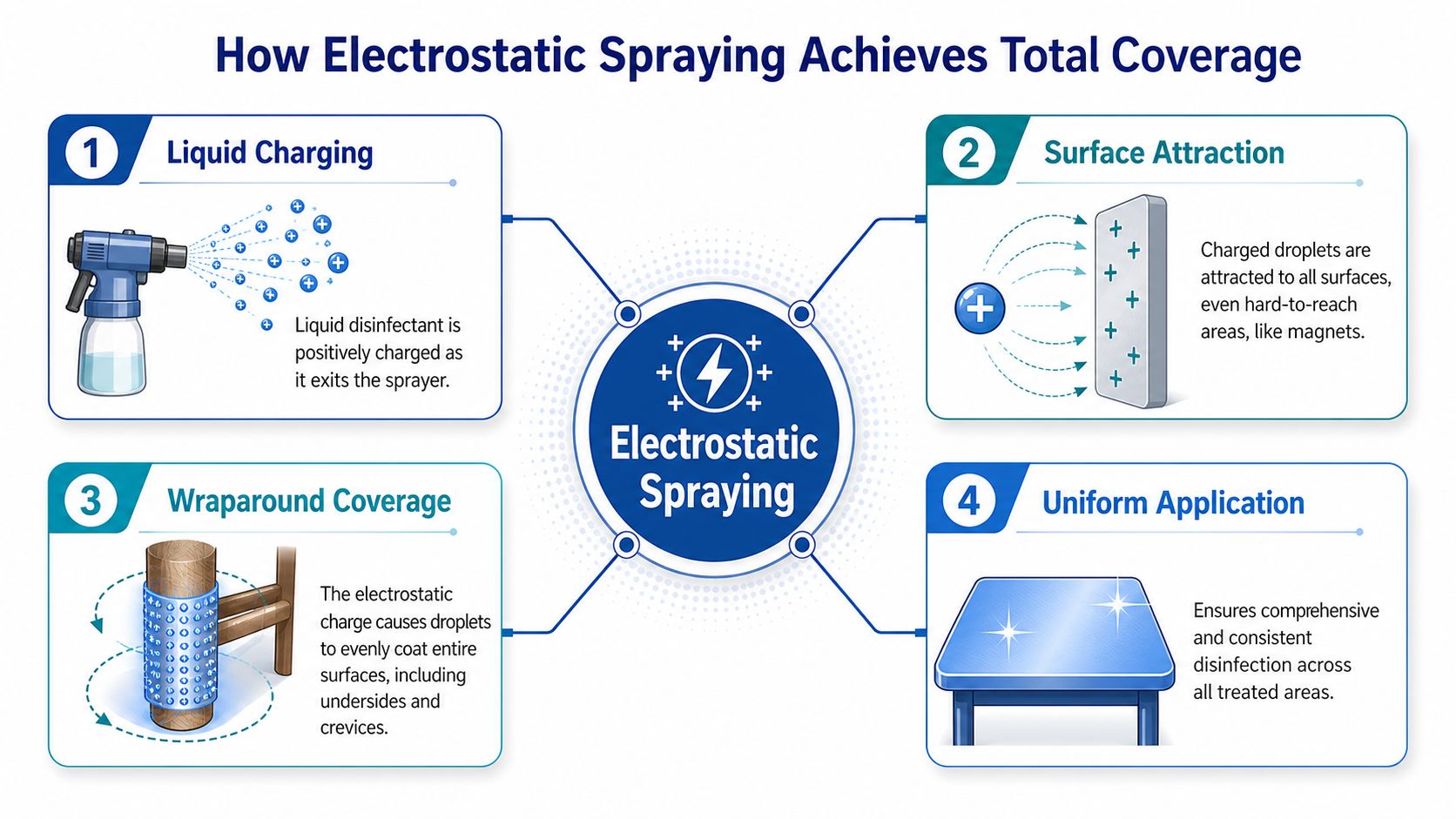
The easiest way to understand electrostatic spraying is to think about static cling. Rub a balloon on fabric and it starts attracting nearby surfaces. Electrostatic sprayers use that same basic principle in a controlled way. The machine atomizes liquid into fine droplets, then applies an electrical charge so those droplets are drawn toward the target surface.
What happens inside the process
An electrostatic system works through three linked actions:
Atomization
The sprayer turns liquid disinfectant into small droplets at the nozzle.Charging
A high-voltage generator gives those droplets an electrical charge.Directed delivery
The charged droplets move toward grounded or oppositely receptive surfaces instead of drifting randomly.
The U.S. EPA's evaluation of electrostatic sprayers describes this atomization-charge-delivery sequence and reports evaluated flow rates ranging from 1.9 to 17 oz/min, with some AC units generating charge levels of about -3.0 to -6.0 mC/kg in testing, as outlined in the EPA review of electrostatic sprayers for disinfectant application.
Why the droplets wrap instead of just landing
With a standard spray bottle, most droplets travel in a straight path. They hit the surface you aimed at, and many never reach the side, underside, or back edge. Electrostatic spraying changes that behavior. The charged droplets are pulled toward the target and tend to cling instead of bouncing off or falling away.
That's why operators talk about a wraparound effect. On a chair leg, bed rail, cart handle, or fixture mount, droplets can move beyond the first point of contact and settle more uniformly around the object.
A good mental model is a magnet drawing metal filings around all sides of an object, not just the side facing your hand.
This is one reason electrostatic spraying improves transfer efficiency. According to Graco's technical explanation of electrostatics, electrostatic spraying improves transfer efficiency by over 50% compared to conventional methods because the electrostatic field drives droplets to wrap around and adhere to grounded targets.
A short visual makes that easier to see in motion:
What that means for facility decisions
For a manager, the value isn't the physics by itself. The value is what the physics allows your team to do. It can improve consistency on irregular surfaces, reduce overspray compared with less controlled methods, and support a more methodical disinfection process when paired with the right chemical and technique.
It's also important not to confuse broader coverage with a stronger kill claim. Coverage and kill efficacy are different issues. The sprayer helps place the product where it needs to go. The disinfectant still has to be appropriate for the target pathogen and used correctly within the broader distinction between sanitizing, disinfecting, and sterilizing.
Where readers often get confused
Two misconceptions come up all the time:
“If it coats everything, I can skip cleaning first.”
You can't. Soil, residue, and absorbent contamination can block disinfectant contact.“If the droplet is charged, it will solve any application problem.”
It won't. Surface condition, grounding, operator distance, nozzle setup, and product compatibility still matter.
Electrostatic spraying is powerful because it improves how the liquid reaches the surface. It doesn't replace judgment, training, or protocol.
Electrostatic Spraying vs Fogging and Misting
Facility managers often hear these terms used as if they mean the same thing. They don't. Electrostatic spraying, ULV fogging, and misting are distinct approaches, and each behaves differently in occupied buildings, healthcare spaces, and biohazard responses.
The most useful question isn't which one sounds more advanced. It's which method gives you the right combination of surface targeting, environmental control, and protocol fit for the incident in front of you.
What changes from one method to another
Electrostatic spraying is primarily a targeted surface disinfection tool. The operator applies a charged disinfectant to defined surfaces so it adheres and wraps around the object being treated.
ULV fogging is often used when teams want wide-area dispersion of fine droplets through open air volume. That can be useful in some settings, but it also creates different concerns around drift, settling behavior, and what exactly is being treated. In many real-world facilities, that means more planning around shutdown, ventilation, and reentry.
Misting sits somewhere in the middle. It can distribute disinfectant across broader areas than a wipe application, but without the same charged wraparound effect that makes electrostatic spraying useful on irregular surfaces.
The right choice depends on the problem. If your concern is contaminated surfaces with handles, edges, undersides, and equipment geometry, surface-directed application usually matters more than cloud volume.
Disinfection Technology Comparison
| Feature | Electrostatic Spraying | ULV Fogging | Misting |
|---|---|---|---|
| Primary use | Targeted surface disinfection | Broad-area aerosol dispersion | General spray application across open surfaces |
| Surface adhesion | Charged droplets are drawn to surfaces | Relies more on drift and settling | Relies on spray pattern and gravity |
| Wraparound effect | Yes, on suitable targets | Limited | Limited |
| Control around equipment and furnishings | High when operated correctly | Lower in cluttered spaces | Moderate |
| Risk of oversaturation | Lower when calibrated well | Can be harder to control in enclosed or dense areas | Depends on operator technique |
| Best fit | Rooms, fixtures, furniture, touchpoints, biohazard surface work | Large open areas where aerosol dispersion is part of the plan | Basic broad application where precision is less critical |
| Professional concern | Product compatibility, grounding, dwell time, operator method | Ventilation, drift, settling, reentry control | Uniformity, runoff, missed hidden surfaces |
Which one works best in high-concern settings
If you're responding to a known contamination event, the decision usually turns on whether the problem is airspace treatment or surface treatment. For bodily fluids, touchpoints, furniture, and room contents, surface treatment is the priority. That's why electrostatic spraying often becomes the better fit in healthcare turnovers, common-area disinfection, and targeted infectious disease cleanup.
That doesn't mean fogging or misting are never useful. It means they shouldn't be selected because they “cover the room.” In remediation work, broad dispersion can sound reassuring while still leaving uncertainty about contact on the surfaces people physically contact.
Managers evaluating infectious disease response options often benefit from reviewing how disinfection methods are used in practical outbreak work, especially in COVID-19 disease disinfection and cleanup settings, where surface protocol, occupancy concerns, and documentation all intersect.
A practical decision rule
Use electrostatic spraying when you need controlled, repeatable application to surfaces with shape, depth, and hard-to-reach edges. Use other spray methods only when their dispersion pattern matches the contamination scenario and the building controls are in place to support them safely.
Key Factors for Successful Electrostatic Disinfection
A sprayer doesn't disinfect a building by itself. The outcome depends on product choice, surface prep, and whether the liquid stays wet long enough to do its job.
That's why experienced remediation teams don't start with the machine. They start with the contamination type, the surface material, and the label instructions for the disinfectant.
Dwell time is not optional
Standard biohazard remediation protocols require EPA-registered disinfectants with a contact or dwell time of 5 to 10 minutes on affected surfaces before other treatments are applied, as explained in biohazard cleaning considerations for disinfectant contact time.
That point gets missed often. A surface can look evenly coated and still fail the process if the product dries too fast or is wiped away too soon. Electrostatic spraying can improve distribution, but it doesn't erase dwell time requirements.
Practical rule: If the disinfectant label requires the surface to remain wet, operators have to apply enough product, in the right way, for that wet contact to actually occur.
Surface prep determines whether spray contact matters
Electrostatic droplets can cling well, but they still need access to the contaminated surface. Heavy soil, protein residue, dust layers, and absorbent debris interfere with that contact. In real remediation work, technicians often have to remove visible matter and clean first before they can disinfect effectively.
Three issues commonly affect outcomes:
Chemical compatibility
Not every disinfectant works well in every electrostatic unit. Viscosity, formulation, and label permissions matter.Material response
Porous finishes, damaged paint, electronics, and sensitive equipment may require selective treatment rather than blanket spraying.Application discipline
Fast passes, poor overlap, or excessive distance can produce thin, uneven deposition even with good equipment.
Why trained operators still wear full PPE
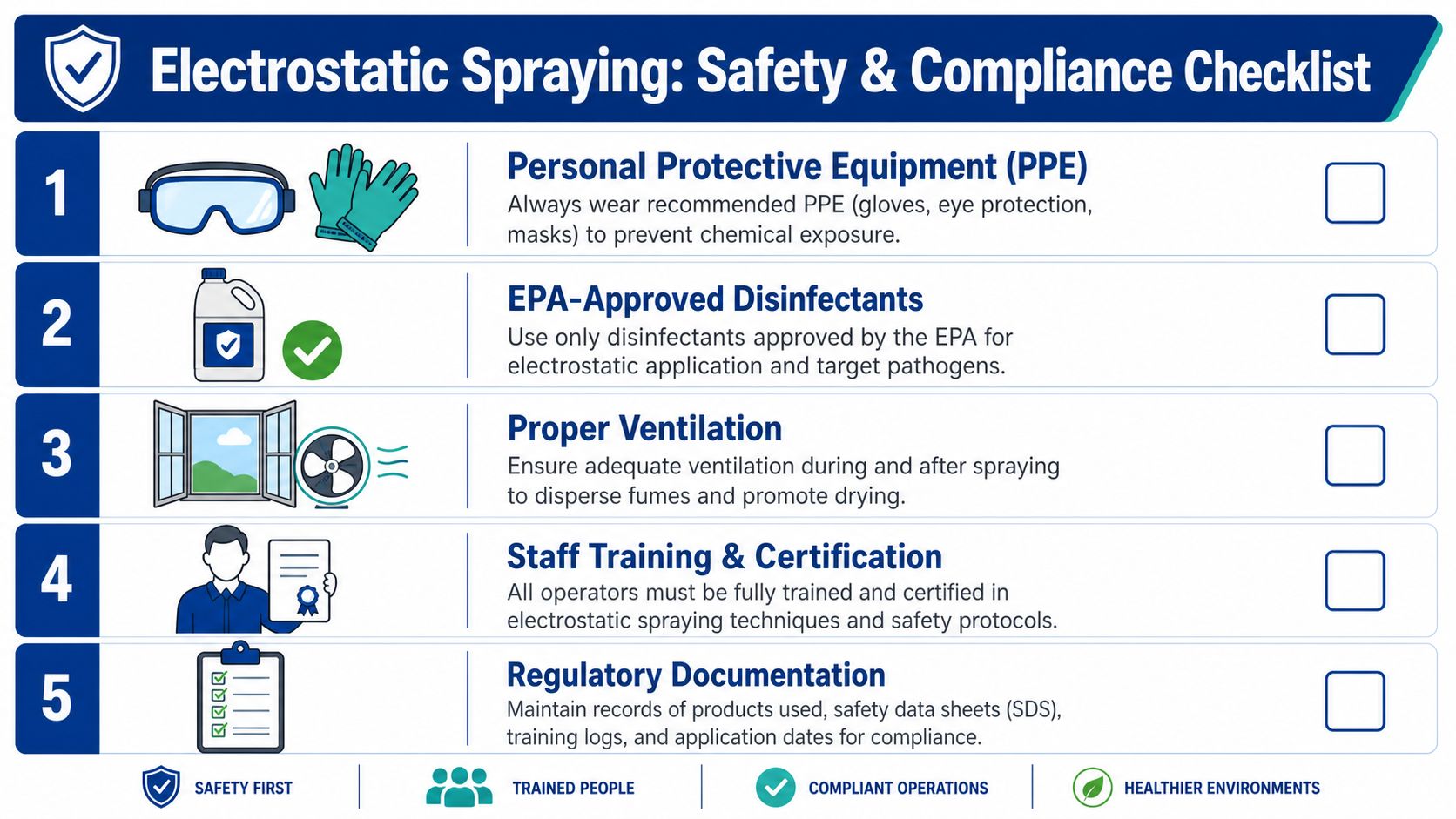
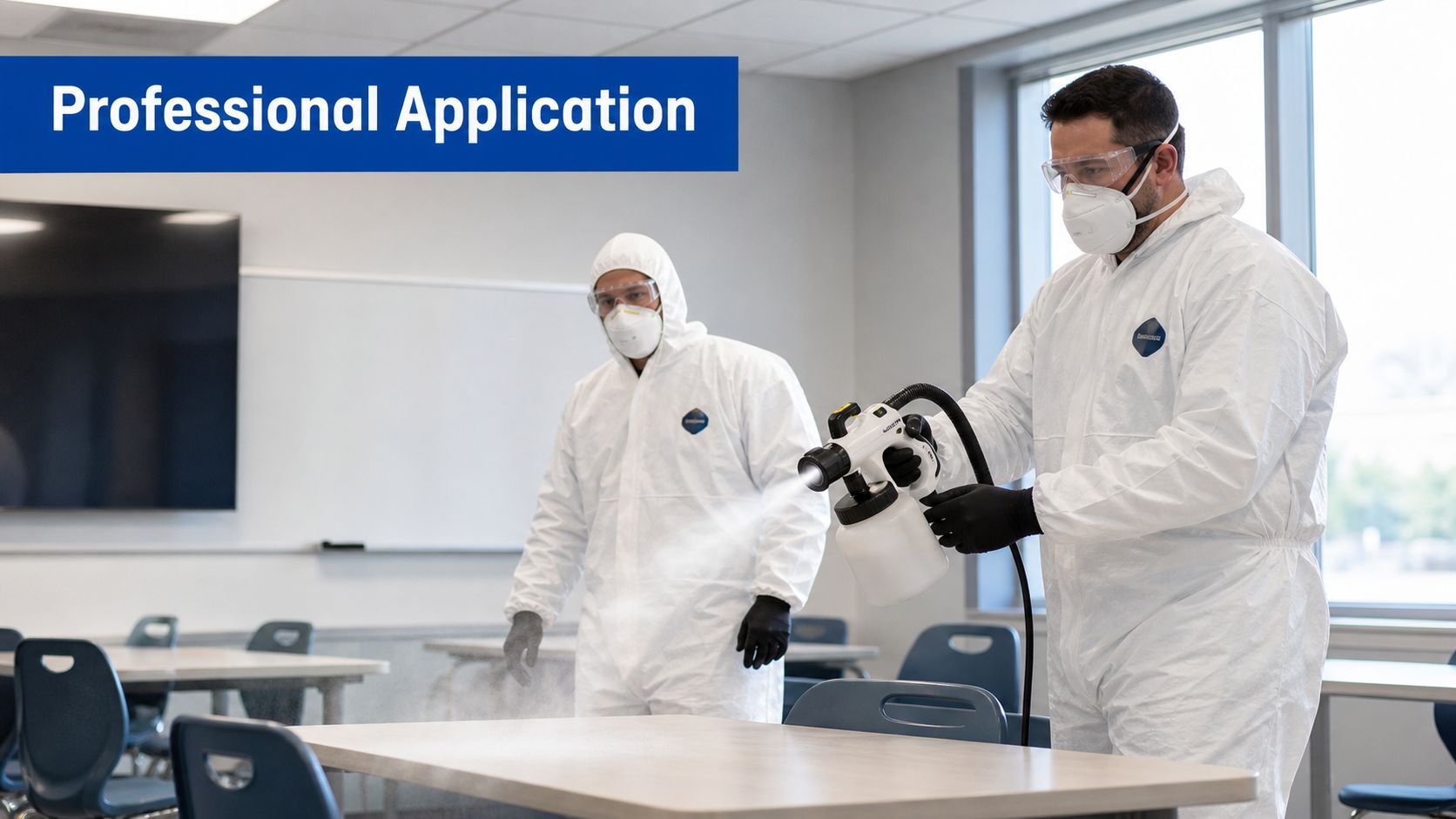
Electrostatic disinfection still creates airborne droplets during application. That means worker protection remains part of the plan, especially where contamination may involve bodily fluids or infectious material. Selection of gloves, coveralls, eye protection, and respirators has to match both the chemical being sprayed and the hazard environment.
Facilities that treat electrostatic spraying as a plug-and-play janitorial add-on often underestimate that risk. Proper PPE for biological hazards isn't just a worker safety issue. It also supports cleaner, more controlled operations by reducing secondary contamination and rushed technique.
The tool works best inside a protocol
Electrostatic spraying becomes most reliable when it's one part of a sequence:
- Assess the contamination.
- Remove visible soil and affected debris.
- Clean the surface appropriately.
- Apply the disinfectant with the right method.
- Allow full dwell time.
- Perform any follow-up odor control or post-treatment steps that the scenario requires.
That's the difference between using a machine and carrying out compliant disinfection.
Navigating Safety and Regulatory Compliance
Electrostatic spraying sounds simple when it's reduced to a sales pitch. Fill the tank, pull the trigger, coat the room. In regulated environments, it's nothing like that. The process introduces chemical exposure, aerosol behavior, equipment performance questions, and worker safety obligations that can create liability if handled casually.
Training standards separate cleaning from remediation
When biohazard conditions are involved, the training threshold rises sharply. Per 29 CFR 1910.120(q)(6)(iii), workers performing offensive or aggressive roles in controlling hazardous substance releases must complete 24 hours of HAZWOPER training at the hazardous materials technician level, according to OSHA's interpretation on HAZWOPER training requirements.
That matters because many contamination events in facilities aren't routine custodial tasks. Bloodborne pathogens, decompositional fluids, medical accidents, and unknown substance releases require a remediation mindset, not a housekeeping mindset.
A general cleaning team may know how to disinfect a countertop. That does not mean they're prepared to assess exposure pathways, control waste handling, or choose the correct protective equipment in a biohazard environment.
Safety depends on more than the sprayer itself
Proper electrostatic application also depends on how the equipment is configured and grounded. If the charge isn't sustained correctly, deposition becomes less reliable. Some industry guidance notes that grounding resistance above 1 megohm can cause charge dissipation issues that compromise coverage in temporary or irregular environments, as discussed in this electrostatic grounding safety video.
Calibration also affects performance in complex spaces. Guidance on coating systems identifies situations where operators must adjust voltage, nozzle choice, and working distance to avoid poor penetration in cavities or recessed surfaces, an issue covered in this discussion of electrostatic spray coating problems and calibration variables.
Poor grounding and poor calibration don't just reduce neatness. They can reduce whether disinfectant actually lands where the operator believes it did.
Documentation and containment protect the facility
Compliance isn't limited to operator training. Managers should expect a professional process to account for:
Product records
The team should document the disinfectant used, label instructions, and safety data.Ventilation planning
Aerosolized chemicals affect reentry timing, odor, and occupant exposure management.Application boundaries
Sensitive equipment, food-contact areas, porous materials, and occupant pathways all require control.Program oversight
Infection prevention and environmental services leaders need records they can review later.
Those controls become especially important in healthcare, behavioral health, and multi-occupant facilities where one weak response can create broader operational consequences. Strong infection control compliance practices help connect the field work to documentation, occupant safety, and defensible decision-making.
How Professionals Integrate Electrostatic Spraying
In professional remediation, electrostatic spraying is a step in a larger system. It's valuable because it improves how disinfectant is delivered, but it only works as intended when the scene is stabilized, the contamination is characterized, and the environment is prepared correctly.
That's the difference many facility managers need to understand. Equipment is not the service. The protocol is the service.
The sequence starts before any disinfectant is applied
Professional remediation protocols require containment with 6-mil poly sheeting and negative-air machines with HEPA filtration before cleaning or disinfection begins, according to this biohazard remediation guide for property managers.
That containment step protects adjoining rooms, corridors, HVAC pathways, and occupants from cross-contamination. In a school, clinic, office, or multifamily building, that may be the most important decision in the whole response. If the area isn't isolated first, the cleanup itself can spread the problem.
What the integrated workflow looks like
A professional team typically works through a sequence like this:
Site assessment
Technicians identify the contamination source, impacted materials, occupant risks, and waste streams.Containment setup
Barriers and negative air isolate the work zone and protect unaffected areas.Gross removal and cleaning
Visible biological matter, damaged porous contents, and residues are removed before disinfection.Targeted disinfection application
Electrostatic spraying is used where broad, uniform surface coverage supports the remediation goal.Verification and follow-up
The team checks treated areas, manages odor control if needed, and documents the work.Waste packaging and disposal
Regulated material is handled according to applicable requirements.
Why this matters for facility managers
From your side of the table, the key question isn't whether a vendor owns an electrostatic sprayer. It's whether the team understands when to use it, when not to use it, and how to integrate it into a compliant remediation plan.
A provider should be able to explain:
What is being treated
Hard surfaces, porous materials, contents, HVAC-adjacent components, or high-touch infrastructure.What must be removed instead of sprayed
Some contaminated materials can't be disinfected in place and have to be taken out as regulated waste.How cross-contamination is controlled
Hallways, neighboring rooms, shared restrooms, and return-to-service pathways need a clear plan.
The strongest remediation responses are rarely the flashiest. They're controlled, documented, and specific to the environment.
Electrostatic spraying earns its place because it helps trained technicians apply disinfectant more uniformly on challenging surfaces. In a compliant program, that can improve confidence in the process and reduce the chance that hidden edges or recessed surfaces will be treated inconsistently. But it's most effective when paired with containment, source removal, worker protection, and clear post-treatment verification.
When a facility faces a biohazard, infectious disease concern, or trauma-related contamination, the safest path is a provider that understands both advanced disinfection technology and the regulatory framework around it. 360 Hazardous Cleanup supports property owners, healthcare leaders, managers, and families with professional biohazard remediation, discreet response, and compliance-focused service built for high-stress situations where getting it right matters most.