An incident has happened. The site is blocked off, phones are ringing, people are asking questions, and the first instinct is usually practical. Who cleans this up? What can reopen? What has to be documented for insurance, law enforcement, or family members?
Those are urgent questions. But they aren't the only ones.
A traumatic event can leave behind two kinds of damage. One is visible in the room, hallway, unit, office, or vehicle. The other spreads through conversations, reviews, social posts, media coverage, employee anxiety, tenant concern, and community speculation. If the physical scene is handled poorly, the reputational damage often grows faster. If the response is handled with care, privacy, and discipline, recovery becomes much more manageable.
That's why reputation protection services matter in trauma-related situations. They aren't just for celebrities, political campaigns, or large consumer brands. For a facility manager, a hospital administrator, a landlord, an insurance adjuster, or a family trying to protect dignity during a painful week, reputation protection is part of crisis response. It starts with facts, discretion, and a cleanup process people can trust.
The Aftermath of an Incident
A property manager may walk into an apartment building after an unattended death and realize that the problem isn't limited to one unit. Staff members are shaken. Neighbors have noticed emergency vehicles. Tenants are texting each other. Someone has already posted online. A business owner after a workplace accident faces a similar problem. Even if the affected area is contained, people want answers immediately.
That moment is where many people get confused. They think cleanup and reputation are separate issues. In practice, they overlap from the first hour.

Professional remediation restores safety. Reputation protection helps restore confidence. One deals with contamination, odor, disposal, and compliance. The other deals with what people believe happened, how responsibly the situation was handled, and whether they still trust the organization or household involved. A helpful starting point is understanding the importance of professional trauma scene cleanup after the incident, because the quality of that response shapes every later conversation.
Why this has become a mainstream business concern
The market itself shows how seriously organizations now take this issue. The global reputation protection software market was valued at $3.8 billion in 2025 and is projected to reach $9.6 billion by 2034, which shows that reputation management has become a mainstream part of enterprise risk management, not a niche add-on (DataIntelo market report).
That trend makes sense on the ground. A traumatic event doesn't stay local for long. Staff may discuss it in group chats. Residents may leave reviews. Media outlets may call before facts are fully verified. Search results can preserve incomplete or misleading narratives long after the site itself has been cleaned and reopened.
Practical rule: The first credible action is often more important than the first polished statement.
What readers often miss
Reputation protection services aren't only about getting positive reviews or pushing bad press down in search results. In crisis settings, they help control confusion. They support accurate communication, reduce harmful speculation, and protect privacy while the people closest to the event are still trying to process what happened.
For trauma-related incidents, the foundational step is simple. If the physical response is chaotic, visible, insensitive, or noncompliant, no later communication strategy can fully undo that impression.
Why Reputation Is Your Most Critical Post-Crisis Asset
After a traumatic incident, people usually ask whether reputation work is really necessary. If the scene is cleaned and operations resume, won't things settle down on their own?
Sometimes they do. Often they don't.
Reputation functions like an invisible stain. You can remove contamination from flooring, walls, or furniture, but doubts can remain in the minds of tenants, employees, patients, visitors, or neighbors. They may wonder whether the area is safe, whether management handled the event with integrity, or whether leadership cared more about speed than people. Those impressions affect renewals, morale, referrals, and cooperation long after the visible damage is gone.
Physical restoration doesn't answer every human question
A safe environment matters. But trust depends on more than sanitation. People also watch for signs of competence and compassion.
Consider three common reactions after a serious incident:
- Employees ask whether leadership protected them and communicated clearly.
- Residents or tenants ask whether the property is safe and whether future concerns will be taken seriously.
- Families ask whether privacy, dignity, and personal belongings were handled with respect.
None of those questions are answered by bleach, barriers, or disposal manifests alone. They're answered by the full response.
A well-managed site tells people, without saying a word, that someone is taking responsibility.
Speed matters, but so does what you do with it
Once a crisis is public, passive monitoring isn't enough. Effective response hinges on speed and stakeholder communication, with its essential value coming from crisis-management execution that shifts the narrative from damage toward responsible resolution (RingCentral on reputation management).
That point is especially important for organizations that think they are “too small” to need reputation protection services. A small clinic, apartment complex, warehouse, or family-owned business can be more vulnerable than a national brand because it has fewer formal communication resources and deeper ties to one local community. One mishandled event can shape local perception for a long time.
A thoughtful response helps repair that damage. It also supports the wider process of restoring community trust after traumatic events through biohazard cleanup.
What reputation actually protects
A post-crisis reputation plan protects more than image. It protects:
| Asset at risk | What people worry about | What a strong response shows |
|---|---|---|
| Property confidence | “Is this place safe now?” | The site was remediated correctly and responsibly |
| Workforce morale | “Will management protect us?” | Leaders acted promptly and communicated clearly |
| Community trust | “Can we believe what we're being told?” | Facts, empathy, and consistency guided the response |
| Family privacy | “Will this become public spectacle?” | Dignity and discretion were treated as priorities |
When readers think “reputation,” they often hear “marketing.” After trauma, reputation is closer to credibility under stress. That's why it becomes one of the most important assets to protect.
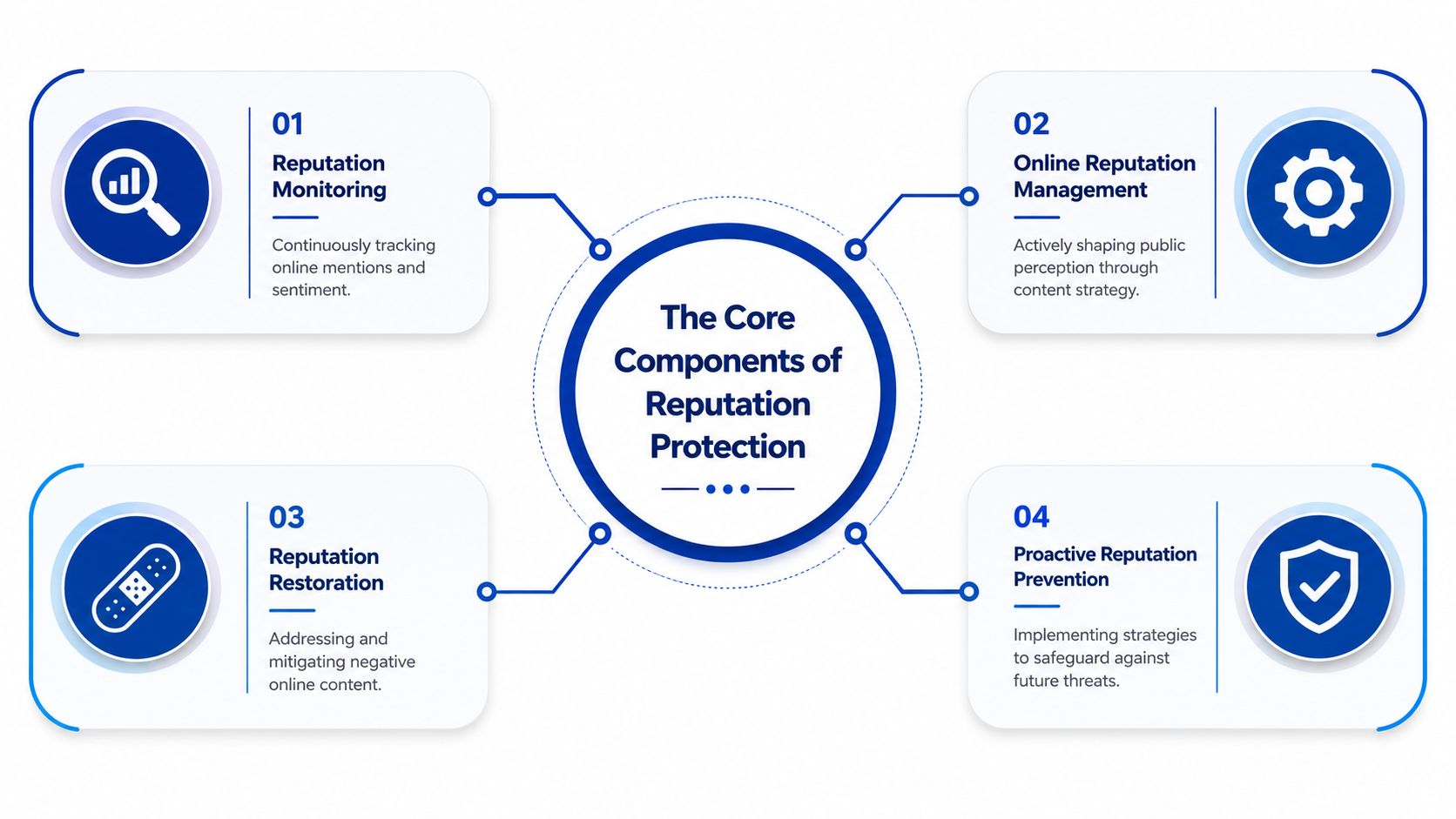
The Core Components of Reputation Protection
People often buy reputation protection services without a clear picture of what they're buying. That creates frustration later. A vendor may promise “monitoring,” while the client assumes that includes media handling, search strategy, executive guidance, and insurance-sensitive communication. It usually doesn't unless those services are defined in advance.
Reputation protection combines monitoring, analysis, and influencing public perception across digital channels. Reputation systems often aggregate user ratings on scales such as 0 to 5 stars, while broader services also track web-based media and alerts that can affect public standing (ScienceDirect overview of reputation services).
Crisis communications
This is the disciplined handling of what gets said, when, and to whom.
In a trauma-related event, crisis communications usually covers internal talking points, family-sensitive language, staff instructions, holding statements for inquiries, and approved updates for stakeholders. The purpose isn't spin. It's accuracy under pressure.
A useful benchmark is whether everyone involved can answer basic questions consistently. If one manager says the site is clear, another says cleanup is ongoing, and a third refuses comment without guidance, confusion grows fast.
Public relations and media handling
PR becomes relevant when reporters call, when a local incident starts circulating publicly, or when community concern rises beyond the people directly affected.
This work may include preparing a spokesperson, responding to media requests, correcting misinformation, and helping an organization speak in a tone that sounds human rather than defensive. In trauma cases, silence can look evasive, but careless over-sharing can violate privacy or create legal problems.
Online reputation management
Many readers first think of reputation protection services. Online reputation management watches reviews, social posts, search visibility, forums, local listings, and other digital channels where public perception forms.
It can also extend to specific leadership concerns. If an event places owners, executives, or physicians under online scrutiny, guidance on managing executive online reputation can help decision-makers understand what should be monitored, what may be removable, and what requires a documented response.
Legal and insurance coordination
This pillar is easy to overlook and costly to ignore.
A statement that sounds compassionate can still create problems if it conflicts with legal advice, chain-of-custody facts, employment obligations, or claim documentation. Reputational communication has to align with the actual remediation process, which is one reason operational discipline matters. Sound providers understand biohazard cleanup best practices and guidelines for safe and effective cleanup because the facts on the ground must support the message.
Key distinction: Mention-tracking tells you that people are talking. Reputation protection helps you decide what to do next.
Together, these components form a shield. Monitoring spots the issue. Communications organizes the message. PR manages the wider audience. Legal and insurance coordination keeps the response usable, defensible, and respectful.
Integrating Cleanup with Communication Strategy
A strong communication plan begins before anyone drafts a statement. It begins at the curb, in the hallway, at the front desk, and inside the affected room.
People notice how responders arrive. They notice whether the crew appears calm or careless. They notice whether workers protect privacy, limit unnecessary visibility, and treat family members or staff with respect. Those details become the first public message, even if no press release is ever written.
What on-site conduct communicates
Professional remediation supports reputation by creating facts that others can stand behind. If a team documents properly, follows disposal rules, controls access, and communicates with empathy, a property manager or adjuster has something solid to tell stakeholders. If the response is sloppy, that weakness becomes part of the story.
Cleanup and communication reinforce each other in a few specific ways:
- Discretion lowers speculation when vehicles, entry points, and crew behavior don't turn the site into a spectacle.
- Compliance supports credibility when documentation shows the work was performed according to applicable handling and disposal requirements.
- Compassion reduces secondary harm when families, tenants, and employees aren't treated like obstacles in a process.
- Coordination prevents contradictions when site teams, managers, adjusters, and agency partners are working from the same facts.
The first message is often nonverbal
A trauma scene doesn't need polished branding language. It needs evidence that the people in charge are competent and humane.
That's why coordination with responders, building leadership, and authorities matters so much. A cleanup partner that understands how to work alongside first responders, coroners, and property managers can reduce friction at exactly the time when mixed messages cause the most damage.
When people don't have clear facts, they fill the gap with assumptions.
Why this matters for families and facilities alike
Facility managers often think about reopening, liability, and workforce confidence. Families often think about privacy, dignity, and getting through the next day. Insurance adjusters think about scope, documentation, and covered services. The common thread is trust.
A remediation provider becomes part of reputation protection, even if they aren't a PR firm. Their work affects what can be truthfully said later. A discreet arrival, respectful communication, and a clean chain of documented action don't just restore a site. They give everyone else a more stable foundation for the next conversation.
That connection is the part many digital-only articles miss. In trauma situations, public trust rarely begins online. It begins with what happened on site when people were most vulnerable.
A Practical Post-Incident Readiness Checklist
At 7:15 a.m., a property manager gets three calls in five minutes. A resident wants to know whether the hallway is safe. A regional supervisor asks when the building can reopen. An employee has already posted a partial account online. In moments like that, reputation does not break because someone lacked a polished statement. It breaks because the site response, the facts, and the public message drift apart.
A practical checklist keeps those pieces aligned. It gives facility managers, families, and adjusters a clear order of operations so the physical cleanup supports the communication plan instead of lagging behind it. That connection matters. If the scene is handled poorly, no later PR effort can fully repair the loss of trust.
The checklist below fits commercial buildings, healthcare settings, multifamily properties, and private family situations where several decision-makers may be involved at once.
Before an incident happens
Choose one spokesperson
Assign one person to speak to staff, residents, media, vendors, or outside agencies if an event occurs. The best choice is usually the person who can stay calm, stick to verified facts, and resist the urge to fill gaps with guesses.Build a contact sheet
Include legal counsel, insurance contacts, site leadership, HR when relevant, and a professional remediation company. 360 Hazardous Cleanup handles trauma scene cleaning, crime scene cleanup, unattended death cleanup, industrial accident cleanup, and related biohazard remediation, with insurance coordination and discreet response options. It also helps to review what to look for in a trusted cleanup partner before you need one.Prepare short holding statements
Draft plain-language templates for likely situations. Keep them brief. Confirm awareness, express concern, and state that more information will be shared once facts are verified.
In the first hours after an incident
Secure the site first
Control access, protect privacy, and limit side conversations near the scene. A phone camera or overheard comment can turn confusion into a public problem fast.Verify facts before anyone speaks publicly
If details are still developing, say that plainly. A careful short statement causes less harm than a confident wrong one.Document each decision
Keep a simple running log of who was notified, what was confirmed, when cleanup was authorized, and what was communicated. This record helps with insurance, legal review, and message consistency later.
Simple rule: If a statement has not been verified, it should not appear in a public update.
After initial stabilization
Once the immediate pressure eases, review the response the way an adjuster reviews a claim. Start with sequence, scope, and proof. Public trust often follows the same logic. People want to see that the scene was handled responsibly, the impact was contained, and leadership communicated with care.
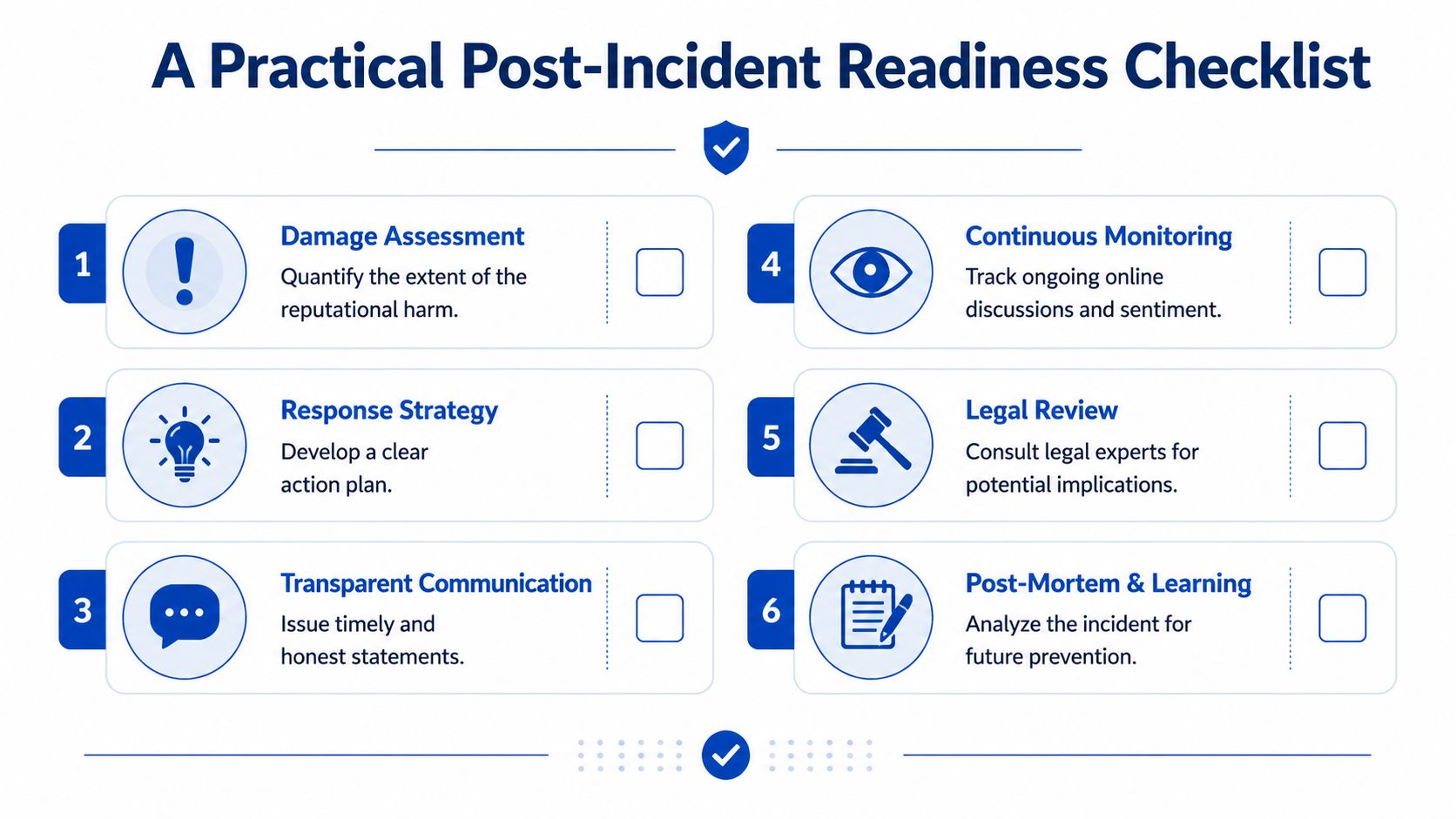
A useful readiness review starts with these six questions:
| Checklist item | What to ask |
|---|---|
| Damage assessment | What affected the site, the people involved, and confidence in the property or organization? |
| Response strategy | Who is leading cleanup, communication, and documentation, and are those roles clearly separated? |
| Transparent communication | What can be shared now without violating privacy, legal guidance, or investigative boundaries? |
| Continuous monitoring | Where is the incident being discussed, by whom, and which claims need correction or context? |
| Legal review | Do public statements match insurance, employment, tenant, and privacy obligations? |
| Post-incident learning | Which delays, gaps, or misunderstandings should be corrected before another event occurs? |
A checklist works like a chain of custody for decision-making. It shows who did what, when, and why. That kind of order does more than reduce mistakes. It helps restore confidence because the cleanup, the documentation, and the public message all support the same reality.
How to Select the Right Protection Partner
Choosing a reputation partner after a traumatic event can be harder than choosing a cleanup company. Many firms use reassuring language, but their actual service model may be built for product launches, general SEO, or social media engagement rather than crisis conditions.
That mismatch causes trouble fast. A marketing-focused vendor may overpromise content removal, underestimate privacy constraints, or suggest public tactics that conflict with realities of an active scene, an insurance claim, or a grieving family.

Start with operational fit
A useful partner should understand that post-incident reputation work isn't separate from operations. Ask whether they can work alongside legal counsel, adjusters, HR, facilities, healthcare privacy constraints, or law enforcement limitations. If they only talk about reviews and content strategy, they're probably too narrow for trauma-related work.
Independent guidance also draws a clear line between passive monitoring and active digital risk protection. Top-tier providers offer active protection, and auditable governance such as SOC 2 Type II compliance and ISO 27001 certification is a meaningful sign of formal controls for sensitive data handling in regulated environments (guidance on choosing a reputation protection company).
Questions worth asking
Use the interview process to test depth, not polish.
How do you handle privacy-sensitive incidents?
Listen for caution, process, and coordination. Be wary of anyone who immediately jumps to aggressive publicity tactics.What do you monitor besides reviews?
Strong reputation protection services should account for search visibility, social channels, false narratives, impersonation risk, and media exposure.How do you work with remediation and claims documentation?
In these situations, facts from the scene matter. The partner should respect them.What controls protect sensitive information?
This is where governance matters. If they handle names, incident details, health-related context, or claim materials, controls shouldn't be vague.
A related concern is choosing the right field partner in the first place. Guidance on finding and choosing a trusted cleanup partner can help buyers evaluate the operational side of the response before reputational issues compound.
Watch how providers frame success
Some readers find it helpful to see how professionals talk through vendor evaluation in a more conversational format:
The biggest red flag is a partner who treats reputation as a cosmetic issue. In trauma settings, it isn't cosmetic. It's tied to safety, liability, privacy, and trust. The right partner should sound measured, not theatrical.
Ask for process before promises. Serious providers can explain how they work even when they can't discuss private client details.
Reputation Recovery in the Real World
A commercial facility manager dealt with a serious workplace accident in a section of a building shared by multiple teams. The immediate concern was safety and cleanup, but the next problem came from rumor. Employees in unaffected areas began filling the gaps with guesswork. Management responded by securing professional remediation, limiting access, giving staff a clear verified update, and answering only what could be confirmed. The site was restored, and just as important, employees saw a disciplined response instead of confusion.
A multifamily property manager faced an unattended death in a tenant unit. Neighbors saw official vehicles and started asking whether the building had a health risk. The manager's early instinct was to say as little as possible. That changed once they realized silence was fueling fear. A coordinated approach helped them protect privacy while still addressing resident concerns about safety, access, and the remediation process. The cleanup itself reduced hazard. The communication around it reduced panic.
A family, working through the aftermath of a private trauma, had a different concern. They weren't worried about media. They were worried about dignity. Extended relatives were calling, neighbors had noticed activity, and no one in the household knew how much information to share. In that case, reputation recovery wasn't about brand image. It was about preserving the family's peace and avoiding unnecessary exposure during grief. Discreet cleanup, careful language, and a small circle of designated communication made the home feel private again.
These situations look different on the surface, but the pattern is the same. The physical scene must be remediated correctly. The human response must be steady. Public trust returns when people can see that the situation was handled safely, lawfully, and with respect.
If you need help after a traumatic event, 360 Hazardous Cleanup provides biohazard remediation, trauma scene cleanup, crime scene cleanup, unattended death cleanup, industrial accident cleanup, and related hazardous materials services with an emphasis on discretion, documentation, and compassionate communication. When the physical site and public trust both need careful handling, having the right response partner can make the next steps much clearer.