You're usually searching for sharps disposal nyc at the exact moment you don't want to make a mistake. A family member has filled a sharps container with insulin needles. A superintendent found a syringe in a tenant turnover. A property manager opened a unit and realized this isn't simple trash. The problem feels small until you think about who could get hurt next.
That reaction is appropriate. Sharps disposal isn't just a housekeeping issue. It's a safety issue, a compliance issue, and in some situations, a biohazard issue. The right answer depends on what you're holding, where it came from, and whether the scene involves anything beyond ordinary household medical use.
Why Proper Sharps Disposal in NYC Is a Matter of Safety
A used needle, lancet, or syringe creates risk long after it's been used. The immediate concern is obvious. Someone handling trash, cleaning a room, or sorting recyclables could get stuck. The less obvious concern is that people often assume every sharps situation has the same disposal path. In practice, it doesn't.
A published study at a New York City teaching hospital found that 20% of all reported sharps injuries were directly related to disposal (study details on PubMed). That matters because it shifts the conversation. Disposal isn't the final easy step. It's one of the moments when people get injured.
Why disposal mistakes happen
Most mistakes come from one of three assumptions:
- “It's just one needle.” One loose sharp can still injure a family member, porter, cleaner, or sanitation worker.
- “Any container is fine.” Weak or poorly sealed containers fail when they're compressed, dropped, or handled.
- “All sharps are household sharps.” They aren't. A diabetic's home lancets are different from needles mixed with blood-soaked materials in a contaminated apartment.
Practical rule: If you know the sharps came from routine home medical use, the issue is usually containment and legal disposal. If the origin is unknown or the area includes blood or other bodily fluids, treat it as a possible exposure event instead of a trash question.
That distinction matters because sharps can carry the same exposure concerns that apply to other blood and body fluid incidents. If you need a plain-language overview of those hazards, this guide to common bloodborne pathogens is useful background.
The question to ask first
Before you think about where to drop anything off, ask this:
Is this a simple household sharps situation, or is this part of a larger contaminated scene?
If it's simple household use, NYC gives residents a workable path. If it's part of a move-out, trauma scene, unattended death, hoarding condition, or unknown drug-use environment, the answer changes fast. That's where many online guides stop short, and that's where people get into trouble.
How to Safely Contain and Label Sharps for Disposal
Containment comes before disposal. If the container is wrong, everything that happens after that gets riskier.
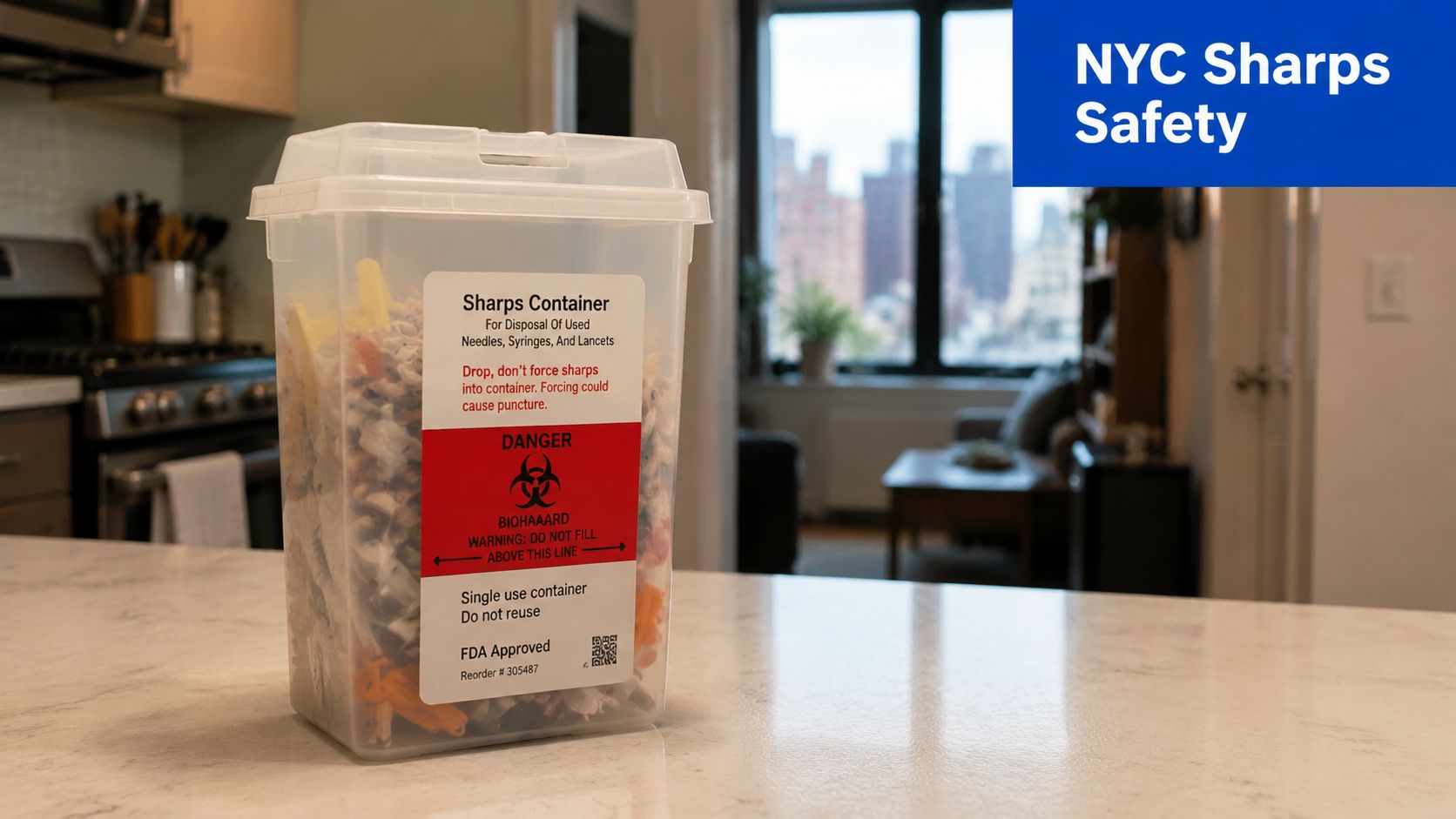
NYC311 says used syringes and lancets should go into a leak-proof, puncture-resistant container. The lid should be taped shut, and the container should be labeled “Home Sharps – not for recycling” when you're preparing it for disposal under the city's household rules. The point isn't paperwork. The point is preventing a loose sharp from injuring the next person who touches that container.

What works
A good household sharps container has three traits. It resists punctures, it won't leak, and it closes securely.
Use one of these approaches:
A purpose-made sharps container
This is the cleanest option. It's designed for needles and lancets, and the closure is usually more reliable.A heavy-duty plastic container with a tight-fitting lid
For household use, some residents use a rigid plastic bottle or similarly sturdy container when an approved sharps container isn't available. It needs to stay upright and sealed.A taped, clearly marked final container
Once the container is ready for disposal, tape the lid shut and mark it exactly as NYC directs: “Home Sharps – not for recycling.”
What doesn't work
Some containers seem convenient but create avoidable risk.
- Glass jars break.
- Thin plastic bottles can split or collapse.
- Milk cartons or paper containers puncture and leak.
- Open bags are never acceptable for loose sharps.
- Overfilled containers put pressure on the lid and increase the chance of a stick during closure.
Keep the container upright, keep it where children and pets can't reach it, and seal it before it gets crammed full. Most injuries happen when people improvise late.
A simple preparation checklist
| Step | What to do | Why it matters |
|---|---|---|
| Choose the container | Use a puncture-resistant, leak-proof container | Prevents needlesticks and leaks |
| Add sharps carefully | Place used sharps directly inside after use | Reduces handling and accidental contact |
| Seal the lid | Close it securely and tape it shut | Keeps contents from spilling out |
| Label the outside | Write Home Sharps – not for recycling | Warns others and supports compliance |
For households, this process is straightforward. For anyone managing cleanup in a rental, office, or common area, the same handling discipline still matters, even before you determine whether the waste qualifies for ordinary household disposal. Broader handling principles for contaminated materials are covered in this overview of biohazard waste management safety and compliance.
The trade-off people get wrong
People often focus on convenience. They want the fastest way to get the sharp out of sight. That instinct leads to loose caps, weak bottles, or unlabeled containers.
The better trade-off is simple. Spend an extra minute making the container safe, and you reduce the chance that someone else pays for your shortcut with an injury.
Approved Sharps Disposal Options for NYC Residents
Once the sharps are safely contained and labeled, NYC residents have a few legitimate disposal routes for home medical sharps. The best option usually depends on volume, convenience, and whether you want the container removed immediately or during normal household trash disposal.
Under NYC rules, properly contained and labeled home medical sharps can be placed in your regular trash, and New York State law requires hospitals and nursing homes to accept properly contained sharps from the public (NYC311 guidance for home medical sharps). That's the core rule set most residents need.
Option one in-home disposal through regular trash
For many households, this is the simplest lawful route. If the sharps are from personal medical use at home, and the container is sealed, puncture-resistant, leak-proof, taped shut, and labeled correctly, NYC allows residents to place it in regular trash.
This option is practical, but only if the preparation is done correctly. It should never go into recycling. This is an absolute requirement.
Option two hospital or nursing home drop-off
Some people prefer not to place a sharps container in household trash at all. New York State requires hospitals and nursing homes to act as collection centers for properly packaged home sharps. Call ahead before going. Facilities may have designated hours, specific entrances, or intake procedures.
This route is often a good fit when:
- You want direct handoff instead of curbside disposal
- You have a full sharps container and don't want it sitting at home longer
- A family caregiver is helping and wants the clearest institutional disposal path
Option three mail-back or container programs
If you use sharps regularly, planning ahead helps. Many residents buy purpose-built containers rather than improvising. If you're comparing container styles for home use, DME Superstore's sharps collection is a useful reference point for what compliant home containers generally look like.
Some people also use mail-back services offered through container programs or healthcare suppliers. Availability and program rules vary, so the key is to follow the instructions that come with the specific product rather than assuming every container works the same way.
Which option fits your situation
| Situation | Usually the best fit | Main consideration |
|---|---|---|
| Routine home use | Regular trash under NYC rules | Container must be properly prepared |
| You want direct drop-off | Hospital or nursing home | Call ahead first |
| Ongoing home injections | Sharps container program | Pick a container you'll actually use consistently |
If the sharps came from your own home medical care and the container is prepared the right way, disposal is usually straightforward. The confusion starts when people apply these household rules to cleanup scenes that aren't household situations at all.
For readers who need the larger compliance picture around handling and disposal of hazardous material streams, this resource on biohazard waste disposal provides helpful context.
When Standard Disposal Rules Do Not Apply
Most public-facing guidance on sharps disposal nyc is written for household users. That's useful, but incomplete. It doesn't answer the harder questions property managers, landlords, cleaners, and families run into when sharps are mixed with visible contamination, left behind after a crisis, or found in batches with no known history.
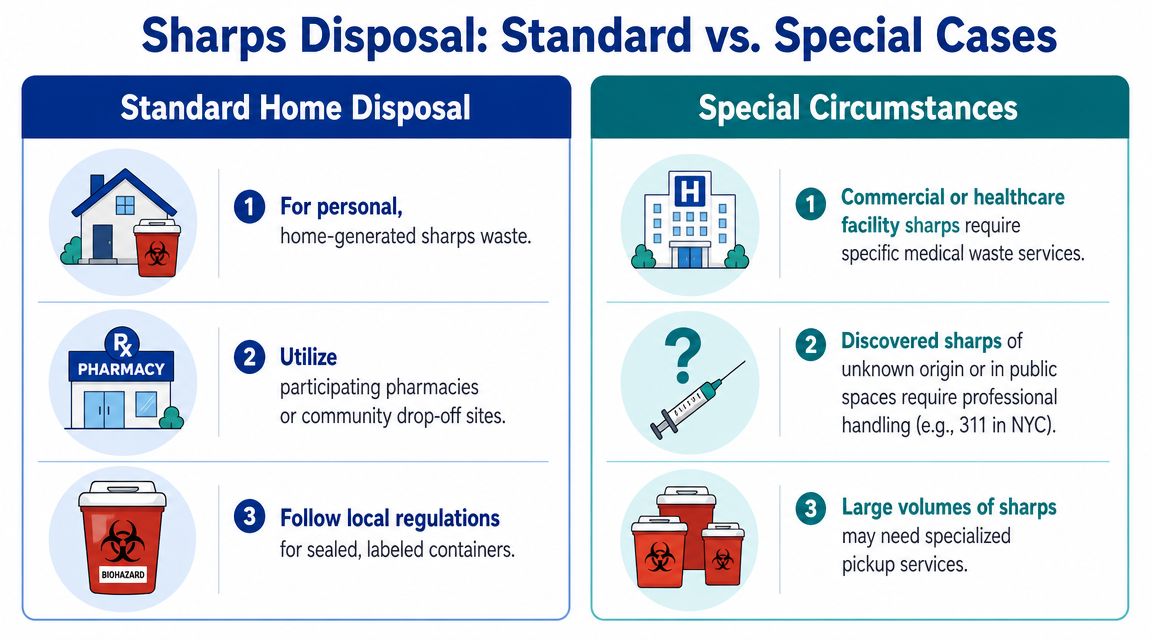
NYC-facing disposal guidance doesn't provide a full decision tree for those scenes. As the city's own disposal pages make clear, the focus is household packaging and drop-off, which leaves a safety and compliance blind spot for contaminated scenes and property cleanouts (NYC DSNY sharps disposal information).
Red flags that change the answer
If any of the conditions below are present, stop thinking in terms of ordinary household disposal.
Unknown origin
A syringe found in a hallway, vacant unit, alley, restroom, or common area isn't the same as a labeled home sharps container from a resident who uses insulin.Visible blood or bodily fluids
Once sharps are mixed with contaminated materials, you're no longer dealing with a simple home disposal question.Multiple sharps or scattered loose needles
Volume changes the handling approach. It also increases the chance that one gets missed.Trauma or unattended death scene
In these environments, sharps may be only one part of a larger biohazard condition.Cleaning staff exposure concerns
If custodial workers, maintenance staff, or family members would need to sort through debris to find or remove the sharps, the risk profile has changed.
Household disposal versus special-case handling
| Situation | Household sharps guidance fits | Professional assessment is the safer path |
|---|---|---|
| Personal insulin needles in a sealed container | Yes | Usually not needed |
| One resident's lancets prepared for trash | Yes | Usually not needed |
| Loose syringe in a vacant apartment | No | Yes |
| Needles mixed with blood-contaminated debris | No | Yes |
| Large volume after a cleanout | No | Yes |
A sealed household sharps container is a disposal task. Loose sharps in a contaminated environment are a scene-management problem.
The practical mistake to avoid
Property managers often try to solve these situations with gloves, a grabber tool, and a trash bag. That may feel efficient, but it creates two problems. First, it exposes workers to avoidable needlestick risk. Second, it blurs the line between household waste handling and regulated contamination response.
Families make a different mistake. They assume if NYC allows home sharps in regular trash, the same must be true for anything sharp found in a residence. It isn't. Context matters. Origin matters. Contamination matters.
Calling a Professional for Biohazard Remediation
When sharps are tied to blood, bodily fluids, unknown exposure history, or a larger traumatic event, this stops being a disposal errand. It becomes a remediation problem.
A qualified biohazard team doesn't just remove the obvious sharp. They assess the scene, identify what's contaminated, isolate the work area, use appropriate protective equipment, package waste correctly, and route that waste through the proper disposal chain for regulated material. That's a different level of work than placing a sealed home sharps container in regular trash.
What professionals handle that DIY cleanup doesn't
The gap is wider than commonly believed.
Scene assessment
Professionals identify whether the sharps are part of a broader contamination event instead of treating the needle as the only hazard.Exposure control
Workers use trained handling methods and protective equipment rather than improvised cleanup.Waste segregation
Sharps, contaminated porous materials, and other affected contents may require different handling paths.Documentation and disposal chain
In commercial, healthcare-adjacent, or trauma-related contexts, disposal isn't a simple household drop-off decision.
Why this protects property owners and families
The primary benefit is not convenience. It's risk reduction.
If a landlord asks maintenance staff to clear a contaminated unit, that decision can expose employees to injury and create avoidable liability. If a family member handles sharps from an unattended death scene without proper controls, they may miss contaminated materials that still need removal and disinfection.
A broader explanation of why certified responders matter in these environments is covered in this article on why hiring certified biohazard professionals matters for your safety.
The safest cleanup is the one that doesn't ask an untrained person to guess where the hazard begins and ends.
For readers comparing service standards and wanting a practical outside example of what expert biohazard remediation typically involves, that overview is a useful benchmark. The core idea is the same in any market. Serious contamination requires trained handling, compliant transport, and full remediation, not partial pickup.
When to stop and call
If you're facing any of the following, it's time to bring in professionals:
- Sharps mixed with bodily fluids
- Unknown drug-use debris in a rental or common area
- Multiple containers or scattered loose sharps
- Post-trauma, suicide, or unattended death conditions
- Any cleanup where staff would have to sort contaminated contents by hand
Those aren't edge cases. They're exactly the scenarios where ordinary online sharps guidance stops being enough.
A Clear Path to Safety and Compliance
Most sharps situations fall into one of two lanes.
The first lane is routine household disposal. If the sharps came from personal home medical use, and they're placed in a leak-proof, puncture-resistant container with the lid taped shut and labeled correctly, NYC gives residents a clear disposal path.
The second lane is biohazard remediation. If the sharps are loose, mixed with blood or bodily fluids, tied to an unknown source, or part of a larger property cleanup, standard household guidance doesn't fully address the risk. That's where people need assessment, containment, and compliant removal that goes beyond ordinary trash handling.
The best decision-making principle is simple. Dispose of household sharps as household sharps. Treat contaminated or unknown sharps scenes as biohazard scenes. That one distinction prevents a lot of injuries, confusion, and bad cleanup decisions.
For anyone responsible for a building, a unit turnover, or a difficult family situation, it also helps to understand the broader legal framework around contaminated material handling. This overview of biohazard remediation laws and regulations is a strong place to start.
If your situation goes beyond a sealed home sharps container and into a contaminated scene, unknown sharps, or a trauma-related cleanup, 360 Hazardous Cleanup is available 24/7 to help you make the safest next decision. Their team provides discreet, compassionate biohazard remediation with a focus on compliance, risk control, and protecting everyone who may enter the property next.