In most situations, the property owner is the party financially responsible for crime scene cleanup, and professional remediation usually runs from $1,500 for minor incidents to $25,000 or more for extensive contamination, with most residential jobs falling between $1,500 and $5,000. The part many people don't realize is that responsibility and out-of-pocket payment aren't always the same thing, because insurance, victim assistance funds, and a qualified remediation company can often help carry much of the actual burden.
If you're reading this right after a traumatic event, you're probably trying to process several things at once. The scene may have just been released. Family members, staff, tenants, or employees may be waiting for answers. You may also be hearing conflicting advice about what happens next and who pays for crime scene cleanup.
This is where a structured process matters. Police, EMS, and fire personnel handle emergency response and investigation. After that, the property still has to be made safe for re-entry, and that work falls into a different category entirely. It becomes a private cleanup matter involving the property owner, the insurance carrier, and a professional biohazard remediation team that can document the work properly.
The good news is that there is a path through this. You don't have to solve every financial and logistical issue on your own in the first hour.
After a Traumatic Event What Happens Next
The first stage is usually controlled by public agencies. First responders stabilize the scene, preserve evidence, and complete the investigative steps they need. When they leave, many people expect the space to be cleaned by the same agencies. That isn't how these situations work.
What remains is often a regulated biohazard environment. Blood, bodily fluids, compromised materials, and contaminated contents have to be assessed, removed, transported, and documented correctly. That process is separate from law enforcement's role, and it's one reason families and property managers feel blindsided.
The first practical decisions
Once the scene is released, the priorities are usually straightforward:
- Confirm access status. Make sure the scene has been formally released before anyone enters for cleanup.
- Avoid disturbing the area. Well-meaning attempts to wipe, bag, or move materials can create health risk and complicate documentation.
- Call your insurer early. Even before full scope is known, opening the claim starts the paper trail.
- Bring in a remediation company that understands claims. The right firm doesn't just clean. It helps organize the next steps.
A lot of emotional strain comes from uncertainty, not just cost. People want to know who is responsible, whether insurance may apply, whether the property can be occupied, and how long the disruption may last.
Practical rule: Treat the cleanup as both a health issue and a claims issue from the very beginning.
For a deeper look at the immediate response phase, our article on the importance of professional trauma scene cleanup after the incident walks through why the first cleanup decisions matter so much.
Who is usually involved
The support system usually includes a small group of decision-makers:
- Property owner or responsible occupant: The person who authorizes access and starts the financial process.
- Insurance adjuster or carrier representative: The party who reviews coverage, documentation, and reimbursement.
- Professional remediation crew: The team that performs compliant cleanup and creates the records the claim may depend on.
- Victim advocate, attorney, or case support contact: Sometimes needed when coverage is limited or legal issues are involved.
That structure helps reduce chaos. Instead of asking one overwhelming question, you break the situation into parts: secure the site, document the loss, confirm coverage, restore the property safely.
The Primary Rule of Financial Responsibility
A family can be standing in a doorway after the police release a scene, asking a question nobody expected to face. Who is responsible for getting this space safe again?
In most cases, the starting point is the property itself. The property owner, or the party with legal control of the premises, is usually the one responsible for authorizing and arranging crime scene cleanup. That can feel harsh, especially when the owner did nothing to cause the event. It is still the rule that sets the process in motion.

The reason is practical. Police agencies secure the area, investigate, and release the scene when their work is complete. They do not return private homes, rentals, or businesses to a safe living or operating condition. Biohazard remediation, disposal, odor control, selective demolition, and documentation for re-occupancy all fall on the property side.
That point matters because the person who is legally responsible is not always the person who ultimately funds the work.
At 360 Hazardous Cleanup, families often need the most support. They are trying to process a traumatic event while also figuring out access, authorization, insurance, invoices, and records. A good cleanup firm should do more than complete the remediation. It should help the client handle the claim path, gather the right documentation, and reduce preventable delays.
Why police do not pay for cleanup
Once law enforcement releases the scene, the next phase is a private remediation project with health, safety, and compliance requirements. The work may involve bloodborne pathogen controls, regulated waste packaging, removal of affected porous materials, equipment decontamination, and written job records. If contamination reached carpet pad, subfloor seams, drywall, insulation, or contents, the scope can increase fast.
Families run into similar confusion with other post-death costs. Legal responsibility and payment source do not always match. This guide to understanding autopsy expenses shows how that gap can create unexpected bills even when a public process is involved.
What responsibility actually means
The clearest way to look at it is to separate authority, payment, and project management.
| Question | Practical meaning |
|---|---|
| Who is legally responsible | The party expected to address contamination affecting the property |
| Who may pay for the work | Insurance, victim assistance, restitution, landlord funds, business funds, or direct payment |
| Who manages the process | Usually the owner, property manager, tenant with authority, or another authorized representative |
That distinction helps people make better decisions early. Waiting for a city agency, police department, or other outside party to take over often stalls cleanup and can slow an insurance claim. The better approach is to confirm who can authorize access, document the condition of the site, and start the funding review at the same time.
Responsibility can also get more complicated in rentals, shared properties, and municipal settings. For a closer look at those property-specific questions, see our article on whether the property owner, tenant, or municipality is responsible for biohazard cleanup.
The key point is simple. Primary responsibility tells you who has to act first. It does not tell you that they will be left to handle every cost alone.
Who Pays in Common Cleanup Scenarios
The rule doesn't feel real until you apply it to an actual property. Most readers are trying to map the answer onto one situation: their home, a rental unit, a vacant property, or a business location.
Single-family home
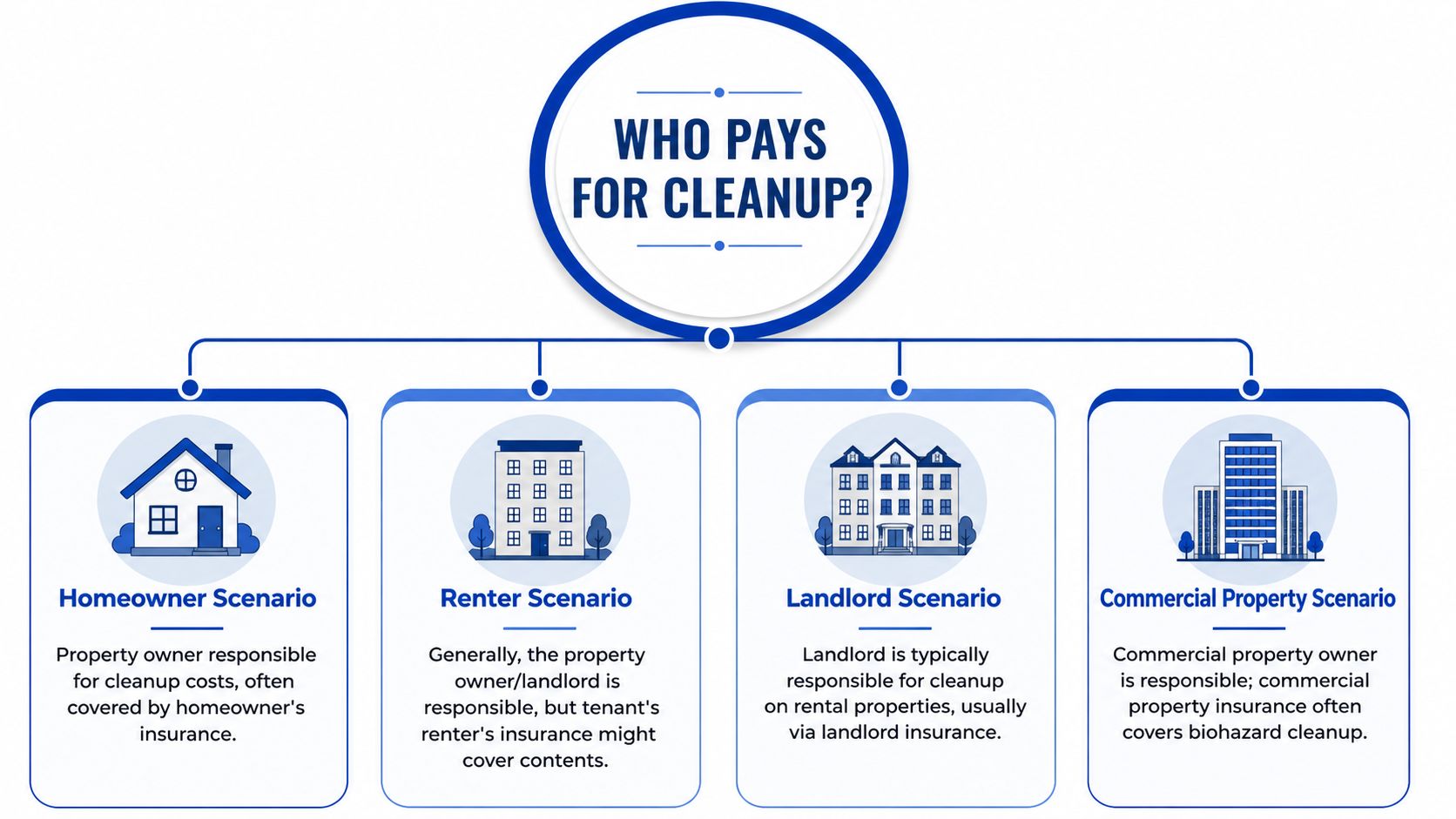
A homeowner usually authorizes the cleanup because the contamination affects their property directly. If the event happened inside the residence, garage, entry area, or on other private portions of the property, the homeowner is typically the financially responsible party.
What changes from one household to another isn't the basic responsibility. It's the funding path. Some people have a homeowner's policy that responds promptly. Others find out they need more documentation before the carrier can confirm coverage.
A common source of confusion is the presence of family members. If relatives are involved in decisions, they may assume next of kin status changes who pays. It usually doesn't. The property owner remains the key party for the cleanup contract and site access.
Rental property
Rental situations require closer reading. The landlord often pays when the incident is unrelated to tenant negligence or when restoring the unit is part of the landlord's obligation to provide a safe, rentable space. Tenant-caused negligence can shift responsibility toward the tenant, especially where lease language addresses damage or contamination.
That doesn't always mean the tenant writes a check directly. It means liability may point in that direction, and the landlord may later seek reimbursement if the facts and lease support it.
In rentals, the lease matters, but so do the actual facts of the event. A lease clause won't erase the owner's duty to restore a contaminated unit before re-occupancy.
For readers working through these residential questions, our article on biohazard cleanup in residential homes and common scenarios breaks down how cleanup decisions play out inside houses, apartments, and shared living spaces.
Commercial property
Commercial owners and facility managers usually face a different pressure. They aren't only thinking about cleanup cost. They're also managing work stoppage, restricted access, liability exposure, employee concerns, and documentation for insurers or internal risk teams.
In a warehouse, office, clinic, retail unit, or plant, the owner or controlling entity generally arranges the remediation. If the business is a tenant, the lease and the exact location of the contamination usually drive the conversation between tenant and property owner. In practice, someone still has to act fast to secure the site and begin compliant cleanup.
A practical way to think about it
When people ask who pays for crime scene cleanup, they often need this quick hierarchy:
- Owner-occupied home: The owner usually takes the lead.
- Leased residence: The landlord often leads, unless negligence points elsewhere.
- Business premises: The controlling business or commercial owner usually acts first.
- Multi-party property situation: Responsibility may be shared contractually, but cleanup can't wait for every dispute to be resolved.
That last point matters. Financial responsibility can be sorted out in parallel. The health and property risk usually can't.
How Insurance Covers Biohazard Cleanup Costs
Insurance often helps with biohazard cleanup, but the coverage usually sits inside broader parts of the policy. Families expect to see a line that says "crime scene cleanup." In practice, adjusters usually review these losses under property damage, liability, loss of use, or related endorsements, depending on what happened and who owns the property.

Where coverage is often found
The same cleanup job can be treated differently from one policy to another. In an owner-occupied home, the claim may involve property damage and temporary living costs if the space is unsafe to occupy. In a rental property, the policy review may focus more on building damage, habitability, and what falls under the landlord's coverage versus the tenant's. On a commercial loss, the carrier may pay closer attention to restoration scope, business interruption concerns, and site documentation.
That variation is why policy language matters, but so does presentation. A carrier has to understand what contamination existed, why certain materials could not be salvaged, and what work was required to make the property safe again.
A useful starting point is this guide on how homeowners insurance may or may not cover biohazard cleanup. It helps property owners identify where this type of claim may fit before they start arguing over terminology.
What adjusters usually look for
Adjusters usually need a clear file that answers three practical questions:
- What caused the loss? The event has to fit the policy terms.
- What was affected? Rooms, contents, structural materials, and access limits all matter.
- Why was the cleanup scope reasonable? Removal, treatment, disposal, and clearance steps need to match the conditions on site.
Weak documentation slows approval. Clear documentation gives the adjuster something concrete to review.
This is one of the biggest practical trade-offs. Families want the ordeal handled quickly and discreetly. Carriers want records, photos, scope notes, and disposal details before they commit to payment. A professional cleanup company helps close that gap by documenting the work in claim-ready language while also protecting the people involved from having to manage every form and phone call themselves.
Coverage is only part of the process
Even with coverage in place, the claim experience can still be difficult. Some carriers authorize work quickly. Others ask for incident details, proof the scene was released, itemized estimates, or clarification about damaged belongings before they approve the full scope.
That is why the cleanup partner matters. At 360 Hazardous Cleanup, we often help clients organize the paperwork, communicate scope clearly, and submit the records insurers usually ask for. The goal is simple. Reduce the administrative burden on the family or property representative while keeping the work compliant, well documented, and easier for the carrier to evaluate.
A better early question is, "What does the insurer need to approve this safely and promptly?" That question usually gets the claim moving in the right direction.
A Step-By-Step Guide to Your Insurance Claim
Claims are easier when you treat them like a sequence instead of one giant problem. The order matters. So does the quality of the documentation.

Start the claim before cleanup begins
Contact the carrier as soon as the scene is released or as soon as you know remediation will be required. You don't need every answer on the first call. You do need a claim number, a contact point, and a record that you notified them promptly.
Have the property address, a short factual description of the event, and the date of loss ready. Keep the description simple and accurate.
Document the condition without interfering
Take only the photographs and notes you can gather safely and lawfully. Don't move materials to get better images. Don't start wiping surfaces.
Use a simple checklist:
- Photograph affected areas if access has been cleared.
- Write down who released the scene and when.
- Save communications with law enforcement, management, or the carrier.
- Track temporary housing or access issues if the property can't be used.
Use a remediation company that can support the claim
For many families and managers, time is either saved or lost in this process. Professional remediation follows strict OSHA and DOT regulations, and non-compliance can risk fines of over $14,000 per violation. About 75% of insurance policies classify cleanup under additional living expenses or liability, and experienced cleanup firms streamline claims by handling required documentation and often billing carriers directly, according to Sterile Pros' insurance and compliance overview.
That support matters because a compliant cleanup company can usually provide scope notes, photographs, line-item billing, waste handling records, and a description of why specific materials had to be removed or treated. Those records reduce avoidable back-and-forth with adjusters.
At this stage, some property owners choose a firm like 360 Hazardous Cleanup because the company coordinates with carriers, helps clients communicate with adjusters, and organizes the paperwork needed for review.
Keep the insurer and the remediation team aligned
The claim tends to move better when both sides are working from the same facts. That means:
- Ask for claim-specific requirements early. Some carriers want estimates first. Others want emergency mitigation to proceed immediately.
- Approve necessary emergency work in writing. Delays can make contamination harder to remediate.
- Request itemized records. Generic descriptions create unnecessary questions.
- Keep one file for everything. Store invoices, emails, adjuster notes, and release information together.
A short explainer can help if you need to prepare for that first insurance conversation.
What slows claims down
Claims usually get harder for avoidable reasons:
| Problem | Why it causes issues |
|---|---|
| DIY disturbance of the scene | It can blur the original scope and create safety concerns |
| Incomplete invoices | Adjusters may not see why the work was necessary |
| Late reporting | The carrier may ask more questions about timing and condition |
| Multiple decision-makers with no lead contact | Information gets inconsistent fast |
If you're overwhelmed, focus on the next document, not the entire claim. One clear file beats ten scattered phone calls.
Assistance Beyond Your Insurance Policy
A denied claim or a coverage gap does not end the process. Families and property owners often still have other paths to pursue, and a good cleanup company should help organize that next step instead of leaving you to sort it out alone.
In practice, the first question is not just who might pay. It is what support is available, what paperwork each option requires, and which route is realistic given the circumstances.
One option is state victim compensation. These programs can sometimes help with crime-related cleanup expenses, but eligibility rules vary by state and by case. A police report is usually part of the file. Some programs also ask for proof of financial hardship, invoices, and documentation showing why the cleanup was necessary. At 360 Hazardous Cleanup, we often see families feel relieved once they understand there is a process and a checklist, even if the answer is not immediate.
Another possible source is court-ordered restitution. It can matter, but it is usually slower and less predictable than insurance or victim assistance. Courts may order reimbursement, yet collection depends on whether the responsible party can and does pay. That makes restitution more of a possible recovery source than a plan to rely on for urgent cleanup costs.
When outside legal help may make sense
Some cases get stuck in disputes over coverage, exclusions, liability, or delayed responses from the carrier. If that happens, legal review may help you understand whether the denial is valid or whether more documentation could change the outcome. This guide on hiring an insurance lawyer is a useful starting point.
What to gather for secondary assistance
If you need to apply for outside help, keep the file tight and complete:
- The incident report or case reference
- Your remediation invoice and scope documentation
- Any insurance denial, reservation, or partial payment records
- Proof of ownership, tenancy, or legal responsibility
Those records make a real difference. Secondary assistance programs and legal reviewers usually make decisions from documents, not verbal summaries. A cleanup firm that documents the work carefully and helps you assemble the file can reduce delays and take some weight off your shoulders during a hard week.
Choosing a Compassionate and Compliant Cleanup Partner
Determining who covers the cost of crime scene cleanup is just one aspect of the actual decision. The remaining factor involves whom you trust to access the property, manage regulated waste appropriately, and establish a record that ensures your protection in the future.
A poor choice creates problems that outlast the event itself. Incomplete cleaning can leave contamination behind. Weak documentation can undermine an insurance claim. Casual handling of materials can expose staff, relatives, tenants, or contractors to risk they never should've faced.
What actually matters in a provider
Look for a company that can do four things well:
- Work within regulation. Cleanup has to follow OSHA and transport rules, not household cleaning habits.
- Document every stage. Claims and property files depend on records, not verbal assurances.
- Communicate calmly. The people making decisions may be in shock, grieving, or under operational pressure.
- Protect privacy. Discretion matters in residential neighborhoods, multifamily properties, healthcare settings, and commercial sites.
The right cleanup partner doesn't add drama to a crisis. It reduces risk, narrows confusion, and helps the property move toward safe use again.
Compassion and compliance belong together. A team can be kind and still be rigorous. In this field, it has to be both. That's what gives owners, managers, families, and adjusters confidence that the space was handled correctly.
When people ask who pays for crime scene cleanup, they're often asking a second question underneath it: "How do I get through this without making things worse?" The answer is to follow the process, document carefully, and work with a qualified biohazard remediation partner that understands both the human side and the administrative side.
If you need help navigating cleanup, insurance communication, or next steps after a traumatic event, 360 Hazardous Cleanup provides 24/7 biohazard remediation support with discreet response, compliant documentation, and practical guidance so you can focus on safety and recovery.