
If you're looking at a stained ceiling tile, a musty storage room, or a shower corner that never seems to stay clean, you're probably asking a practical question, not a scientific one. What do mold spores look like, and how can I tell whether what I'm seeing is a cosmetic nuisance or a larger contamination issue?
That confusion is common. Often, mold is pictured as a fuzzy black patch on drywall. Professionals look deeper. They know the visible patch is only part of the story, because the material that spreads through a building is usually microscopic, airborne, and impossible to identify confidently by color alone.
For facility managers, homeowners, insurance adjusters, and anyone reviewing a mold report after water damage, that distinction matters. A wall stain can suggest a moisture problem. A spore identification under microscopy can help explain where contamination may be traveling, whether hidden growth is likely, and why proper containment and verification are so important.
The Visible Signs of a Mold Problem
Most mold concerns start with something ordinary. A dark speckled line along grout. A fuzzy patch behind stored boxes. A ceiling stain that stays damp after a leak has supposedly been fixed. These visible clues matter, but they don't tell the whole story.
What you can see with the naked eye is usually a mold colony, not an individual spore. Colonies can appear in several colors, including green, white, gray, brown, orange, or black. That variety is one reason visual identification is unreliable. Many different molds can look similar on a wall, fabric panel, wood trim, or ceiling tile.
What color and texture can tell you
Color can offer a clue about moisture conditions, age of growth, or the material being colonized. It can't confirm the exact mold type. A dark patch may lead people to assume "black mold," while a pale powdery area may get dismissed as dust or old paint residue.
Texture often gives better practical guidance than color alone:
- Fuzzy growth often appears on drywall, cardboard, insulation-facing surfaces, and stored belongings.
- Slimy growth can show up where moisture stays active for longer periods, such as around plumbing leaks or persistent condensation.
- Powdery or dusty-looking growth may appear on wood, painted surfaces, or HVAC-adjacent areas where spores settle and colonies begin forming.
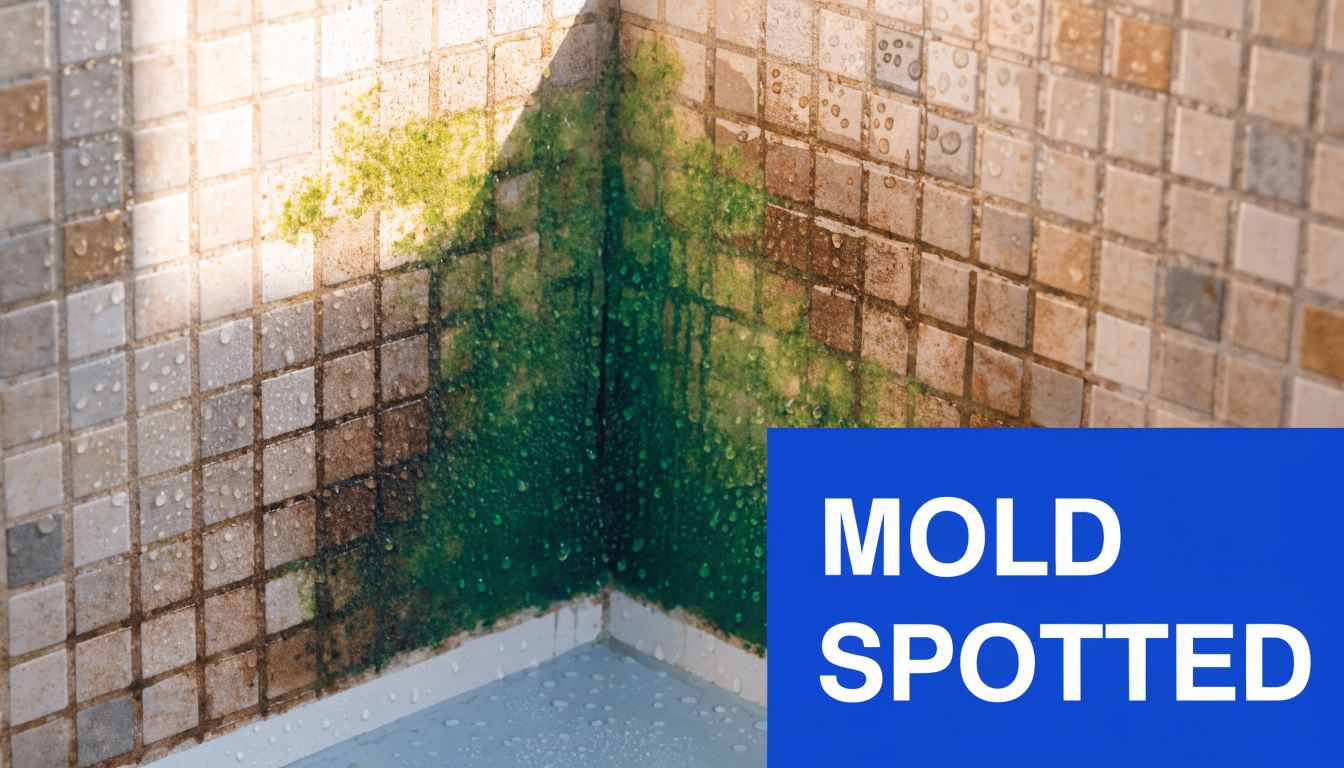
Where mold tends to show up first
Moisture drives the pattern. In homes, early signs often appear around shower grout, window frames, under sinks, in basements, or behind furniture placed against exterior walls. In commercial buildings, problem areas often include supply closets, ceiling plenums, HVAC zones, wall cavities near plumbing, and any room with prior roof or pipe leaks.
A quick field check helps organize what you're seeing:
| Location | Common visible clue | What it often suggests |
|---|---|---|
| Bathroom tile or grout | Green, dark, or patchy residue | Ongoing humidity or poor drying |
| Drywall near leaks | Staining, bubbling paint, fuzzy growth | Hidden moisture in wall assembly |
| Ceiling tiles | Brown rings with spotting | Roof leak or HVAC condensate issue |
| Fabric or stored items | White or gray dusty film | Damp storage conditions |
| Window frames | Dark specks or repeated return growth | Condensation problem |
Practical rule: If a surface keeps discoloring after cleaning, treat it as a moisture investigation problem, not a housekeeping problem.
People also get tripped up by the phrase "black mold." Some dark colonies may indeed be concerning, but appearance alone isn't enough to name the organism. That's why a wall that looks dramatic may not match the species people assume, and a less striking patch may still point to significant hidden contamination. If you're dealing with dark staining indoors, this guide on black mold on walls can help you understand what visible growth does and doesn't prove.
What Mold Spores Actually Look Like Under a Microscope
An individual mold spore doesn't look anything like the blotchy patch on a wall. Mold spores are invisible to the naked eye and measure about 2 to 10 microns. That's why people can smell mold, react to it, or spread it through a building without seeing anything obvious at all.
Under a microscope, the picture changes completely. Instead of "green mold" or "black mold," you start seeing specific shapes, attachment patterns, and structures that lab professionals use to sort one group from another.
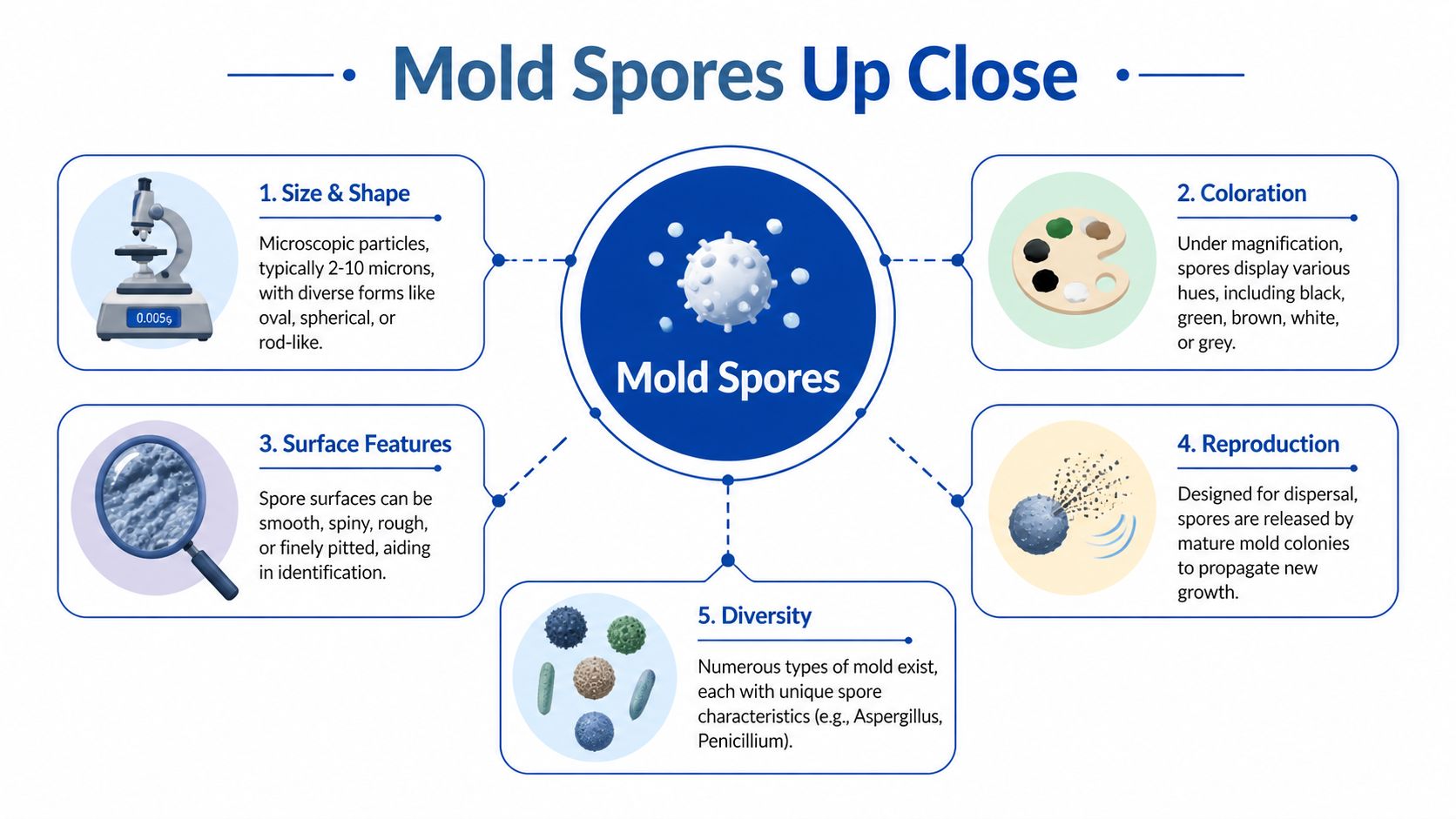
The easiest way to picture common indoor spores
The fastest way to make microscopy understandable is to use plain visual analogies.
- Aspergillus looks like chains of round spores growing from a flower-like fruiting body.
- Penicillium appears as brush-like chains of spheres.
- Stachybotrys often looks like mottled black grapes on a stick.
- Cladosporium can appear in several forms, including ovoid, bi-cellular, banana-like, or shield-shaped structures with black connection points.
- Chaetomium produces lemon-shaped spores in sea urchin-like structures.
- Trichoderma tends to look like green clumped spores, similar to tiny grape clusters on pyramidal branches.
That level of detail isn't academic trivia. It helps explain why a lab report may identify categories that don't match what a property owner expected from a quick look at a wall.
Why Asp-Pen confuses so many people
One of the biggest points of confusion is the common grouping called Asp-Pen, short for Aspergillus and Penicillium. These molds can look so similar under routine review that quick field assumptions are risky. A person may see green growth and assume a specific species, but professionals know that visual guesses can be wrong.
When a report groups material as Asp-Pen, that isn't indecision. It's a reminder that close-looking molds often require lab-based confirmation rather than a snap judgment from color or texture.
This matters for anyone trying to verify remediation. Facility managers may need to know whether contamination likely spread through return air pathways. Insurance personnel may need to interpret whether visible cleanup addressed the actual source. Property owners may need to understand why "it looked clean" doesn't automatically mean the environment has been properly cleared.
Why spore shape matters in the real world
Microscopic form gives context that visible colonies can't. A black slimy patch might make people focus only on Stachybotrys, but another mold could be present nearby or in the air. Conversely, a less dramatic green or gray area might be releasing spores into occupied spaces more readily than expected.
That is why professional interpretation matters when asking what do mold spores look like. The answer isn't just "tiny dots." It's a set of identifiable structures that can help explain spread, hidden growth, and whether cleanup decisions were based on evidence instead of assumption. If you're sorting out terminology first, this breakdown of mold vs mildew vs biohazard mold can help clarify why these labels aren't interchangeable.
How Microscopic Spores Become a Widespread Problem
A single spore is microscopic. A building-wide problem is not. The bridge between those two realities is movement plus moisture.
Spores travel easily because they're light enough to hitch a ride on normal indoor activity. Air currents move them. HVAC systems can distribute them. Shoes, clothing, boxes, carts, and pets can carry them from one room to another. Once they land on a surface with the right conditions, growth can begin.

The three conditions mold needs
Think of mold spread as a chain reaction that depends on three ingredients:
A place to feed
Drywall paper, wood, dust, fabric, and many stored materials can support growth.A workable indoor environment
Most occupied buildings provide temperatures mold can tolerate.Moisture
This is the deciding factor. Without moisture, spores may settle but won't establish active growth.
That's why a small visible patch often isn't the whole problem. If condensation continues above a ceiling, if a wall cavity stayed wet after a plumbing failure, or if an HVAC component keeps introducing damp air, spores can keep seeding new areas out of sight.
Why hidden spread is so common
Many people focus on the spot they can see. Professionals focus on the path moisture and air may have created. A stain under a window may connect to wet insulation. A musty office may involve duct lining, return plenums, or wall cavities. A clean-looking basement may still have an active source behind shelving or paneling.
For building operators trying to reduce recurrence, Engle Services' advice on indoor air is a useful reminder that air handling, filtration, and moisture control work together. Mold isn't only a surface issue. It's often an air movement issue too.
A colony grows where conditions are favorable. Spores travel where the building allows them to travel.
That is why prevention has to go beyond wiping surfaces. Long-term control depends on leak correction, humidity management, drying, and inspection of concealed spaces when warning signs point to a larger footprint. This is also why effective mold prevention and risk mitigation always starts with moisture control rather than cosmetic cleanup.
Understanding the Health Risks of Mold Spore Exposure
People respond to mold exposure differently. One person may notice a musty room immediately. Another may only realize something is wrong when congestion, irritation, or headaches keep returning in the same area of the building. The safest approach is to take occupant complaints seriously without jumping to conclusions about a specific diagnosis.

Allergic and respiratory reactions
Many concerns begin with irritation that feels familiar. Sneezing, coughing, itchy eyes, throat irritation, and asthma flare-ups are common reasons people start investigating a space. In workplaces, schools, care settings, and homes, these patterns often show up first as repeated complaints about one wing, one office, one bedroom, or one HVAC zone.
That doesn't mean every symptom is caused by mold. It means mold should stay on the list when symptoms track with a building or a moisture event.
Irritant effects and indoor comfort problems
Mold problems don't always announce themselves through visible growth. Sometimes the first sign is a stubborn musty odor and a room that feels uncomfortable to occupy. Occupants may describe headaches, a sense of stale air, or irritation that improves when they leave the space.
Those complaints matter operationally. Even before a surface colony is obvious, a musty environment can signal hidden moisture, microbial activity, or poor air handling that deserves professional attention.
For homeowners looking to reduce moisture-prone conditions, practical tips for homeowners from Northpoint Construction offer useful maintenance ideas, especially for below-grade areas where dampness can persist unnoticed.
Why some molds raise extra concern
Certain molds, including Stachybotrys, are often discussed because of the compounds some molds can produce. That is one reason professionals avoid casual cleanup in heavily affected areas. Disturbing contaminated materials without containment can spread particles into occupied spaces and make assessment harder.
This short video gives a helpful overview of why mold exposure concerns should be handled carefully.
Occupant safety comes first. If people are reporting symptoms in a water-damaged space, the right response is investigation, source control, and safe remediation. Not guesswork.
For facility managers and homeowners alike, the key point is calm but firm. Mold concerns don't require panic. They do require respect, documentation, and a response that considers both building conditions and the people spending time inside them. If water intrusion has already occurred, this overview of the hidden dangers of water damage and mold-related hazards is a practical next read.
Why DIY Mold Testing Can Be Dangerously Misleading
DIY mold test kits feel appealing because they promise a quick answer. Set out a plate, swab a surface, mail something off, and wait for results. The problem is that a quick answer isn't the same as a reliable one.
Indoor environments naturally contain some level of airborne biological material. A simple kit usually can't tell you whether what it captured reflects normal background conditions, a hidden active source, or contamination created by the way the sample was collected. That leaves people with two bad outcomes. False reassurance, or unnecessary alarm.
What home kits usually miss
Many kits are limited in ways that matter:
- They don't capture the building context. A result means little without understanding moisture history, ventilation patterns, and where occupants are reporting concerns.
- They struggle with hidden growth. A plate in the middle of a room may miss a wall cavity, ceiling plenum, or intermittently active HVAC source.
- They don't resolve interpretation problems. If a report uses broad categories or growth appears after a sample is disturbed, homeowners often misread what the finding means.
This is especially important when people want a species name from a visible patch. As covered earlier, some mold groups are difficult to distinguish confidently without proper microscopy and professional interpretation.
Why professional assessment is different
A qualified inspector doesn't rely on one shortcut. They build a picture of the problem. That process may include moisture mapping, targeted surface sampling, air sampling in the right locations, and a visual inspection guided by the building's leak history and occupant complaints.
A professional also asks the questions a kit can't answer. Is this active growth or residual staining? Is there a moisture source still present? Is the contamination isolated, or has air movement likely spread it beyond the visible area?
A DIY result is a snapshot with no map. Professional assessment connects the sample to the source, the building, and the risk.
If you're debating whether a hardware-store test is enough, this guide on when you need professional mold remediation lays out why proper diagnostics should come first.
The Professional Remediation and Verification Process
Good remediation is controlled, methodical, and documented. It isn't a crew spraying chemicals at a wall and leaving once the stain looks lighter. The visible residue matters, but the objective is to remove contaminated material safely, prevent cross-contamination, and confirm the environment has been returned to an acceptable condition.
Containment comes before removal
Professionals start by separating the affected area from the rest of the building. Depending on conditions, that may involve physical barriers and negative air pressure so disturbed particles don't migrate into adjacent rooms, hallways, or occupied zones.
This step matters most in facilities where people remain onsite, such as offices, clinics, multifamily properties, or care settings. Without containment, cleanup activity itself can spread contamination.
Air cleaning and material removal
Once the area is isolated, crews typically use HEPA-filtered air scrubbers and other engineering controls to capture airborne particulates during the work. Contaminated porous materials may need to be removed because mold can penetrate beyond the cleanable surface.
Examples often include:
- Drywall and insulation affected by leaks or cavity moisture
- Ceiling tiles exposed to roof or condensate damage
- Carpet pad or fabric furnishings that stayed wet long enough to support growth
- Wood or structural surfaces that require detailed cleaning after source correction
Non-porous and semi-porous surfaces are then cleaned using procedures matched to the material and the extent of contamination. The moisture source must be corrected as part of the job. Otherwise, recurrence is likely.
Verification is what proves the job was done right
The final stage is often the one property owners underestimate. Cleanup isn't complete when the area looks better. It is complete when remediation has been followed by post-remediation verification, typically performed independently, to confirm that conditions support safe re-occupancy and that the contamination was addressed effectively.
That verification may include visual review, moisture confirmation, and environmental testing appropriate to the project. For commercial properties and regulated environments, this documentation can be critical for risk management, insurance files, occupant communication, and compliance expectations.
A credible remediation process answers three questions clearly:
| Question | What a professional process addresses |
|---|---|
| Was spread controlled during cleanup? | Containment and negative air |
| Were contaminated materials handled safely? | Removal, cleaning, and compliant disposal |
| Is there evidence the area was properly cleared? | Post-remediation verification |
When these steps are skipped or rushed, the same space often becomes a repeat claim, a repeat complaint, or a repeat cleanup.
Frequently Asked Questions About Mold Identification
Is mold the same as mildew
Not exactly. People use the words interchangeably, but they don't usually mean the same thing in practice. Mildew often refers to lighter, more superficial growth on damp surfaces, while mold is a broader term that includes many organisms capable of deeper colonization and wider spread.
If the material is recurring, tied to water damage, or showing up in porous building materials, treat it as a mold investigation issue rather than assuming it's minor mildew.
Can you identify mold by color alone
No. Color is one of the least reliable ways to identify mold. Dark growth may not be the species people assume, and green, gray, or white growth can still signal a significant moisture problem.
A useful rule is simple: color may help you notice a problem, but it can't diagnose the problem.
What do mold spores look like without a microscope
You generally won't see individual spores at all. What people notice instead is colony growth, staining, dust-like residue, or a musty odor. The actual spores are microscopic, which is why a room can have an air quality problem before there is an obvious visual patch.
If I clean the visible spot, is the problem solved
Not necessarily. Surface cleaning may remove what you can see, but it won't fix hidden moisture inside walls, above ceilings, or within HVAC components. If the underlying source remains, growth often returns.
This is one reason repeated wipe-downs can create false confidence. The surface looks improved, while the system causing the contamination stays active.
Should I paint over mold
Painting over active mold is not a remediation strategy. Paint can temporarily hide staining, but it doesn't remove contaminated material or correct the moisture source. In some cases, it makes later assessment harder because the surface no longer shows the original pattern clearly.
Why do professionals care about the exact spore type
Because different microscopic forms help them interpret reports, understand likely spread, and decide what level of investigation is needed. A professional isn't just trying to name a mold. They're trying to answer bigger questions about hidden contamination, occupant risk, and whether remediation was adequate.
If you're responsible for a building, the most important question usually isn't "What color is it?" It's "Where is the moisture, where did the spores travel, and has the area been properly verified?"
When should I stop investigating it myself
Stop and bring in qualified help when any of these are true:
- The growth keeps returning after cleaning.
- There was a leak, flood, or chronic condensation issue and materials may still be wet inside assemblies.
- Occupants are reporting symptoms tied to a room or building area.
- The contamination may involve HVAC, wall cavities, or commercial space operations.
- You need documentation for insurance, property management, tenant communication, or compliance purposes.
Careful mold identification is less about labeling a stain and more about understanding what the building is telling you.
If you need experienced help evaluating mold contamination, planning safe remediation, or documenting a clearance process, 360 Hazardous Cleanup provides professional biohazard and environmental cleanup services with a strong focus on safety, discretion, and regulatory compliance. Their team supports homeowners, facility managers, insurers, and public agencies during high-stress situations when clear guidance and proper containment matter most.