The officers are gone. The front door may be splintered, drawers may be open, and the room may feel unfamiliar in a way that's hard to describe. For many property owners, that quiet after a police search is the worst part. The activity stops, but the questions start.
You may be staring at a document left behind and wondering what it means, whether the search was lawful, what happens to seized items, and when you can begin cleaning and securing the property. If the scene involves blood, bodily fluids, drug residue, fingerprint powder, tear gas, or other hazardous contamination, the pressure rises quickly because safety and documentation matter immediately.
A search warrant and affidavit are the two key documents behind that search. Understanding them won't erase what happened, but it can help you regain a sense of control. It also helps you make better decisions about preserving evidence, protecting your legal interests, and starting recovery in a way that's safe and insurable.
Navigating the Aftermath of a Police Search
The first moments after a search often feel disorienting. A homeowner walks back into the bedroom and finds mattresses moved, closet contents on the floor, and property tags attached to missing electronics. A facility manager opens an office after investigators leave and sees damaged cabinets, disrupted records, and possible biohazard exposure in an area employees normally use.

That reaction is normal. Even when officers act under court authority, the experience can leave people shaken, angry, embarrassed, or unsure what to touch. If you're in that position, the most useful first step is to slow down and identify what paperwork you have.
Usually, people remember seeing the warrant because it's the paper that authorizes entry. Many don't realize there's also an affidavit, which is the sworn factual statement used to persuade a judge that probable cause exists. Sometimes that affidavit isn't immediately available to the person whose property was searched, especially if the court has sealed it.
What people usually need first
In practical terms, most property owners need answers to four questions:
- Was this search authorized: You need to know what officers were permitted to search and seize.
- What was taken: An inventory or receipt matters for legal follow-up and insurance records.
- Is the property safe to enter: A scene may be legally released but still unsafe to occupy or clean without precautions.
- How do I document the condition now: Photos, notes, and professional observations can become important very quickly.
The legal event may be over for the day, but the property event is just beginning.
If your building has contamination, visible damage, or a traumatic history tied to the search, your next steps should balance legal caution with health and safety. Families and managers often need a calm recovery plan more than they need more speculation.
A helpful starting point is this guide on life after the police leave, which focuses on stabilizing the property and the people affected by the scene.
Understanding the Search Warrant and Affidavit
A lot of confusion comes from treating these two documents as if they're the same thing. They aren't.
The simplest way to understand a search warrant and affidavit is this. The affidavit is the sworn explanation. The warrant is the judge's approval based on that explanation. One provides the factual basis. The other gives legal authority to search.
A plain-language analogy
Think of the affidavit as the blueprint and the warrant as the permit. The officer or investigator presents facts under oath in the affidavit. A judge or magistrate reviews those facts. If the judge concludes the legal standard is met, the judge signs the warrant authorizing the search.
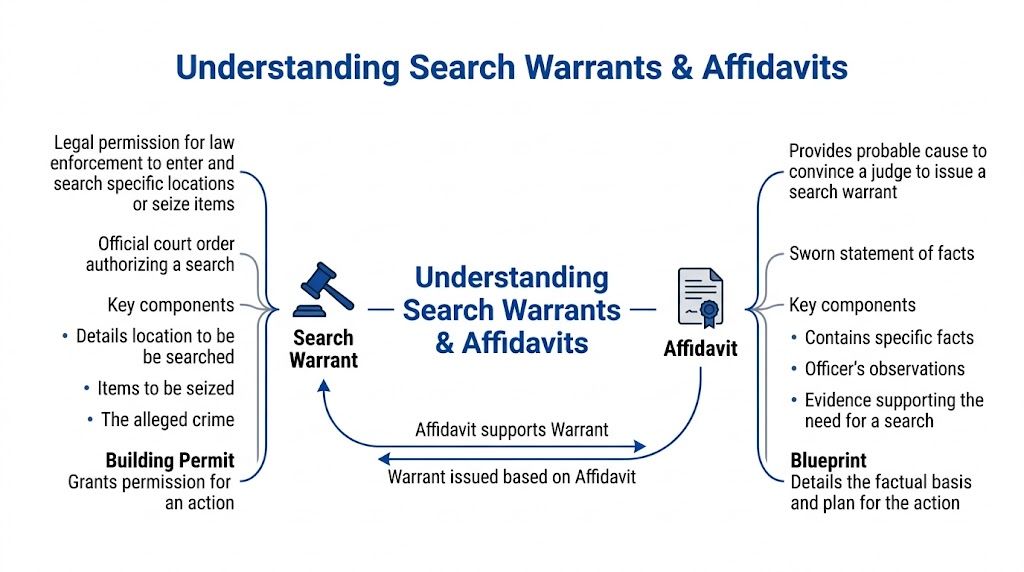
That distinction matters because the warrant usually tells you what place may be searched and what items may be seized, while the affidavit explains why law enforcement believed evidence would be there. Legal guidance notes that these are distinct instruments: the warrant is the magistrate-approved order authorizing the search, and the affidavit is the sworn factual record used to establish probable cause, and it must contain enough detail for a judge to independently evaluate whether evidence is likely to be found at the location, as explained in this overview of how search warrants and affidavits differ.
What each document usually does
| Document | Main function | What a property owner should look for |
|---|---|---|
| Search warrant | Authorizes the search | Address, location, items to be seized, issuing judge |
| Affidavit | Supports probable cause | Facts, observations, sources of information, connection to the property |
A property owner often sees only the first document at the scene. That's one reason people leave the encounter still unsure why their property was searched.
Why this distinction matters after the search
This isn't just legal theory. It affects what you can document and what professionals can rely on afterward.
If you manage restoration, insurance communications, or occupant re-entry, the warrant may be your first proof of lawful entry. The affidavit, when available, can provide deeper context about alleged evidence locations and investigative concerns. That context may affect how you preserve a room, whether you delay cleanup in a specific area, or how you describe the loss to carriers and counsel.
If your situation involves a crime scene, biohazard contamination, or a restricted area that may later need coordinated release, this overview of how hazardous cleanup teams work with law enforcement and first responders gives a practical picture of why chain-of-custody awareness and scene discipline matter.
The Legal Standard of Probable Cause
The phrase probable cause sounds technical, but the basic idea is narrower than many people think. It doesn't mean police must prove a case beyond doubt before a search. It means a judge must find a legally sufficient reason to believe evidence of a crime is likely at a specific place.
Legal guidance describes probable cause as a "fair probability" that evidence of a crime is located in a particular place. The same guidance explains that a judge reviews the application and affidavit and will issue the warrant only if probable cause exists that a crime was committed, evidence exists, and that evidence is at the specified location. It also notes that the formal rules of evidence don't apply to a warrant application, so hearsay may be included if needed to establish probable cause, as explained by the Alameda County District Attorney's search warrant guidance.
What judges usually need to see
A strong affidavit usually gives the judge concrete facts, not guesses. That often includes:
- Specific observations: What an officer saw, heard, recovered, or documented.
- A clear location link: Why evidence is expected at this property, not somewhere else.
- Time information: Facts should be timely enough to support the idea that the evidence is still there.
- Corroboration: Supporting records, photos, communications, or other facts can strengthen the chain of logic.
- Informant detail: If a confidential source is involved, reliability and basis of knowledge matter.
Where readers often get confused
Many people assume probable cause means officers must have direct evidence that conclusively proves guilt. That's not the test. The judge is not deciding guilt at this stage. The judge is deciding whether the affidavit provides enough factual detail to justify a search.
Practical rule: Probable cause is about whether the facts make the search reasonable, not whether the case is already won.
That also explains why vague suspicion isn't enough. The affidavit should connect the alleged crime, the evidence sought, and the place to be searched in a way that allows the judge to make an independent decision.
For property owners, this matters because the legal authority to enter your home, office, unit, or facility depends on that paper trail. If later litigation challenges the warrant, the affidavit often becomes the focal point.
How the Search Warrant Process Really Works
Television teaches people to imagine a long, dramatic sequence with late-night calls, urgent courtroom scenes, and extended judicial debate. In reality, the process is often fast, routine, and heavily dependent on the written affidavit.
A large Harvard Law Review study found that over 93% of warrants were approved on the first attempt, over 98% were eventually approved, and the median time from opening an affidavit to sending back a judicial warrant was only 3 minutes. The same study found that one out of every ten warrants was read, analyzed, and responded to in 1 minute or less, according to the Harvard Law Review's empirical analysis of warrant review.

The practical sequence
The usual pattern looks like this:
- An officer gathers facts and develops probable cause.
- The officer drafts an affidavit under oath.
- In some cases, a prosecutor reviews the draft.
- The paperwork goes to a judge or magistrate, often through established procedures.
- The judge signs the warrant if the affidavit supports probable cause.
- Officers execute the warrant within the scope the judge approved.
Why speed matters to property owners
That speed surprises people. It also explains why law enforcement can arrive with a signed warrant much faster than a property owner expects. The process may feel sudden at the door because most of the legal work happened before anyone knocked.
For owners and managers, the important takeaway is practical. By the time the team arrives, they're usually operating from paperwork already approved by a court. Arguing about the underlying facts at the threshold rarely changes what happens in that moment.
Fast approval doesn't eliminate constitutional limits. It shows how much weight the system places on the written affidavit and the judge's quick review of it.
If you're trying to understand who may have been present during the search or what roles different officers played, this guide to police department ranks and duties can make the scene easier to decode.
Your Rights When Law Enforcement Executes a Warrant
When officers are at your property with a warrant, your goals should be simple. Stay calm. Don't interfere. Protect your legal position. Preserve your ability to document what happened afterward.
The warrant gives law enforcement authority to search within the scope the judge approved. It does not require you to answer questions beyond identifying yourself where legally required, and it doesn't mean you must consent to anything broader than what's authorized.
What you can do in the moment
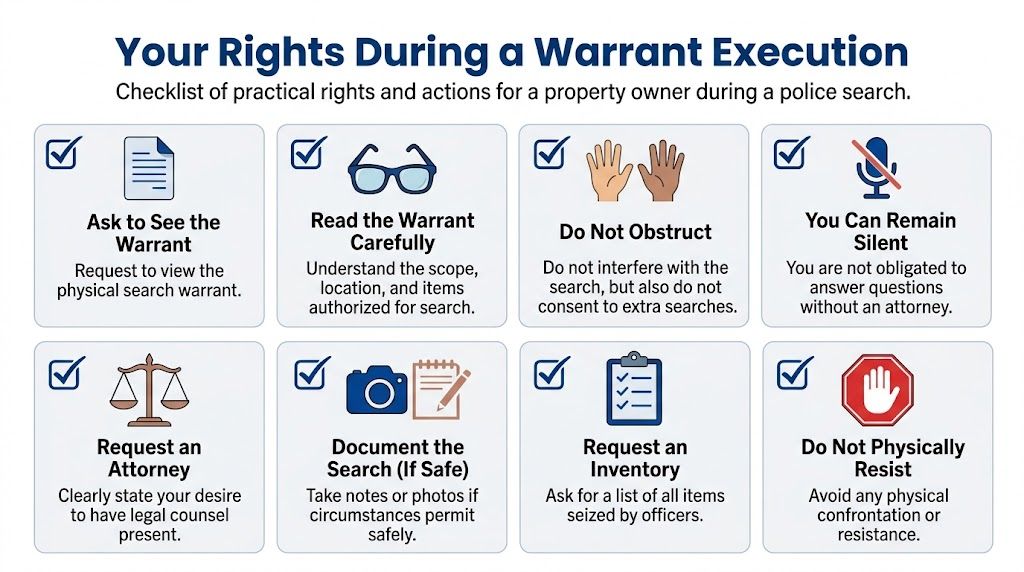
These steps are usually the safest and most useful:
- Ask to see the warrant. Read the address, the areas covered, and the items listed for seizure.
- Do not physically resist. Even if you believe the search is improper, physical confrontation usually creates additional risk.
- Do not expand the search by consent. You can cooperate without volunteering permission for officers to search beyond the warrant.
- State that you want an attorney. Use clear language and keep it simple.
- Remain silent if questioned. You don't need to explain, speculate, or fill awkward silence.
- Request an inventory or receipt. If items are seized, documentation matters later.
- Take notes if safe. Record names, agencies, times, damage, and the rooms searched.
A short outside resource on protecting your rights from unlawful police searches can also help if you're trying to understand the difference between lawful execution and overreach.
What not to do
Some reactions are understandable but unhelpful.
Don't block entry. Don't hide items. Don't argue with line officers about constitutional doctrine in the doorway. Don't start cleaning or moving possible evidence while the search is active. And don't assume casual conversation is harmless if you're distressed and speaking off the cuff.
This short video gives a practical rights-focused overview:
If children, patients, tenants, or employees are present
Commercial and care settings add another layer. A clinic, behavioral health center, warehouse, or apartment complex may have people on site who are frightened and confused.
In those situations, designate one calm contact person if possible. That person can observe, document, and communicate with counsel or leadership. Others should focus on keeping residents, patients, or staff away from the search area.
If the search involves a trauma scene, bodily fluids, suspected drug contamination, or chemical agents, legal authority to search doesn't equal safety to re-enter.
That distinction matters. Law enforcement may finish its work while the property still needs restricted access, specialized PPE, or regulated remediation before normal use can resume.
After the Search, Cleanup, Insurance, and Moving Forward
When the search ends, many people assume the main crisis is over. Legally, maybe. Environmentally and operationally, not always.
A property can be released by law enforcement and still be unsafe for family members, tenants, staff, or contractors. Bloodborne contamination, fingerprint chemicals, broken glass, pepper spray or tear gas residue, drug-related contamination, and puncture hazards can remain after officers leave. Ordinary janitorial cleaning isn't designed for that kind of scene.
Why documentation comes before cleanup
One of the hardest parts of the aftermath is the paper gap. A court may seal the affidavit to protect an ongoing investigation or an informant. Pennsylvania's rule specifically allows search-warrant affidavits to be sealed in certain circumstances and filed with the court after issuance, which is why owners and vendors may end up with the warrant but not the full supporting facts, as noted in Pennsylvania Rule 201 and related access rules.
That means your documentation after the search becomes more important, not less.
Create a record of the property's condition before anything is moved or discarded. That record may help with insurance, legal review, internal incident reporting, and repair planning.
A useful post-search checklist
- Photograph every affected area: Include entry points, damaged locks, disturbed rooms, residue, and visible contamination.
- Separate damage from contamination: A broken door is a repair issue. Blood, bodily fluids, or chemical residue is a remediation issue.
- Preserve paperwork: Keep the warrant, inventory sheet, business cards, case numbers, and any release information together.
- Notify insurance early: Give the carrier a clear description of what happened and ask what documentation they want first.
- Limit access: Don't let staff, tenants, or family members wander through the scene until hazards are evaluated.
- Use qualified remediation professionals where biohazards exist: Safety, disposal rules, and evidence-awareness all matter.
A practical guide to talking with your insurance company about cleanup services can help you organize that conversation before avoidable mistakes compound the claim.
Why professional remediation matters
Trauma and crime-related cleanup isn't just about appearance. It's about exposure control, compliant waste handling, surface decontamination, documentation, and occupant safety. If a property owner hires the wrong kind of cleaner, the result may be incomplete decontamination, improper disposal, or poor claim support.
A lawful search can create a restoration problem that isn't visible from the doorway.
That is especially true in rentals, healthcare spaces, multifamily properties, and commercial sites where reopening too early can expose others to health risks and liability. The right response is careful, documented, and compliant. It should respect both the investigation and the people who have to live or work there afterward.
Frequently Asked Questions About Search Warrants
Can I see the affidavit right away
Not always. You may receive or view the warrant itself while the affidavit remains sealed, redacted, or delayed from disclosure. If the affidavit is sealed, a lawyer can advise you on whether and when to seek access through the court.
Who pays for damage caused during a lawful search
That depends on the circumstances, the agency involved, applicable law, and your insurance policy. From a practical standpoint, document every damaged door, lock, cabinet, wall, window, and fixture immediately. Don't wait until repairs begin.
When is it safe to start cleaning
Only after the scene is released and after you've considered whether hazards remain. Legal access and safe occupancy are not the same thing. If there's blood, bodily fluids, chemical residue, decomposition, drug contamination, or sharps, bring in qualified remediation professionals before anyone resumes normal use of the space.
How do I get seized property back
Usually through the agency holding the property, sometimes with court involvement. Ask for the property receipt or inventory, the case number, and the contact information for the evidence unit or investigator. Your attorney can help if the process stalls.
What if I think the search was unlawful
Don't litigate that issue on site. Preserve documents, write down what happened, and contact counsel. The challenge often turns on the warrant, the affidavit, and how the search was executed.
Can I check whether someone has an active warrant
If you're trying to verify status before a surrender, legal consultation, or family decision, this resource for checking active warrants may help you understand common starting points. For legal advice about a specific case, speak directly with a lawyer in the relevant jurisdiction.
What if the property is a rental, clinic, or workplace
Treat it as both a legal event and a safety event. Notify ownership, counsel, risk management, and insurance as appropriate. Restrict access until hazards are assessed, and keep a clean record of who entered the affected area after law enforcement left.
For broader practical concerns about contamination, scene release, re-entry, and professional cleanup, this collection of biohazard cleanup frequently asked questions is a useful companion resource.
If your property is dealing with the aftermath of a police search, trauma scene, unattended death, chemical agent exposure, or other hazardous contamination, 360 Hazardous Cleanup provides compassionate, compliant help around the clock. Their team understands that recovery isn't just about cleaning. It's about protecting health, preserving documentation, supporting insurance needs, and helping families and property owners regain safe use of the space with dignity.