A call comes in after hours. A tenant has moved out, the apartment smells wrong, and there are stains on the floor that nobody wants to get close to. Or a facilities manager opens a storage room after a medical incident and realizes the problem isn't just what can be seen. It's what may still be in the air, in porous materials, and on every surface someone might touch next.
In moments like that, people often think first about cleanup supplies. Gloves. Masks. Coveralls. Maybe a “hazmat suit.” But that's only part of the picture. In real biohazard work, safety starts with decisions, not gear alone. The right team has to identify the hazard, choose equipment that matches it, put that equipment on correctly, work without spreading contamination, and remove everything without exposing workers or occupants.
That's where personal protective equipment standards matter. They turn a frightening, uncertain situation into a process people can follow. They also protect the people who enter the scene first, whether that's a trained remediation crew, a maintenance worker, or a family member who doesn't yet realize how much risk is present.
Why PPE Standards Are the First Line of Defense in a Crisis
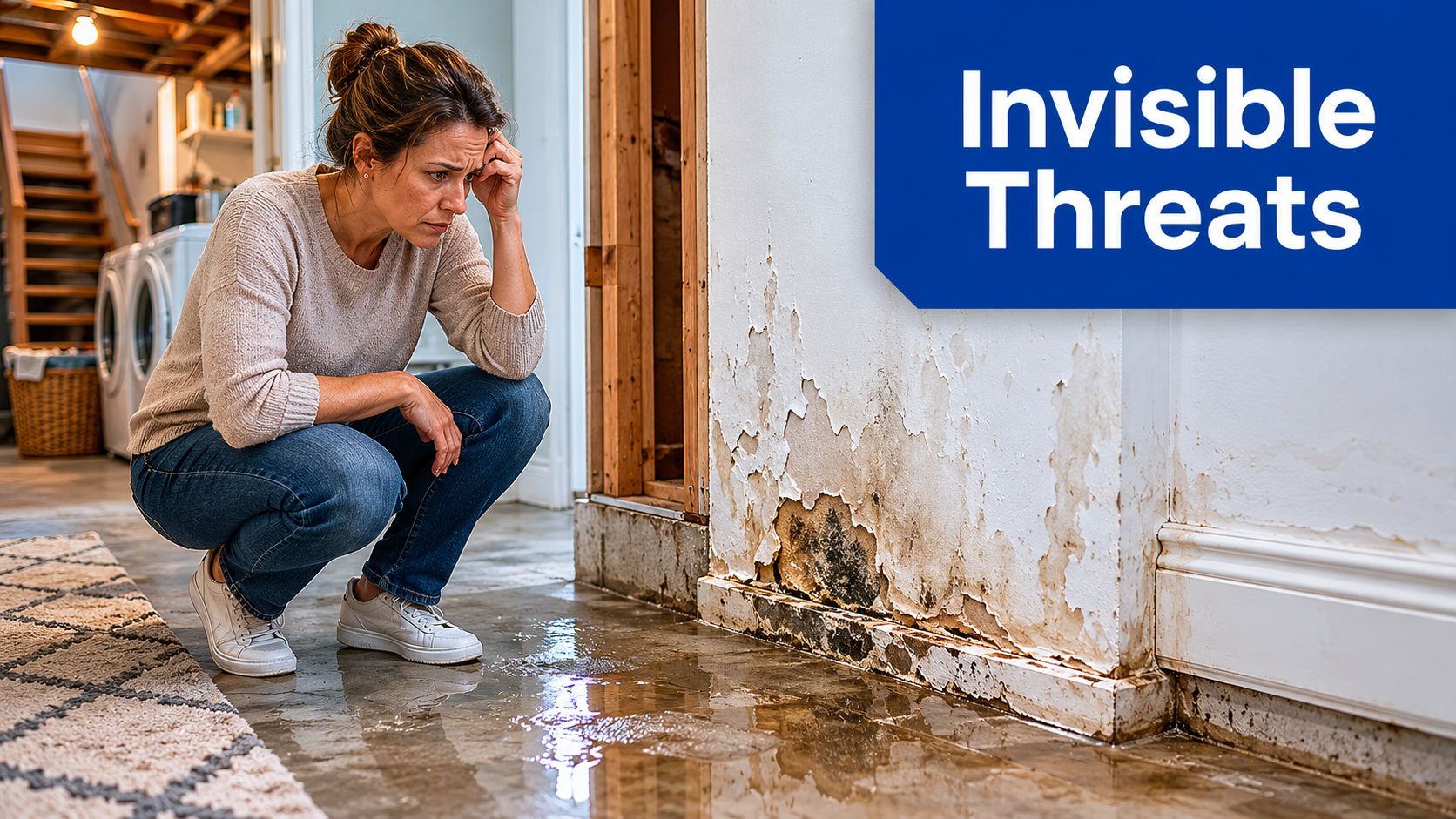
When people face a biohazard scene for the first time, they usually focus on the visible damage. Blood on flooring. Mold after water intrusion. Bodily fluids in a bathroom. Debris from an emergency response. The visible mess feels urgent, but the bigger danger is often invisible.
A contaminated surface can carry more than dirt. Air in the room may contain particles. A torn glove, poor respirator choice, or exposed wrist can turn a cleanup attempt into an exposure event. That's why personal protective equipment standards exist. They create a disciplined way to reduce exposure when people are at their most vulnerable.
OSHA defines PPE as equipment worn to minimize exposure to workplace hazards, and its framework applies across general industry, maritime, and construction through enforceable standards on selection, use, and maintenance for hazards that include chemical, radiological, physical, electrical, and mechanical risks, as outlined in OSHA's personal protective equipment overview. That regulatory foundation also shaped a major procurement category. One forecast places the U.S. PPE market at USD 17.36 billion in 2026 in the same OSHA-grounded market summary provided in the verified data.
What standards change on the ground
Without standards, people improvise. They wear a dust mask for a splash hazard. They reuse contaminated gloves. They buy disposable coveralls without checking whether the material matches the exposure risk. In a crisis, improvisation feels fast. It often creates a second problem.
With standards, the process changes:
- Hazards are assessed first so the equipment matches the actual risk.
- Equipment is selected deliberately instead of by appearance or convenience.
- Removal and disposal are controlled so contamination doesn't spread to hallways, vehicles, or homes.
- Workers are trained to recognize the limits of their gear.
Practical rule: PPE isn't a costume. It's one part of a safety system that only works when the hazard, the gear, and the work method all match.
For property owners and families, this is why professional help matters. A compliant team doesn't just arrive with supplies. It arrives with a method. If you want a plain-language primer focused specifically on remediation work, 360 Hazardous Cleanup has a helpful resource on the importance of personal protective equipment in biohazard cleanup.
Understanding the Key Agencies Behind PPE Regulations
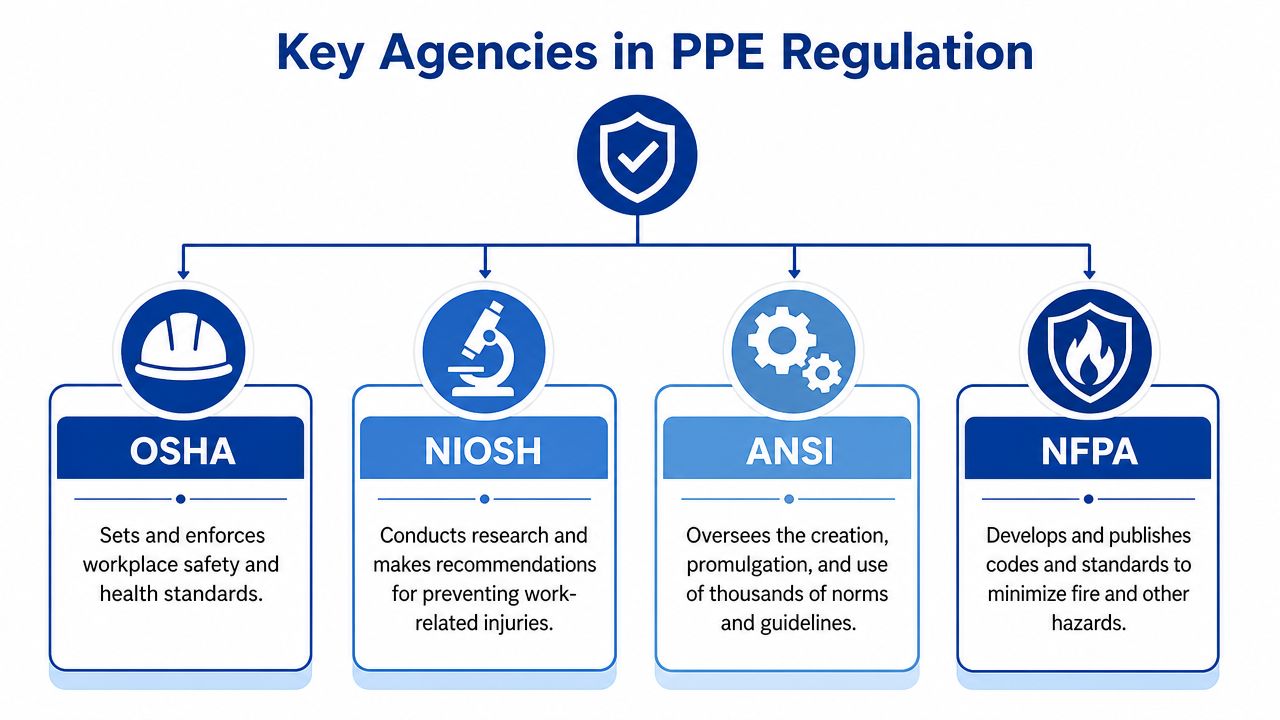
Many people hear a string of acronyms and assume they all do the same thing. They don't. In practice, these organizations work more like parts of a city. One group writes enforceable rules. Another studies what keeps people safe. Another develops detailed performance standards. Another publishes codes used in higher-risk emergency settings.
OSHA enforces workplace safety requirements
Think of OSHA as the agency with legal authority in the workplace. It requires employers to assess hazards and provide appropriate protection where hazards remain. In biohazard remediation, OSHA is often the framework people mean when they talk about compliance.
For an employer, OSHA questions are direct. Was the hazard recognized? Was the correct PPE provided? Was it maintained? Were workers trained?
NIOSH evaluates respiratory protection and worker needs
NIOSH plays a different role. It studies occupational safety problems and helps shape the technical understanding behind protection, especially around respirators and worker usability. NIOSH is also where an important unresolved issue becomes clear. The agency formally sought public input on PPE challenges for underserved user populations, including women and people with smaller or larger body types, in the Federal Register notice on needs and challenges in PPE use for underserved user populations.
That matters on a real cleanup site. Gear that technically meets a standard can still fail a worker if it doesn't fit, if it interferes with movement, or if a respirator can't seal properly on that specific face.
ANSI and NFPA shape performance expectations
ANSI and related consensus bodies help define how certain PPE should perform. These are the specifications buyers and safety managers often rely on when comparing products.
NFPA is especially relevant in hazardous materials and emergency response settings where fire, chemicals, or specialized entry conditions are part of the risk picture. NFPA codes and standards often influence what “appropriate protection” looks like in scenarios where the hazard goes beyond routine maintenance or custodial work.
A compliant remediation program doesn't rely on one acronym. It reads the scene through multiple lenses: legal duty, technical performance, fit, and emergency response conditions.
Why this matters when hiring a cleanup provider
A serious provider should understand the difference between enforceable rules and consensus standards, and also know when emergency response guidance changes the PPE decision. That fluency is one reason certifications and training matter in a way that goes beyond marketing language. 360 Hazardous Cleanup explains that broader compliance picture in why our certifications and training matter beyond the basics.
Choosing the Right Protection Level for the Hazard
On a professional cleanup site, the first question isn't “Where are the suits?” It's “What are we dealing with?”
A proper hazard assessment looks at the source of contamination, how people might be exposed, whether the air is known or unknown, and what tasks workers must perform. Wiping a surface, removing porous materials, cutting drywall, or handling chemically contaminated debris can each change the PPE decision.
Why one hazmat suit isn't enough
People often use “hazmat suit” as if it describes one product. It doesn't. The EPA uses four levels of protection to match PPE to the severity and certainty of the hazard. In the EPA's emergency response guidance on personal protective equipment levels, Level A provides the highest respiratory and skin protection with a totally encapsulating chemical-vapor protective suit and positive-pressure SCBA, while Level C is only appropriate when airborne concentrations are known and air-purifying respirators are acceptable.
That distinction is critical. A worker may appear protected because they're wearing a suit, gloves, and a mask. But if the respirator type is wrong, or if skin exposure remains possible, the protection is incomplete.
EPA levels of protection for hazmat response
| Level | Respiratory Protection | Skin/Body Protection | Typical Scenario |
|---|---|---|---|
| Level A | Positive-pressure SCBA | Totally encapsulating chemical-vapor protective suit | Highest uncertainty or highest toxicity, where both inhalation and skin exposure require maximum protection |
| Level B | Positive-pressure SCBA | Hooded chemical-resistant clothing with less skin protection than Level A | Serious respiratory hazard where maximum respiratory protection is needed, but full vapor-tight skin protection isn't required |
| Level C | Air-purifying respirator | Chemical-resistant clothing | Known airborne concentrations where the contaminant and conditions allow air-purifying respirators |
| Level D | No specialized respiratory protection for contaminated atmospheres | Standard work clothing or minimal protection | Low-risk tasks where nuisance contamination is controlled and no respiratory hazard is present |
How professionals make the decision
A competent team typically works through questions like these:
- What is the contaminant? Bloodborne material, decomposition fluids, chemical residue, infectious material, or mixed hazards all change the answer.
- How can exposure happen? Through inhalation, splash, skin contact, puncture, or contact with contaminated surfaces.
- What is known and what is still unknown? Unknown airborne conditions push decisions toward more conservative protection.
- What task is happening next? Bagging waste, demolition, cleaning, and transport all create different exposure pathways.
Using the wrong level can leave the most dangerous exposure pathway open. A strong suit with the wrong respiratory protection is still a failure.
For lab managers and health and safety staff, some of the same decision logic appears in this practical article with crucial advice for research labs, especially where contamination control depends on matching protection to the specific substance and task.
For a broader biohazard context, 360 Hazardous Cleanup also offers a primer on understanding biohazard safety levels. It's useful when a property owner or facility manager needs to understand why crews may increase protection before work begins, not after something goes wrong.
The Critical Importance of Training and Fit-Testing
Owning PPE doesn't mean a worker is protected. A respirator still has to seal. Gloves still have to allow safe movement. Goggles still have to stay in place during work. And a worker still has to know how to put equipment on and remove it without contaminating themselves.
That sounds basic. It isn't.
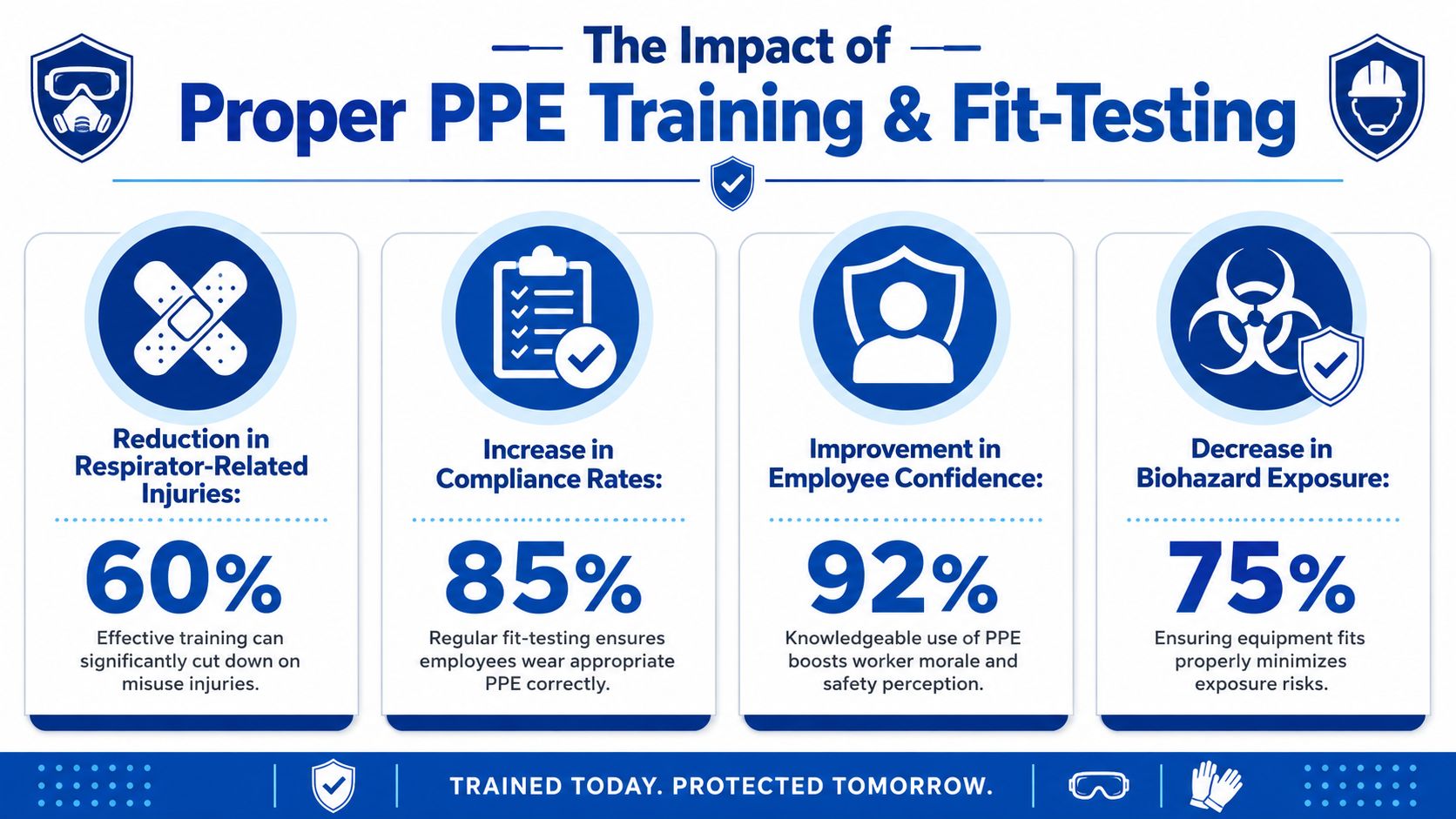
A peer-reviewed worker study found that 27.7% reported using no PPE at all, and it cited prior research showing 34% of occupational accidents were caused by not using PPE at the time of the incident. The same study identified the lowest safety-culture score in safety training, at 1.58, as reported in the peer-reviewed article available through PMC. Those findings tell a hard truth. Equipment on a shelf doesn't protect anyone.
Why fit-testing matters
Respirators are where many people get overconfident. A mask can look snug and still leak around the nose, cheeks, or chin. Facial structure, movement, sweating, talking, and fatigue all affect performance. In biohazard remediation, that isn't a minor detail. It's the line between filtered breathing and direct exposure.
Training also covers what workers tend to underestimate:
- Donning order matters because exposed skin during setup can create an avoidable contact risk.
- Doffing order matters even more because the outside of the PPE may be the most contaminated surface in the room.
- Task limits matter because vision, dexterity, and heat stress change what a worker can safely do.
A short demonstration helps make those principles easier to recognize in practice.
Why fit and usability are not small issues
A program fails if it protects only the “average” wearer. Some workers need smaller sizes. Some need larger cuts through the shoulders or hips. Some need equipment that works with prescription eyewear, hearing protection, or mobility limitations.
That's why usability matters as much as certification. A respirator nobody can wear correctly for a full task cycle becomes a false reassurance. In real operations, supervisors have to think beyond procurement and ask whether the assigned worker can move, see, kneel, lift, communicate, and exit safely in that exact PPE configuration.
The safest PPE program is the one workers can wear correctly under stress, for the full task, without losing protection halfway through.
For organizations building that kind of culture, 360 Hazardous Cleanup has a useful article on the crucial role of training in biohazard cleanup.
Maintaining a Constant State of Readiness
Many organizations focus heavily on buying PPE and very little on what happens next. That gap creates risk. Equipment that met the standard when purchased can become unreliable if it's stored poorly, exposed to temperature swings, or left uninspected for long periods.
In emergency cleanup work, readiness is not a one-time purchase. It's a maintenance discipline.
Storage conditions affect compliance
EPA guidance published in 2024 states that PPE and go-bags should be stored in clean, dust-proof containers, ideally in climate-controlled conditions, and should not be left in vehicles even briefly because heat and cold can degrade readiness, as noted in the EPA health and safety manual chapter on personal protection equipment storage and readiness.
That advice answers a common real-world mistake. Facilities teams often keep emergency kits in trunks, cargo areas, or maintenance sheds for convenience. Convenience can damage elastics, seals, packaging, and readiness long before anyone notices.
What a readiness program actually includes
A durable PPE program usually includes more than a closet full of boxes:
- Inspection routines for damaged packaging, expired components, broken seals, and missing parts
- Storage controls that protect against dust, moisture, heat, and cold
- Replacement tracking so staged inventory doesn't deteriorate into unreliability
- Post-incident decisions on decontamination, disposal, and documentation
For facility teams managing stocked supplies across multiple locations, this external guide for facility PPE management is a useful operational reference because it focuses on supply discipline rather than just the initial purchase.
Why this matters in a crisis
When an incident happens, nobody wants to discover that stored PPE has become brittle, unsealed, or otherwise questionable. The cost of that mistake isn't just delay. It can mean a worker enters underprotected, or a crew must stop work midway through containment to replace compromised gear.
A compliant program treats PPE as living inventory. It is selected, assigned, checked, protected, and replaced with the same care given to any other safety-critical system.
PPE Standards Applied to Real-World Scenarios
At 2 a.m., a crew arrives at a home where a family has just learned something terrible happened inside. The workers are not choosing PPE from an abstract chart. They are deciding how to protect themselves, keep contamination from spreading through the property, and reduce the chance that a grieving family faces another preventable harm.
That is what standards are for. They turn a stressful scene into a series of disciplined choices.
Biohazard remediation almost never involves one neat hazard. A single job can combine blood or other bodily fluids, contaminated porous materials, airborne particles created during removal, chemical residues, and sharp objects hidden in debris. In practice, PPE standards help crews answer one question over and over: what could enter the body here, and how do we block that pathway before work begins?
An unattended death scene in a residence
A bedroom or bathroom may contain visible fluids, odor, insect activity, and materials that have absorbed contamination below the surface. Opening windows and carrying items out might feel like a practical first step, but those actions can spread particles and track contamination into clean areas.
A trained team reads the room differently. They assess where fluids traveled, which materials must be removed, whether dried residue could become airborne during disturbance, and whether needles, broken glass, or exposed fasteners are hidden in linens or flooring. PPE decisions follow the hazard, not the emotion of the moment. That may mean gloves selected for puncture and fluid resistance, body covering that protects against surface transfer, footwear protection that can be decontaminated or discarded, and respiratory protection matched to the work being done.
The reason matters. Proper PPE at this stage protects more than the technician. It helps contain contamination inside the work area instead of carrying it into hallways, vehicles, dumpsters, or another family's home later that day. Teams that need a clearer view of how these decisions connect to regulation can review this explanation of OSHA and biohazard cleanup compliance and safety standards.
An infectious disease cleanup in a care setting
A clinic exam room or long-term care suite may appear orderly. The hazard is often less visible and more procedural. Cleaning, bagging waste, changing linens, and disturbing contaminated surfaces can all create opportunities for transfer to skin, clothing, mucous membranes, or nearby equipment.
Here, PPE has to work with the task. Gloves must hold up to both exposure and disinfectants. Face and eye protection must prevent splash contact during cleaning. Gowns or coveralls must stay closed and covered while the worker bends, reaches, and lifts. If the site assessment and protocol call for respiratory protection, that choice has to reflect the exposure risk created by the actual cleanup steps, not just the diagnosis associated with the room.
Sequence controls outcome. A worker can wear the right gear and still contaminate themselves by touching the wrong surface during removal. That is why experienced crews treat donning, work practices, and doffing as one connected system.
In high-stress cleanup, the removal phase often carries the highest risk because contamination is now on the worker's own PPE surface.
A crime scene involving tear gas residue
This kind of job causes confusion because the hazard profile changes halfway through the mental checklist. Crews may be preparing for bloodborne pathogen controls, then discover residue from a chemical agent on walls, furniture, and HVAC pathways.
That changes PPE selection immediately. Biohazard protection alone may not address chemical irritation to the eyes, lungs, and skin. Depending on the conditions, workers may need sealed eye protection or a full-face respirator, cartridges appropriate to the contaminant, and protective clothing that limits residue contact during removal and decontamination. The job also requires stricter attention to what leaves the structure, including tools, waste streams, and clothing layers exposed during the response.
A mixed-hazard scene is a good reminder that compliance is not a box-checking exercise. It is applied judgment under pressure. The standard only protects people when the crew can translate it into the right decision for the room in front of them.
A Practical Compliance Checklist and Key Questions Answered
A checklist matters most when a scene is chaotic. A family is waiting outside. A property manager wants the space cleared. A crew is under pressure to move quickly without carrying contamination into the hallway, the truck, or the next job. In that moment, PPE standards stop being abstract rules and become a sequence of decisions that protects workers, occupants, and everyone who enters the property afterward.
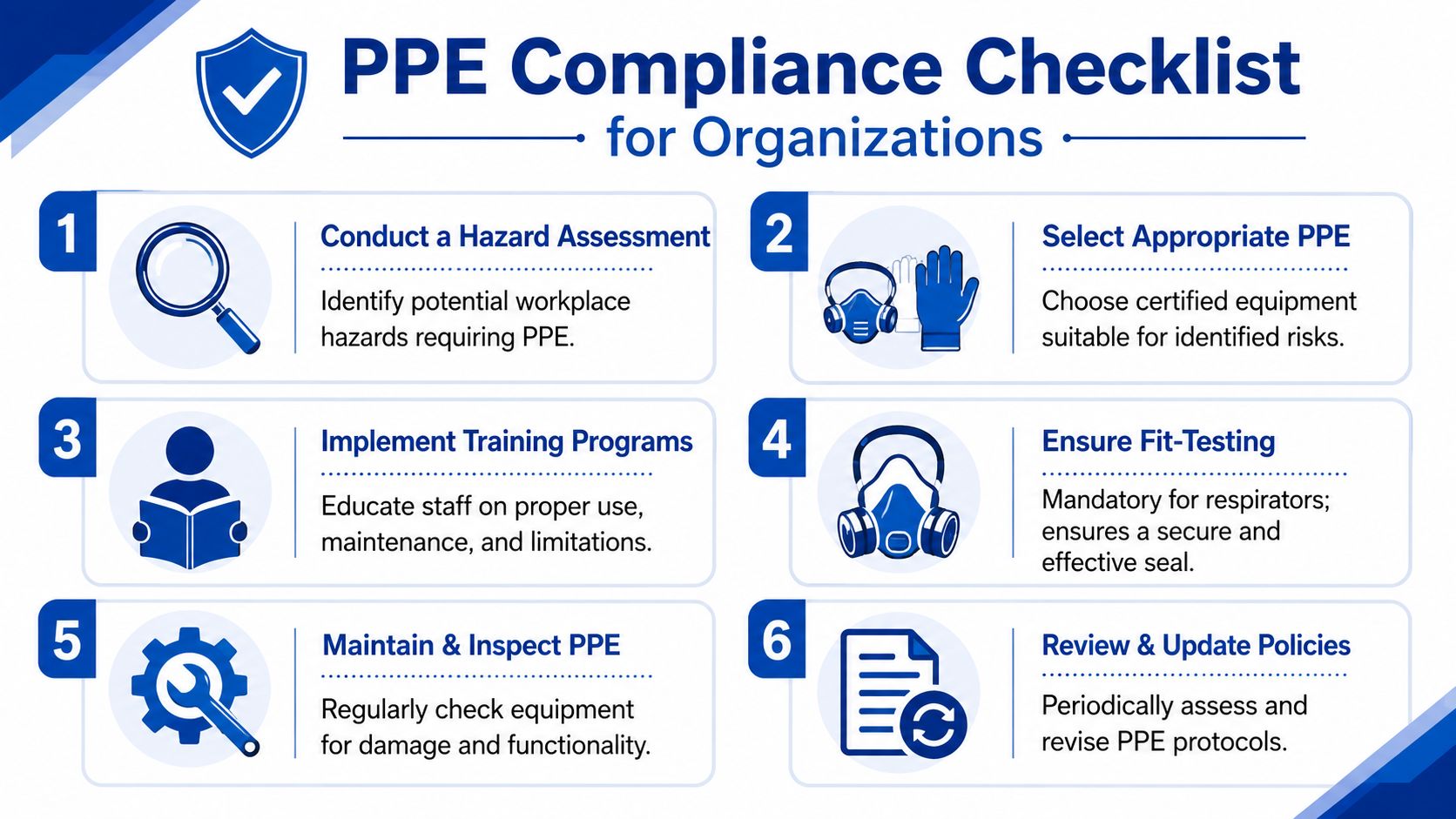
A practical checklist for organizations
A good PPE program works like a chain. If one link fails, the whole system is weaker.
- Assess the hazard before work begins. Identify whether the exposure risk involves splash, inhalation, skin contact, sharps, chemical residue, or several hazards at once.
- Match PPE to the exposure pathway and task. Select equipment based on what can reach the worker, how the work will be performed, and how long the crew will be in the area.
- Check fit, range of motion, and real-world usability. Gear has to protect the person wearing it, not an average body type on paper. If gloves limit grip, eyewear fogs, or clothing gaps during movement, the selection needs to change.
- Train workers to use the full system correctly. That includes putting gear on, working in it safely, removing it without self-contamination, and recognizing when the equipment is no longer adequate for conditions on site.
- Store, inspect, and replace equipment on a schedule. Readiness means the respirator seal is intact, cartridges are current, suits are undamaged, and replacement stock is available before an emergency call comes in.
- Document decisions and actions. Keep records of hazard assessments, PPE selection, employee training, fit-testing where required, inspection logs, and disposal or decontamination steps.
For a remediation-focused explanation of how those decisions connect to OSHA requirements, see this guide to OSHA and biohazard cleanup compliance and safety standards.
Common questions people ask
Can household cleaning supplies replace professional PPE and procedures
No. Household products may remove visible residue, but they do not establish containment, control exposure, or address regulated handling of contaminated materials. In a trauma or biohazard scene, the method matters as much as the cleaning agent because the risk includes what people cannot see.
Are all hazmat suits basically the same
They are not. Suit material, seam design, permeability, tear resistance, and compatibility with the selected respirator all affect protection. A suit that works for liquid splash may fail in a setting that includes chemical vapors, sharp debris, or heavy physical movement.
What happens to contaminated PPE after a job
The answer depends on the item, the contaminant, and whether the equipment is disposable or approved for decontamination under the employer's protocol. Used PPE must be handled as part of the exposure control plan, not dropped into ordinary trash because the visible work is finished.
If a worker feels fine, can PPE requirements be relaxed
No. Exposure does not always produce immediate symptoms. Many safety failures happen when a team mistakes the absence of discomfort for the absence of hazard.
Good compliance means making the right choice under stress, then repeating that choice consistently until the site is safe again.
When a property is affected by trauma, bodily fluids, infectious contamination, or another hazardous event, choosing a provider is also a safety decision. 360 Hazardous Cleanup helps families, facilities, and organizations manage these situations with trained remediation practices, regulatory awareness, and a calm, respectful approach that protects both people and property.