That dark patch on drywall or the musty smell near a return vent tends to send people in the same direction. They grab a spray bottle, a scrub brush, and the strongest cleaner they can find. Sometimes that's enough for a minor surface issue. Often, it isn't.
The hard part is that mold removal products can make a problem look better before the property is safer. A wall may brighten. A stain may fade. The odor may drop for a few days. But if moisture is still feeding growth inside drywall, insulation, wood, or an HVAC pathway, the cleanup hasn't solved the underlying problem.
Confronting a Mold Problem in Your Property
Finding mold in a home, office, warehouse, or rental unit is unsettling because the next decision feels urgent. You want it gone fast, but you also don't want to make it worse by spreading spores, damaging materials, or masking a deeper water issue.
That urgency helps explain why retail demand is so strong. The global mold remover market reached USD 2.34 billion in 2024 and is projected to reach USD 4.28 billion by 2033, while North America accounted for about USD 850 million in 2024, according to Growth Market Reports on the mold remover market. People are actively buying products because indoor air quality and building maintenance matter, and because mold rarely feels like a problem you can ignore.
What most property owners are actually dealing with
In the field, the first visible sign is often the least important one. The discoloration on a wall may be the last stage of a leak from above. The mildew smell in a closet may point to condensation, not a one-time spill. Mold around a vent may be less about the register itself and more about humidity, airflow, or contamination inside the system.
If you suspect the issue may be tied to ventilation or ductwork, this breakdown of expert advice on air duct mold is a useful companion read because it focuses on the moisture and airflow conditions that allow growth to return.
For wall contamination specifically, homeowners often start by comparing what they see to common patterns of black mold on walls. That can help with early recognition, but identification alone doesn't answer the more important question. Is this a surface-cleaning job, or a remediation job?
Practical rule: If you can see mold, assume there's a moisture story behind it until proven otherwise.
What works, and what doesn't
A small amount of surface growth on a hard, non-porous material can sometimes be treated safely with the right product and precautions. A larger area, recurring growth, contamination inside porous materials, or anything connected to hidden moisture usually needs a different response.
That's the decision point that matters most. Not which bottle has the strongest label. Not which cleaner promises to kill on contact. The primary issue is whether the contamination is superficial or structural.
Understanding the Categories of Mold Removal Products
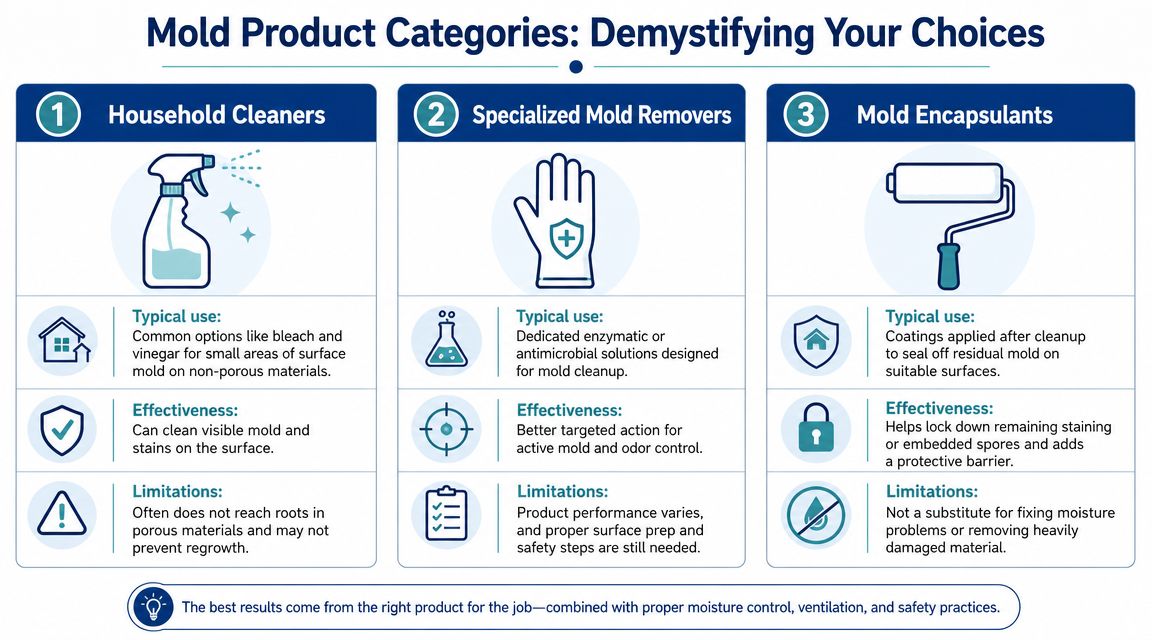
The product aisle makes everything look interchangeable. It isn't. Some products clean. Some bleach stains. Some sanitize. Some seal a treated surface. Very few, by themselves, resolve a true mold problem inside building materials.
Household cleaners and stain removers
The first category includes common consumer products such as bleach-based sprays, detergents, vinegar-based cleaners, and general-purpose bathroom or wall treatments. These are usually aimed at visible surface contamination.
Their strengths are simple. They're easy to buy, easy to apply, and sometimes effective on a minor issue affecting tile, metal, sealed stone, or another non-porous surface. Their weakness is just as important. Many are better at changing the appearance of mold than correcting the conditions that created it.
A quick comparison helps:
| Product category | What it usually does well | Main limitation |
|---|---|---|
| Household cleaners | Cleans grime and some surface residue | Doesn't address hidden moisture |
| Stain removers | Lightens or removes discoloration | Can make active growth look “gone” |
| Sanitizing products | Reduces contamination on treated surfaces | Limited when mold has penetrated porous materials |
| Encapsulants | Seals a prepared surface after remediation steps | Not a shortcut for removal |
For readers trying to sort out what they're seeing, mold vs mildew vs biohazard mold differences can help clarify why product choice changes depending on the material and contamination type.
Specialized mold removers
Dedicated mold products are usually formulated with more control than a generic household cleaner. That matters. According to a patented mold-cleaning formulation, professional-type compositions may use 0.5% to 6.0% hypochlorite by weight along with 0.02% to 2.0% acetic acid and 0.03% to 3.0% citric acid. The same technical material notes a pH of 12.5 in a foaming spray designed to cling to vertical surfaces and reduce drip loss.
That tells you something important about performance. Better products aren't just “stronger bleach.” They're engineered for contact time, adhesion, and controlled oxidation.
Think of the difference like this. A household cleaner is often a wet wipe approach. A specialized remover behaves more like shaving cream on a wall. It stays where you place it, works longer on grout, masonry, siding, or concrete, and wastes less product by running down the surface.
Surface cling matters on vertical materials because chemistry only works while it stays in contact with the contamination.
That same chemistry also raises safety demands. Products with strong oxidizers or high alkalinity need better ventilation, tighter compatibility checks, and stricter handling. They also should never be mixed casually with acids or ammonia.
Encapsulants and coatings
Encapsulants are commonly misunderstood. They aren't magic paint. They're used after proper prep, cleaning, and removal steps on appropriate substrates. Their role is to seal residual staining or stabilize a treated surface, not to trap an active moisture problem inside a wall cavity and hope for the best.
Used correctly, they can be part of a professional system. Used too early, they become camouflage.
The Hard Truth About DIY Mold Removal
A lot of mold advice skips the most uncomfortable fact. A cleaner can remove the evidence without removing the problem.
That's why DIY work so often feels successful right up until the patch comes back. The wall looks cleaner. The tenant thinks it's resolved. Then the odor returns after rain, or the stain bleeds back through paint, or the growth spreads along a baseboard that seemed fine a week earlier.
Why appearance can be misleading
The best analogy is rust on a car panel. If someone sands the surface lightly and paints over it without fixing the corrosion underneath, the panel may look restored for a while. It isn't restored. The material is still breaking down below the finish.
Mold behaves the same way in porous building components. Drywall, insulation, ceiling tile, carpet backing, and unfinished wood can all hold contamination below the visible surface. A spray bottle can reach the face of the material. It can't reliably undo colonization that has moved inward.
According to remediation specifications from Fiberlock, killing, encapsulating, or inhibiting mold is not adequate. Proper source removal comes first, especially when porous materials such as drywall or insulation are colonized.
Where products do have a role
That doesn't mean products are useless. They have a valid place in the right setting.
- Hard surfaces can often be cleaned effectively when the contamination is light and the moisture source is already corrected.
- Exterior areas like some sections of siding may respond well to targeted cleaning methods. For practical exterior examples, this guide on removing mold from house siding is helpful because siding behaves differently than interior drywall.
- Post-removal treatment can support a broader remediation plan after damaged materials are removed and the area is dried properly.
What products don't do is replace containment, demolition of unsalvageable materials, drying, or investigation into hidden moisture.
If you're weighing whether a cleanup is drifting into a higher-risk category, why DIY biohazard cleanup is a serious health risk makes the larger point well. Once contamination can spread through air movement, porous materials, or improper handling, the cleanup stops being a simple janitorial task.
If mold keeps coming back in the same place, stop buying stronger chemicals and start looking for the water source.
Safety Protocols for Using Mold Products
Even a small cleanup can go sideways if the work area isn't controlled. The main risk isn't only the cleaner you're spraying. It's what happens when scrubbing, brushing, tearing, or even wiping disturbs a colony and sends contamination into the air.
A 2022 peer-reviewed study on household mold cleanup behavior found that about 90% of residents reported using bleach alone or with other agents, but only 42% of bleach users reported wearing a breathing mask or respirator. That gap matters. People often use aggressive chemistry without protecting their lungs adequately.
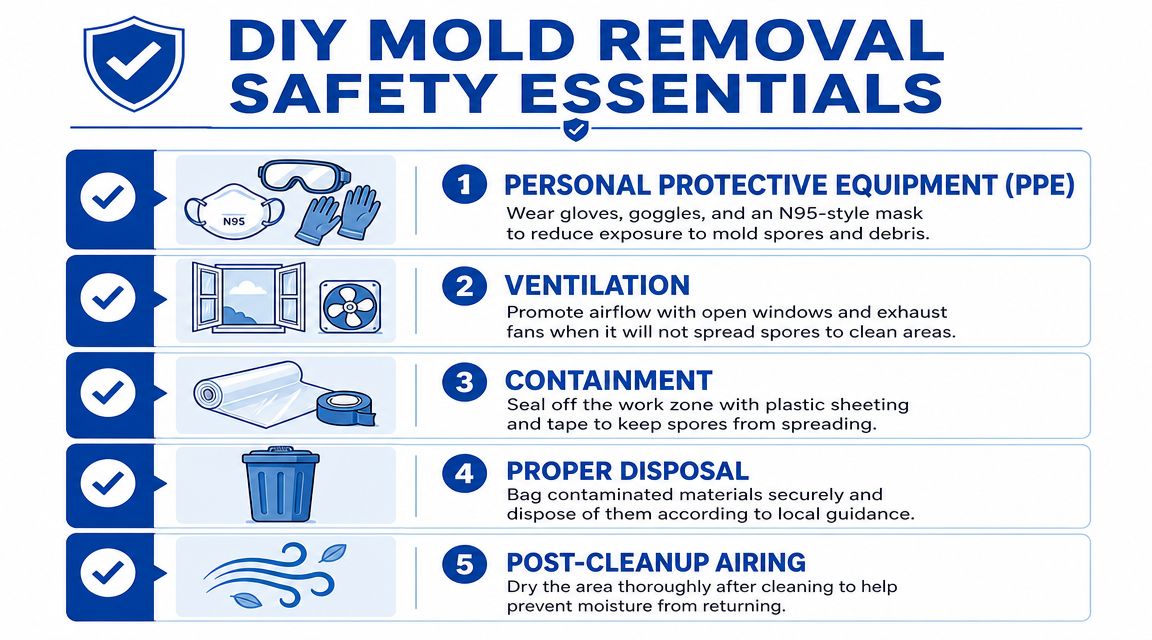
Non-negotiable precautions
For a minor cleanup on a small, non-porous area, basic discipline matters more than brand choice.
- Protect your airway with a properly fitted respirator suitable for the task. A loose face covering isn't enough.
- Shield your eyes and skin with goggles and non-porous gloves because splashes, aerosols, and residue are common during spraying and scrubbing.
- Ventilate to the outdoors when the product label allows it, so fumes and disturbed particulates don't linger indoors.
- Isolate the work zone by closing doors, limiting foot traffic, and preventing air movement from carrying contamination to clean areas.
- Bag waste promptly so contaminated rags, paper towels, and disposable materials don't sit exposed in the room.
The broader logic behind this is the same one emphasized in PPE requirements for biohazard cleanup. Protection isn't an accessory. It's part of the cleanup process itself.
Product mistakes that create new hazards
Certain errors show up again and again:
| Mistake | Why it's risky |
|---|---|
| Mixing chemicals | Can create dangerous fumes and material damage |
| Oversaturating drywall | Adds moisture to a material already at risk |
| Dry scraping without control | Spreads contamination into nearby spaces |
| Using household fans carelessly | Can push spores through the property |
| Skipping disposal steps | Leaves contaminated waste in occupied areas |
Field note: If a cleanup method creates more airborne dust, stronger fumes, or wetter materials than you started with, stop and reassess.
Know when to stop
If the contamination extends beyond what you can isolate safely, or if cleaning requires cutting into walls, lifting flooring, or opening HVAC components, the risk profile changes fast. At that point, the product is no longer the main issue. The work method is.
Environmental and Disposal Considerations
A mold cleanup isn't finished when the stain is off the wall. Waste handling matters. So does chemical handling. Property owners often focus on application and forget that contaminated debris and leftover product can create a second problem if they're handled carelessly.
Disposal is part of remediation
Removed drywall, insulation, carpet, and other mold-affected porous materials need to be contained so debris doesn't shed during transport through the property. Even when local rules differ, the safe practice is the same. Bag or wrap contaminated material securely, limit handling, and avoid dragging debris through occupied areas.
Chemical products also come with disposal instructions that shouldn't be treated as boilerplate. Oxidizers, disinfectants, and specialty coatings can have compatibility and environmental concerns that affect drains, containers, and surrounding surfaces.
- Read the label fully before cleanup starts, not after you've opened the bottle.
- Separate waste streams when a product label requires special handling for containers or residue.
- Avoid casual dumping of leftover chemicals into sinks, storm drains, or outdoor soil.
- Document disposal steps in commercial settings where maintenance records matter.
For landlords, facility teams, and anyone managing a larger loss, biohazard waste disposal requirements offer a useful reminder that contaminated waste handling is a compliance issue, not just a housekeeping task.
The trade-off most people miss
A stronger product can reduce scrubbing time on the right surface. It can also increase ventilation demands, PPE needs, and disposal complexity. That's one reason trained remediation crews don't judge a product by how harsh it smells or how fast it bleaches a stain. They judge it by whether it fits the material, the contamination level, the occupancy conditions, and the disposal obligations that follow.
Critical Signs That Professional Remediation Is Required
This is the decision point most DIY guides avoid. They tell you how to scrub. They don't tell you when scrubbing is the wrong move.
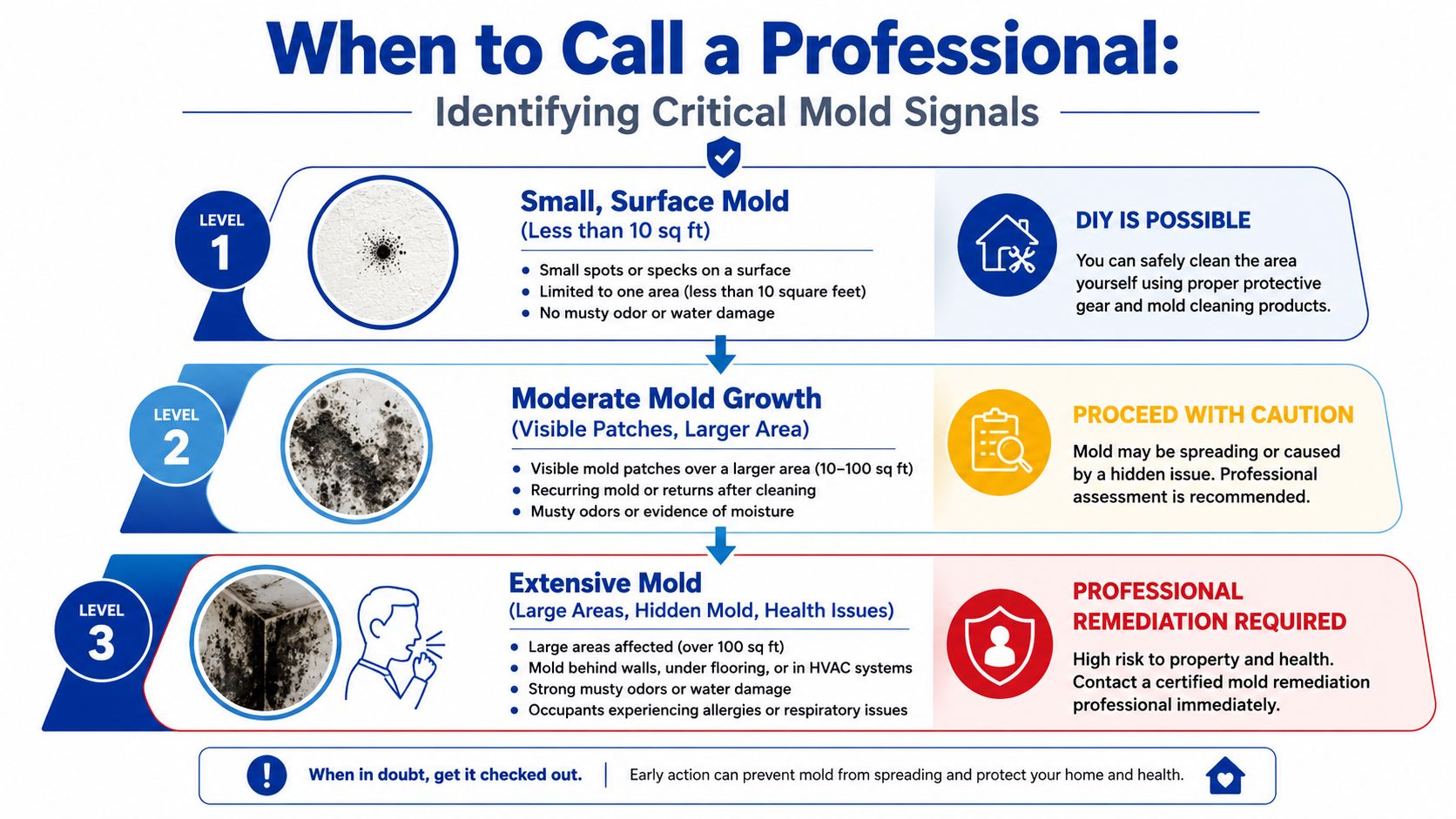
A useful benchmark appears in the visual hierarchy below. It helps separate a manageable surface issue from a contamination event that deserves professional control.
Clear triggers to stop using products
If any of these conditions are present, it's time to shift from consumer products to professional assessment and remediation:
- The affected area is larger than 10 square feet. That threshold appears in the graphic above because the size of the contamination changes the containment and removal approach.
- The mold keeps returning after you've cleaned the same area.
- The material is porous and visibly degraded, such as drywall, insulation, ceiling tile, carpet, or unfinished wood.
- There's a hidden-moisture clue such as bubbling paint, warped trim, recurring staining, or a persistent musty odor with no visible source.
- The HVAC system may be involved, including contamination near vents, inside duct pathways, or around air-handling components.
- Occupants are sensitive or medically vulnerable, or the building houses patients, residents, children, or elderly occupants.
- The cleanup would require demolition rather than surface wiping.
Why this distinction matters
Retail and DIY content often focuses on bleach, vinegar, detergents, stain removers, or wall cleaners. The unresolved question is whether the product is addressing a surface issue or disguising a structural one. That's the gap highlighted in Home Depot's consumer guidance on getting rid of mold, which underscores that products are tools for surface treatment, not a substitute for moisture-source correction or a full contamination assessment.
That distinction matters most in commercial and multifamily settings. One maintenance worker with a spray bottle can unintentionally turn an isolated wall issue into a tenant complaint, an indoor air quality concern, or a larger remediation claim if contaminated material is disturbed without containment.
A simple decision framework
| Situation | Best next step |
|---|---|
| Small spot on a hard, non-porous surface | Careful cleaning may be reasonable |
| Repeat growth in the same area | Investigate moisture source |
| Mold in porous or hidden materials | Professional remediation |
| HVAC-related contamination | Professional inspection and containment |
| Occupied sensitive environment | Professional risk-managed response |
A product is enough only when the issue is truly on the surface, the moisture source is already corrected, and the work can be done without spreading contamination.
Partnering with a Remediation Specialist
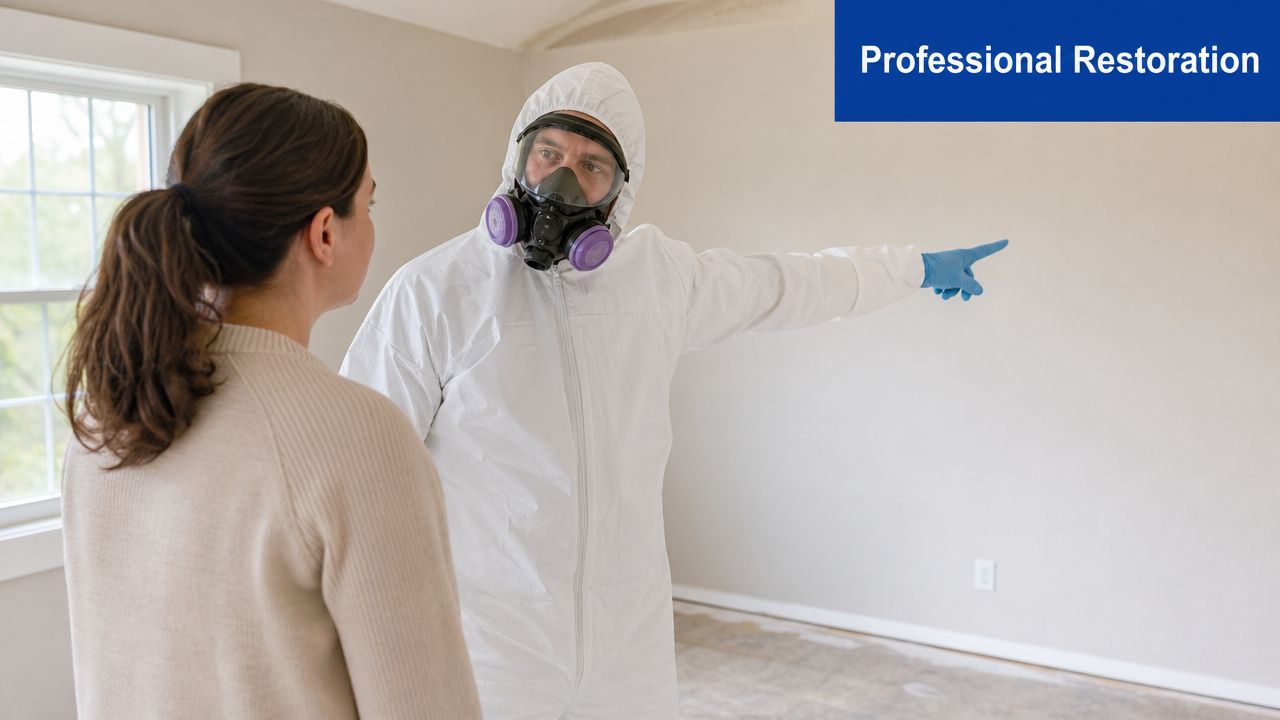
Professional mold work isn't just cleaning with better chemicals. It's a controlled process built around assessment, containment, removal, cleaning, drying, and documentation.
What a proper response looks like
A remediation specialist starts by identifying where the moisture is coming from and how far the contamination has spread. That may include checking adjacent rooms, wall cavities, framing, insulation, and mechanical pathways instead of limiting the response to the visible stain.
Then comes containment. That step protects unaffected areas while crews remove unsalvageable materials, clean salvageable structural surfaces, and manage debris without cross-contaminating the rest of the property. In some projects, a company such as 360 Hazardous Cleanup may use EPA-approved methods as part of its mold remediation process, but the larger value is the controlled workflow around those products, not the bottle alone.
After removal and detailed cleaning, the site needs to be dried and evaluated so the same conditions don't recreate the problem. For commercial properties, rentals, and healthcare-adjacent settings, this process also supports documentation, occupant communication, and safer re-entry decisions.
This short video gives a helpful visual sense of what a professional process can involve.
Why experience matters in high-stress situations
People usually call for help when they're already under pressure. A tenant is upset. A sale is pending. A family is worried about a child's bedroom. A facility manager needs the area returned to service without creating liability elsewhere in the building.
That's why the right remediation partner should bring more than labor. They should bring judgment. They should know when material can be cleaned, when it has to be removed, how to contain work safely, how to handle contaminated debris properly, and how to communicate clearly without minimizing the risk or exaggerating it.
The best outcome isn't just a cleaner-looking surface. It's a property that's been handled safely, discreetly, and in a way that reduces the chance of recurrence.
If you're dealing with mold and aren't sure whether a product is enough, 360 Hazardous Cleanup can help you assess the situation, identify where DIY ends, and determine the safest path forward for your property.