A lot of people start the same way. They notice a musty smell that doesn’t go away after cleaning. Or they find a dark patch near a baseboard, under a sink, around an HVAC vent, or behind stored boxes after a leak. At first, it’s tempting to treat it like a housekeeping problem.
It usually isn’t.
When people search for mold remediation specialists near me, they’re often already under pressure. They may be worried about indoor air quality, a tenant complaint, a pending property sale, a patient-care environment, or whether insurance will cooperate. The right response isn’t panic. It’s a controlled, documented, safety-first process that deals with the mold itself, the moisture source behind it, and any contamination risks the visible growth may be hiding.
When a Musty Smell Becomes an Urgent Call
That musty odor matters because mold problems rarely stay limited to what you can see. A small-looking area on drywall may trace back to a larger moisture problem inside a wall cavity, above a ceiling, or in ductwork. In commercial spaces and multifamily properties, that hidden spread is often what turns a manageable issue into a disruption.

The first decision is usually the most important one. Should you wipe it down and monitor it, or call a professional team? The clearest line comes from the EPA guidance summarized by the Texas Department of Licensing and Regulation mold program. Professional intervention is mandated for areas exceeding 10 square feet of visible mold growth, and that matters because unlicensed remediation fails 40% of post-treatment inspections, while DIY attempts average 25% re-infestation.
What property owners often underestimate
A visible stain is only one part of the job. Mold also affects:
- Indoor air quality: Disturbing growth without controls can push spores into adjacent rooms, hallways, and HVAC pathways.
- Building materials: Drywall, insulation, ceiling tile, wood trim, and stored contents can all hold contamination differently.
- Operations: Offices, clinics, rentals, and warehouses often need a plan that limits downtime while protecting unaffected areas.
- Documentation: If a leak, flood, or plumbing event caused the problem, the way you document the loss can affect the insurance conversation later.
Practical rule: If occupants can smell it consistently, there’s usually more to investigate than surface discoloration alone.
If the mold followed a leak, slab issue, or plumbing failure, it also helps to review broader water-damage guidance. Property owners dealing with active moisture intrusion may find this overview of Los Angeles water and mold remediation useful because it connects the water source to the mold response, which is exactly how a real remediation plan should begin.
What works and what doesn’t
What works is fast moisture control, a documented scope, and containment before disturbance.
What doesn’t work is spraying over growth, painting over staining, running fans across active contamination, or asking a general handyman to “cut it out” without proper controls. Those shortcuts often spread the problem and make clearance harder later.
The Professional Mold Remediation Process Explained
A proper remediation project is methodical. Good teams don’t guess, and they don’t start tearing into materials before they’ve defined the work area, protected the clean areas, and planned how contaminated air will be managed.
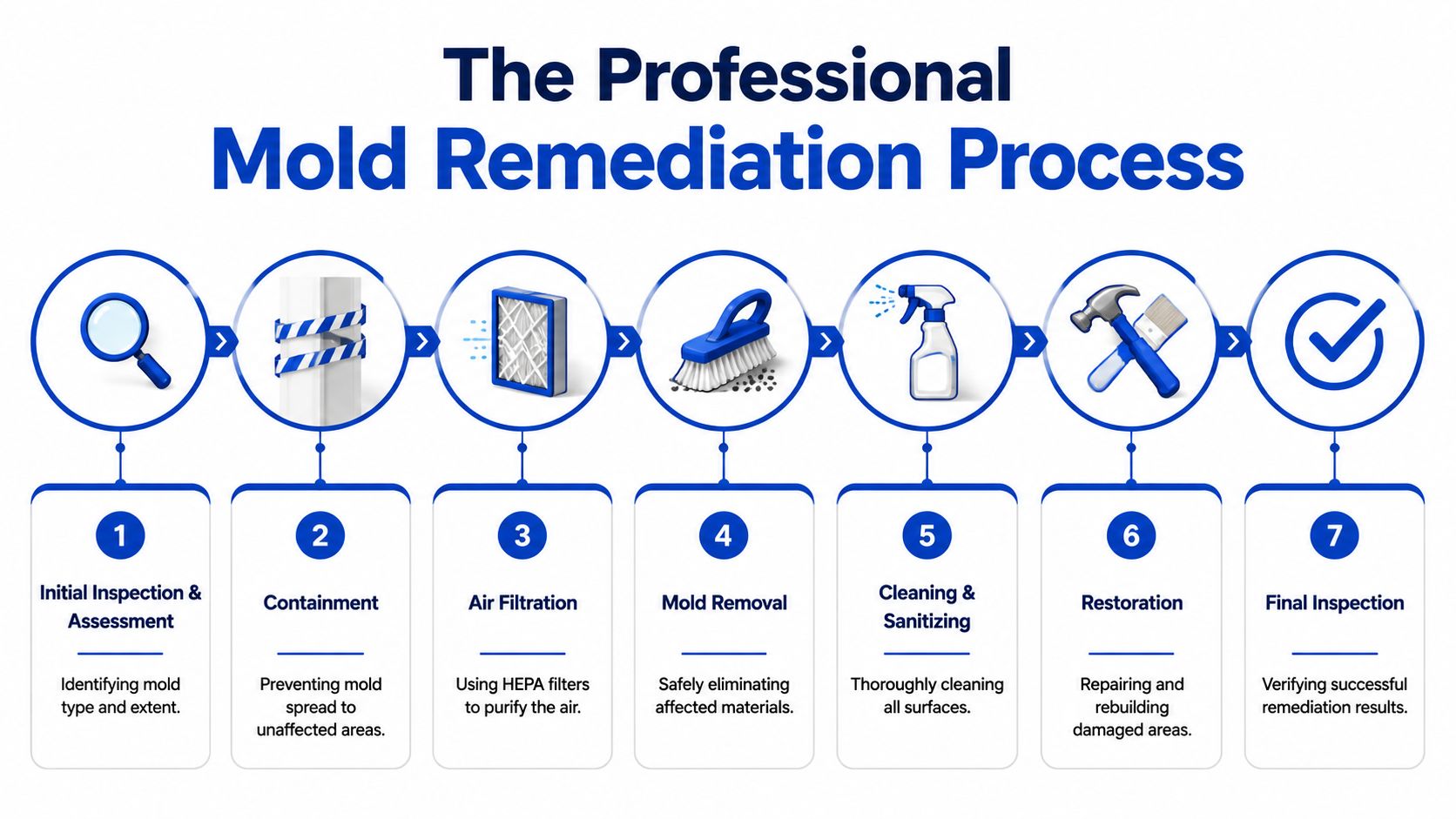
A more detailed primer on the overall workflow appears in this overview of what mold remediation involves, but the field process usually follows six practical phases.
Inspection and damage assessment
The first step is identifying not just where mold is visible, but why it grew. Teams inspect for leaks, humidity loading, condensation, drainage problems, roof intrusion, plumbing failures, and HVAC contribution. In facilities work, this stage also maps occupancy concerns, sensitive equipment, infection-control constraints, and traffic flow.
The goal isn’t to name a problem. It’s to define a scope that can solve it.
Containment and air control
Containment is where professional work separates itself from surface cleaning. ATI Restoration’s mold remediation guidance notes that HEPA air filtration and negative air pressure containment systems are over 99.97% efficient at capturing particles as small as 0.3 microns, and that without these barriers, airborne spore counts can increase 10- to 100-fold during removal.
That’s why crews isolate affected rooms, build barriers, and control airflow before disturbing contaminated materials.
Disturbing mold without containment can contaminate the clean side of the building faster than most owners expect.
Removal and cleaning
Once the area is controlled, technicians remove unsalvageable porous materials and clean salvageable surfaces using methods suited to the substrate. The process often includes HEPA vacuuming, damp wiping, controlled demolition, and detailed cleaning of settled dust.
This is also where experienced judgment matters. Some materials can be restored. Others shouldn’t be.
Contents handling and restoration planning
In homes, that might mean evaluating furniture, boxes, clothing, and sentimental items. In commercial properties, it may involve shelving, files, electronics, medical equipment zones, or warehouse stock. The work has to protect what can be saved without carrying contamination into clean areas.
A short comparison helps clarify the difference:
| Area of work | Primary concern | Typical professional focus |
|---|---|---|
| Drywall and insulation | Hidden spread and moisture retention | Selective removal and controlled disposal |
| Structural framing | Surface contamination and drying | HEPA cleaning, moisture verification, treatment as appropriate |
| HVAC-adjacent areas | Spore movement through air handling | Isolation, inspection, coordination with mechanical access |
| Contents and inventory | Salvage versus contamination transfer | Cleaning decisions, staging, documentation |
Post-remediation verification
A project isn’t done because the wall looks clean. It’s done when the space has been remediated, dried, cleaned, and verified according to the agreed scope. That may include visual review, moisture confirmation, and clearance steps appropriate to the setting.
For occupants, this is the difference between “it looks better” and “it’s ready to return to service.”
Verifying Credentials and Certifications
When people compare mold remediation specialists near me, they often focus first on response time. That’s understandable. But credentials matter more than speed if the wrong crew creates cross-contamination, misses the moisture source, or puts workers and occupants at risk.

A qualified provider should be able to explain, in plain language, what training their technicians hold, what standards guide their work, and how they document safety decisions on site. If they get vague when you ask about containment, respiratory protection, disposal, or post-remediation verification, that’s a warning sign.
What credentials mean in practice
You don’t need a contractor who can recite acronyms. You need one who can translate training into field behavior.
Look for signs such as:
- Applied training in microbial remediation: This tells you the crew has formal exposure to containment, cleaning methods, PPE selection, and project controls.
- Insurance that matches the work: General liability and workers’ compensation aren’t paperwork details. They protect the property owner if something goes wrong.
- Comfort with compliance language: A real remediation firm can discuss OSHA, EPA-related practices, jobsite documentation, and disposal protocols without improvising.
- Experience with occupied properties: Hospitals, clinics, rentals, and active commercial spaces require more than demolition skills. They require sequencing and communication.
For readers who want a practical sense of how training translates into field readiness, this page on training, certification, and expertise in biohazard cleanup is useful because it frames credentials as operational safeguards, not marketing language.
Ask for proof, not reassurance
A reliable company won’t be offended if you ask for license information where applicable, insurance certificates, written scope details, or names of the standards they follow. They should expect those questions.
What you’re buying is risk control. The cleaning itself matters, but the bigger value is preventing spread, failed clearance, liability, and repeat loss.
This short video gives a helpful visual reference for what informed, trained remediation work should look and sound like in the field.
Key Questions to Vet Potential Providers
A phone call with a mold contractor shouldn’t feel like requesting a generic estimate. It should feel like an interview. The right questions reveal whether a company understands containment, moisture science, occupant safety, and unusual contamination scenarios.
One point is especially important. According to Green Home Solutions’ Cleveland mold remediation page, mold recurrence can be as high as 40% within 12 months, and DIY test kits fail in 60% of commercial settings due to hidden HVAC mold. That’s why your questions should focus less on “How fast can you spray something?” and more on “How will you keep this from coming back?”
For a broader list you can use during vendor calls, this roundup of top questions to ask mold remediation companies is a strong starting point.
Questions that reveal real competence
Ask these directly, and listen for specific answers:
How will you identify the moisture source?
If the answer centers only on removing visible mold, the plan is incomplete.What containment method will you use?
They should be able to explain barriers, airflow control, and how they’ll protect adjacent areas.How do you handle HVAC concerns?
Hidden contamination in air handling is one reason surface-level fixes fail.What materials do you expect to remove, and what might be salvageable?
Experienced teams can explain why drywall, insulation, wood, contents, and non-porous surfaces are treated differently.What does your post-remediation verification process look like?
You want a clear end point, not “we’ll know when it looks clean.”
Questions for complex or sensitive jobs
Many providers find this challenging. If the property has more going on than a simple leak, ask:
- Have you handled mold in hoarding conditions?
- Can you work where bodily fluids, infectious waste, or decomposition-related contamination are also present?
- What’s your protocol if the site involves tear gas residue and mold in the same structure?
- How do you protect privacy for tenants, staff, residents, or families during a sensitive cleanup?
If a provider sounds confident only while discussing standard residential wall mold, but hesitates when biohazards enter the picture, keep looking.
What a good answer sounds like
Strong answers are calm, specific, and process-driven. Weak answers are vague, overly simple, or built around one product. Mold remediation is rarely about a miracle chemical. It’s about source control, containment, removal strategy, cleaning, drying, and verification.
Understanding Costs and Navigating Insurance
Cost is one of the first questions owners ask, and it should be. But mold jobs don’t price like simple repairs because the estimate reflects risk control as much as labor. Two areas that look similar on the surface can require very different scopes based on moisture migration, material type, occupancy, access, and whether contamination has reached concealed spaces or HVAC pathways.
What drives the estimate
Most remediation proposals are shaped by a few practical variables:
- Extent of contamination: A single accessible wall is different from growth that tracks through multiple assemblies.
- Type of materials affected: Porous finishes, insulation, stored contents, and specialty surfaces all change the approach.
- Containment complexity: Occupied offices, healthcare spaces, and multifamily corridors usually require tighter controls.
- Source correction needs: If the leak, drainage issue, or humidity problem isn’t solved, remediation alone won’t protect the property.
- Restoration scope: Removal is one phase. Rebuild and finish work are separate planning questions.
A good estimate should separate these elements clearly enough that you understand what you’re paying for and why.
How to make the insurance process easier
If the mold followed a sudden water event, start documenting immediately. Take photos before anything is disturbed, keep records of when the loss was discovered, save plumbing or maintenance reports, and write down occupant observations while they’re still fresh. That timeline often matters.
A lot of owners also need help knowing how to speak with adjusters without accidentally oversimplifying the loss. This guide on how to talk to your insurance company about cleanup services is useful because it focuses on documentation, communication, and avoidable claim mistakes.
Trade-offs that affect the final outcome
The cheapest proposal is often the narrowest proposal. It may exclude containment detail, omit contents handling, skip moisture verification, or leave gray areas around clearance and reconstruction. That can create delays, disputes, and extra cost later.
A better approach is to ask each bidder to explain the assumptions behind the scope. If one proposal is much lower, find out what they aren’t including.
Why Choose 360 Hazardous for Complex Scenarios
Most articles about mold stop at drywall, dehumidifiers, and HEPA filtration. Real properties aren’t always that simple. Some of the hardest calls involve mold mixed with biohazard conditions, and that’s where a standard mold-only contractor may not be equipped for the actual risk on site.
The overlap shows up more often than people think. Severe hoarding, unattended deaths, trauma scenes, flood-affected healthcare spaces, and certain industrial incidents can create environments where mold is only one layer of the cleanup problem. BBB marketplace information on Cleveland-area mold services highlights that 20% to 30% of hoarding cases involve secondary mold growth, yet many local mold services don’t present the biohazard certifications needed for safe cleanup in those conditions.
Where mold-only service can fall short
A conventional mold crew may be prepared to build containment and remove contaminated material. They may not be prepared to manage:
- Bodily fluid contamination
- Infectious waste handling
- Scene privacy concerns
- Regulated disposal pathways
- Law enforcement or property-management coordination
- Tear gas residue combined with mold and water damage
Those aren’t edge cases for many families, landlords, and facility managers. They’re the exact reason a broader remediation skill set matters.
When dual expertise changes the outcome
For complex jobs, one provider that understands both microbial contamination and biohazard controls can reduce handoff problems and keep the scope coherent. That matters when timelines are tight and the property can’t tolerate confusion between trades.
One example is 360 Hazardous Cleanup’s overview of why professional biohazard response is often the right first call. In situations where mold intersects with hoarding debris, trauma residue, or other hazardous materials, a team with that cross-disciplinary capability can build one safety plan instead of forcing the owner to coordinate multiple incomplete ones.
Some properties don’t have a “mold problem” or a “biohazard problem.” They have both, at the same time, in the same rooms.
That distinction is easy to miss until the job starts. It’s much better to identify it at intake.
Preventing Future Mold Growth After Remediation
Good remediation removes contamination. Great remediation leaves the building harder to re-infest. The long-term fix is moisture control, not wishful thinking.
Green Home Solutions’ Denver mold guidance notes that effective prevention requires keeping relative humidity below 60%, and that professional remediation uses tools such as thermal imaging and wood moisture verification below 15%, which prevents recurrence in 98% of cases. That’s the practical standard owners should think in. Not “Did we clean it?” but “Did we return the materials and the environment to conditions that no longer support growth?”
A prevention checklist that holds up
Use this after the remediation phase is complete:
- Control indoor humidity: In damp basements, lower levels, storage rooms, and poorly ventilated bathrooms, dehumidification is often the difference between success and repeat growth.
- Fix leaks fast: Roof penetrations, window failures, plumbing drips, and HVAC condensate issues should be corrected before finishes are closed back in.
- Verify drying before rebuild: Replacing drywall over damp framing creates a hidden restart.
- Improve ventilation where moisture loads are predictable: Laundry areas, locker rooms, kitchens, utility rooms, and certain patient-care spaces need reliable airflow management.
- Inspect exterior water pathways: Roof drainage, grading, gutters, and flashing details often contribute more than owners realize.
If the problem began at the roofline or around exterior moisture intrusion, a specialized resource like this guide to Arizona roof mold removal can help owners think more clearly about where water is entering and how roof-related growth differs from interior remediation.
What prevention really means
Prevention isn’t a one-time treatment. It’s a maintenance discipline. The properties that stay clean are the ones where someone owns the moisture problem, checks vulnerable areas, and responds early when conditions change.
If you’re dealing with mold in a home, rental, healthcare setting, or commercial property, and especially if there may be hoarding conditions, bodily fluid contamination, or another biohazard layer involved, 360 Hazardous Cleanup can help you assess the situation, understand the risks, and move toward a safe, compliant cleanup plan with less confusion and less stress.