You notice the smell first. Then a dark patch near a baseboard, a ceiling stain that wasn't there last month, or damp drywall behind stored boxes in a utility room. For homeowners, that moment is stressful. For a property manager or facility lead, it can become a time-sensitive risk issue fast.
A mold remediation quote should calm that situation down, not make it more confusing. A proper quote isn't just a number on a page. It's the first written plan for how the affected area will be isolated, cleaned, dried, verified, and returned to service without spreading contamination into the rest of the property.
That's why experienced remediation teams treat estimating as part of risk control. The same discipline that helps service companies win more cleaning clients also matters in remediation, where unclear scope creates disputes, missed work, and repeat contamination. If you're trying to understand what professional mold work should look like before you approve anything, this guide on protecting your health and home during mold remediation gives helpful context.
Understanding Your Mold Remediation Quote
A family often calls after getting two very different prices and wondering whether one contractor is overcharging or the other is missing something. That's a fair concern. Mold work is one of those categories where a low number can mean the quote excludes the steps that protect the rest of the building.
A quote is a scope document first
When mold is present, the question isn't only, “How much will cleanup cost?” Instead, the question is, “What has to happen so this contamination is removed safely and doesn't come back because the moisture problem was never addressed?”
A professional quote answers that in writing. It identifies what's known, what's assumed, what needs access for confirmation, and what conditions would trigger a scope change. That's what makes it a risk management document.
A vague quote often looks cheaper because it leaves the expensive parts unstated.
That matters for health, property value, insurance documentation, and future liability. If spores are spread during demolition, if porous materials are cleaned when they should have been removed, or if reconstruction begins before materials are dry, the “savings” disappear quickly.
Why the paperwork matters during a stressful event
A clear estimate helps you make decisions under pressure. It tells you whether the team plans to isolate the work zone, protect adjacent areas, handle debris correctly, and verify the site before rebuild. It also gives adjusters, owners, and facility stakeholders something auditable.
Look for these signals early:
- Defined work area: The quote should identify where contamination is visible, suspected, or moisture-damaged.
- Technical controls: It should describe containment and air-management steps, not just “remove mold.”
- Moisture thinking: It should connect remediation to the water source.
- End point: It should say how the project is considered complete.
If a quote gives you a lump sum with little explanation, you're not looking at a full plan. You're looking at uncertainty disguised as simplicity.
What a Professional Mold Remediation Quote Includes
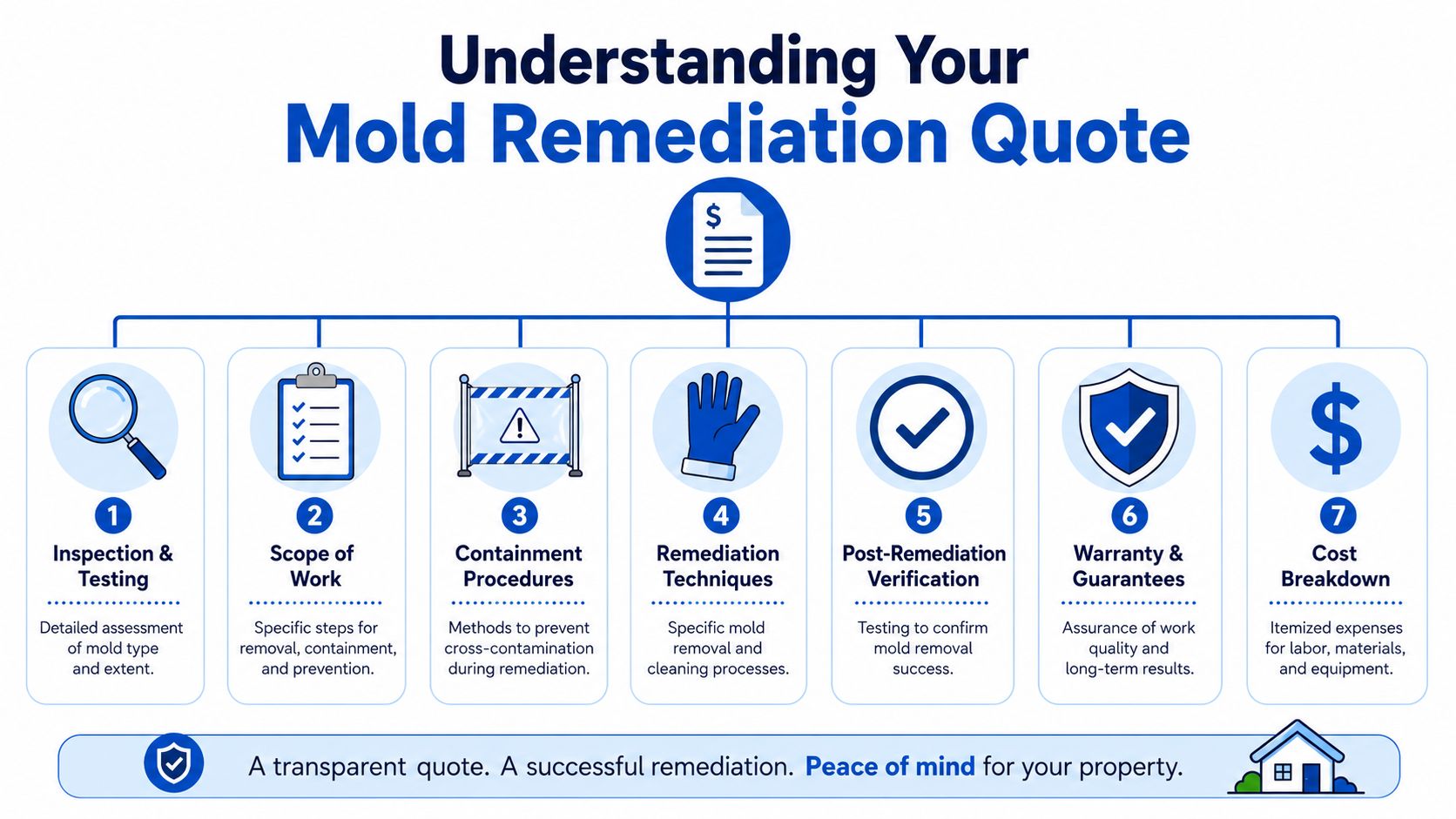
A legitimate mold remediation quote should be itemized. Not because paperwork is nice to have, but because each line item controls a different part of the risk. If those tasks are bundled together under one label, you can't tell what protection is included and what isn't.
Inspection and moisture-source evaluation
The most important technical input in the quote is the moisture-source scope. The EPA states that the key to mold control is moisture control, and that porous materials like ceiling tiles and carpet may need disposal if moldy because contamination can be difficult or impossible to remove completely. A quote should therefore separate line items for source correction, containment, removal, drying, and post-clean verification, as outlined in the EPA's basic mold cleanup steps.
Many weak estimates falter here. They price visible staining but don't define the leak, humidity issue, plumbing defect, wall cavity moisture, or HVAC contribution behind it.
Containment and engineering controls
Containment prevents a localized issue from becoming a whole-property issue. The quote should specify how the crew will isolate the work area and protect unaffected spaces.
That commonly includes:
- Physical barriers: Plastic sheeting and sealed work zones
- Negative-air setup: Air scrubbers or negative pressure to control airborne spread
- HEPA filtration: For air cleaning and vacuuming during remediation
- Protected pathways: Measures for crew movement and debris removal
If containment isn't written into the estimate, don't assume it's included.
Practical rule: If demolition is planned, containment should be planned too.
Removal, cleaning, drying, and disposal
Professional remediation quotes usually separate material handling into distinct tasks because each one affects labor, disposal, and verification.
A thorough scope may include:
- Controlled demolition of unsalvageable porous materials
- HEPA vacuuming of surfaces and debris
- Cleaning of salvageable hard surfaces
- Drying and dehumidification before repair begins
- Bagging and sealed disposal of contaminated materials
EPA guidance also warns against painting or caulking moldy surfaces before cleanup and drying because coatings can fail and trap residual moisture. That's one reason surface-only proposals are risky.
Verification and documentation
The end of remediation isn't when the visible staining is gone. It's when the affected area has been cleaned, dried, and verified according to the stated scope.
A quote should tell you:
- whether moisture readings are documented
- whether post-remediation verification is included
- whether clearance testing is part of the scope or handled separately
- whether reconstruction is excluded until dry conditions are confirmed
For readers comparing how specialized cleanup scopes are written across high-risk categories, this guide on biohazard cleanup and the quoting process is useful because it shows why clear scope language matters so much.
Key Factors That Drive Your Remediation Costs
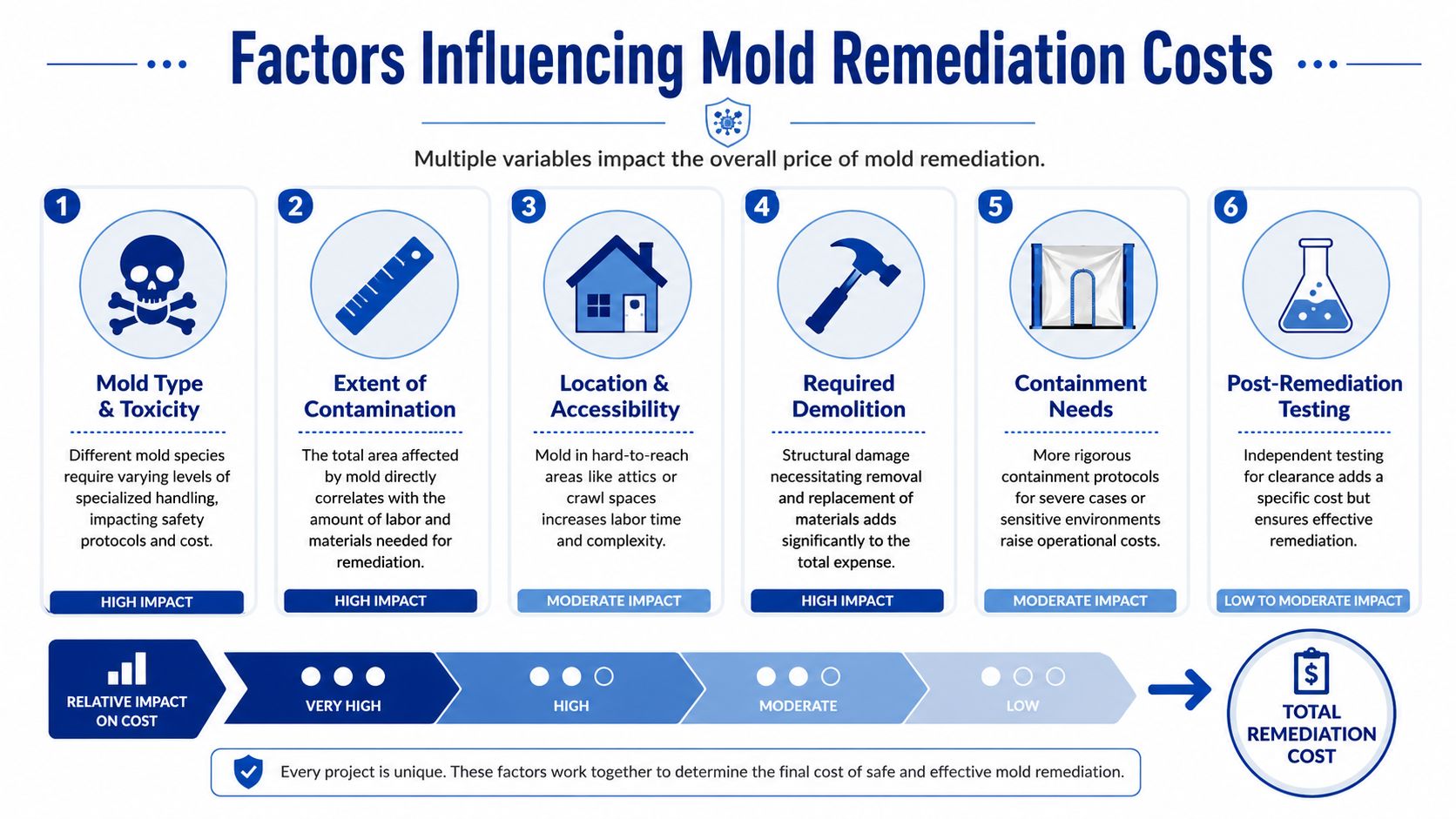
The number on a mold remediation quote moves with scope, not with fear. That's why two projects that both get called “mold problems” can price very differently.
The most widely cited homeowner benchmark is this: the national average for mold remediation is about $2,368, with most homeowners spending between $1,223 and $3,753, and contractors commonly charging $10 to $25 per square foot, according to Angi's mold remediation cost guide. Those numbers are useful only as a starting point. They don't replace a site-specific assessment.
What changes the price most
Think of cost drivers as layers of complexity added to the same basic job.
- Area size: More affected square footage usually means more labor, more containment material, and more cleaning time.
- Accessibility: Open wall surface is simpler than a ceiling cavity, crawlspace, or area behind built-ins.
- Material type: Porous materials often create more labor and disposal than hard, cleanable surfaces.
- Demolition needs: Once drywall, insulation, or finishes must be removed, the project becomes more than surface cleaning.
- Containment level: Sensitive environments and occupied properties usually require tighter controls.
- Verification requirements: Documentation and clearance add process, but they also reduce disputes.
Why cheap quotes can become expensive
A low quote may only cover visible removal. Then hidden growth is found once the wall opens. Or the moisture source turns out to involve a pipe chase, roof leak, or HVAC issue. Or the estimate excludes disposal, filtration, or post-clean confirmation.
That's why the right comparison isn't lowest number versus highest number. It's defined scope versus undefined scope.
Here's a short explainer worth watching if you want to understand how remediation work is commonly approached in the field:
The value question
The best-value quote is often the one that reduces future uncertainty. If the estimate accounts for access, isolation, drying, and verification, you're less likely to face callbacks, occupant complaints, or reopening finished surfaces later.
For a broader look at how scope affects high-stakes cleanup pricing, this resource on navigating biohazard cleanup costs through a transparent quoting process is relevant because the same estimating principle applies. Clearer scope usually means fewer surprises.
How to Prepare for an Accurate On-Site Assessment
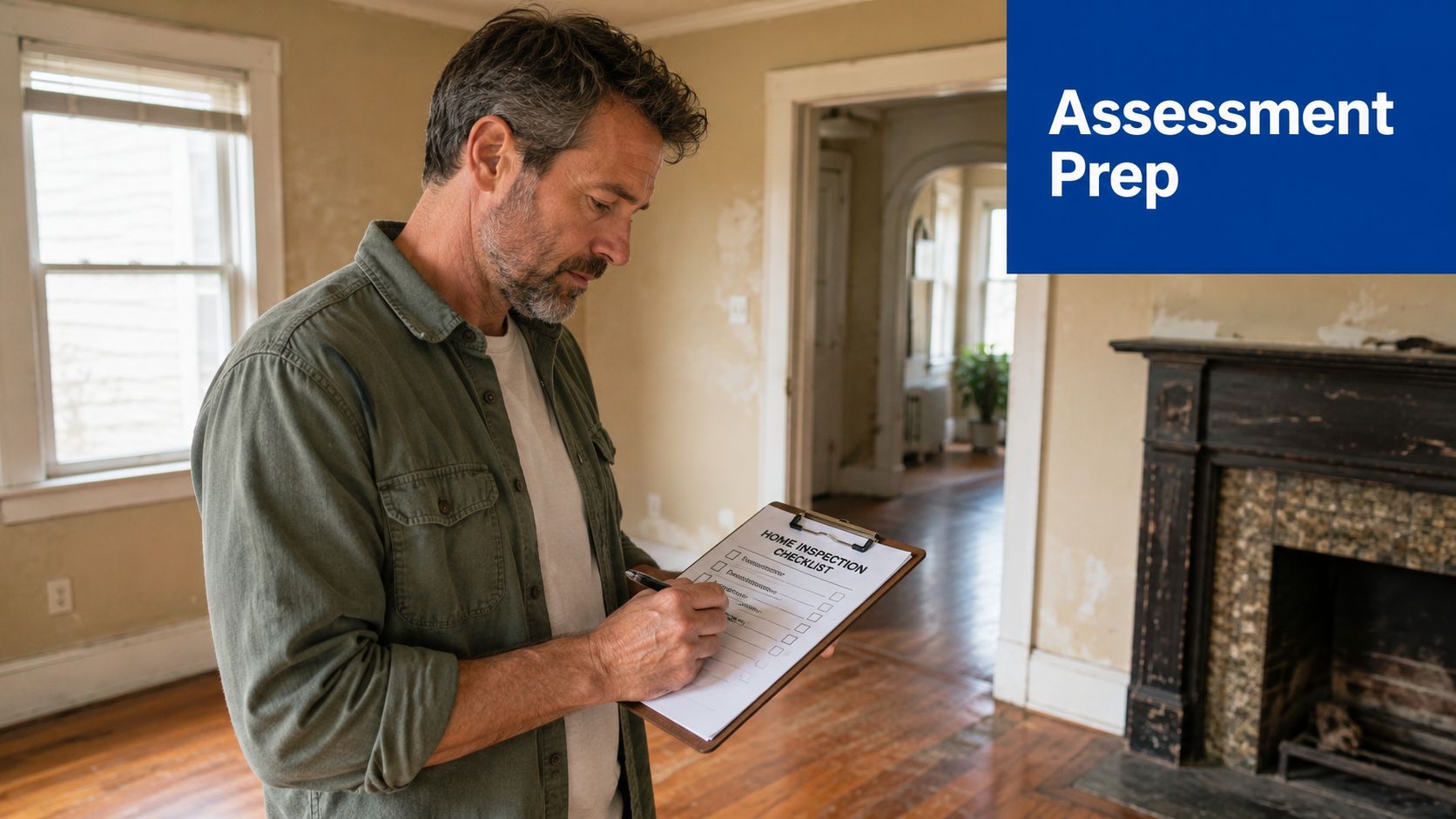
You can help the estimator produce a more accurate mold remediation quote before anyone unloads equipment. Good preparation saves time, sharpens scope, and reduces the odds of a vague estimate built on guesswork.
Gather evidence before the visit
Start with documentation. You don't need to diagnose the problem. You just need to preserve what you've observed.
Prepare these items:
- Clear photos: Capture visible growth, staining, warped materials, bubbling paint, and any damaged contents.
- Short videos: Show room context so the estimator can see layout, nearby fixtures, and likely moisture paths.
- Odor notes: Write down where the smell is strongest and whether it changes after rain, HVAC use, showers, or plumbing use.
- Water history: List leaks, floods, overflows, roof events, condensation issues, or past repairs in the area.
This helps the assessor see patterns, especially when the visible mold is only one part of the problem.
Make access easier
Estimators can't price what they can't inspect. If the suspected area is blocked by storage, furniture, merchandise, or equipment, move what you safely can before the appointment.
That doesn't mean disturbing contaminated material. It means clearing pathways, gaining access to utility rooms, and making sure the team can reach walls, baseboards, ceilings, and mechanical spaces without delay.
If you know there was recent water damage, say so early. Mold quotes become more accurate when the moisture timeline is clear.
Bring documents that affect scope
For commercial sites and managed properties, paperwork matters almost as much as physical access.
Useful records include:
| Item | Why it helps |
|---|---|
| Maintenance logs | They show prior leaks, repairs, and repeat problem areas |
| Roof or plumbing reports | They help connect contamination to a likely moisture source |
| Prior remediation invoices | They reveal what was done before, and what may have been missed |
| Occupancy notes | They affect scheduling, containment needs, and work-hour restrictions |
If the mold followed a leak or overflow, this guide on immediate steps after discovering water damage is worth reviewing before the assessment. Early decisions around drying and documentation often shape the eventual remediation scope.
Critical Questions to Ask Before Signing a Quote
A signed quote commits you to a process, not just a price. The right questions will tell you whether the provider has thought through contamination control, moisture correction, and project closeout.
Start with the moisture issue
One of the most important questions is this: Does this quote include diagnosing and repairing the moisture intrusion, or only removing visible mold? That distinction matters because many jobs fail when cleanup happens without solving the underlying water problem, as discussed in PuroClean's article on what homeowners should ask in quotes for mold inspection versus remediation.
A solid answer should identify whether source correction is included, excluded, or handled by another trade.
Ask questions that expose scope gaps
Use direct language. You're not being difficult. You're making sure the job is defined.
Ask questions like these:
- What containment methods will you use? You want to hear specifics, not general reassurance.
- Is negative air or air scrubbing included in the quoted scope? If yes, it should be written, not verbal.
- What materials do you expect to remove, and what materials do you expect to clean in place? This reveals whether the contractor understands porous versus salvageable surfaces.
- How will debris be bagged, moved, and disposed of? This matters in occupied homes, multi-tenant sites, and healthcare settings.
- What must be dry before reconstruction starts? The answer should tie cleanup to moisture verification, not the calendar.
- How is project completion verified? You need to know whether the quote includes documentation only, internal verification, or outside clearance.
A careful contractor doesn't resist technical questions. They answer them in writing.
Listen for clarity, not sales language
Strong answers are usually plain and specific. Weak answers often sound comforting but vague. If someone says, “We handle everything,” ask them to break “everything” into line items and assumptions.
A credible mold remediation quote should also make clear what isn't included. That's not a flaw. It's honesty. If plumbing repair, electrical work, or reconstruction are excluded, that should be stated so nobody is surprised later.
Common Red Flags to Watch for in a Quote
The most dangerous mold quote often doesn't look dangerous. It looks simple, fast, and affordable. That's why quote review matters.
A major red flag is when a quote doesn't itemize hidden work like containment, negative-air filtration, demolition, and post-remediation verification. Bundling those into a single price obscures the biggest drivers of overages and is a frequent cause of scope disputes. Industry guidance also notes that price can range from $1,500 to $50,000 depending on severity and scope, which is exactly why a headline number without detail is so misleading, as discussed in EnviroVantage's guide to questions to ask a mold remediation contractor.
Quotes that should make you pause
Some warning signs show up before work begins.
- Phone-only pricing: A firm number offered without seeing the site usually means assumptions are replacing inspection.
- One-line scope: “Mold removal” by itself doesn't explain containment, cleaning method, disposal, or verification.
- Pressure to sign immediately: Urgency is sometimes real, but pressure without documentation is a bad sign.
- Missing exclusions: If the quote never states what's not included, change orders become more likely.
- No discussion of moisture source: Visible mold is the symptom. A quote that ignores the cause is incomplete.
Homeowners and managers dealing with indoor environmental services can also benefit from general scam-awareness reading outside mold specifically. This article on avoiding air duct cleaning fraud is useful because the same pressure tactics and vague promises show up across restoration categories.
Professional Quote vs. Red Flag Quote
| Component | What to Look For (Professional Quote) | What to Avoid (Red Flag) |
|---|---|---|
| Site assessment | On-site review with visible conditions and assumptions documented | Price given before inspection |
| Scope of work | Itemized tasks with defined work area | Single lump-sum line |
| Containment | Written barriers, negative air, or air-control plan where needed | No mention of isolation |
| Material handling | Distinguishes cleaning from removal and disposal | “Treat all affected areas” with no detail |
| Moisture issue | Identifies source correction or clearly states exclusions | Focuses only on visible mold |
| Verification | States how completion is confirmed | No end-point criteria |
| Change conditions | Lists assumptions that could affect final cost | Open-ended verbal promises |
Why hidden work matters so much
Containment, air control, disposal, and verification don't always photograph well, but they're often what protect the property from secondary spread and later disputes. In a school, office, clinic, or occupied home, those tasks also protect adjacent occupants and support defensible documentation if questions arise later.
If a quote is cheap because it skips controls, it isn't actually cheap. It just sends the cost downstream.
This is especially important when insurance, tenant relations, or resale disclosure could come into play. The cleaner the paperwork, the easier it is to show what was addressed and how.
The 360 Hazardous Approach to Estimates
A sound mold remediation quote protects more than a wall or ceiling. It protects occupants, operations, documentation, and the chance of a lasting fix. That's why estimating has to be tied to inspection, containment planning, moisture control, and clear closeout criteria.
At 360 Hazardous Cleanup, estimates are built around those risk decisions rather than a generic “mold removal” label. The process starts with a careful conversation, moves to on-site assessment, and then translates findings into an itemized scope that can be reviewed by an owner, manager, or adjuster. For clients who want to understand the standards behind that process, this overview of training, certification, and expertise at 360 Hazardous Cleanup explains the operational mindset behind high-consequence cleanup work.
When a quote is written clearly, people can make decisions calmly. That's the point. In stressful situations, clarity is part of the remediation.
If you need a clear, professional mold remediation quote, 360 Hazardous Cleanup can help you understand the scope, the risk points, and the next steps without guesswork. Reach out for an on-site assessment and an itemized estimate that treats the quote as a safety plan, not just a price.