A staff member calls before the building opens. Someone found red-bag waste in a regular dumpster behind the loading dock. Near it, there are used gloves, a broken sharps container, and a few leaking bottles with faded labels. Nobody knows how long it's been there, who moved it, or whether anyone touched it without protection.
That moment is where improper waste disposal stops being an abstract environmental topic and becomes an operational crisis. For a facility manager, property owner, clinic administrator, or maintenance supervisor, the immediate questions are practical. Is the area safe? Who could be exposed? What has to be documented? Which rules apply?
People often think improper waste disposal means littering or careless trash handling. In professional settings, it usually means something more serious. A failure in segregation, storage, labeling, containment, training, vendor coordination, or emergency response. When that failure involves biohazardous, chemical, medical, or regulated waste, the consequences can reach employees, visitors, patients, waste haulers, neighboring properties, and the organization itself.
Understanding the Stakes of Improper Waste Disposal
In workplaces, improper waste disposal often starts subtly. A nurse drops contaminated PPE into general trash because the right container isn't nearby. A warehouse stores leaking solvent containers in a janitorial closet. An office renovation leaves batteries, fluorescent components, and paint waste mixed into standard debris. No one intended harm, but the system failed.
That's why this issue has to be viewed as a safety and compliance problem, not just a housekeeping problem. Waste becomes dangerous when people misidentify it, mix it, move it without controls, or send it into the wrong disposal stream. Once that happens, the risk spreads beyond the original point of disposal.
What improper disposal looks like in real operations
A few common examples show where confusion happens:
- Healthcare settings may see sharps, blood-contaminated materials, or specimen-related waste placed into regular bags.
- Commercial buildings may accumulate old cleaners, pesticides, or unknown chemicals in maintenance rooms without clear labeling.
- Industrial and mixed-use properties may combine ordinary trash with absorbents, spill debris, or contaminated PPE after an incident.
- Residential turnovers and hoarding environments may contain bodily fluids, medical supplies, and household hazardous waste in the same room.
Each of those situations requires a different response. The first task is proper identification. The second is controlling access and preventing further exposure. Helpful background on that broader risk picture appears in this overview of biohazard waste management safety and compliance.
Practical rule: If you don't know what the material is, don't move it, compact it, hose it down, or place it in another bin.
Why the stakes keep rising
The broader waste context matters here. The world generates over 2.1 billion metric tons of municipal solid waste annually, up from 1.3 billion tons in 2012, and that volume is projected to rise 70% to 3.4 billion tons by 2050, according to the IFC's overview of the global waste problem. That same source notes global municipal waste management costs already exceed US$250 billion annually and are projected to rise to US$426 billion by 2050.
In a professional setting, those large numbers translate into local pressure. More waste streams. More specialized materials. More opportunities for a sorting or storage mistake to turn into a reportable incident.
The Four Categories of High-Risk Waste
When people say “hazardous waste,” they often mean any waste that feels dangerous. That's understandable, but it's not precise enough for a compliant response. In practice, you need to sort what you're seeing into the right category before anyone decides how to contain, package, transport, or dispose of it.
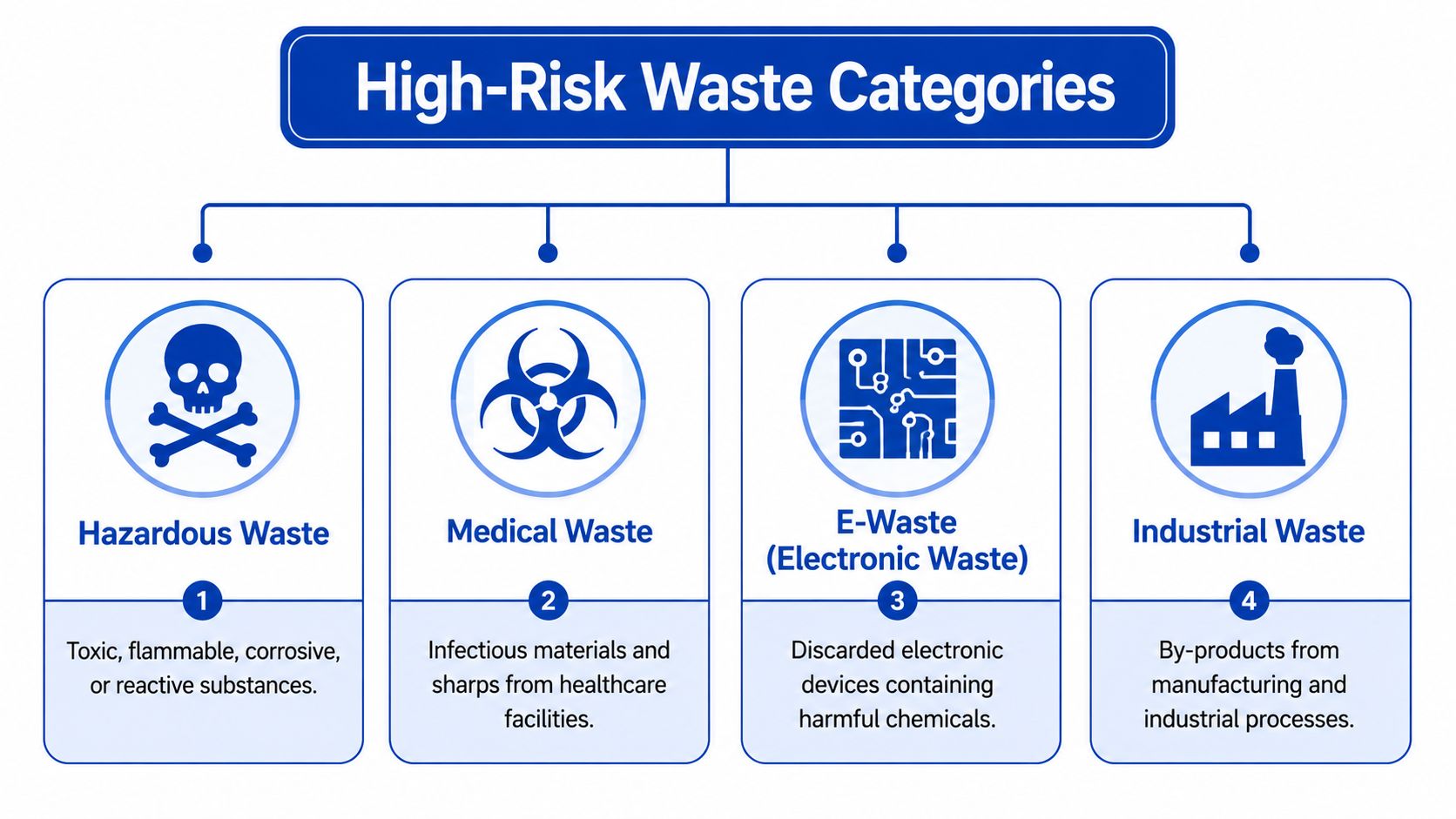
A reliable starting point is understanding what counts as regulated or high-risk material. This guide on what qualifies as hazardous waste and how it's disposed of safely is useful if you're sorting through that first level of confusion.
Medical and biohazardous waste
This category includes items contaminated with blood or other potentially infectious materials, along with sharps such as needles, lancets, and scalpel blades. It also includes blood-soaked dressings, contaminated gloves, certain lab materials, and waste from patient care or trauma scenes.
Why it can't go in regular trash is straightforward. A janitor, waste hauler, or member of the public can be cut, splashed, or exposed. Once sharps or saturated materials leave controlled handling, the risk multiplies because the next person often has no idea what they're touching.
Chemical waste
Chemical waste shows up in more places than people expect. It may be spent solvents, degreasers, disinfectants, acids, strippers, reactive cleaners, or unlabeled bottles left in a maintenance area after staff turnover.
The biggest mistake is assuming that if a product came from a supply closet, it can go back out with ordinary garbage. Some chemicals are flammable. Others are corrosive or reactive. Even without a dramatic spill, mixing incompatible substances can create fumes, heat, or container failure.
E-waste and battery waste
Old laptops, monitors, servers, phones, backup batteries, and circuit boards are often treated as routine junk during upgrades or move-outs. They aren't. The Frontiers review on municipal waste and improper disposal impacts reports that plastic waste generation worldwide amounted to 360 million metric tons in 2020 and is forecast to reach roughly 500 million tons by 2030, while global e-waste was estimated at 62 million metric tons in 2022 and is forecast to grow by around 30% by 2030, surpassing 80 million tons.
That matters inside facilities because electronics often contain components that shouldn't be crushed, burned, or landfilled with general waste. Batteries are especially risky when damaged or stored loosely.
Industrial and mixed regulated waste
Many businesses run into trouble in situations like these. A shop floor spill gets cleaned with absorbents and shop towels. A medical area discards contaminated PPE. A pest-control product is half-used and forgotten. Then someone throws all of it into one container because it “came from the same job.”
Here's a quick perspective:
| Waste type | Common examples | Why general trash is the wrong destination |
|---|---|---|
| Medical | Sharps, blood-contaminated PPE, specimen waste | Exposure and injury risk |
| Chemical | Solvents, acids, cleaners, unknown liquids | Fire, fumes, corrosion, reaction risk |
| E-waste | Devices, batteries, boards, chargers | Toxic component and handling concerns |
| Industrial mixed waste | Spill debris, contaminated absorbents, process by-products | Misclassification creates disposal and liability problems |
If the waste came from treatment, cleanup, maintenance, production, or an exposure event, assume it needs review before disposal.
The Far-Reaching Risks to People and Planet
A facility manager opens a mixed waste container after a rushed shift change. Inside are bagged trash, used PPE, leaking chemical bottles, and a battery crushed under cardboard. What looked like a disposal shortcut has become an exposure scene, a fire risk, and a documentation problem at the same time. In professional settings, improper disposal rarely stays a housekeeping issue. It spreads through people, processes, and the environment.
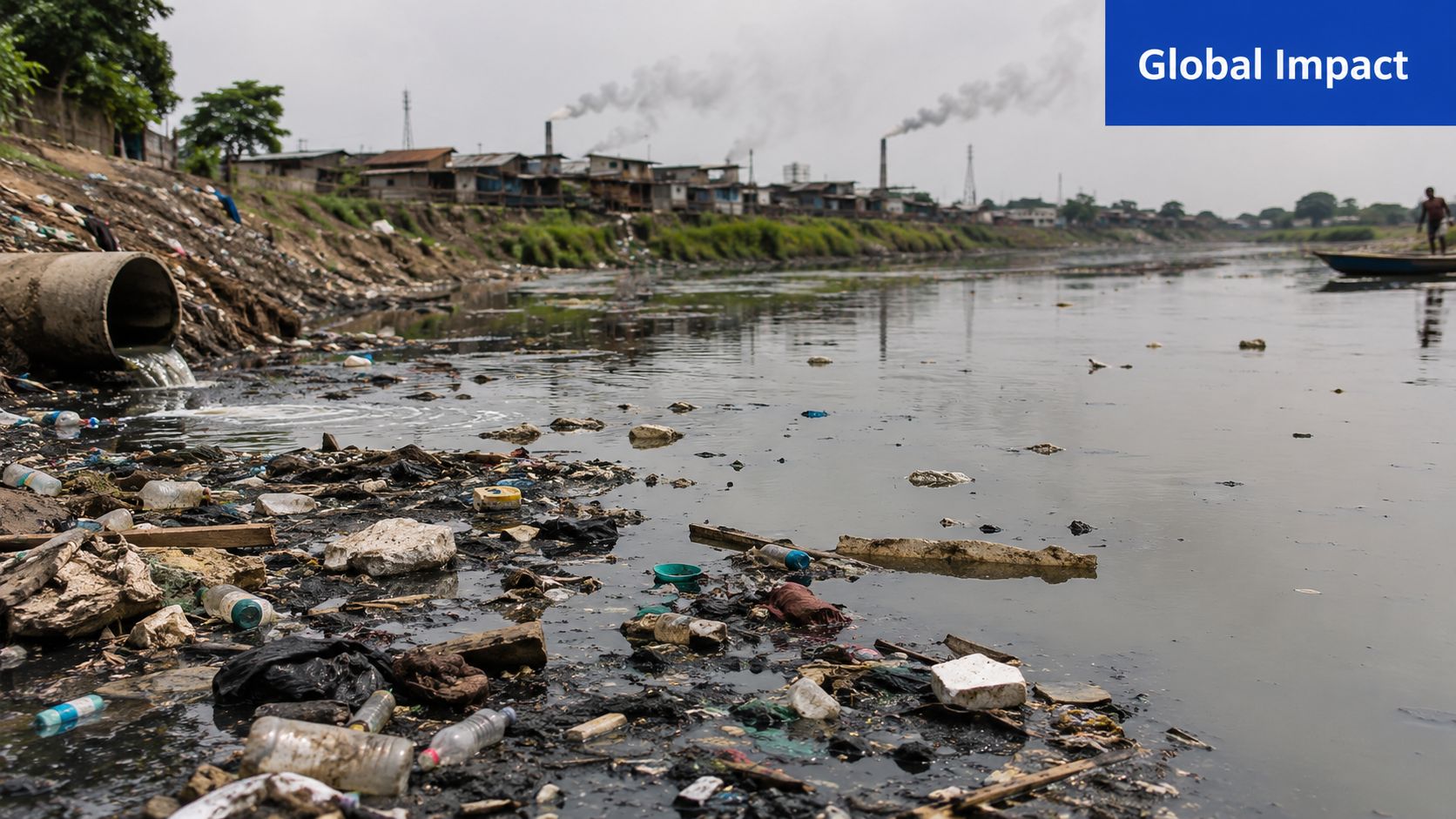
The first harm often happens close to the source. A custodian lifts the wrong bag and suffers a needlestick. A maintenance worker opens a drum and inhales vapors. A hauler loads a container that was labeled as ordinary trash but contains reactive or infectious material. Improper disposal in businesses and healthcare environments creates downstream environmental damage, but the chain usually starts with an operational failure inside the building.
Once waste is mixed, the risk changes. It works like combining unknown ingredients in a machine you still have to touch, move, and store. The original labels stop telling the full story. Cleaners can react with other chemicals. Sharps hidden in soft waste can injure anyone handling the bag. Liquids can seep out, carrying contaminants into floors, drains, soil, and loading areas.
Health risks from contact and mixing
Some consequences are immediate. Chemical burns, splash injuries, vapor exposure, puncture wounds, and contamination of skin or clothing can happen within seconds. Others develop after the waste leaves the site. A peer-reviewed analysis of landfill-related exposure risks describes how unmanaged mixing of hazardous and infectious waste can produce contaminated leachate carrying pathogens and other harmful materials into groundwater and surface water, with associated gastrointestinal, skin, and respiratory illness.
That is why mixed dumpsters and improvised storage corners create so much trouble for facilities. Staff may assume the danger ended when the item was thrown away. In reality, disposal is only one step in a chain that includes internal transport, temporary storage, pickup, transfer, treatment, and final disposal. If the first step is wrong, every later step becomes less safe.
Air and water impacts that last
Medical and industrial waste show how disposal method changes the outcome. The World Health Organization fact sheet on health-care waste states that poor medical waste incineration can release dioxins and furans, and that burning materials containing lead, mercury, and cadmium can spread toxic metals into air, water, and soil. For businesses, that means a bad disposal decision can create a longer environmental footprint than the original incident that produced the waste.
Water contamination is often less visible than smoke or spills, which makes it easy to underestimate. Liquids that escape from containers, wash off outdoor storage areas, or move through damaged landfill systems can travel well beyond the property line. By the time contamination is discovered, the source may be harder to prove and more expensive to address.
For families making end-of-life planning decisions, this broader environmental lens is part of why some people also research alternatives to embalming for the environment. The principle is the same. Disposal choices can shape exposure long after the original event.
A practical overview of safe and responsible hazardous waste disposal methods for businesses and communities explains how proper handling reduces those risks before they spread.
Here's a short visual primer on how contamination can spread through communities and ecosystems:
Waste rarely stays where it was first discarded. People move it. Weather moves it. Water carries it.
Why underserved communities often carry the burden
Improper disposal also has an equity dimension. The EPA's solid waste management equity discussion explains that fair waste planning depends on accurate data and service coverage, yet some communities are left outside both. When collection systems, oversight, and infrastructure are weak, unsafe disposal practices become more likely.
For facilities and organizations, that matters in two ways. First, poor waste practices can harm nearby communities that already face limited environmental protection. Second, organizations are judged not only by what they generate, but by whether they control where that waste goes and how safely it is handled. In a crisis, the safest response is not to guess. It is to isolate the problem, document it, and bring in qualified help before a disposal mistake becomes a health, environmental, and liability event.
Your Legal Duties and the High Cost of Non-Compliance
A lot of organizations wait too long because they hope a questionable waste issue can be handled internally, discreetly, and cheaply. That instinct often creates the most expensive outcome. Once regulated waste is mismanaged, legal exposure can expand quickly across environmental rules, worker safety obligations, documentation failures, and insurance disputes.
For managers, the hard truth is that disposal decisions create a paper trail problem as much as a cleanup problem. If you can't show proper segregation, handling, storage, transfer, and disposal, it becomes difficult to defend the organization's actions later.
Fines are only one layer of the problem
The financial penalties alone should end any idea that non-compliance is a minor risk. According to this explanation of penalties tied to improper RCRA-regulated medical waste disposal, the EPA imposes fines ranging from $22,500 to over $93,000 per infraction for violations. The same source notes repeat offenses can escalate to $5,000 to $25,000 plus potential jail time up to one year for small generators, and false statements or failure to register can trigger civil penalties of $10,000 per violation, accruing daily while the violation continues.
Those numbers get attention, but they aren't the whole story. The hidden costs often include business interruption, emergency response delays, employee injury claims, damaged vendor relationships, and reputational harm with regulators and the public.
OSHA obligations don't disappear because the incident was unexpected
If workers can be exposed, employers have safety duties. That means written plans, training, PPE, reporting pathways, and supervised work practices matter before an incident happens. It also means “we didn't realize the bag had biohazardous contents” isn't a strong defense if the workplace lacked basic controls.
This overview of biohazard remediation laws and regulations is helpful for understanding how these requirements fit together in practice.
Compliance is broader than waste law
Security, access control, documentation, and chain-of-custody procedures also matter. If hazardous or infectious waste sits in an unsecured loading area, the failure isn't just disposal related. It's also an access and oversight problem. That's why many facility leaders look at related operational disciplines such as the benefits of security compliance, because strong compliance programs reduce avoidable incidents across multiple risk categories.
A simple decision guide helps here:
- If waste is unidentified, isolate it and start documentation.
- If staff may have been exposed, trigger internal safety and post-exposure procedures.
- If regulated waste may have entered the wrong stream, treat it as a compliance event, not a janitorial issue.
- If records are incomplete, fix that immediately. Missing paperwork makes a bad situation harder to defend.
Bottom line: Professional handling is usually cheaper than fines, litigation, and a failed audit.
What to Do When You Discover Improper Disposal
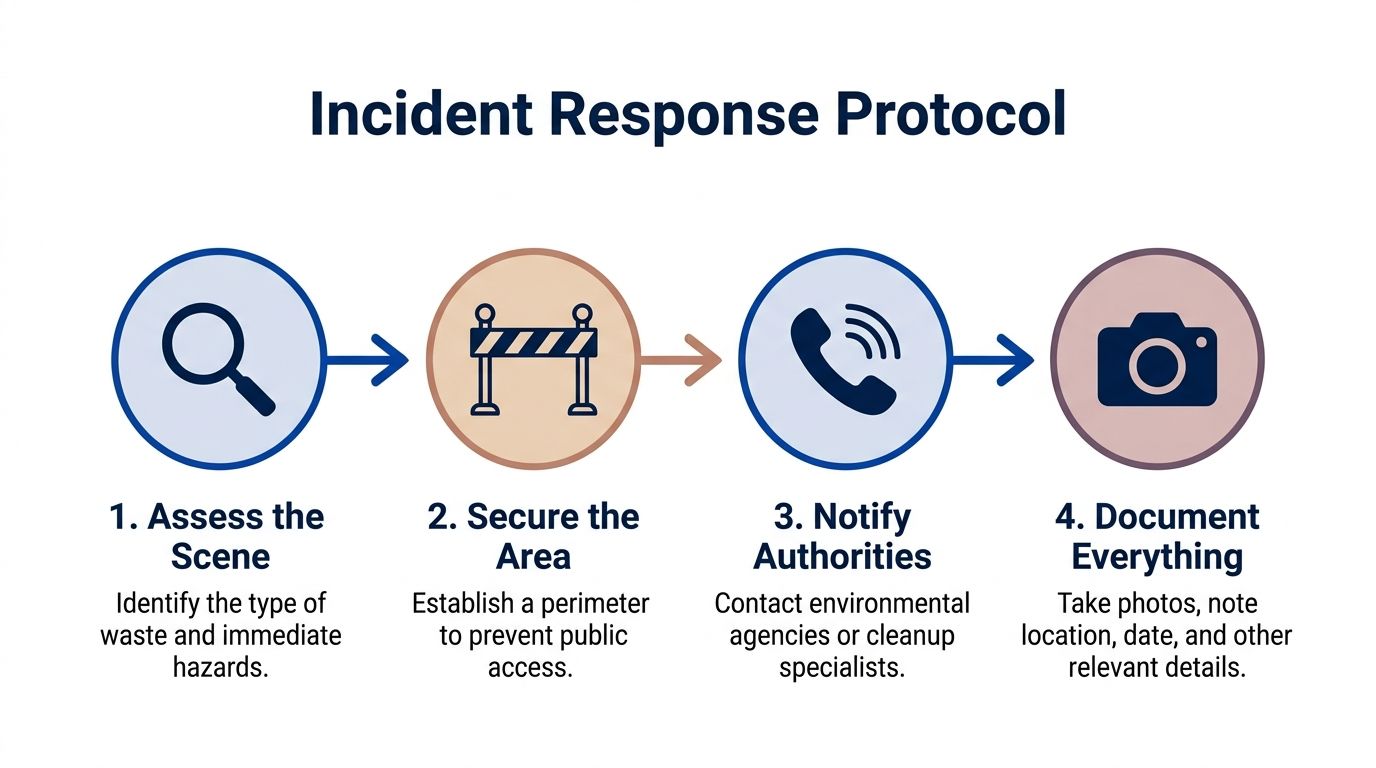
When you find questionable waste, your job is to slow the situation down. People get hurt when someone rushes in with paper towels, a shop vacuum, or a trash cart and tries to “solve” the problem before the hazards are understood.
The safest response is calm, controlled, and documented.
First actions that protect people
Start with the area, not the waste itself.
- Keep people back. Close the room, rope off the section, or block access to the dumpster area.
- Stop routine cleaning. Don't let housekeeping, maintenance, or untrained staff continue normal tasks nearby.
- Look for immediate hazards. Leaks, broken glass, sharps, fumes, damaged containers, and visible contamination all change the response.
- Identify who may have already entered the area. Exposure tracking starts early.
For a more detailed incident checklist, this guide on what to do and not do after discovering a biohazard is a practical reference.
What not to do
At this point, well-meaning people often make the event worse.
- Don't compress bags or containers. That can force out liquids or expose hidden sharps.
- Don't relabel items casually. Guessing at contents creates downstream documentation problems.
- Don't pour liquids down a drain. Unknown chemicals or contaminated fluids need proper evaluation.
- Don't move waste to “tidy up” the area. The original placement may matter for compliance review, insurance, and exposure assessment.
If your team doesn't know the waste stream with confidence, they shouldn't be packaging it for disposal.
Document before anything changes
Take clear photos from a safe distance. Note the date, time, exact location, names of people who found it, and anything staff observed before the area was secured. If a container has markings, labels, or partial identifiers, record them without handling the item more than necessary.
That documentation serves several purposes at once. It helps safety personnel evaluate exposure, supports insurance communication, and preserves a record if regulators or property stakeholders later ask what happened.
The final step is the most important one. Bring in qualified remediation and disposal professionals who can assess the waste category, establish containment, manage decontamination if needed, and route the material into the correct legal disposal pathway.
Why Certified Professionals Are Your Only Safe Option
A janitorial crew can remove visible dirt. That isn't the same as hazard assessment, containment, decontamination, exposure control, and legally defensible waste disposal. When improper disposal involves biohazardous or hazardous material, the difference matters.
Certified remediation work is process-driven. Teams evaluate the site, identify likely waste streams, isolate the area, select PPE matched to the exposure risk, prevent cross-contamination, package waste correctly, and document the chain of handling. That process protects workers, occupants, and the organization.
Training is specific, not generic
Emergency and cleanup work has its own training standard. OSHA states that biohazard remediation workers responding to hazardous substance releases must be trained under HAZWOPER at 29 CFR 1910.120(q)(6), requiring 24 hours of training for offensive roles and 8 hours for defensive roles like post-emergency cleanup, with general site cleanup training ranging from 24 to 40 hours off-site plus 1 to 3 days of supervised field experience, as outlined in OSHA's HAZWOPER interpretation guidance.
That level of training is why certified crews approach a scene differently from ordinary cleaners. They don't just remove what's visible. They work within a defined safety and compliance framework.
The biggest operational failure is often upstream
A major problem in healthcare and similar settings is bad segregation before disposal ever becomes an incident. The Windhoek study summarized here on causes of improper waste segregation among nursing students identifies lack of knowledge, insufficient disposal equipment, and improper training as primary drivers. That finding matches what many facility leaders already suspect. Incidents often begin with unclear color-coding, missing containers, or staff who were never trained well enough to distinguish general waste from high-risk waste under pressure.
What professionals provide that untrained staff can't
A qualified team brings more than PPE.
| Need | Untrained internal response | Certified professional response |
|---|---|---|
| Hazard identification | Guesswork | Structured assessment |
| Containment | Improvised barriers | Controlled isolation methods |
| PPE selection | Generic gloves or masks | Task-specific protective equipment |
| Disposal path | Uncertain | Documented, compliant handling |
| Recordkeeping | Often incomplete | Defensible documentation |
Cleanup is only one part of the job. The other part is proving the waste was managed safely and lawfully.
Creating Policies to Prevent Future Incidents
A disposal incident often starts with an ordinary shortcut. A nurse finishes a procedure, the nearest red bag station is across the room, and a blood-soaked item goes into general trash "just for now." Hours later, housekeeping opens that liner, and a small placement failure has become an exposure event, an internal investigation, and a compliance problem.
That is why prevention in professional settings has to be operational, not aspirational. A policy only works if people can follow it during a rushed shift, a handoff, a spill, or a staffing shortage without stopping to guess.
Build a system people can actually use

The easiest way to prevent repeat incidents is to study where the process breaks under pressure. In many facilities, the failure is not a lack of rules on paper. It is a mismatch between the rule and the actual workflow.
For example, a clinic may require sharps to be discarded immediately, but place the sharps container near the door instead of beside the exam chair. Staff then carry used devices across the room, set them down temporarily, or overfill the nearest container because it is more convenient than walking to another station. The fix is simple but specific. Put the right container at the point of generation, set a replacement schedule before containers are full, and assign someone to verify placement during routine rounds.
Policies should cover the points where mistakes happen most often:
- Use clear segregation rules. Color-coded, labeled containers should be placed where waste is generated, not in a central area that forces staff to improvise.
- Train the people who touch the waste first. Nurses, techs, maintenance staff, cleaners, lab personnel, and supervisors need role-specific instruction based on what they handle.
- Secure storage areas. Hazardous and biohazardous materials should not sit in open corridors, unsecured loading areas, or shared utility rooms.
- Check container availability and condition. Missing lids, overfilled bins, and absent sharps containers push employees toward unsafe workarounds.
- Define escalation paths. Staff should know who to call, what to isolate, and how to document a suspected disposal error.
Training deserves more than a yearly slideshow. Good training works like a fire drill. It gives people a simple response they can use under stress. If a housekeeper finds chemotherapy waste in general trash, or a lab assistant notices an unlabeled container in storage, they should already know the first three steps without hunting for a supervisor.
Put it in writing and update it
OSHA requires employers with potential exposure to bloodborne pathogens to maintain a written Exposure Control Plan that identifies at-risk roles, outlines safety protocols and PPE such as nitrile gloves, face shields, and respirators, details post-exposure procedures, and is reviewed and updated annually, as explained in this guide to OSHA guidelines for biohazard cleanup.
Written procedures matter because people do not perform at their best in the middle of a messy incident. A current plan gives supervisors something more reliable than memory. It sets the disposal path, reporting steps, cleanup limits, and outside-response triggers before an event occurs.
It also creates accountability. If one department keeps mis-sorting waste, leadership can examine whether the issue is training, container placement, staffing, signage, or vendor coordination. That is how facilities reduce liability. They stop treating each disposal error as an isolated mistake and start correcting the process that produced it.
Good policy protects the housekeeper opening a liner, the nurse disposing of a saturated dressing, the technician clearing a treatment room, and the next person who enters the space. In high-risk environments, that daily protection is the true measure of whether a waste program works.
When improper waste disposal creates uncertainty, exposure concerns, or compliance risk, 360 Hazardous Cleanup provides the kind of trained, compassionate support people need in real time. Their team handles biohazard remediation, hazardous materials response, compliant waste handling, documentation support, and discreet crisis cleanup with a safety-first approach that helps facilities, property owners, and families move forward with confidence.