
Professional hoarding cleanup usually falls in the $3,000 to $7,000 range nationally, though projects can run from $1,000 to over $10,000 depending on severity and complexity. If biohazards, structural damage, or heavy disposal needs are involved, the number can move quickly from a basic cleanup quote into a true remediation project.
If you're reading this because a parent’s house has become unsafe, a tenant left behind a severe hoard, or a facility room can no longer be entered without concern, the price question is only one part of what you're carrying. Families often feel guilt and urgency at the same time. Property managers usually feel pressure from liability, deadlines, and occupant safety.
The hard part is that generic cost calculators rarely reflect the true drivers of hoarding cleanup services cost. They don't account for contaminated materials, blocked egress, pest activity, mold, or the emotional reality that sorting decisions can slow work dramatically when a loved one is involved. They also don't tell you when a job has crossed the line from hauling and cleaning into regulated biohazard remediation.
What follows is the kind of explanation I’d give a family member or a building manager standing in the doorway, trying to decide what to do next. The goal isn't to scare you. It's to help you understand what you're paying for, where quotes differ, and how to avoid the expensive mistake of hiring a crew that isn't equipped for the hazards on site.
Understanding Hoarding Cleanup Costs An Introduction
A daughter calls after a fall. Her father insists the house is manageable, but the hallway is narrowed to a single path, the stove is buried, and one bathroom can no longer be used. At that point, the question is not how much it costs to clean up a mess. The question is how much risk is already in the house, and what it will take to make the property safe without causing more harm to the person living there.
That is why hoarding cleanup estimates can vary so widely. The price reflects labor, disposal, sanitation, hazard control, and the time it takes to sort through belongings with care. Some projects stay in the range of removal and cleaning. Others involve contaminated materials, pest activity, damaged subfloors, or human and animal waste, which changes the job from a simple cleanout to regulated remediation work.
Families usually feel the cost before they understand the scope. Property managers see the opposite problem. They understand the liability, but not always the hidden expenses that appear after an unqualified crew starts work and has to stop. I have seen low bids turn into higher total losses because items were handled incorrectly, contamination was spread from room to room, or there was no documentation for an insurance claim or post-loss file.
Why the estimate often feels higher than expected
Hoarding cleanup is slower and more technical than junk hauling. Crews may need to open safe access routes first, identify medications or legal papers, separate salvageable items from contaminated ones, and package waste according to the contents of the pile. That takes training and judgment, not just labor.
If the site includes blocked exits, sharps, mold concerns, insect or rodent activity, or bodily fluids, the crew also needs the right PPE, cleaning agents, containment practices, and disposal plan.
It also helps to use the right definition. A packed home is not always the same as a hoarding case, and risk level can change the work plan more than square footage does. Our guide to the differences between clutter and hoarding conditions explains that distinction and why it affects pricing, staffing, and whether a certified remediation contractor should be brought in.
What families and managers are really paying for
A professional invoice covers more than hauling items to a truck. It covers assessment, trained sorting, worker safety, surface cleaning, disposal coordination, and, when needed, remediation that meets health and legal requirements. In some cases, it also includes photo documentation, moisture checks, odor treatment, and records that help support an insurance submission.
That last part is often missed by online cost calculators. They rarely account for the financial impact of doing the work twice, delaying re-occupancy, missing a claim requirement, or hiring a crew that is not qualified to address contamination. The cheapest estimate can become the most expensive outcome if the property still is not safe at the end of the job.
What Determines The Final Hoarding Cleanup Cost
A family can show me two three-bedroom homes on the same street and get two very different quotes. One may need organized sorting and hauling. The other may require extra crew members, restricted work zones, documentation for an insurance file, and a slower removal plan because the safest path through the home is only two feet wide.
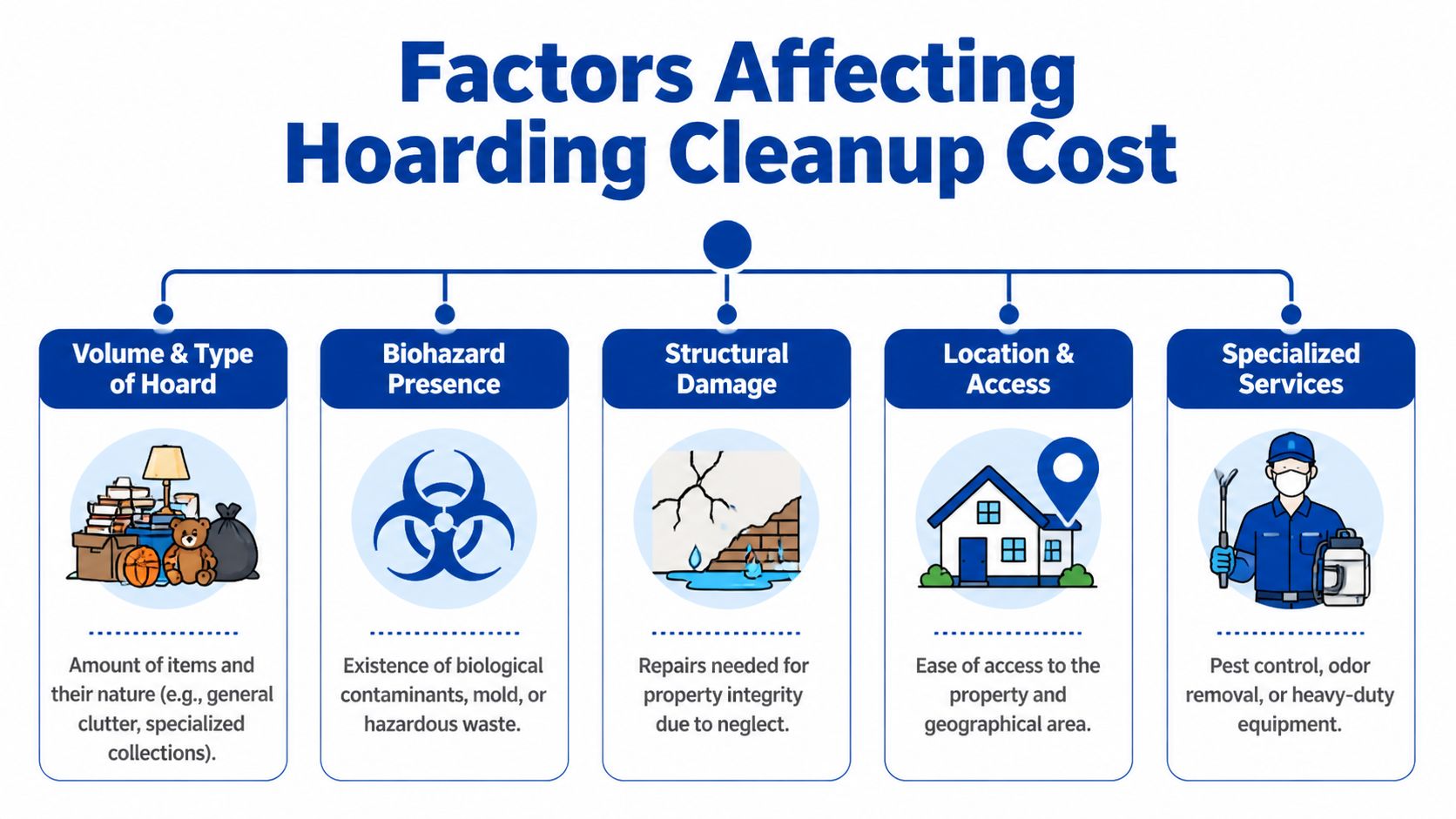
That is why broad price ranges only help as a starting point. Many professional hoarding cleanups fall somewhere between low-thousands pricing and much higher totals once labor, disposal, contamination control, and follow-up services are added. A quote rises or falls based on work conditions, risk, and what has to happen to return the property to safe use.
The variables that move the quote
Square footage matters, but it is rarely the main driver. Crews price around time, risk, access, and disposal complexity.
- Layout and access: Narrow hallways, blocked doors, stairs, elevators, and long carries to a dumpster or truck all add labor time.
- Room function loss: A packed spare room is one thing. A blocked kitchen, bathroom, or exit changes the urgency and the work plan.
- Material mix: Bagged trash, paper, clothing, furniture, food waste, sharps, liquids, and damaged household goods do not move or dispose of the same way.
- Hidden conditions: Pest activity, moisture damage, mold growth, subfloor damage, and contaminated surfaces may only become clear after the first layer comes out.
- Decision-making time: Projects take longer when items must be reviewed carefully with a family, case manager, or property representative before removal.
- Documentation needs: Some jobs require photos, inventory notes, and condition records to support a claim or defend a deposit dispute.
A rough per-square-foot figure can help with early budgeting, but it is a weak tool for complex properties. Online calculators also miss the cost of delays. If an uninsured or untrained crew leaves behind mold, pest-related contamination, or damaged materials that should have been documented, the owner may pay again for proper remediation and lose time on any claim review. That is one reason insurance questions should be raised early, especially where water damage or mold is involved. Guidance on homeowners insurance mold coverage shows how quickly a cleanup issue can turn into a coverage issue.
Estimated Hoarding Cleanup Cost by Severity Level
| Hoarding Level | Typical Scenario | Estimated Cost Range |
|---|---|---|
| Mild | Decluttering, basic cleaning, light organization | $1,000 to $3,000 |
| Moderate | Furniture removal, deeper cleaning, reduced room access | $3,000 to $7,000 |
| Severe | Biohazards, deep cleaning, repairs, major safety concerns | $7,000 to $10,000+ |
These ranges are useful for orientation, not quoting. A home that looks moderate during intake can price like a severe project once crews uncover soaked materials, rodent contamination, or structural damage under compressed piles.
For readers who want a field-based way to assess conditions, our guide to classifying hazardous hoarding situations by type and severity gives a practical framework.
The final quote reflects the conditions required to do the job safely, document it properly, and leave the property in a defensible condition.
Disposal and labor are often misunderstood
Disposal is not just a truck fee. Clean household debris costs less to remove than wet material, pest-affected contents, mattresses, appliances, tires, chemicals, or items that require special handling. In some municipalities, landfill rules, weight limits, and transfer station fees also affect the final invoice.
Labor works the same way. Families often compare hourly rates and miss what is included. A trained crew may spend part of the day building safe pathways, changing PPE, separating keep items from discard items, photographing conditions, or coordinating with a social worker, property manager, or adjuster. Those tasks do not look dramatic on paper, but they are often what keeps the project safe, legally defensible, and less expensive than a failed cleanup that has to be redone.
The Critical Cost of Biohazard Remediation
The biggest mistake people make is treating all hoarding cleanup as junk removal. Once biohazards are present, the work changes category.

In a hoarding setting, biohazards can include animal waste, human waste, mold, bodily fluids, spoiled food breakdown, sewage-related contamination, and materials affected by pests. Those conditions don't just make a job dirtier. They create exposure risk for workers, occupants, maintenance staff, and anyone who enters later without knowing what was left behind.
Why the price rises sharply
Specialized biohazard removal or mold remediation can add $1,000 to $5,000 to the base cost because the work requires certified technicians, OSHA-compliant PPE, and regulated disposal protocols that non-specialized companies cannot provide, according to this breakdown of hoarding cleanup and biohazard pricing.
That additional cost isn't padding. It pays for the controls that protect everyone involved:
- Containment measures: To limit spread into unaffected areas.
- Protective equipment: Respirators, suits, gloves, and changeout procedures.
- Hazard-specific disposal: Especially where regulated waste or contaminated porous materials are involved.
- Documentation: Important for liability, insurance communication, and property turnover.
If mold is part of the picture, insurance questions can become even more complicated. This overview of homeowners insurance mold coverage is a useful starting point for understanding why mold-related claims often hinge on cause, documentation, and policy language.
What doesn't work
What fails most often is hiring a low-cost crew to "clear everything out first" and dealing with hazards later. That approach can spread contamination, damage salvageable surfaces, and create serious liability if workers are exposed without proper controls. It can also complicate insurance documentation because the original conditions were disturbed before anyone properly recorded them.
A better approach is to identify hazards early, decide what requires regulated handling, and follow a documented chain of work from removal to cleaning to disposal. For anyone comparing service categories, this guide to biohazard waste disposal helps clarify why regulated waste handling isn't interchangeable with ordinary hauling.
If a contractor can't clearly explain how contaminated materials will be separated, transported, and documented, keep looking.
The Professional Cleanup Process From Start to Finish
The first day on a hoarding job often starts the same way. A family member wants fast relief, a property manager wants the unit safe, and the person living in the space may already feel exposed or overwhelmed. Good cleanup work brings order to that tension. It sets a clear process, protects dignity, and makes cost decisions visible before the job starts to expand.
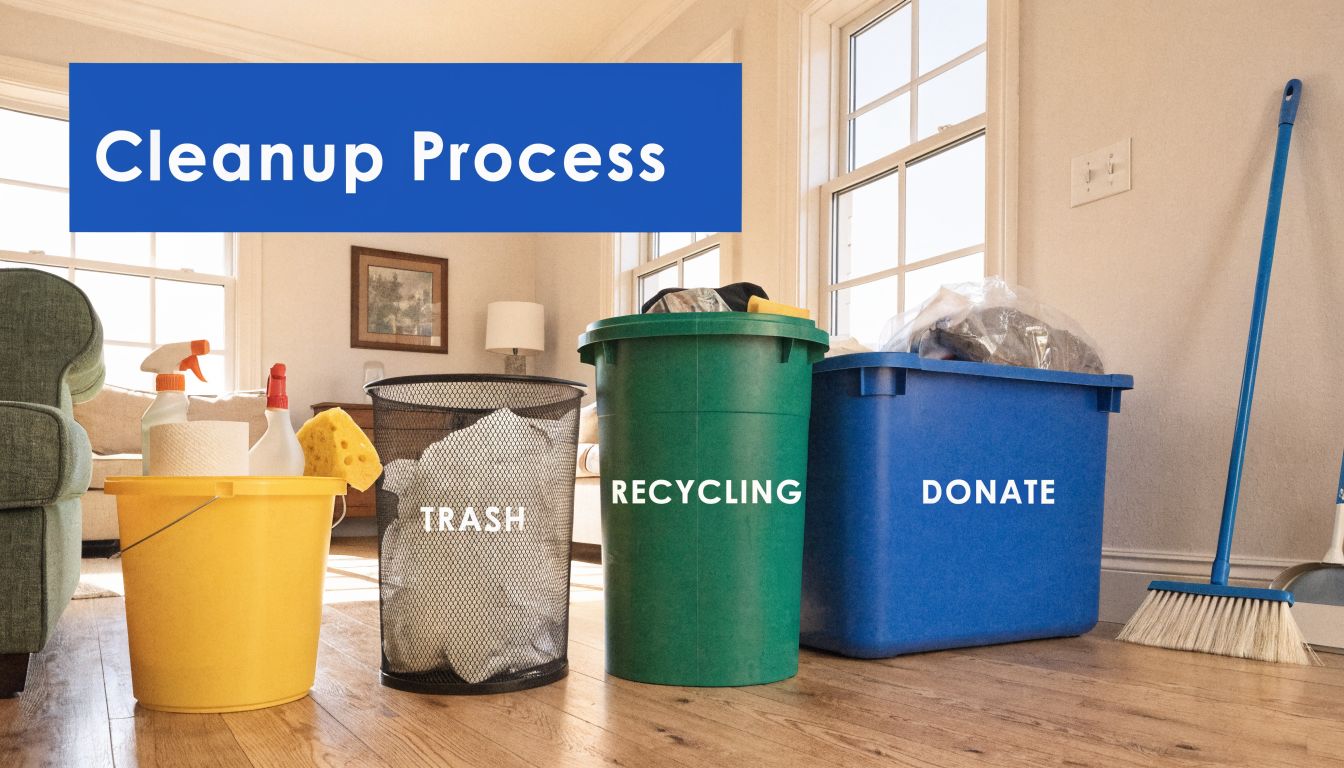
A professional crew should explain who has authority to make decisions, what gets documented, and what conditions can change the estimate. That matters for emotional reasons, but also for financial ones. If hidden contamination, structural damage, pests, or regulated waste show up mid-project, the scope can shift quickly. Families who use online cost calculators rarely see that part coming.
Assessment sets the job up correctly
Cleanup starts with a site assessment. The crew checks access, trip hazards, blocked exits, visible contamination, odor sources, salvage priorities, and whether other specialists may be needed. In practice, this is also where trust is built. A trauma-informed team explains how personal items will be reviewed and how keepsakes, legal papers, medications, cash, and valuables will be protected.
The assessment also protects the budget. If the floor is unstable, if sharps are hidden in piles, or if animal waste has soaked into porous materials, labor time and disposal needs change. Skipping that review is one of the main reasons a low estimate turns into a costly project.
Removal works best when the work is staged
Crews should sort by category, not by speed. The usual streams are keep, discard, donation, document review, and regulated waste. That structure reduces mistakes and keeps emotionally charged decisions from turning into rushed disposal.
A practical overview of that workflow appears in this guide to the biohazard cleanup process.
- Priority item recovery: IDs, financial records, photographs, heirlooms, prescriptions, and devices are pulled early.
- Path creation: Teams open safe walkways first so people and materials can move without falls or pile collapse.
- Orderly removal: Contents come out in a sequence that limits rehandling, cross-contamination, and damage to salvageable areas.
This short video gives a practical sense of how organized cleanup work is carried out in the field.
Cleaning, documentation, and clearance drive the final cost
Once contents are out, the actual condition of the property is visible. Staining, absorbed odor, insect activity, subfloor damage, mold, and contaminated surfaces often show up only after removal. An empty room may still need detailed cleaning, disinfection, deodorization, selective demolition, or clearance testing before anyone should move back in or before a unit can be turned over.
A room can look empty and still be unsafe to occupy.
This is also the stage where experienced firms earn their fee. They document conditions, separate standard debris from regulated waste, and keep records that can support insurance discussions or property management files. The cheaper alternative often misses that paperwork, and the cost shows up later in denied claims, failed turnover inspections, repeat odor treatment, or a second cleanup by a certified team.
For clients comparing providers, 360 Hazardous Cleanup is one company that handles hoarding-related biohazard remediation, insurance coordination, and regulated waste disposal as part of broader remediation work. The name matters less than the standard. Use a company that can explain its process clearly, protect personal property during sorting, and document the job well enough that you do not have to pay twice for the same problem.
Will Insurance Cover Hoarding Cleanup Costs
A family often calls after they have already started throwing things away. Then the insurer asks for photos, a cause of loss, and proof that part of the work involved contamination rather than ordinary junk removal. By that point, some of the evidence that supports a claim is gone.

Standard homeowners policies often do not pay for hoarding cleanup itself. Coverage is more likely when the insurer can tie part of the damage to a covered event, such as a plumbing leak, a fire, or another specific loss named in the policy. Long-term accumulation, deferred housekeeping, and conditions that developed over time are commonly treated very differently. That distinction catches families and property managers off guard because the property still has to be made safe, whether the carrier agrees to pay or not.
The financial risk is not limited to a denied claim. Hiring an unqualified crew to save money can make the insurance side worse. If workers remove contents without documenting room conditions, mix regulated waste with ordinary trash, or discard damaged materials before an adjuster can evaluate them, the property owner may lose reimbursement options and still need a certified firm to correct the work. That is one of the hidden costs generic online calculators miss.
Coverage questions usually come down to causation and documentation. An adjuster wants to know what created the damage, when it likely happened, and which parts of the invoice relate to safety-driven remediation rather than sorting and cleanout. Trauma-informed cleanup matters here too. A careful team can preserve personal items for review, reduce unnecessary disposal, and record conditions without turning a difficult situation into a rushed haul-out that harms the occupant and weakens the claim file.
Useful claim support often includes:
- Pre-loss condition records: Photos and written notes taken before major removal starts
- Cause-related damage notes: Clear separation between clutter removal and damage tied to a covered incident
- Contamination documentation: Observations showing why PPE, disinfection, odor treatment, or porous material removal were required
- Disposal records: Manifests, load summaries, and job notes that show where regulated waste and general debris went
- Scope breakdowns: Invoices that separate labor categories instead of lumping everything into one cleanup charge
For a practical explanation of policy language and common claim issues, see this guide to homeowners insurance coverage for biohazard cleanup.
Ask direct questions before work begins. Does the cleanup company provide photo documentation, written scope notes, and line-item invoicing? Will they speak with the adjuster if needed? Ask the carrier what part of the loss may qualify, what exclusions may apply, and whether they want to inspect before demolition or disposal.
Insurance can offset part of the bill in the right circumstances. It rarely fixes poor documentation, and it rarely covers every part of a hoarding project. Families should plan for some out-of-pocket cost, then treat any covered portion as financial relief rather than the starting assumption.
Sample Hoarding Cleanup Project Estimates
A texted photo of a packed living room is not enough to price a hoarding cleanup. Two homes can look similar in one image and land thousands of dollars apart once a crew opens pathways, checks for floor damage, tests affected materials, and finds out whether the job is simple removal or a regulated remediation project.
Scenario one with moderate clutter in a larger home
A family is trying to clear a house before listing it. The home has heavy accumulation, blocked storage areas, narrowed walking paths, and large furniture that cannot be removed without planning the route out. At the first walkthrough, there are no visible bodily fluids, sewage issues, or animal waste conditions that would force biohazard controls.
In that kind of project, the cost often lands in the moderate range. The bill reflects labor hours, truck volume, disposal fees, furniture breakdown, sorting time, and the condition of surfaces once the contents are gone. A larger home can price higher even when the hazard level stays manageable, because crews spend more time opening rooms, staging salvageable items, and cleaning newly exposed areas.
This is also where families make an expensive mistake. They hire a low-cost labor crew to empty the house fast, then call a remediation company after the property is left with broken keepsakes, mixed valuables, pest-contaminated piles, and damaged surfaces. The second crew ends up doing slower, more expensive work because the first pass removed the order that made safe sorting possible.
Scenario two with severe contamination and hidden escalation
A property manager enters a unit expecting a standard cleanout. Once work begins, the team finds pest activity, saturated soft goods, sharps risk, odor penetration, and sections that need containment and disinfecting before anyone can clear them safely.
That estimate climbs fast, and for good reason.
The job now includes PPE changes, hazard communication, controlled removal, additional disposal handling, more supervisor time, and possible demolition of porous materials that cannot be cleaned to a safe condition. If an uncertified crew starts this work and spreads contamination through common areas, hallways, or HVAC returns, the property owner can end up paying for the original cleanup, the corrective cleanup, and added tenant or turnover delays. Cheap pricing at intake can become the highest-cost option on the file.
Severe projects also create financial questions that online calculators miss. Can part of the loss be documented in a way an insurer will even review? Does the owner need post-cleaning odor treatment, pest follow-up, or repairs before the unit is rentable again? Those costs are tied to the condition of the property, not just the number of bags hauled out.
Why the expense can still make financial sense
A properly run hoarding cleanup protects more than appearance. It preserves claim documentation, reduces liability, supports safer repairs, and gives families or managers a defensible record of what was removed and why.
It also protects people during a hard transition. The best crews do not treat the contents like garbage from the first minute. They build in time for decision-making, identify medication, paperwork, photos, and heirlooms, and keep the process respectful while still controlling labor costs. Families who need help with the emotional side of the process may benefit from guidance on how to achieve a fresh start decluttering.
The lowest quote rarely captures that level of care. The better comparison is total outcome. A safe property, fewer missed valuables, cleaner documentation, and less rework later.
How to Prepare and Choose The Right Cleanup Service
Choosing a cleanup company is where safety, compassion, and cost meet. The wrong hire can leave you with a partially emptied property, unaddressed contamination, and a bigger bill later. The right hire gives you a defensible process and a clear scope.
How to prepare before the team arrives
Don't try to "fix" the property overnight. Quick pre-cleaning often destroys documentation and can expose family members or staff to hazards they weren't prepared to handle. Instead, identify what needs to be protected and what decisions still require input.
A simple prep list helps:
- Set aside critical items: Gather medication lists, legal papers, IDs, keys, and any records tied to ownership or tenancy if you can access them safely.
- Name decision-makers: Decide who has authority to approve disposal, review keepsakes, and speak with the contractor.
- Flag sensitive concerns: Tell the team about pets, sharps, possible mold, known leaks, or any room no one has entered recently.
If you're supporting a loved one through the emotional side of the process, this resource on how to achieve a fresh start decluttering offers helpful language and mindset guidance.
Questions that separate qualified providers from basic haulers
Ask direct questions. A professional team should be comfortable answering them without hedging.
- Training and scope: Do you handle hoarding cases that involve contamination, or only removal of contents?
- Protective procedures: What PPE do your crews use when biohazards or mold are present?
- Disposal handling: How do you separate ordinary debris from contaminated waste?
- Documentation: Can you provide records and photos that help support an insurance claim?
- Client care: How do you protect valuables, documents, and sentimental items during sorting?
- Discretion: Can you work with privacy measures if the family or property owner requests them?
The best question is often the simplest one: "What happens if your crew discovers contamination that wasn't visible during the estimate?"
You want a clear answer. Not a sales pitch. If they can't explain how scope changes are documented and approved, keep interviewing.
The goal isn't to find the lowest headline number. It's to hire a company that can finish the job safely, legally, and respectfully.
If you're facing a hoarding situation and need a clear, compliant plan, 360 Hazardous Cleanup provides hoarding cleanup, biohazard remediation, regulated waste handling, and insurance documentation support for families, property managers, and facilities. Reach out when you're ready to talk through the conditions on site and get a scope based on safety, not guesswork.