
A daughter is standing in a doorway with her phone in her hand, searching for hoarder help near me after realizing her father can no longer reach the stove safely. A landlord enters a unit after a plumbing complaint and finds blocked exits, active moisture damage, and conditions that may trigger reporting and habitability issues. A husband has filled bags, rented a dumpster, and argued for months, only to see the home become more tense and less stable.
This is the point where families, property managers, and tenants realize they are dealing with more than excess stuff.
Hoarding conditions usually involve several problems at once. There is the visible accumulation, but there is also grief, shame, impaired decision-making, fire risk, fall risk, pests, contamination, lease exposure, insurance questions, and the very real chance that a fast cleanout will fail if nobody addresses what happens after the truck leaves. In the field, I have seen well-meant rush jobs create deeper mistrust and a quick relapse.
A safer starting point is understanding the difference between general clutter and a hoarding environment with functional or health hazards. This guide to clutter vs. hoarding can help you identify that line before you hire the wrong kind of help or push a loved one into a cleanup plan that will not hold.
Hoarding disorder is a recognized mental health condition, not laziness or a character flaw. This distinction is critical in the field. It changes how a crew enters the home, how decisions are paced, how family members communicate, and whether the plan includes mental health support alongside disposal and sanitation work.
Good help also goes beyond hauling items away. In serious cases, the job can involve documenting loss for insurance, handling biohazards under the right procedures, protecting a tenant or owner’s privacy, and helping landlords meet health and safety obligations without making a bad situation worse. People looking for practical starting points can also review practical tips to de-cluttering your home, but homes affected by hoarding often need a more careful, trauma-informed process.
The goal is not a dramatic before-and-after photo. The goal is a safe home, a workable plan, and enough support after cleanup to reduce the risk of starting over again.
The First Step Toward Finding Hoarding Help
Many families arrive at this point after a moment that breaks through denial. It might be a fall, a code enforcement notice, a pest issue, a failed inspection, or the first time someone sees that the kitchen, bathroom, or exits can’t be used normally.
The first step isn’t grabbing contractor bags and setting a deadline. The first step is slowing down enough to identify what kind of problem you’re facing. Some homes need organizing help. Others need a biohazard-trained remediation crew, mental health support, and careful planning around privacy, insurance, or legal access.
Start with the right question
Ask this instead of “How do we clean this out fast?”
Is this a clutter problem, a hoarding disorder, or a hazardous hoarding environment?
That distinction affects everything that follows. It changes who should be involved, how the space should be entered, what protective equipment is needed, and whether disposal has to follow regulated handling procedures.
If you need help understanding that line, this guide on clutter vs. hoarding is a useful place to start. It helps families avoid underreacting to a dangerous space or overreacting to a situation that may still be manageable with support.
Practical rule: If the home can’t be safely used for sleeping, cooking, bathing, walking, or exiting, treat it as more than a housekeeping issue.
Keep the early plan simple
At the beginning, people often overcomplicate the process because they feel ashamed or panicked. A calmer approach works better:
- Protect relationships first: Judgment, arguments, and surprise cleanouts usually harden resistance.
- Document obvious hazards: Note blocked exits, visible waste, strong odors, water damage, pests, or inaccessible appliances.
- Look for supportive resources: If the environment isn’t hazardous, practical home organization advice can help with early momentum. Some families find practical tips to de-cluttering your home helpful for small, non-hazardous starting points.
- Decide whether the site is safe to enter: If there’s mold, animal waste, decomposition, sharp objects, or structural instability, stop before DIY sorting begins.
The most productive path is usually the one that respects both realities at once. The home may need physical restoration, and the person may need emotional safety while that happens.
When to Call a Professional for Hoarding Cleanup
Not every overloaded room requires a remediation team. Some situations are disorganized but still safe. The line is crossed when the environment presents health risk, injury risk, fire risk, or contamination risk that ordinary junk removal or family-led cleanout can’t manage responsibly.

Signs the problem is no longer ordinary clutter
Some warning signs are visible right away. Others only become obvious once items are moved and hidden damage appears.
A professional cleanup call is warranted when you see conditions like these:
- Blocked life-safety paths: Hallways, doors, windows, stairs, or exits can’t be used normally.
- Fire load and ignition risk: Large paper accumulation, overloaded outlets, unsafe heaters, or inaccessible electrical panels.
- Biohazard presence: Human or animal waste, rotting food, insects, rodents, sharps, or bodily fluid contamination.
- Moisture-related damage: Active leaks, soft flooring, stained ceilings, visible mold, or musty air.
- Structural stress: Sagging surfaces, unstable stacks, damaged subfloors, or rooms that can’t bear normal traffic.
- Nonfunctional living areas: A kitchen that can’t be used for food preparation, bathrooms that can’t be accessed, or bedrooms no longer safe for sleep.
Why DIY can make it worse
Families often think the main issue is volume. In hazardous hoarding, the bigger issue is exposure. Disturbing contaminated materials can release particulates, spores, and odors into the air. Moving piles without a plan can also uncover needles, pests, hidden leaks, or compromised flooring.
In severe environments, “just start hauling” is not a harmless first step. It can spread contamination across the property, increase injury risk, and complicate insurance documentation later.
A useful reference point is this article on different types and levels of hoarding, especially for families and property managers trying to decide whether they’re dealing with a difficult cleanup or a regulated remediation problem.
The decision test I use in the field
When a caller describes the site, I mentally sort it into three categories.
| Situation type | Usually appropriate response |
|---|---|
| Disorganized but sanitary | Organizer, family support, slow sorting |
| Impaired function without contamination | Hoarding specialist, structured cleanup planning |
| Unsafe, unsanitary, or contaminated | Professional remediation with PPE, containment, and compliant disposal |
If entering the space requires you to think about respirators, sharps, waste, or collapse hazards, it’s time to stop treating it like junk removal.
Special concern for rentals and managed properties
Property managers and landlords have another layer to think about. Once a unit has contamination, mold, pest activity, or bodily fluid exposure, the response has to protect neighboring units, staff, vendors, and future occupants. That means documenting conditions, controlling access, and avoiding untrained labor.
The trade-off is real. Waiting may feel more compassionate in the short term, but delay can increase contamination spread, tenant conflict, habitability issues, and financial loss. Acting too aggressively can also backfire if the resident feels cornered and stops cooperating. The right response balances legal obligations, health risk, and trauma-informed communication.
How to Find and Evaluate Hoarding Cleanup Services
A family can lose weeks by hiring the wrong crew first. I have seen organizers called into contaminated apartments, junk haulers sent into units with sharps and animal waste, and restoration vendors brought in with no plan for sorting valuables or communicating with a distressed resident. The result is usually the same. More cost, more conflict, and less trust.
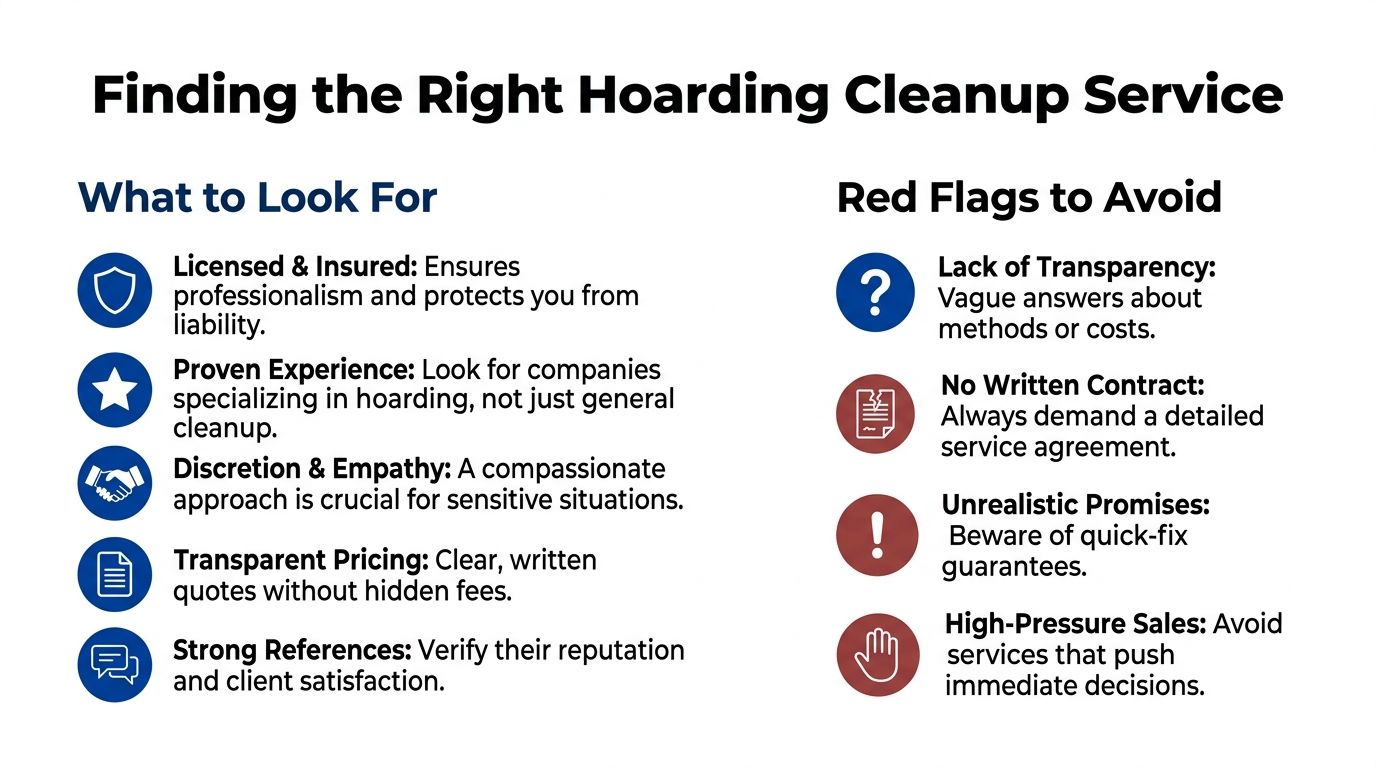
Typing hoarder help near me will surface several categories of providers. They are not interchangeable. An organizer may help with decision-making and structure. A hauling company may clear volume fast. A remediation team should know how to document conditions, control exposure, handle regulated waste, and work in a way that does not push the occupant into panic or shutdown.
Questions worth asking before anyone enters the property
Start with scope, safety, and decision-making. Price matters, but it should come after you know what kind of job this really is.
Ask questions like:
- What types of hoarding conditions do you handle regularly? Listen for direct experience with unsanitary units, pest activity, biohazard concerns, and heavy-content sorting. “We do cleanouts” is not enough.
- How do you assess the property before work starts? A qualified team should explain how they review access, occupant needs, hazards, staging areas, and disposal requirements.
- How do you protect important items during removal? Good providers have a method for identifying documents, medications, cash, jewelry, heirlooms, photos, and items tied to legal or insurance issues.
- What happens if conditions change once work begins? The answer should include escalation procedures for mold, sharps, human or animal waste, structural concerns, or pest-related contamination.
- How do you communicate with the resident and family? Respectful language is operationally necessary. Crews that shame, rush, or joke about the contents usually create resistance that slows the project and increases emotional harm.
- Can you coordinate with outside parties if needed? In real cases, that may include therapists, social workers, Adult Protective Services, building management, insurers, or attorneys.
If you want a basic cleanout overview before comparing specialty providers, this article on the best way to handle a hoarder house cleanout is a useful starting point. It helps separate general hauling advice from the more controlled process required in high-risk properties.
What separates a strong provider from a risky one
The best teams do more than remove debris. They set up a process that protects health, preserves evidence of conditions, and lowers the odds of a traumatic blowup halfway through the job.
That includes practical details families often miss on the first round of calls. Ask whether photos and inventories are available for insurance review. Ask how the company documents pre-existing damage for landlords and property managers. Ask how they handle privacy if neighbors, staff, or other tenants start asking questions. Ask whether they can phase the work so the resident is not forced into hundreds of decisions in a single day.
Cleanup can restore access to a home. It does not treat the condition that led to the accumulation. Providers who understand that distinction usually make better decisions on site.
Respect isn’t a soft skill in hoarding work. It’s operationally necessary. People make clearer decisions when they don’t feel cornered.
Red flags that should make you pause
Poor fit shows up early. Watch for these warning signs:
- A firm quote with no site visit or detailed intake. Hoarding projects vary too much for responsible pricing by square footage alone.
- No written scope of work. If tasks, exclusions, and disposal categories are vague, disputes usually follow.
- No discussion of PPE, containment, or waste handling. That suggests the company is treating a remediation problem like a standard junk pickup.
- Pressure to “clear it all” immediately. Fast action is sometimes necessary, but forced speed can destroy trust, miss valuables, and create problems with family members or insurers.
- Dismissive language about the resident. If a company talks about people with contempt during the estimate, expect the same conduct on site.
- No plan for emotional fallout after the truck leaves. A clean space without support, structure, or referrals can lead to rapid re-accumulation.
What property managers and landlords should verify
Rental and commercial properties need a tighter screening process. The cleanup company should understand habitability issues, access control, resident communication, documentation standards, and the difference between ordinary disposal and regulated waste handling.
Use a checklist like this:
| Ask about | Why it matters |
|---|---|
| Condition documentation | Supports notices, claims, internal records, and disputes about damage |
| Containment and common-area protection | Reduces spread into hallways, elevators, adjacent units, and dumpsters |
| Chain of custody for keys and entry | Protects staff, vendors, and the resident’s privacy |
| Resident communication approach | Lowers the risk of escalation, refusal, or claims of mistreatment |
| Insurance and compliance support | Helps present the loss clearly and supports regulatory or lease-related documentation |
Evaluate hoarder cleanup companies that handle remediation, documentation, and occupant-sensitive cleanup as partners in recovery, not just labor providers. One example in this category is 360 Hazardous Cleanup, which handles hoarding scenarios, biohazard concerns, and insurer communication as part of the project scope instead of leaving those issues for the family, landlord, or resident to solve alone.
What to Expect During the Professional Cleanup Process
People often fear the unknown as much as the cleanup itself. They imagine strangers arriving, tossing everything into dumpsters, and leaving emotional fallout behind. A proper hoarding remediation project doesn’t work like that.
It follows a sequence. Safety comes first. Planning comes second. Removal and cleaning happen in phases. The best crews move deliberately because they’re protecting people, property, and the chances of long-term progress.

The assessment and hazard review
The first visit should not start with hauling. It should start with observation.
A professional methodology includes a safety evaluation with PPE, identification of hazards such as mold, and planning for phased work. The Philadelphia Hoarding Task Force resource describes a process that includes PPE, recognizes risks such as mold spores exceeding 1,000 CFU/m³, and moves into collaborative planning, phased execution, HEPA vacuuming, enzymatic cleaning, and sanitization with hospital-grade disinfectants, as outlined in this professional hoarding cleanup methodology.
During assessment, the team looks at access routes, structural concerns, visible contamination, likely salvage categories, and where containment may be needed. Photos and inventory notes are often part of this stage because documentation matters later.
Collaborative planning, not forced clearing
In a trauma-informed operation, the work plan is explained before the first major removal begins. Rooms are prioritized. Decision points are identified. If the occupant is participating, the team uses simple categories for sorting and keeps choices manageable.
The OHIO rule, meaning Only Handle It Once, is helpful here. Instead of repeatedly moving the same object from pile to pile, items are directed into a decision stream such as keep, donate, recycle, archive, or dispose. That reduces chaos and lowers emotional fatigue.
A good crew also plans for items people commonly lose inside heavy clutter:
- Important papers: IDs, deeds, wills, tax records, medical files
- Sentimental property: Photos, letters, keepsakes, urns
- Financial items: Cash, checkbooks, cards, coins, jewelry
- Medical necessities: Prescriptions, mobility aids, medical documents
Removal, cleaning, and air control
Once the plan is set, the project usually moves room by room. That pace is not inefficiency. It’s how crews maintain chain of decisions and avoid spreading contaminants.
For many sites, the sequence looks like this:
- Create safe work zones: Establish entry and exit paths and isolate sensitive areas if needed.
- Sort and remove obvious waste first: This restores visibility and reduces immediate odor and pest pressure.
- Recover valuables as they appear: Items are set aside, documented, and protected.
- Address hidden contamination: This may include subfloor damage, waste saturation, mold-affected contents, or pest nesting.
- Use HEPA vacuuming and targeted cleaners: Fine particulates and organic residue need more than sweeping and household spray.
- Sanitize surfaces and contents where appropriate: The right product depends on the contamination type and material involved.
For a visual overview of how these environments are approached, this video can help:
What families usually notice by the end
The most visible change is space. The more important change is function. Can the resident walk safely? Use the bathroom? Reach the kitchen sink? Sleep in a bed? Open doors and windows? Let a nurse, inspector, social worker, or maintenance tech enter without danger?
That’s the benchmark. A room can look “cleaner” and still be unsafe. A professional standard aims for usable, sanitary, and supportable living space.
For a closer look at this kind of work, hoarding situations and biohazard cleanup gives a practical picture of how restoration differs from a basic haul-away service.
Navigating Costs Insurance and Privacy Concerns
A daughter may be ready to get help, then freeze at the same three questions. How much will this cost. Will insurance cover any of it. Who is going to know.
Those questions deserve straight answers. Hoarding remediation can involve sorting, heavy removal, biohazard controls, odor treatment, regulated disposal, documentation, and sometimes coordination with a landlord, property manager, or carrier. A bedroom that needs decluttering is one kind of job. A unit with blocked egress, pest activity, waste contamination, or damaged subflooring is another.

What drives the cost
Costs rise or fall based on conditions on site, not just on how full the home looks from the doorway. In practice, the main drivers are labor hours, the amount and type of material removed, access problems such as blocked stairs or narrow hallways, contamination level, disposal requirements, and whether the file needs insurer-ready photo and written documentation.
A proper estimate should separate cleanup work from repairs. Removal and sanitation are one scope. Replacing flooring, drywall, cabinets, or fixtures is another. Keeping those scopes distinct helps families compare bids fairly and helps property owners document what was pre-existing, what was caused by contamination, and what belongs in a repair claim.
Insurance questions to ask early
Coverage depends on the policy language and the cause of loss. Carriers often draw a hard line between sudden covered damage and long-term conditions that developed over time. That does not mean a claim is hopeless. It means the documentation has to be specific.
I advise clients to ask four things early:
- What part of the loss is potentially covered
- What documentation does the adjuster want before disposal
- Whether biohazard remediation must be itemized separately
- Whether temporary access restrictions, tenant issues, or emergency mitigation affect the claim file
Good records protect everyone. For families, they reduce confusion over what was removed and why. For landlords and commercial owners, they help show that the response matched health and safety duties, lease obligations, and disposal rules. If you need help preparing for that call, this guide on how to talk to your insurance company about cleanup services gives a practical starting point.
Privacy should be planned, not assumed
Privacy matters because shame delays treatment and delays cleanup. A careless crew can make a bad situation worse even if the physical work gets done.
Ask direct questions before you sign:
- Are vehicles marked or unmarked
- Who has access to site photos
- How are photos stored and shared
- What does the crew say if a neighbor, tenant, or staff member asks questions
- How long are records kept
- Who can authorize updates to family, caseworkers, property management, or attorneys
In trauma-affected homes, privacy is also emotional protection. People are often handing over a space tied to grief, loss, isolation, or fear of judgment. The cleanup plan should reflect that reality. That includes limiting unnecessary spectators, keeping communication tight, and avoiding casual comments on site.
The cheap bid can cost more later
I have seen low-price haul-away crews clear a unit fast, then leave the owner with no usable photo log, no contamination notes, no disposal trail, and no defensible record for a carrier or housing file. That creates new problems. Claims get harder to support. Landlords struggle to show compliance. Families argue over missing items because nobody documented the work carefully.
Price matters. Scope matters more.
A serious provider should be able to explain what is included, what is excluded, what must be preserved for review, and how confidentiality will be handled from first call to final invoice.
Life After Cleanup Planning for Sustainable Recovery
A successful cleanup does not end when the truck leaves. It ends when the home stays functional and the person has support strong enough to reduce the chance of returning to crisis conditions.
That’s the part many cleanup discussions skip. The debris is gone, but the habits, anxiety, grief, indecision, trauma, or attachment patterns that shaped the environment may still be there. If nobody addresses that reality, the property can slide backward quickly.
Why aftercare matters
Without therapeutic intervention, hoarding relapse rates can be as high as 80% to 90% within 6 to 12 months post-cleanup, according to this hoarding cleanup and relapse reference. That same source points to a critical gap in many cleanup responses. The physical work happens, but referrals to mental health support or services such as Adult Protective Services never get built into the plan.
That’s why the best outcome is usually a combined recovery model. Cleanup restores safe conditions. Therapy or support groups help the person make different decisions under stress. Family members learn what support looks like and what enabling looks like.
What a realistic maintenance plan includes
A post-cleanup plan does not need to be elaborate. It needs to be specific enough to survive a bad week.
The strongest plans usually include a few elements:
- Regular therapy or hoarding-informed counseling: CBT remains the main evidence-based treatment approach.
- A limited intake rule: New items only come in through an agreed process.
- Routine reset times: Small, scheduled maintenance is easier than waiting for another crisis.
- One accountable support person: Not a critic. Someone who notices drift early.
- Referrals when needed: Adult Protective Services, case workers, support groups, or medical providers.
What families should avoid after the cleanup
The most common mistake after remediation is replacing structure with hope. People say, “The house is clean now, so maybe it will stay that way.” It usually won’t without systems.
A few practices tend to undermine recovery:
- Unplanned donations or gifts: Well-meaning relatives can restart accumulation.
- Storage units used as emotional overflow: They move the issue offsite without resolving it.
- Shame-based check-ins: “Don’t let this happen again” rarely helps.
- No follow-up appointments: Momentum fades fast when there’s no next step on the calendar.
Recovery holds when the person has both a safer space and a repeatable routine for protecting it.
Frequently Asked Questions About Hoarding Remediation
Can family members force a cleanup on an unwilling adult
Usually, no. Adults generally retain autonomy over their possessions and living space unless there is a legal basis for intervention. That may involve a lease issue, a health or safety order, guardianship, or action through appropriate agencies. Families should get legal or case-management guidance before attempting a forced cleanout, because surprise action often escalates conflict and can damage trust.
What should a landlord do first with a hoarding tenant
Document the condition, protect staff from unsafe entry, and follow the lease and local legal process carefully. If there are signs of contamination or immediate risk, pause routine maintenance activity until qualified professionals assess the unit. Landlords should also avoid using general labor for hazardous conditions because that can create liability.
Will everything be thrown away
No responsible team should approach the property that way. Valuable documents, medication, financial items, family keepsakes, and legally important records need a search-and-recover process. Disposal should be planned, documented, and carried out with clear rules instead of panic decisions.
Is the home livable as soon as cleanup is finished
Sometimes. Sometimes not. Livability depends on what is found during the project. A home may need follow-on work if crews uncover subfloor damage, mold, pest-related damage, appliance failure, plumbing issues, or other structural concerns. Cleanup can restore safe conditions, but it can also reveal repairs that were hidden under the accumulation.
Should I hire an organizer, therapist, junk hauler, or remediation company
It depends on the condition of the site. If the environment is sanitary and functional, an organizer may be enough. If the resident is struggling with hoarding behaviors, therapy is important. If there is contamination, waste, mold, sharps, pests, or severe safety risk, remediation comes first. In the hardest cases, the right answer is a coordinated effort rather than one provider doing everything.
How do I talk to the person without making things worse
Use specific observations instead of labels. Say, “I’m worried because the stove can’t be reached,” or “I’m concerned about falls and sanitation,” rather than “This is disgusting” or “You need to get rid of everything.” Calm, concrete language keeps more doors open than confrontation.
If you’re dealing with a hoarding situation that may involve contamination, unsafe living conditions, or insurance and property management concerns, 360 Hazardous Cleanup provides 24/7 biohazard remediation support with discreet response, compliant handling, and practical guidance for families, landlords, facilities, and adjusters who need a clear next step.