The phone won't stop ringing. Someone is asking whether the house is safe. Someone else wants a statement for insurance. A child is in the next room. You haven't had water, sleep, or a clear thought in hours.
In such moments, many families get stranded. People talk about grief as if it happens in a quiet room, long after the crisis has passed. In real life, grief often arrives in the middle of scene access questions, police procedures, contaminated areas, family calls, and decisions that can't wait.
Emotional support for families has to work in that reality. It has to help with sorrow and with sequence. It has to answer what to do right now, who should handle what, and how to protect the people in the home from more harm.
Navigating the Unthinkable A Guide for Families in Crisis
In the first hours after a traumatic death, suicide, or serious biohazard event, most families aren't asking for a theory of healing. They're asking practical questions. Can we go back inside. What do we tell the children. Who handles the calls. What happens to the room. Those questions are emotional questions too.
Public guidance often separates emotional care from practical needs. Yet WithinReach's crisis support guidance identifies a core problem: in the first 24 to 72 hours after a traumatic event, the emotional burden is tightly linked to the cleanup workflow itself, and families benefit from support that helps them make immediate decisions about who can stay in the home, what children should be told, and how to reduce the stress of repeating their story.
That matches what experienced scene responders see every day. Families don't need pressure. They need order. They need someone to help separate the urgent from the important.
What support looks like in the first days
A calm response usually starts with a few priorities:
- Protect people first. Keep anyone who doesn't need to be near the affected area away from it.
- Reduce decision overload. Put one person in charge of updates, one person in charge of immediate family communication, and one person in charge of practical paperwork if possible.
- Limit retelling. Every repeated explanation can deepen exhaustion. Decide early who will speak to law enforcement, insurance, extended family, or building management.
- Accept that the home may not be usable right away. Emotional recovery can't begin in a space that still feels unsafe or contaminated.
Practical rule: If a task exposes a family member to trauma reminders, biohazard risk, or repeated questioning, delegate it whenever you can.
A lot of families feel guilty for needing structure so soon. They shouldn't. Structure is care. It lowers the number of decisions your brain has to make while you're in shock.
If your loss involves suicide, some families find it helpful to read grounded guidance on the emotional aftermath, such as this resource on coping with the emotional impact of losing a loved one to suicide. The value isn't in finding perfect words. It's in realizing your confusion is normal, and that immediate support can be both compassionate and practical.
Your First Steps Creating a Zone of Safety
The first job isn't to solve everything. It's to create a zone of safety. That means safety in the biological sense, safety in the emotional sense, and safety in the communication sense.
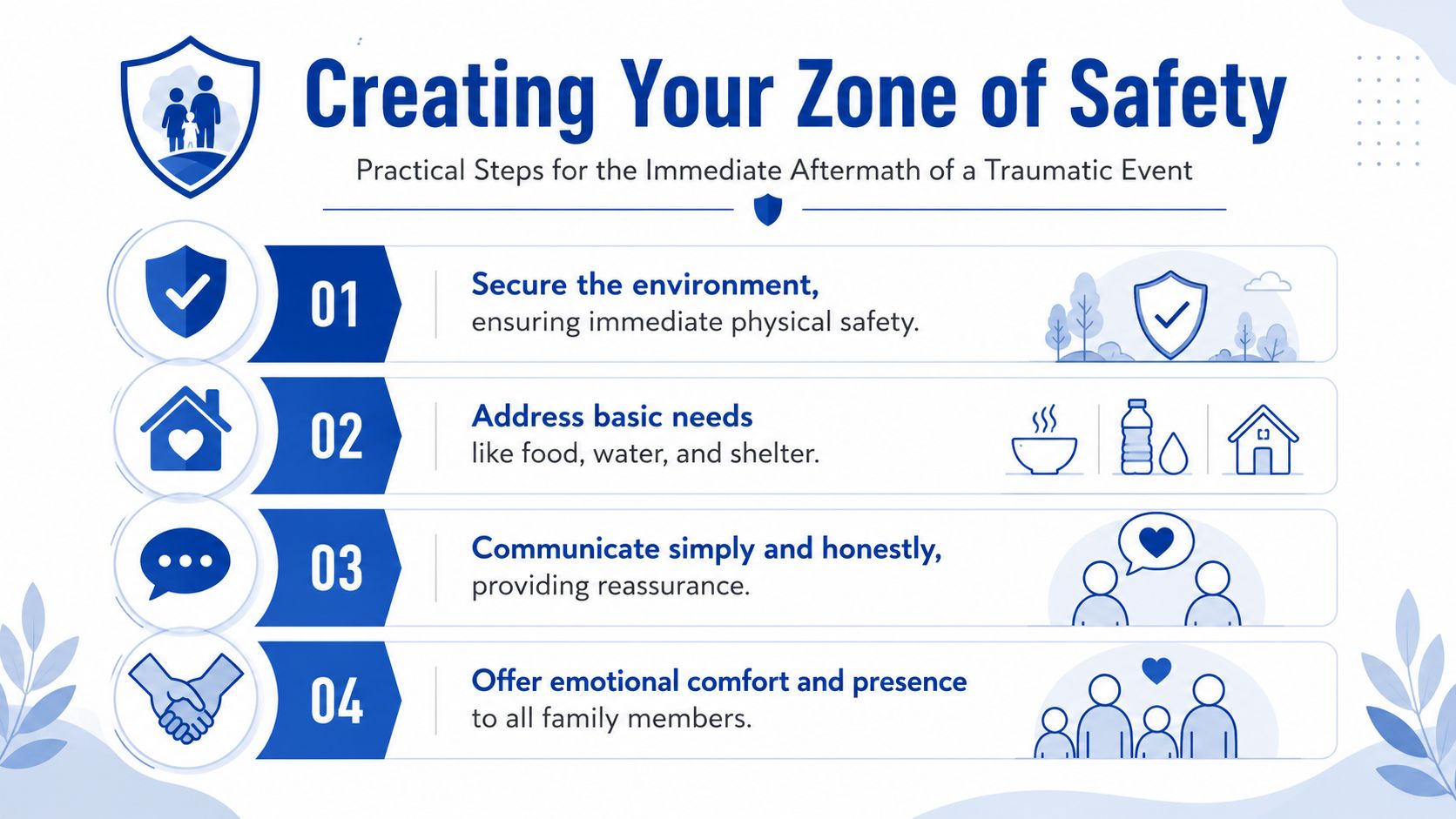
Secure the affected space
Don't treat the room or area as a normal part of the house. Restrict access. Close doors if you can do so without interfering with law enforcement instructions. Keep children, pets, and well-meaning relatives out of the space.
That protects people from two kinds of harm. The first is obvious. Potential exposure to bloodborne pathogens or other hazardous material. The second is less visible but just as real. Repeated visual exposure can intensify distress and make the event harder to process.
Stabilize the household, not the whole future
Most families do better when they stop trying to answer long-range questions on day one. Focus on a shorter list.
- Where will everyone sleep tonight
- Who has the house keys and access
- Who needs medication, food, water, or clothing
- Which adult is calm enough to make calls
- Whether the home is usable without entering the affected area
If the answer to that last question is no, make a temporary plan and stop there. You don't need a permanent solution in the middle of acute grief.
Use one point of contact
Choose one person who can field incoming communication. This should be someone organized, not necessarily the closest relative.
A single point of contact helps with:
- Family updates: Fewer repeated phone calls and fewer conflicting messages
- Agency communication: Law enforcement, property management, school staff, clergy, or employers hear the same basic facts
- Boundary protection: The most affected family members can step back from calls they're not ready to take
If your phone becomes the crisis, hand it to someone else for two hours. That simple change can lower the pressure in the entire home.
Bring in trained scene support early
Many families lose control without realizing it. They assume cleanup is a later issue, or a housekeeping issue. It isn't. Trauma scene and biohazard remediation is part of restoring safety.
A trained remediation team handles the contaminated environment, helps define what areas are restricted, and documents the work in a way that supports the next steps. That may include insurance documentation, site access questions, and decisions about whether anything can be safely recovered from the area.
Professional scene management also protects emotional bandwidth. When the environment is being handled by trained people, the family can stop staring at the room and start caring for each other.
How to Talk to Each Other When Words Fail
Silence can feel safer than saying the wrong thing. But families usually need simple language more than perfect language.

In family well-being data from King County, 78% of children lived in homes where the family demonstrated resilience during difficult times, and that resilience was closely tied to caregivers having someone to turn to for emotional support. 93% relied on a family member or close friend, and 91% relied on a spouse or partner, according to the Best Starts for Kids brief on family resilience and caregiver support.
Talking to a partner
One spouse wants details. The other can't tolerate another question. That mismatch is common.
Try shorter statements:
- “I can answer one question right now, not ten.”
- “I'm not shutting you out. I'm overloaded.”
- “Can you handle calls for the next hour while I sit with the kids?”
This kind of communication does two things. It lowers blame, and it turns vague distress into a clear request.
Talking to a teenager
Teenagers usually detect evasion immediately. They don't need every detail, but they do need honesty.
A useful approach sounds like this:
“Something very serious happened. Some parts are still being handled, and the house may not feel normal for a while. You don't need to manage this for the adults. You can ask me direct questions, and if I don't know yet, I'll tell you that.”
That gives truth without forcing them into an adult role. It also relieves them of the burden of pretending they're fine.
For families who need more age-sensitive language, the Soul Shoppe blog on child communication offers practical guidance on speaking with empathy during hard conversations.
A later conversation about trauma support can also help normalize what the family is going through. This overview of how cleanup companies provide support to affected families can help adults explain why outside help is part of care, not a sign that the family is failing.
Here's a brief resource some families find helpful when emotions and language both feel raw:
Talking to a young child
Young children need fewer words and more repetition. They need to know who is with them, what will happen next, and that their feelings won't get them in trouble.
A strong script is often simple:
- “Something very sad happened.”
- “You are safe with me.”
- “Some grown-ups are helping with the house.”
- “It's okay to feel mad, confused, quiet, or scared.”
Avoid promises you can't keep. Don't say everything will be fine if you don't know that yet. Say what is true now.
Assembling Your Professional Support Team
Families often hear “ask for help” as if it means surrendering control. In crisis work, the opposite is true. The right help lets you keep control of the decisions that matter, while trained people handle the tasks that require expertise.
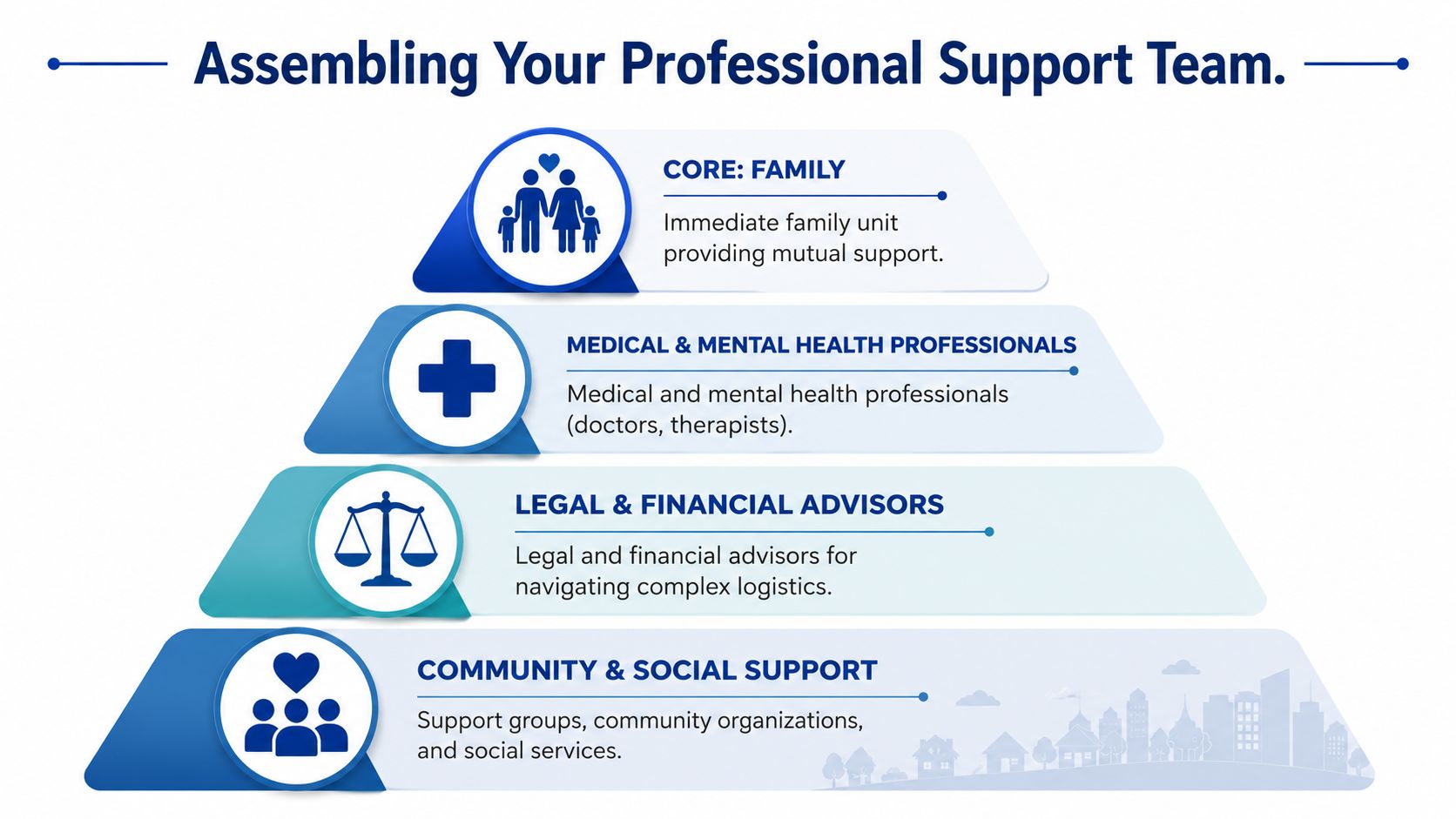
Different professionals solve different problems
Here's the trade-off many families miss. If you ask one person to do everything, that person usually becomes overwhelmed. Support works better when roles are clear.
| Support role | What they help with | What they usually should not carry alone |
|---|---|---|
| Counselor or therapist | Grief processing, trauma reactions, coping strategies | Scene safety, contamination decisions, insurance workflow |
| Victim advocate or case support contact | System navigation, communication, referrals | Biological remediation and clearance |
| Clergy or trusted community leader | Ritual, spiritual care, presence, practical coordination | Technical cleanup decisions |
| Biohazard remediation specialist | Hazard containment, removal, cleaning, documentation, discretion | Clinical grief treatment |
A family under pressure often tries to merge these roles. That's where things break down. A therapist can help with grief, but shouldn't decide whether a contaminated room is safe. A cleanup crew can restore the environment, but shouldn't be expected to replace counseling.
Why cleanup is part of emotional support
This is not optional. If a traumatic event has left biological contamination, the family needs trained remediation. The reason is safety, but the effect reaches further than safety.
Removing contaminated materials, controlling odor, documenting affected areas, and restoring the space as much as possible reduces the number of visual and sensory triggers inside the home. It also spares relatives from attempting a task that can be physically unsafe and psychologically damaging.
Field reality: Families recover better when they don't have to become the cleanup crew.
That's why a professional cleanup company belongs on the support team alongside counseling and community care. One practical resource on this point is how cleanup professionals can connect families to grief counseling resources, which reflects the fact that environmental recovery and emotional recovery often need to move in parallel.
What to look for in a remediation partner
A capable provider should be able to explain:
- Scene readiness: When work can begin, especially if law enforcement is involved
- Scope boundaries: Which areas are affected and which are not
- Documentation: What records may help with an insurance claim
- Privacy options: Whether discreet arrival is available
- Communication style: Who updates the family and how often
For example, 360 Hazardous Cleanup provides biohazard remediation, trauma scene cleaning, and insurance coordination support for families and property owners dealing with these events. That type of service is useful because it removes a technical and emotionally intense burden from the household while keeping the response structured and compliant.
Managing Logistics Without Draining Your Reserves
Paperwork can become its own form of trauma. Insurance calls, access questions, invoices, employer notifications, school communication, and family coordination all compete for the same limited energy.
The fix isn't doing more. It's reducing friction.

Build one simple records system
Use one notebook, one folder, or one shared digital note. Not three systems at once. Every time someone calls, write down the person's name, organization, date, and what they asked for.
Keep these categories separate:
- Immediate household needs
- Insurance and claim communications
- Property access or landlord issues
- Medical or death-related documents
- People who have offered help
That last category matters more than families expect. In crisis, people often say “let me know what you need.” Write the names down and assign concrete tasks later.
Protect your language on calls
When you're exhausted, it's easy to overshare. Don't try to tell the full story on every call. Give only the information needed for that purpose.
A calm script can sound like this:
“We've had a traumatic incident in the home. We're coordinating cleanup and documentation now. Please tell me exactly what you need from us today.”
That phrase keeps the conversation task-focused. It also helps stop strangers from pulling personal details out of you when you're not ready.
Delegate the administrative burden
If a remediation company can coordinate directly with the carrier, collect required documents, and explain what the insurer is asking for, that preserves family energy for higher-value decisions. It also reduces errors caused by grief and fatigue.
Families who need help understanding this process may find this guide on insurance coverage for biohazard cleanup and navigating claims with confidence useful. The key idea is simple. You should not have to become an expert in claim language while trying to absorb a loss.
A short list of what not to do
- Don't clean first and document later. Sequence matters.
- Don't let five relatives call the insurer separately. Mixed information creates confusion.
- Don't make permanent decisions during acute shock unless there is a safety reason.
- Don't accept shame for needing help with forms, calls, or access issues. Administrative work drains the same emotional reserves you need for grieving.
Finding Hope Resources for Long-Term Healing
The first days are about stabilization. The months after are different, and many families discover that support has to fit real life, not just good intentions.
A strong recovery path is rarely one single provider. It's usually a mix of counseling, practical support, trusted community connection, and a pace the family can tolerate. That matters even more for households facing language barriers, disability access issues, stigma, immigration concerns, or distrust of institutions.
Research on engaging underserved families after crisis emphasizes that effective support must be accessible, with culturally responsive communication, interpreters, trauma-aware approaches that respect privacy, and support that doesn't assume families are ready to share their story immediately, as outlined in the CADRE guide on engaging underserved families.
What good long-term support actually looks like
Not every family wants the same kind of help. Some want formal therapy right away. Some can't tolerate it yet. Some trust a faith leader first. Others need a support group where they don't have to explain the basics.
Look for help that offers:
- Language access: Interpreters or providers who can communicate directly with the family
- Flexible format: In-person, phone, or virtual options when transportation or privacy is difficult
- Trauma-aware pacing: Providers who don't force disclosure before trust is built
- Disability access: Physical access, communication accommodations, and realistic scheduling
- Community credibility: Organizations that understand the family's cultural and social context
Useful places to start
National and local options can both matter. In practice, families often do well when they combine one formal support path with one familiar community-based path.
Some people also benefit from broader caregiving communities, especially when grief overlaps with elder care, household responsibility shifts, or long-term family strain. In that situation, the Family Caregiving Kit resources can be a useful starting point for finding support-group style help and caregiver-focused guidance.
Another helpful perspective for the months ahead is this discussion of the long-term effects of trauma and the support services offered by crime scene cleanup companies. Families often feel pressure to “be done” once the home is restored. That pressure is misplaced. Environmental recovery and emotional recovery move on different timelines.
What healing often requires
Healing usually asks for repetition more than intensity. The same simple supports matter again and again. A person who returns your call. A therapist who doesn't rush you. A school counselor who understands the child's behavior has context. A faith or community contact who respects privacy. A friend who can sit in the room without forcing conversation.
The most important thing to remember is that support only counts if your family can use it. If the format, language, setting, or tone makes help harder to access, it isn't the right fit yet. Keep adjusting until support feels possible.
Healing does not depend on doing everything at once. It depends on finding the next tolerable step, then the next one after that.
You don't have to carry grief, contaminated property concerns, insurance stress, and family communication all by yourself. Those are separate burdens. They can be addressed separately, by the right people, in the right order.
When a traumatic event leaves a home unsafe or overwhelming, 360 Hazardous Cleanup can help families move through the next steps with professional biohazard remediation, discreet response, and practical guidance around documentation and insurance coordination. The goal is simple: restore safety, reduce avoidable stress, and give your family room to focus on healing.