
If you're searching for crime scene cleanup in Fresno, there's a good chance something difficult has happened very recently. You may be a family member standing outside a home, a landlord trying to secure a unit, a facility manager waiting for law enforcement to release an area, or an insurance professional trying to understand what happens next. In that moment, the biggest questions are usually simple: Is the property safe, who handles this, and how much of it will be covered?
Those questions deserve straight answers. Crime scene cleanup isn't standard cleaning, and it also isn't just about visible blood or obvious damage. It's a regulated biohazard process that can involve contaminated porous materials, odor, chemical residue, documentation, and insurance issues that many people don't discover until they're already under pressure.
What Crime Scene Cleanup in Fresno Actually Involves
When people hear “crime scene cleanup,” they often think of wiping down a surface and removing visible stains. In reality, professional biohazard remediation is a controlled safety process designed to remove contamination that may not be visible at all.
In Fresno, the need for fast response is substantial. The Fresno Police Department's Crime Scene Investigations Section had 19 technicians providing 24/7 forensic support and responded to approximately 6,200 crime scenes in 2021, while the communications center handled 418,770 9-1-1 calls and 517,043 non-emergency calls that year, according to the Fresno Police Department annual report. For families, landlords, and facilities, that means this isn't a rare edge case in a major city. It's an ongoing public-safety reality.
It's not janitorial work
A trauma or crime scene can contain blood, bodily fluids, tissue, or other potentially infectious material. Some of that contamination can travel into places people don't think to check at first, such as under flooring, into carpet padding, inside baseboards, or behind drywall.
A useful comparison is this: a qualified remediation technician works more like a surgical safety professional than a house cleaner. The job requires protective equipment, controlled work zones, careful removal methods, and lawful disposal procedures. Precision matters because the goal isn't to make a room look cleaner. The goal is to make it safe for re-occupancy.
For a broader overview of what the service includes, this closer look at crime scene cleanup helps explain why trained crews follow a very different standard than ordinary cleaners.
What the work usually includes
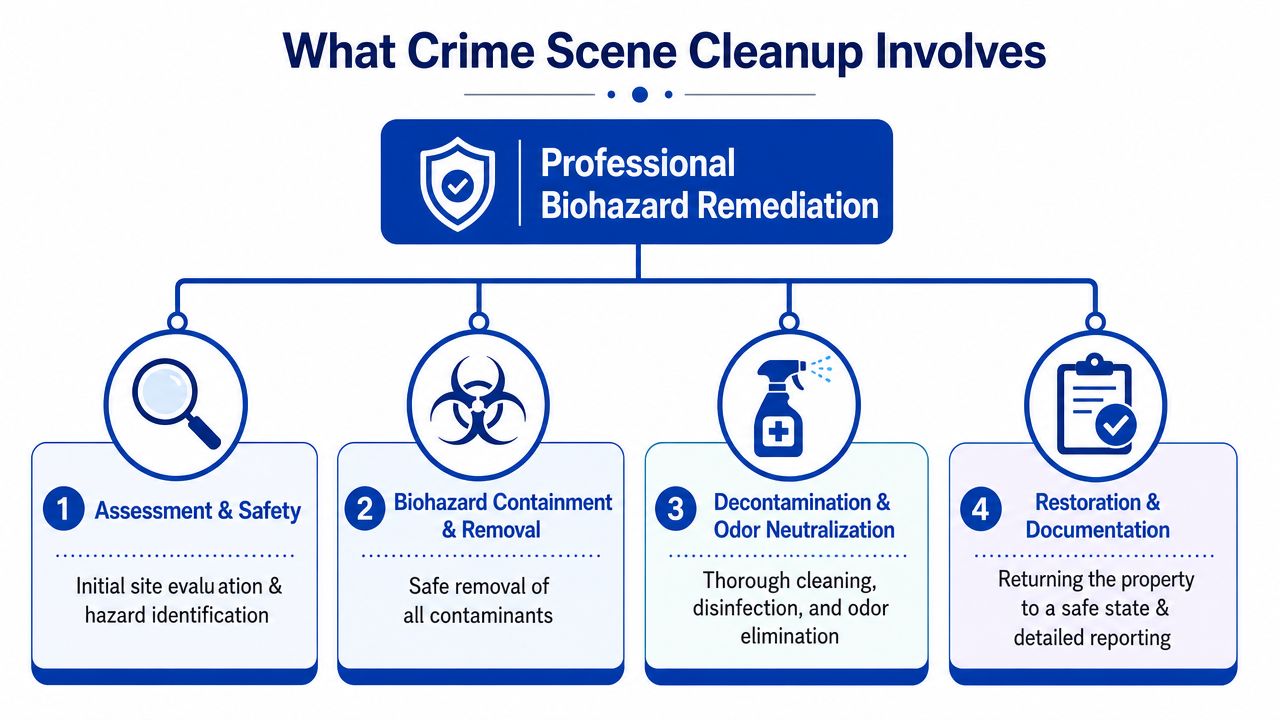
A professional response typically covers several separate tasks, not one single pass through the room:
- Site evaluation: Identifying where contamination spread, including places hidden by furniture, flooring, or building materials.
- Safety setup: Establishing controlled access so contamination doesn't move into hallways, adjacent rooms, HVAC pathways, or common areas.
- Material removal: Removing impacted porous materials when they can't be safely restored.
- Cleaning and disinfection: Treating affected non-porous or salvageable surfaces with proper methods.
- Odor treatment: Addressing odor at its source, not just masking it.
- Documentation: Recording what was affected and what was removed, which can matter for insurance and property records.
Practical rule: If contamination may have soaked into a porous material, appearance alone doesn't tell you whether it's safe.
Why families and property managers often get confused
The hardest part is that some of the risk is invisible. A room may look manageable after first responders leave. But visible appearance and biological safety are not the same thing. A property owner may also assume their regular cleaning vendor can take over, only to learn later that the work involves specialized handling and disposal requirements.
That's why crime scene cleanup in Fresno should be approached as a health, safety, and compliance issue first. Cleaning is only one part of the job. Risk reduction is the primary purpose.
Navigating Biohazard Regulations in Fresno and California
Once a scene is released, many people assume they can hire a cleaning company and move on. California doesn't treat biohazard remediation that casually. In practice, the work sits inside a web of safety rules, waste-handling requirements, and reimbursement restrictions that affect families, landlords, and commercial owners alike.
What “qualified” actually means
The most important point is that not every cleaner is equipped for trauma remediation. A provider may be good at deep cleaning and still be the wrong fit for a scene involving bloodborne risk, contaminated materials, or regulated waste.
California's Victim Compensation Board states that it may reimburse reasonable crime-scene cleanup costs up to $1,709, but only for biohazard materials, not damaged property, and only when payment goes to a provider registered as a trauma scene waste management practitioner with the California Department of Public Health, as explained on the Board's crime-scene cleanup service provider guidance. That single requirement causes confusion for many families. They may assume any invoice will qualify, when the provider's registration status can affect reimbursement.

For landlords dealing with habitability, repairs, and urgent turnover decisions, this practical guide for property owners is also useful background. It helps frame the broader responsibility side of property care, even though biohazard remediation itself requires its own specialized compliance path.
Where liability shows up
The legal risk usually doesn't come from bad intentions. It comes from shortcuts.
If an unqualified person removes contaminated materials, bags waste incorrectly, or reopens an area before it's safe, the property owner may inherit the consequences. In residential settings, that can affect family members, tenants, maintenance workers, or future occupants. In commercial settings, it can affect employees, visitors, and vendors.
Common trouble spots include:
- Improper disposal: Contaminated waste can't be treated like ordinary trash.
- Incomplete removal: Fluids may have spread below the visible surface.
- Poor documentation: Insurance carriers often need a clear record of what was affected and what was done.
- Premature re-entry: A room can look normal before it's fully remediated.
A clear explanation of the compliance side appears in this guide to biohazard remediation laws and regulations, especially for readers who need to understand why cleanup is a regulated service rather than a convenience service.
A compliant cleanup protects more than health. It also protects the owner from avoidable disputes about disposal, documentation, and whether the property was made safe in a legally defensible way.
The practical takeaway
For most Fresno property owners, the regulatory question isn't academic. It affects reimbursement eligibility, occupant safety, and potential liability after the scene is closed. If you're hiring for this kind of work, ask about registration, waste handling, documentation, and scope before anyone starts removing material.
The Professional Crime Scene Cleanup Process Step by Step
The first call is usually made when someone is tired, shaken, and trying to make decisions quickly. Knowing what happens next can lower some of that stress. A professional response follows a sequence for a reason. Each stage protects the next one.
After the initial dispatch conversation, the crew's first task is assessment. Fresno-area providers commonly advertise 24/7/365 availability, same-day response, and arrival within a few hours. One Fresno-specific listing says technicians can be at the door “in a matter of a few hours,” another says crews can arrive within 2 hours for an assessment, and a Central California provider states it has served the region since 1995 and handles about 250 decomposition cases each year, according to this Fresno area crime scene cleanup listing. That matters because many scenes can't sit unattended for long once access is available.
Step 1 begins with assessment and control
The crew identifies the affected area, confirms what kind of contamination is present, and determines whether the impact is limited to one room or extends into nearby surfaces and materials. The team then establishes boundaries so no one accidentally walks through the area and spreads contamination elsewhere.
That controlled setup can feel formal, but it's what keeps a confined problem from becoming a larger one.
The core removal stage
Professional cleanup follows a specific sequence. Technicians isolate the area, remove contaminated porous materials such as drywall, carpet padding, or subflooring that absorb fluids, and then disinfect impacted surfaces. Surface-only cleaning is usually insufficient for complete remediation, as described in this step-by-step guide to professional crime scene cleanup.
That's the part many people underestimate. If biological material has entered a porous surface, the material itself may need to be removed rather than cleaned in place.
What the full process often looks like
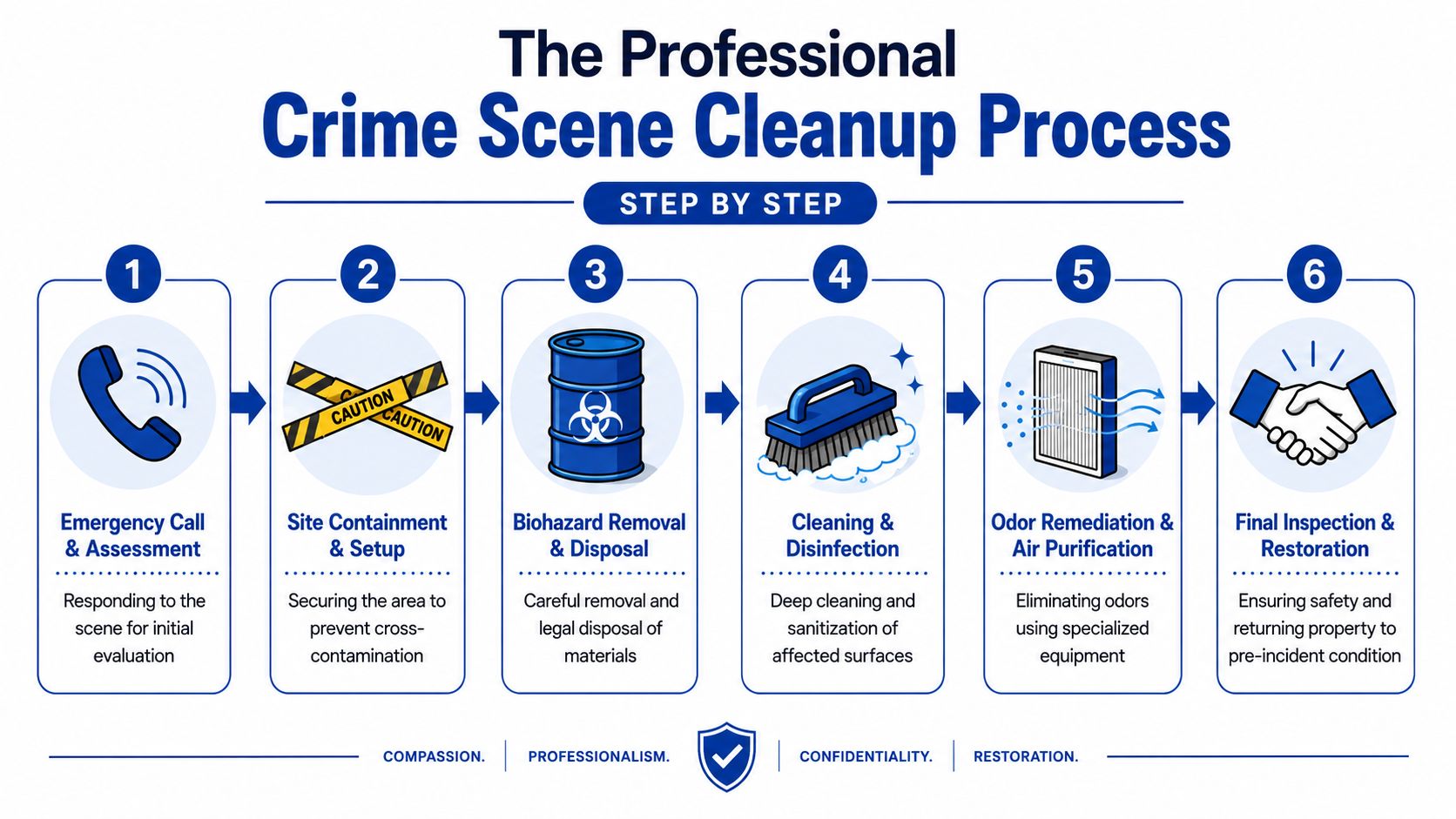
A typical service call follows this order:
Emergency intake
The company gathers basic details, confirms access, and determines whether law enforcement or other agencies have released the scene.On-site evaluation
Technicians inspect visible and likely hidden impact areas, then outline the work scope.Containment setup
Barriers, controlled access points, and protective procedures reduce cross-contamination.Removal and disposal
Unsalvageable contaminated materials are removed and handled through proper waste procedures.Detailed cleaning and disinfection
The crew treats salvageable surfaces and works through the affected zone methodically.Odor remediation and verification
Source-based odor treatment and final quality checks help determine whether the area is ready for re-entry.
Here's a visual walkthrough of that sequence:
For readers who want a plain-language version of the workflow, this step-by-step biohazard cleanup process guide is a useful companion.
What you should expect from the crew
You should expect clear communication, a defined work zone, and a realistic explanation of what can be saved and what can't. You should also expect the answer to change once damaged materials are opened up. Hidden spread is common in trauma scenes.
If a technician says a surface looks clean but still needs further treatment or removal, that usually reflects experience, not upselling.
Scenarios Requiring Specialized Cleanup in the Fresno Area
“Crime scene cleanup” is a narrow phrase for a much wider category of emergency remediation. In Fresno, the calls that require this work often involve very different conditions, and each one creates its own safety and occupancy problems.
When the challenge is decomposition
An unattended death is one of the situations families and property managers struggle to picture until they're facing it. The issue isn't only emotional. Decomposition can affect flooring, subflooring, furniture, surrounding contents, and odor conditions in ways that are difficult to resolve without specialized removal and decontamination.
That kind of call is not unusual in the broader region. A Central California provider states it handles around 250 decomposition cases annually, which highlights how often this category appears in real operations, as noted in the earlier Fresno-area service listing.
When the scene involves trauma or violence
Homicide, suicide, and severe accidents often leave visible contamination, but the hidden impact may matter more. Blood can travel farther than people expect, particularly around seams, grout lines, trim, and absorbent materials.
For a family, this is usually the most overwhelming type of call because the room still carries the event. For a landlord or employer, the pressure often comes from needing to secure the property while also respecting privacy and preserving documentation.
Nontraditional situations that still need expert cleanup
Some of the most misunderstood calls don't look like classic “crime scenes” at all.
- Industrial incidents: A workplace accident may involve bodily fluids, damaged materials, and the need to protect employees before reopening.
- Hoarding environments with biohazards: Cleanup can involve sharp objects, waste, odor, contamination, and difficult salvage decisions.
- Drug-related contamination: Residue concerns can turn an apparently minor cleanup into a specialized decontamination job.
- Vehicle contamination: Cars, fleet vehicles, and transport vans can require confined-space remediation.
For properties where drug residue may be a concern, this resource on fentanyl exposure and certified cleanup teams is worth reviewing because it addresses a risk many owners underestimate.
Why response speed matters in these cases
Fresno-area providers position this service as emergency work, with 24/7/365 availability and arrival within a few hours for incidents such as homicide, suicide, and decomposition, according to the earlier Fresno area listing. That quick mobilization matters because the next decision is often tied to safety, access, and whether other people might enter the space.
Different incidents create different hazards, but the common rule is simple. If the scene includes biological contamination, unknown residue, or a question about safe occupancy, treat it as specialized remediation.
Understanding Costs Insurance and How to Choose a Provider
The cost question usually arrives before the shock has worn off. Families ask because they're trying to keep up with funeral arrangements, missed work, and immediate housing concerns. Property managers ask because every day of delay can affect residents, leases, and repairs. Insurers ask because scope and documentation determine what happens next.
What usually drives the price
There isn't a single standard fee for crime scene cleanup in Fresno. The price depends on conditions at the property.
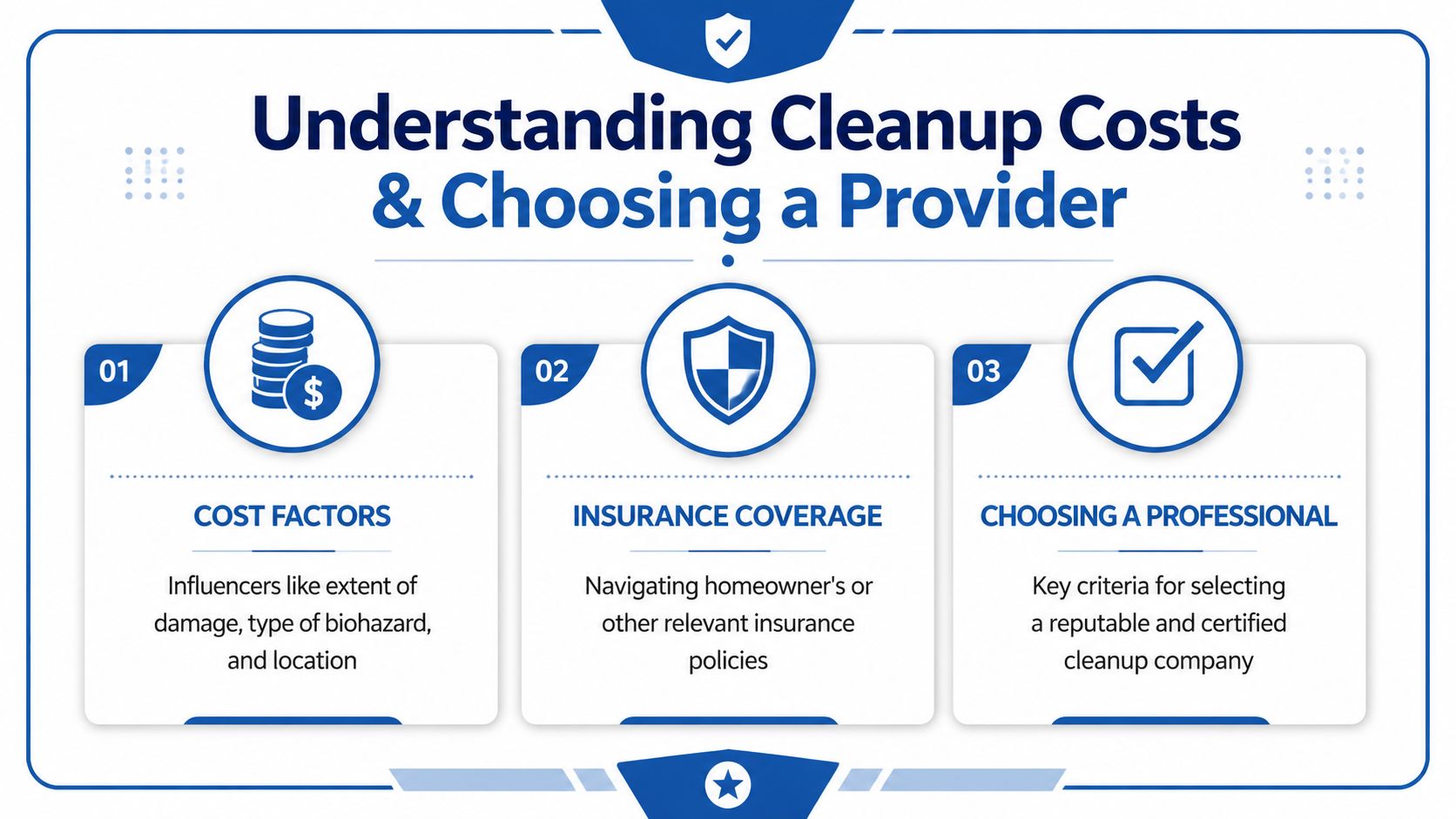
A few of the variables include:
- Extent of contamination: A localized incident is different from one that affected several rooms or traveled beneath surfaces.
- Type of material affected: Carpet, drywall, padding, insulation, and subflooring may need different treatment decisions.
- Access conditions: Apartments, upper floors, occupied properties, and commercial sites can complicate setup and removal.
- Additional hazards: Odor, decomposition, chemical residue, or drug-related contamination can change the scope.
- Documentation and coordination needs: Insurance, management approvals, or multi-party communication can add complexity.
The part many people don't learn until too late
California's Victim Compensation Board may reimburse crime-scene cleanup costs, but the cap is $1,709, and payment is limited to a provider registered with the California Department of Public Health. The Board also limits reimbursement to biohazard materials rather than damaged property, as stated in the earlier state guidance. For many families and owners, that means state assistance may help, but it may not close the full gap.
That's why the insurance conversation matters so much. People often assume “crime scene cleanup” is broadly covered. Sometimes it is. Sometimes coverage is narrower than expected, tied to the cause of loss, the policy language, the property type, or the difference between remediation and repair.
Financial reality: The biggest problem after a scene isn't always finding a crew. It's finding out that the claim process is narrower and slower than you expected.
For households already trying to estimate related end-of-life expenses, this funeral cost calculator, how much does a funeral cost, estimate f can help build a broader planning picture during an already difficult week.
How to choose a provider without making the situation worse
When you're comparing providers, ask direct questions. You're not looking for a sales pitch. You're looking for a company that can do the work safely and document it properly.
A good screening checklist includes the following:
| What to ask | Why it matters |
|---|---|
| Are you qualified for trauma and biohazard remediation? | General cleaning experience isn't the same as regulated biohazard work. |
| How do you handle waste disposal and documentation? | Those records may matter for both compliance and insurance. |
| Can you explain what is cleanup versus repair? | Biohazard remediation and reconstruction are not always the same scope. |
| Do you coordinate with insurers? | Claims often move more smoothly when the provider can supply clear scope details. |
| Do you handle non-blood contamination too? | Some scenes involve chemical or drug residue, not just bodily fluids. |
| Can you respond quickly once the site is ready? | Time matters for occupancy, odor control, and property security. |
One option families and property owners sometimes consider is 360 Hazardous Cleanup's insurance guidance resource, which explains how cleanup claims are typically discussed with carriers and where misunderstandings often happen.
A practical way to think about the decision
Don't choose based on speed alone, and don't choose based on the lowest number if the scope is unclear. A cheaper quote can become more expensive if the provider misses contaminated materials, can't support the claim file, or leaves the owner to sort out compliance questions later.
The right provider should be able to explain the work in plain language, distinguish remediation from rebuilding, and help you understand what may or may not be recoverable.
Frequently Asked Questions About Fresno Cleanup Services
Will my neighbors or tenants know what happened
Not necessarily. Many clients ask for discretion, especially in multifamily housing, commercial buildings, or tightly connected neighborhoods. The most practical step is to ask the company how they handle arrival, site access, and communication with occupants or staff. Clear planning matters more than assumptions.
If you manage a property, limit the number of people who enter the area and route questions through one decision-maker. That reduces confusion and protects privacy.
Is the property safe right after the crew leaves
It should only be reoccupied when the affected area has completed the full remediation process and the provider indicates it's ready. The key issue is not whether the room looks normal. The key issue is whether the contamination has been properly removed, treated, and verified according to the scope of work.
If part of the structure needs repair after contaminated material is removed, the area may be biologically safe but not yet fully restored. Those are different milestones.
What if the contamination isn't blood
That's one of the most important questions in crime scene cleanup in Fresno. Some scenes involve tear gas, pepper spray, and fingerprint powder, and those residues may require specialized decontamination before a property is ready for re-occupancy, as described on this Fresno biohazard cleaning service page covering adjacent hazards.
In other words, a scene can be legally released and still not be functionally ready for occupants. Chemical residue, odor, and mixed-hazard conditions can continue affecting the property after visible evidence is gone.
What should I do while waiting for the cleanup crew
Follow the simplest safety rule first. Keep people out of the area.
Use this short checklist:
- Do not touch materials: Don't handle flooring, bedding, furniture, or personal items from the affected area.
- Keep access limited: Prevent children, tenants, staff, or maintenance workers from entering.
- Avoid ordinary cleaning attempts: Mops, household sprays, and shop vacs can spread contamination rather than remove it.
- Document only if needed: If insurance or ownership records require photos, take them carefully and from a distance if it's safe to do so.
- Wait for release and instruction: If law enforcement or another agency is involved, follow their direction before allowing entry.
Can personal belongings be saved
Sometimes yes, sometimes no. Non-porous items may be candidates for cleaning, while porous items that absorbed contamination often can't be safely restored. The answer depends on what was exposed, how long it remained there, and what the item is made of.
People often need an honest, calm explanation rather than false reassurance. A qualified crew should tell you what appears salvageable, what doesn't, and why.
Who usually needs this service besides families
A wide range of Fresno clients may need it, including landlords, apartment managers, hospitals, clinics, behavioral health facilities, industrial sites, insurers, and public agencies. The common factor is not the property type. It's the presence of contamination, occupant risk, or uncertainty about safe re-entry.
What's the first question I should ask when calling
Ask whether the company handles your specific type of contamination and what they need to know before dispatch. That keeps the conversation grounded in scope, safety, and next steps instead of generic promises.
If you're facing a difficult scene and need calm, factual guidance, 360 Hazardous Cleanup provides 24/7 biohazard remediation support, including trauma scene cleanup, unattended death cleanup, tear gas remediation, insurance coordination, and compliant handling of hazardous materials so families, property managers, and facility operators can move toward a safe next step.