Commercial mold remediation cost can start around $2,000 to $5,000 for smaller jobs, while larger projects often land around $30,000 to $50,000, and major commercial losses can climb much higher. In more complex environments, a common benchmark is $15 to $35 per square foot, which means a substantial event can move into the tens or hundreds of thousands of dollars fast.
If you're reading this after a roof leak, plumbing failure, HVAC complaint, or failed indoor air quality check, you're probably trying to answer two questions at once. First, what will this cost? Second, how much risk do we take on if we handle it badly or wait too long?
That's the right way to think about it. Mold in a commercial property isn't just a cleaning issue. It affects occupant safety, reopening decisions, insurance documentation, vendor coordination, and in many buildings, your legal exposure if employees, tenants, patients, or visitors are still using the space.
The hard part is that the invoice rarely reflects the full cost of the problem. Business interruption, staff displacement, emergency repairs, after-hours access, tenant communication, and proof-of-clearance work often matter just as much as the physical removal itself. A cheap scope can become the expensive choice if it leaves hidden growth in wall cavities, ductwork, insulation, or other assemblies.
Your Guide to Navigating Commercial Mold Remediation
A facility director usually doesn't discover mold under ideal conditions. It shows up after a complaint, during a renovation opening, behind vinyl wallcovering, above ceiling tile, or inside an air handler that should've been dry. By the time someone calls for pricing, they're often balancing operations, safety, and pressure from leadership to get the building back online.
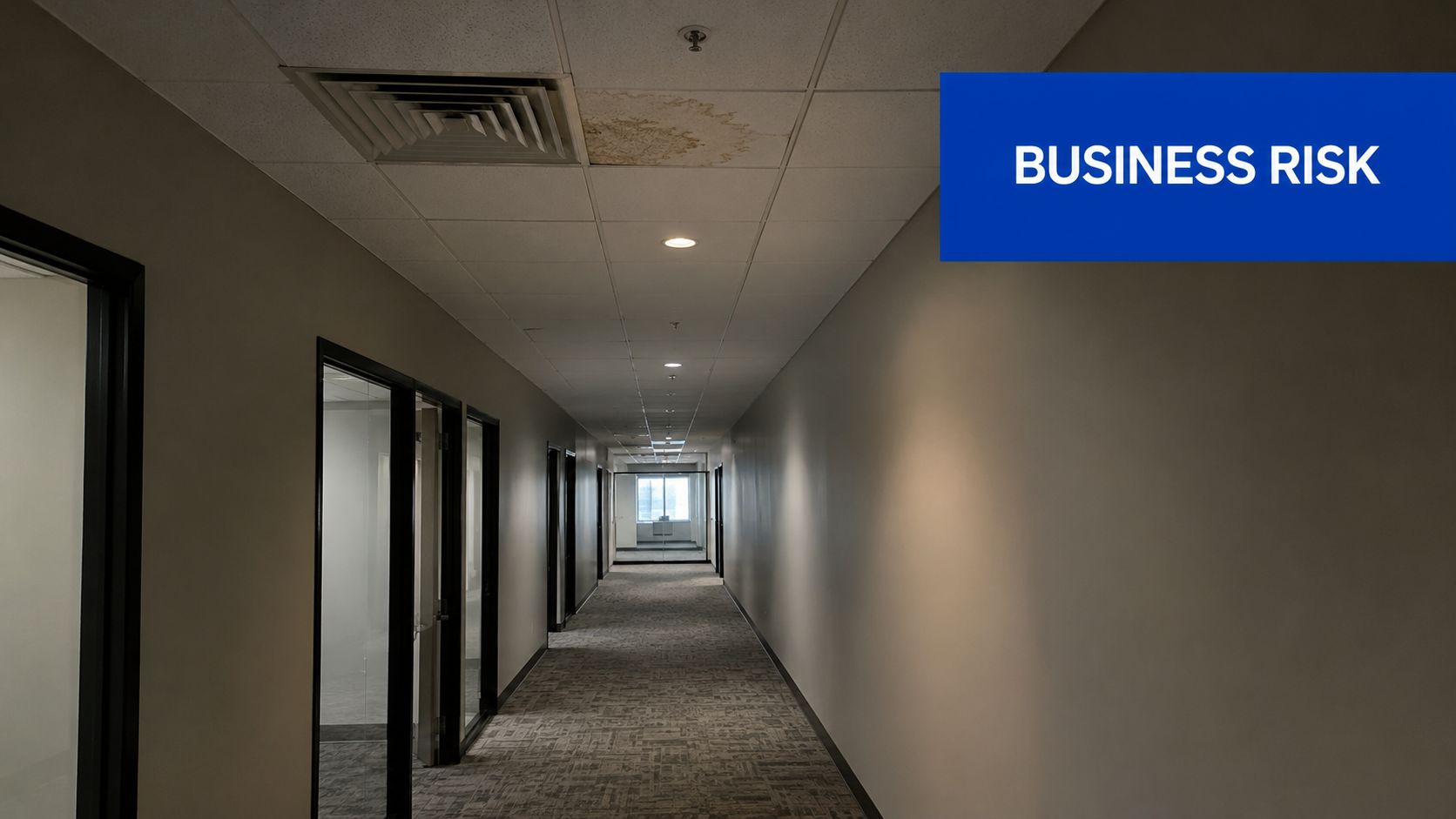
The first useful shift is to stop treating the job as a janitorial line item. Mold remediation is a risk-control project. The scope has to address the visible contamination, the moisture source, the pathways that let spores spread, and the documentation that shows the space can be reoccupied responsibly.
That larger context helps explain why demand for professional containment and cleanup continues to rise. The global Mold Remediation Service Market was valued at USD 1,395.2 million in 2026 and is projected to reach USD 1,848.4 million by 2033, reflecting a 4.1% CAGR, according to Coherent Market Insights on mold remediation service market projections.
What capable buyers do first
The smartest commercial clients usually start with three actions:
- Stabilize the moisture issue: Stop the leak, condensation source, or intrusion path before anyone argues about cleanup method.
- Control exposure: Restrict access to the affected area until someone defines whether simple isolation or full containment is needed.
- Document conditions early: Photos, maintenance logs, leak history, and occupant complaints become valuable once insurance, legal, or compliance questions appear.
Field reality: The visible mold is often the smallest part of the job. The expensive part is proving where contamination did and did not travel.
If you want a simple companion resource on the water-to-mold chain, EZ Plumbing on mold removal gives a useful owner-level overview. It won't replace a site-specific scope, but it helps frame why moisture control and removal have to be planned together.
Understanding Commercial Mold Remediation Pricing Models
Most commercial buyers see pricing presented in one of two ways. The contractor either quotes a per-square-foot rate or issues a fixed project bid based on scope, containment, access, demolition, and restoration conditions. Both models can be legitimate. Problems start when a buyer assumes they mean the same thing.
Per-square-foot pricing
Per-square-foot pricing works best when the affected footprint is reasonably defined and the level of work is consistent across the area. It gives procurement teams a fast benchmark and makes it easier to compare one space to another.
A widely used benchmark for commercial mold remediation is $15 to $35 per square foot for complex environments, while more standard projects are often closer to $10 to $25 per square foot, according to TSIAC International's commercial mold cost guide. That same guide notes that a 5,000-square-foot contamination could range from roughly $50,000 to $125,000 in standard conditions and $75,000 to $175,000 or more when access is difficult or contamination is embedded in assemblies.
A rate like that usually reflects more than wiping surfaces. It often accounts for containment barriers, negative-air control, HEPA filtration, labor-intensive demolition, bag-out procedures, cleaning of adjacent impacted materials, and site protection.
Fixed project bids
A fixed bid is more common when the affected area isn't easy to measure cleanly. Think concealed wall cavities, ceiling plenums, duct runs, interstitial spaces, elevator equipment rooms, or mixed-use occupied buildings where access windows drive labor.
A solid fixed bid should answer these questions:
| Quote item | What it should clarify |
|---|---|
| Containment plan | What areas will be isolated and how |
| Removal scope | Which materials will be cleaned, removed, or replaced |
| Drying and filtration | What equipment will run and for how long |
| Verification steps | How the contractor documents completion |
| Exclusions | What is not included, especially reconstruction |
If a proposal gives one round number with little detail, you're not looking at simplicity. You're looking at hidden assumptions.
For buyers who want to understand what transparent line-item scoping should look like in a hazardous cleanup context, this discussion of transparent pricing and trust is a useful lens. The principle is the same in mold work. The clearer the scope, the fewer surprises later.
Why two quotes can be far apart
The cheapest quote may assume surface cleaning. The higher quote may assume controlled demolition, off-hours work, disposal, final cleaning, and verification support. Those aren't minor differences. They're different jobs.
A low number often buys a narrow scope. A complete scope costs more because it reduces the odds that you'll reopen into a second round of contamination.
Key Factors That Drive Your Remediation Budget
A facility director usually calls about price after the first sighting on drywall or ceiling tile. A budget problem often shows up later, when the affected area reaches supply ducts, occupied suites, tenant improvements, or records storage and the project shifts from cleanup to business continuity and risk control.
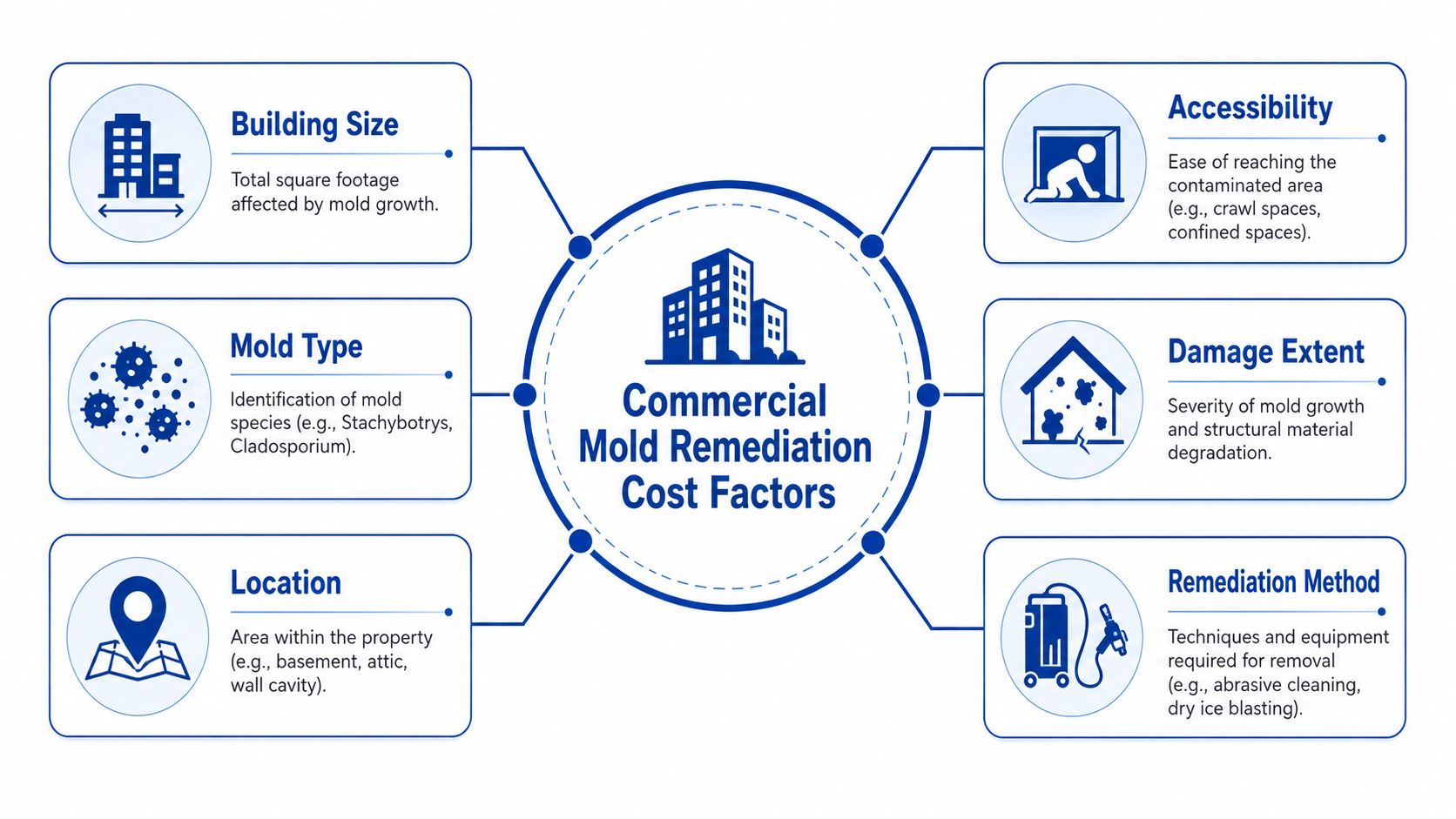
Size matters, but depth matters more
Square footage sets the starting point. Material condition, moisture history, and how far contamination has moved usually decide the final number.
Two properties can report the same affected area and land in very different budget ranges. Surface growth on cleanable, non-porous material is one scope. Wet drywall, insulation, wood framing, built-ins, and hidden chases create another scope entirely because crews have to open assemblies, remove porous material, bag debris under containment, and keep contamination from spreading during demolition.
The cost difference comes from labor intensity, waste handling, drying time, and how much of the building has to be protected while the work happens. In practice, that also means higher soft costs for management attention, occupant communication, and delayed reopening if the source moisture was active longer than anyone realized.
Infrastructure contamination changes the job
Once mold reaches building systems, budgets rise quickly because access, sequencing, and verification get harder.
The U.S. Environmental Protection Agency's mold guidance for schools and commercial buildings notes that contaminated HVAC systems can spread mold throughout a building and should be addressed as part of the remediation scope, as explained in the EPA mold remediation guidance for schools and commercial buildings. That is why a problem that starts in one room can become an operational issue for an entire floor or air distribution zone.
Common budget drivers include:
- HVAC involvement: Duct lining, air handlers, diffusers, and internal insulation can require specialized cleaning, component removal, or shutdown coordination.
- Porous material loss: Drywall, ceiling tile, insulation, carpet pad, and some casework often cost more to remove and replace than to attempt to clean.
- Restricted access: Healthcare spaces, labs, food production areas, data rooms, and occupied offices require tighter infection control, scheduling, and documentation.
- Source repair and rebuild separation: Remediation may solve contamination, while plumbing repairs, envelope work, and reconstruction sit in different contracts and different budgets.
- After-hours production loss: Night work, phased access, and temporary relocation reduce disruption but raise labor and project management costs.
For a broader look at how a moisture incident expands beyond visible staining, hidden water damage risks that include mold, bacteria, and structural issues gives useful context for what owners are paying to prevent.
Here's a practical explainer before the next point:
Compliance and proof now affect pricing
Commercial remediation budgets include more than removal. They often include the records and controls needed to defend the decision later with leadership, insurers, tenants, regulators, or counsel.
The New York City Department of Health mold guidelines state that remediation plans should account for worker protection, containment, cleanup methods, and correction of the underlying water problem, as outlined in the NYC Department of Health guidelines on assessment and remediation of fungi in indoor environments. In commercial work, that translates into line items for moisture mapping, condition documentation, negative air, work logs, clearance coordination, and communication with affected occupants.
Those items add cost, but they also reduce larger losses. A cheaper project that skips documentation, weakens containment, or leaves damp material in place can trigger tenant complaints, failed post-remediation verification, repeat mobilization, and longer downtime. For many owners, that second round costs more than doing the first round correctly.
How to Evaluate Quotes and Identify a True Professional
Commercial buyers often receive estimates that differ so much they seem to describe different buildings. In many cases, that's exactly what's happening. One quote prices visible staining. Another prices the actual risk.
Green flags in a commercial proposal
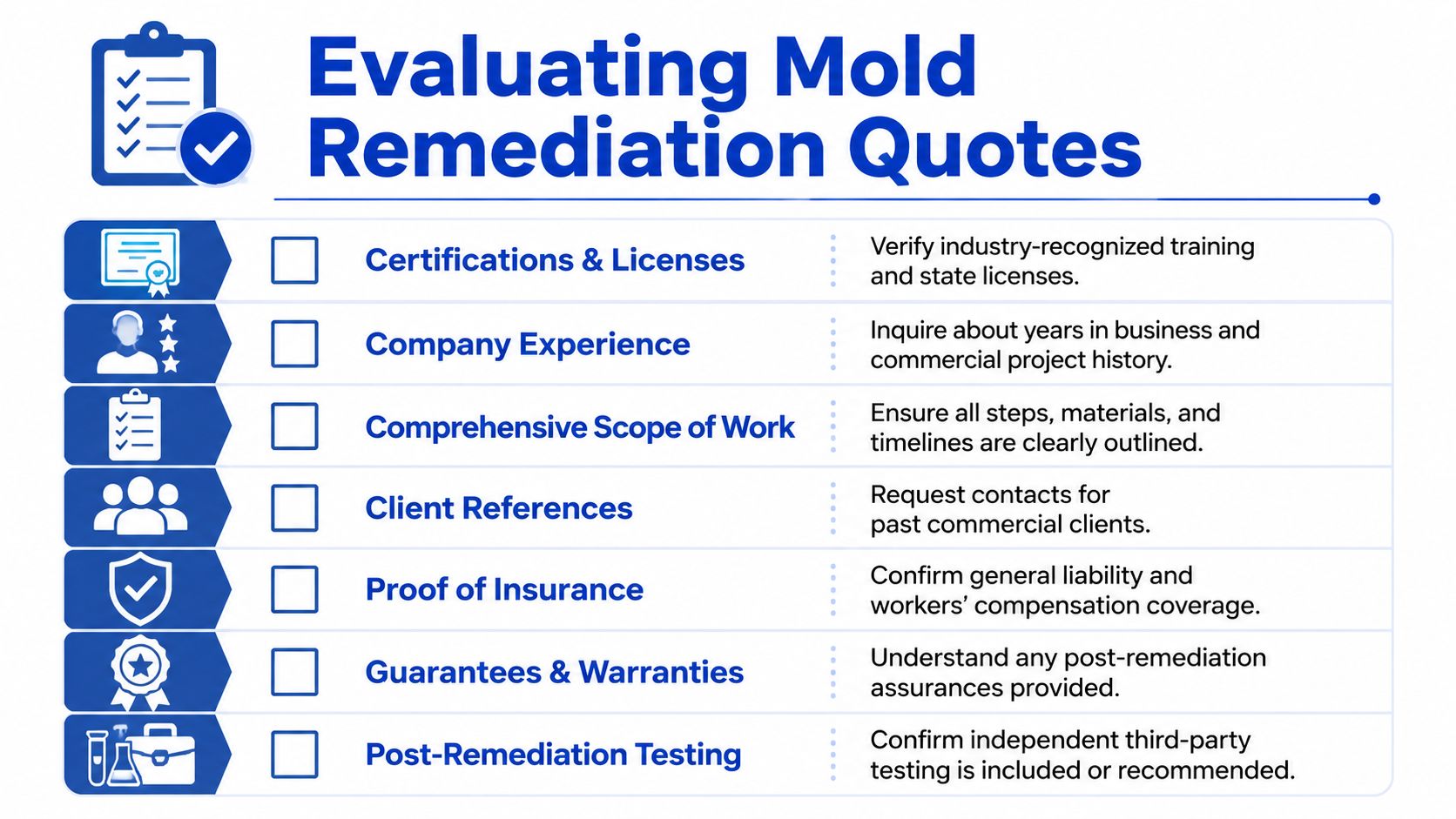
A professional quote should describe the work in enough detail that your facilities team, safety lead, insurer, and leadership can all understand what's being purchased.
Look for these signs:
- Defined containment language: The proposal should state how affected areas will be isolated and how cross-contamination will be controlled.
- Material-specific scope: It should distinguish between cleaning, removal, disposal, and reconstruction exclusions.
- Documentation plan: The contractor should explain how they'll record conditions, progress, and completion.
- Operational coordination: In occupied facilities, the quote should address access windows, after-hours scheduling, and communication needs.
Post-2024 pricing is increasingly influenced by stricter compliance and diagnostic requirements. Older cost guides often miss that many current budgets need to include detailed sampling, moisture mapping, and containment verification to prove a building is safe, as explained in FDP Mold Remediation's discussion of modern cost pressures.
That's one reason higher quotes are sometimes more responsible quotes. They may include the proof package your legal, risk, or insurance team will ask for later.
Red flags that usually get expensive later
A weak quote often sounds attractive because it avoids uncomfortable details. That's exactly the problem.
Watch for:
- Vague language: “Treat affected area” without describing methods, materials, or containment is not a real scope.
- No mention of verification: If the proposal ends with cleaning and says nothing about confirming completion, expect disputes.
- No insurance or licensing information: Commercial work needs more than a business card and a fogger.
- No exclusions list: If reconstruction, consultant testing, or hidden conditions aren't addressed, change orders are likely.
Practical rule: If you can't tell where the contractor believes the contamination begins and ends, you can't tell what they'll stand behind.
If you're comparing providers and want a practical benchmark for what to ask, this guide to evaluating mold remediation companies can help structure the conversation. One factual example in that category is 360 Hazardous Cleanup, which states that it provides detailed assessments to inform mold remediation quotes for commercial properties.
Navigating Insurance Claims for Mold Damage
Insurance questions usually turn on one issue. What caused the mold? A sudden covered water event may be treated very differently from a long-term maintenance problem, chronic humidity issue, or deferred repair.
That means the claim often succeeds or struggles before remediation even begins. If the origin story is weak, the file gets harder. If the timeline, moisture source, and affected areas are documented clearly, the carrier has a better basis to evaluate the loss.
What to gather immediately
When a commercial mold issue appears, collect evidence before conditions change:
- Photos and video: Capture the affected areas, leak source, wet materials, and any visible spread.
- Maintenance records: Pull work orders, roof reports, plumbing calls, HVAC service notes, and tenant complaints.
- Incident timeline: Record when the problem was first noticed, who responded, and what emergency steps were taken.
- Professional findings: Independent assessment and remediation documentation often become central to the claim file.
For a plain-language overview of how commercial property policies often approach covered losses, exclusions, and endorsements, the Professional Insurance Advisors guide to commercial property insurance coverage is a helpful reference.
Where remediation support matters
A capable remediation contractor doesn't replace your broker, adjuster, or legal counsel. But they can make the claim process cleaner by producing organized site records, photos, containment descriptions, and scope documentation that align with what carriers ask for.
That support becomes especially important when the dispute isn't whether mold exists, but whether the response was timely, reasonable, and tied to a covered event. In those situations, sloppy records can cost more than the cleanup itself.
If your team is trying to understand the claim side of hazardous cleanup in practical terms, this article on insurance coverage and claim navigation lays out the documentation mindset well.
The Remediation Process and Managing Business Disruption
The direct cleanup invoice is only part of the commercial mold remediation cost. The larger operational question is how much of the building you can keep functioning while the work happens.
Most projects move through a predictable sequence, but the disruption profile changes based on occupancy, infection-control requirements, production schedules, and whether contamination sits in public-facing or mission-critical areas.
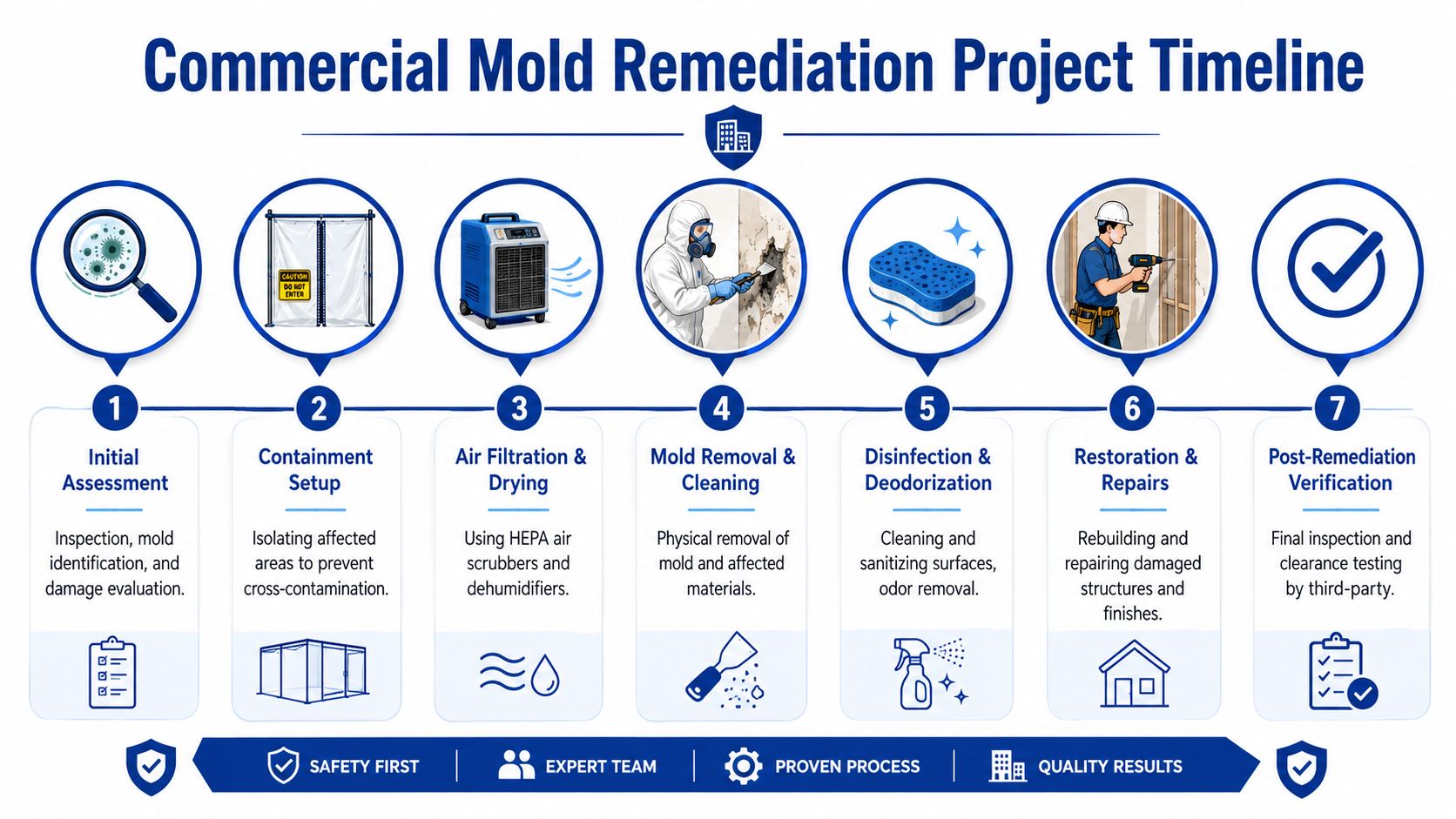
What the project usually looks like
A typical commercial job starts with inspection and scope confirmation. Then crews build containment, establish air control, remove or clean affected materials, and complete detailed cleaning before any final verification steps happen.
In an occupied building, the sequencing matters as much as the remediation method. Work might be split by suite, department, wing, or after-hours access window to keep the rest of the operation moving.
In commercial settings, the best project isn't the one with the lowest initial number. It's the one that solves the problem while protecting operations, documentation, and re-entry decisions.
Where disruption grows
Not every phase creates the same level of interruption. These are the moments that usually affect operations most:
| Project phase | Typical operational concern |
|---|---|
| Containment setup | Restricted access, rerouted traffic, noise |
| Demolition and removal | Occupant separation, dust control, waste handling |
| HVAC isolation or cleaning | Airflow changes, comfort complaints, scheduling constraints |
| Final clearance coordination | Delayed reopening if records or consultant signoff lag |
What works is early communication. Tell tenants, staff, or department heads what areas are restricted, what systems are affected, and what “safe to occupy” means in your process. What doesn't work is informal messaging that leaves people filling in the gaps themselves.
For a deeper operational view, this commercial building mold remediation guide is useful for planning around occupancy, sequencing, and re-entry.
Frequently Asked Questions About Remediation Costs
Is post-remediation verification really necessary
A facility director approves the cleanup, reopens the area, and then gets questions from tenants, HR, legal, or an insurer asking one simple thing: what proves the space was brought back to an acceptable condition?
In many commercial settings, post-remediation verification is the document trail that answers that question. It helps support re-occupancy decisions, shows that the work hit a defined endpoint, and reduces arguments later if a claim, complaint, or lease dispute surfaces. The testing cost is usually small compared with the cost of reopening too early and having to explain or repeat the job.
Can in-house maintenance handle part of the cleanup to save money
Sometimes, but the savings are usually on the front end only.
Maintenance staff are often the right team for the first response. They can shut down water, document conditions, open access, and help control the source. Once the work involves containment, negative air, selective demolition, handling contaminated materials, or clearance documentation, the risk profile changes. At that point, using a qualified remediation contractor is usually the lower-cost decision over the life of the incident because it reduces spread, rework, and liability exposure.
I have seen partial in-house cleanup turn a manageable room-level loss into a multi-area project. Disturbing mold without controls can affect adjacent spaces, contents, and HVAC pathways.
Why are some projects dramatically more expensive than others
Because price follows scope, complexity, and consequence.
A small, isolated issue in a storage area is one type of job. A loss that affects occupied offices, healthcare space, food production, tenant suites, or air handling systems is a different class of project entirely. Costs rise fast when the work requires night shifts, phased containment, third-party oversight, specialized disposal, detailed documentation, or reconstruction coordination.
The visible mold is rarely the whole bill. The larger financial exposure often comes from downtime, temporary relocation, delayed reopening, employee complaints, lease friction, and the need to prove the problem was handled correctly.
What's the long-term cost of waiting on a smaller mold issue
Waiting usually increases both the remediation scope and the business risk.
Moisture problems keep feeding the condition until the source is corrected. Materials degrade, adjacent assemblies can become involved, and the timeline gets harder to document. That matters if an insurer reviews late notice, if a tenant claims the issue affected operations, or if leadership wants to know why a limited repair turned into a major capital event.
Small mold problems are often cheapest when handled early. Large mold losses are expensive partly because they stayed active long enough to affect operations, records, and confidence in the building.
If you need a clear scope before the problem gets more expensive, 360 Hazardous Cleanup provides commercial mold remediation support with detailed assessments, documentation, and coordination that help owners make informed decisions about risk, compliance, and reopening.