Effective bloodborne pathogen exposure prevention is not a single action but a multi-layered system of safety. A truly comprehensive strategy combines engineering controls, meticulous work practices, personal protective equipment (PPE), rigorous training, and a formal Exposure Control Plan (ECP). The primary objective is to create a work environment where the risk of transmitting diseases like HIV, Hepatitis B, and Hepatitis C is systematically minimized, ensuring the health and well-being of every team member.
The Foundation: A Comprehensive Exposure Control Plan

An Exposure Control Plan (ECP) is the cornerstone of any effective safety program, not merely a document for compliance. It is a living, operational guide that details precisely how an organization protects its employees from bloodborne pathogens.
A generic template is insufficient. The potential hazards in a dental office are fundamentally different from those at an industrial accident site or a long-term care facility. An effective ECP is built upon a realistic, site-specific hazard assessment that identifies genuine risks. This analysis is the foundation for every other safety measure implemented.
Non-Negotiable Elements of a Compliant ECP
OSHA regulations are unequivocal about the requirements for an ECP. It must be a written document, readily accessible to all employees, and reviewed annually—or whenever new tasks or procedures alter exposure risks. It is a dynamic strategy, not a static file.
The plan is a set of mandatory protocols, not a collection of suggestions. It must clearly delineate the specific controls and procedures used to ensure employee safety.
To meet OSHA standards, your ECP must incorporate several essential components. We have summarized the core requirements here to provide a clear roadmap for compliance and protection.
Core Components of an OSHA-Compliant Exposure Control Plan
| Component | Key Objective | Practical Example |
|---|---|---|
| Exposure Determination | Identify all job roles and tasks with potential for exposure. | Listing not just paramedics but also the technicians responsible for decontaminating the ambulance interior after a transport. |
| Methods of Compliance | Detail the specific controls used to prevent contact. | Mandating the use of needleless IV systems and requiring puncture-proof sharps containers in all patient care areas. |
| Hepatitis B Vaccination | Ensure at-risk employees are offered the vaccine at no cost. | Implementing a clear process for new hires to receive the vaccine series and maintaining official declination forms for those who refuse. |
| Post-Exposure Protocol | Outline immediate steps following an exposure incident. | A step-by-step guide detailing an employee's immediate actions after a needlestick, including who to notify and where to seek medical evaluation. |
| Recordkeeping | Maintain meticulous documentation of all safety activities. | Keeping a detailed sharps injury log and records of all employee BBP training sessions, including dates and attendees. |
These elements are the bedrock of a plan that meets regulatory scrutiny and, more importantly, keeps your team safe. For those developing these procedures, mastering a standard operating procedure template can provide a solid framework for building out these sections with clarity and consistency.
Why a Proactive Plan Is Critical
The stakes are exceptionally high. The World Health Organization estimates that 3 million healthcare workers experience occupational exposure to bloodborne pathogens annually. These statistics represent thousands of preventable infections that can have life-altering consequences.
A strong Exposure Control Plan transforms safety from a reactive measure into a proactive culture. It demonstrates a commitment to employee well-being that goes beyond mere compliance, building trust and resilience within your team.
A well-crafted plan does not wait for an incident to occur; it anticipates risks. By clearly defining roles, procedures, and emergency responses, you empower your team to act confidently and safely, no matter the situation. For a deeper understanding of regulatory specifics, our guide to OSHA guidelines for biohazard exposure is an excellent resource.
Ultimately, a robust ECP is about ensuring every team member returns home safely at the end of their shift.
Implementing Engineering and Work Practice Controls
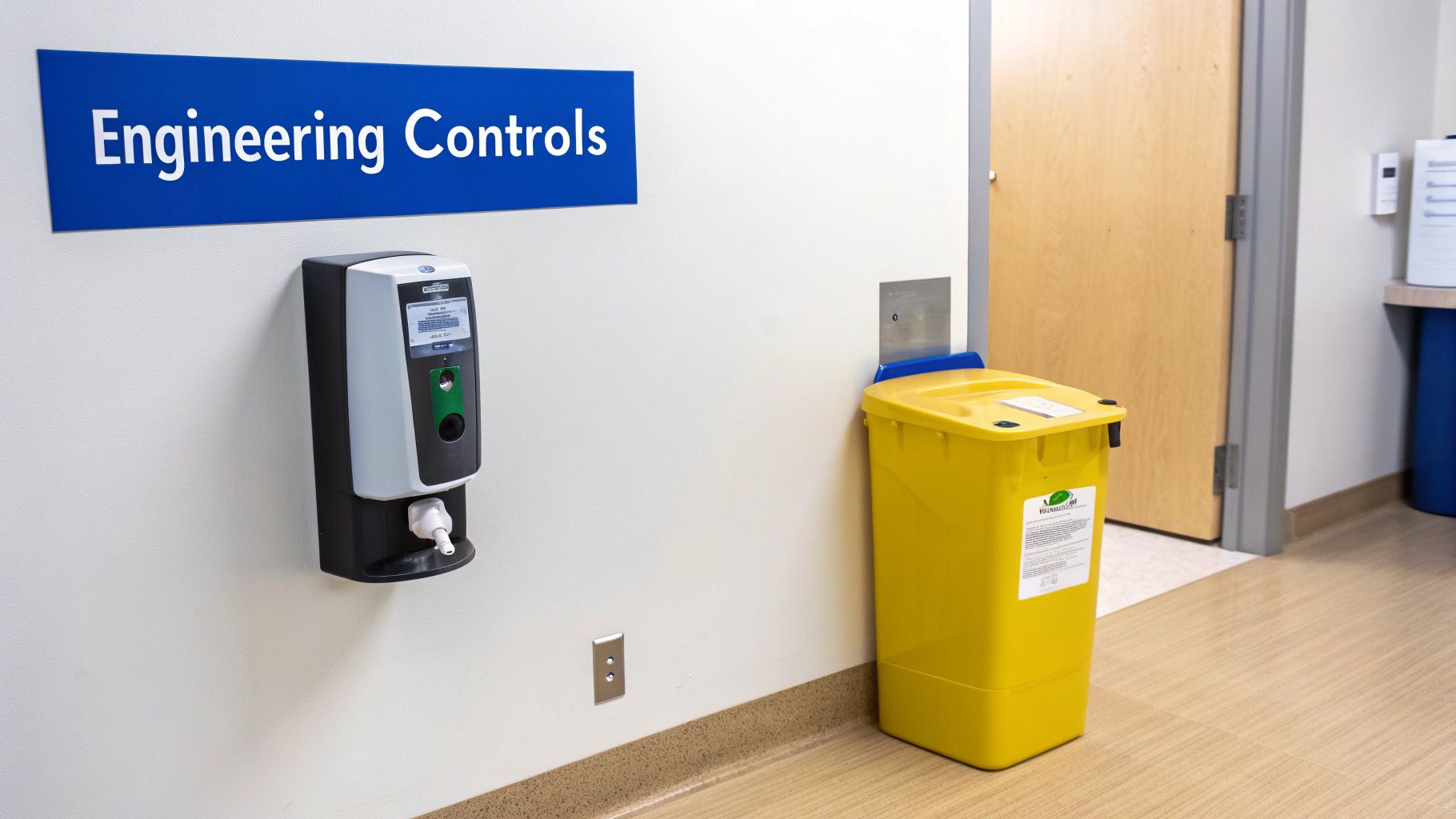
The most effective strategies for preventing bloodborne pathogen exposure are integrated directly into daily operations. Rather than relying solely on memory, leading safety programs utilize a combination of physical safeguards and standardized procedures to make safety the default outcome.
This approach is built on two critical concepts: engineering controls and work practice controls.
Understanding the distinction is key. Engineering controls are physical modifications to the workplace that isolate people from hazards, acting as automatic safety features. Work practice controls, in contrast, are behavioral—they are the specific, trained methods for performing tasks to reduce the risk of exposure.
Engineering Controls: The First Line of Physical Defense
The purpose of an engineering control is to remove the hazard at its source or place a physical barrier between an employee and a potential threat. These are often the most effective tools because they function independently of human behavior.
Some of the most common and effective engineering controls include:
- Sharps Disposal Containers: These puncture-resistant, leak-proof containers are specifically designed to safely contain used needles and other sharp instruments, physically preventing accidental sticks.
- Self-Sheathing Needles: Many modern medical devices incorporate safety features. Needles that automatically retract into a protective sheath after use are a prime example—the hazard is neutralized immediately.
- Biosafety Cabinets: In laboratory settings, these ventilated enclosures are essential. They create a sterile workspace while protecting personnel from infectious aerosols.
These physical solutions are the bedrock of a safe workplace. For a deeper understanding of how these measures fit into a broader strategy, review our guide on what business owners should know about biohazard exposure at the workplace.
The value of a well-designed engineering control lies in its simplicity and reliability. It provides a constant layer of safety that protects your team around the clock, independent of individual actions.
Work Practice Controls: Cultivating Safe Habits
While engineering controls provide the right tools, work practice controls dictate their proper use. These are the documented procedures and protocols that make safe actions second nature, minimizing exposure risk through consistent, learned behaviors. This is the human element of your safety program.
Consider these real-world examples:
- Handwashing Protocols: A mandatory, well-enforced handwashing procedure immediately following the removal of gloves is a cornerstone of infection control.
- Waste Handling Procedures: This includes strict policies against reaching into trash containers, ensuring biohazard bags are sealed correctly, and preventing regular waste from being placed in sharps containers.
- "No-Touch" Techniques: Training staff to use tools like forceps or tongs to handle contaminated items instead of their hands is a simple procedural shift with a significant safety benefit.
The most effective safety programs integrate both types of controls. For example, a facility manager might install automatic, touch-free hand sanitizing stations (engineering control). This is then supported by mandatory training and clear signage reminding staff to use them after handling waste (work practice control).
This layered approach creates a powerful defense system, making safe procedures feel automatic and fostering a culture where safety is a shared responsibility.
Selecting and Using Personal Protective Equipment Correctly
When engineering and work practice controls are in place, Personal Protective Equipment (PPE) serves as the final, critical barrier between a worker and a potential biohazard. This is not simply about having the equipment available; it's about selecting the appropriate gear and using it with absolute precision. Proper bloodborne pathogen exposure prevention relies heavily on this last line of defense.
Simply providing gloves and a mask is not a sufficient safety plan. The selection of appropriate PPE requires a technical assessment based on the specific hazards present. For example, while standard nitrile gloves are common, a situation involving harsh cleaning agents requires a glove material specifically rated to withstand those chemicals without degrading. This is where professional expertise and training are critical.
Matching PPE to the Specific Hazard
The type of PPE required is dictated entirely by the risks of the task at hand. A routine blood draw in a clinic has vastly different PPE requirements than a large-scale trauma scene remediation.
At 360 Hazardous Cleanup, our teams always begin with a meticulous risk assessment to determine the precise level of protection needed. This involves evaluating every potential route of exposure:
- Inhalation: Are aerosols present? This determines the need for respiratory protection, ranging from a standard surgical mask to a full-face respirator with specialized cartridges.
- Dermal Contact: What is the volume of fluid and which surfaces are contaminated? This informs our choice of impermeable gowns, coveralls, and dedicated shoe covers.
- Eye and Face Exposure: Is there a risk of splashes or splatters? This makes goggles or full-face shields essential to protect mucous membranes.
To better understand how PPE fits into the larger safety framework, you can learn more about the role of PPE in ensuring safety during biohazard cleanup in our detailed article. This knowledge is crucial for anyone responsible for managing biohazard risks.
The Critical Sequence: Donning and Doffing
Selecting the right equipment is only the first step. The procedures for putting it on (donning) and—more importantly—taking it off (doffing) are critical to preventing cross-contamination. A single misstep during this sequence can transfer pathogens from a contaminated glove to clean skin.
The exterior of your gloves is typically the most contaminated piece of equipment. Incorrect removal is one of the most common ways self-contamination occurs, completely negating the protective benefit of wearing them.
Our biohazard technicians are rigorously trained on these procedures until they become automatic. The doffing process is methodical, moving from the most contaminated items to the least to ensure all pathogens are contained and disposed of properly.
This procedural discipline is a key differentiator between a trained professional and an individual attempting to manage a situation without adequate preparation. It underscores why attempting to clean a significant biohazard event without professional assistance is incredibly dangerous.
Global data illustrates the challenge of maintaining these standards. According to WHO data, regional differences in prevention are significant: the African region had the highest prevalence of occupational exposure at 68.4%, while the American Region reported the lowest at 22.6%. This disparity highlights the impact of strict safety protocols. You can read the full research about these regional findings on occupational exposure for more detail.
Ultimately, PPE is far more than a uniform. It is a life-saving tool that requires expert selection, proper fit, and mastery of procedure—a clear reminder of why the expertise of a professional biohazard remediation team is indispensable in high-risk situations.
Training and Vaccinations: Empowering Your Team
A bloodborne pathogen exposure prevention plan is only as effective as the people implementing it. The best engineering controls and PPE are rendered ineffective without a well-informed and properly trained team. True workplace safety is achieved by creating a culture where every individual understands the risks and knows exactly how to respond.
This requires more than a passive, annual training video. It is about empowering your team with practical, hands-on knowledge. When employees understand the why behind each protocol, safety transforms from a requirement into a shared commitment.
The Importance of Role-Specific Training
For training to be effective, it must be relevant. Generic presentations are easily forgotten. The most impactful training connects directly to the real-world tasks that employees perform daily.
This is why professional remediation teams like ours undergo such rigorous and continuous education. Our work demands a deep, practical knowledge that cannot be acquired from a manual alone. To understand this in practice, you can read also about the crucial role of training in biohazard cleanup and how it builds true expertise.
Both initial and annual refresher training should always cover these core areas:
- Pathogen-Specific Information: Detailed education on HIV, HBV, and HCV, including modes of transmission and symptoms.
- Operational Protocols: A hands-on review of your organization's Exposure Control Plan.
- PPE Mastery: Practical sessions on selecting, donning, and doffing appropriate gear safely.
- Emergency Procedures: Clear instructions for immediate actions to take in the event of an exposure.
An effective safety program also recognizes that safety principles extend beyond the workplace. Broader strategies, such as protecting healthcare workers and their families from infectious exposure, reinforce that these practices are about protecting lives, both on and off the job.
Vaccination: A Critical Layer of Prevention
While training prepares your team to handle potential exposures, vaccinations provide a powerful biological defense against specific pathogens. For occupational health, the Hepatitis B vaccine is a non-negotiable safeguard for anyone at risk. It is a safe and highly effective way to prevent a serious and potentially life-altering liver infection.
OSHA mandates that employers must offer the three-shot Hepatitis B vaccination series free of charge to any employee with occupational exposure risk. This is a requirement for a compliant safety program.
If an at-risk employee declines the vaccine, they must sign an official OSHA declination form. This document serves as proof they were informed of the risks but chose not to be vaccinated. Importantly, they may change their mind at any time and receive the vaccine later at the employer’s expense.
This process ensures every employee makes an informed decision about their health while protecting the employer by documenting that the required offer was made and understood.
Comprehensive prevention is proven to be effective. One major hospital study showed that implementing robust safety controls led to a 67% reduction in occupational exposures over six years. However, the same study noted a concerning trend: Hepatitis B vaccination coverage among staff declined from 80.15% to 71.71% during that period. This serves as a stark reminder that even the best programs require constant vigilance and education to remain effective.
Ultimately, multiple layers of defense are necessary. Combining dynamic, hands-on training with a proactive vaccination program is how you build a truly resilient safety culture. This approach not only satisfies regulations but also creates a workplace where every team member feels protected, valued, and confident.
Managing Decontamination and Post-Exposure Incidents
Even with the most meticulous prevention plan, the risk of an exposure incident is never zero. Accidents can happen, and the response in the first few moments is critical—not just for the individual's health, but for the safety and compliance of the entire facility.
This is where professional knowledge of decontamination and incident response becomes absolutely essential.
The Critical Difference Between Cleaning and Disinfection
A common and dangerous misconception is confusing standard janitorial cleaning with clinical-level disinfection. Wiping a surface with a generic cleaner may make it appear clean, but it does little to neutralize resilient bloodborne pathogens.
Effective bloodborne pathogen exposure prevention and response demand the use of specific, EPA-registered disinfectants proven to be effective against viruses like HIV, HBV, and HCV.
Proper decontamination is a scientific process. It requires not only using the correct chemicals but also understanding dwell times—the specific amount of time a disinfectant must remain wet on a surface to be effective. For any significant contamination, this process is far beyond the scope of a standard cleaning crew's training and equipment.
Professional biohazard remediation ensures every square inch of an affected area is treated correctly, eliminating pathogens and restoring the space to a biologically safe condition. This detailed approach mitigates long-term health risks and protects against serious liability. To understand what is involved, explore our detailed guide on the correct procedure for cleaning blood spills.
The Immediate Post-Exposure Response Plan
In the event of an exposure, a clear, pre-defined response plan is your most valuable asset. It eliminates guesswork during a high-stress moment and ensures all necessary steps are taken quickly and correctly. Every employee with potential exposure risk must be trained on this protocol until it becomes second nature.
The flow chart below illustrates the proactive safety measures that build a prepared and resilient team.
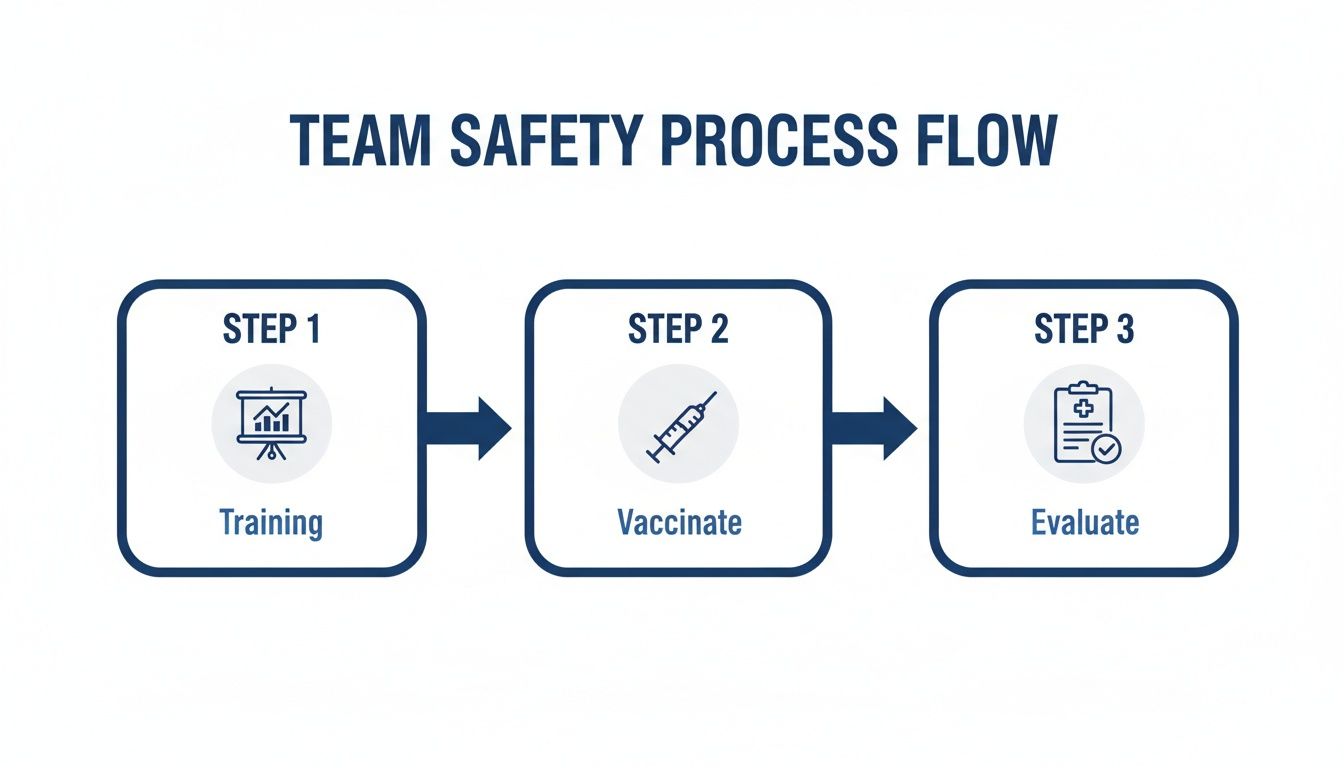
This visual highlights a continuous cycle of readiness, beginning with comprehensive training, reinforced by preventative vaccination, and maintained through ongoing health evaluations.
An effective post-exposure plan must be easy to follow, focusing on immediate actions that protect the individual while properly documenting the incident for regulatory compliance.
A quick-reference guide can be invaluable in a chaotic situation. This table breaks down the essential first actions for both employees and management.
Immediate Steps After a Potential Exposure Incident
| Action Step | Responsibility | Key Rationale |
|---|---|---|
| Administer First Aid | Employee | Immediately wash needlesticks and cuts with soap and water. Flush splashes to the eyes, nose, or mouth with large amounts of water or sterile saline. |
| Report Incident | Employee & Supervisor | The employee must notify their supervisor at once to initiate the formal response and ensure prompt medical care. |
| Seek Medical Evaluation | Management | The employee must be sent for a confidential medical evaluation immediately. This allows a healthcare professional to assess the risk and determine the need for post-exposure prophylaxis (PEP). |
| Document Everything | Management | Every detail of the incident must be recorded, often in a sharps injury log. Documentation must protect the employee’s privacy in accordance with HIPAA and OSHA standards. |
These steps ensure a swift, compliant, and compassionate response that prioritizes employee health above all else.
The moments immediately following an exposure are critical. Having a clear, practiced, and compassionate response protocol not only ensures compliance but also demonstrates an unwavering commitment to your team's health and well-being.
This structured response highlights the value of a professional partner like 360 Hazardous Cleanup. In the event of a significant biohazard release, our teams manage the entire decontamination and waste disposal process with strict adherence to federal and state regulations. We handle the cleanup so you can focus on caring for your team, ensuring the situation is managed with the utmost safety, discretion, and compassion.
Your Top Questions About Pathogen Safety Answered
When it comes to bloodborne pathogen exposure prevention, theory is one thing, but real-world application is another. We frequently receive practical questions from facility managers, business owners, and employees navigating the complexities of OSHA compliance and workplace safety.
Here, we address some of the most pressing questions with direct answers based on our extensive field experience.
What Is the Single Most Important Part of a Prevention Program?
While every component of a safety strategy is important, the site-specific, written Exposure Control Plan (ECP) is the most critical. This document is not just a compliance requirement; it is the operational playbook for your entire safety program.
The ECP functions as the central nervous system of your prevention efforts. It details exact protocols for everything—from PPE selection and biohazardous waste handling to the precise steps to take following an exposure. Without a detailed and consistently updated ECP, safety efforts become a series of disconnected reactions, increasing the risk of non-compliance and serious incidents.
A well-developed Exposure Control Plan is the single greatest tool for transforming safety from an abstract concept into a daily practice. It codifies your commitment to protecting your people and provides a clear, actionable roadmap for everyone to follow.
Remember, this plan must be a living document. It should be reviewed annually and updated anytime a new task or procedure changes the risks your team faces.
Can My Regular Janitorial Staff Handle a Biohazard Spill?
This is a critical question, and the answer is almost always no—unless the spill is extremely minor. An employee properly trained on the BBP standard and equipped with a spill kit may be able to manage a few drops of blood.
However, for anything larger—such as spills from a medical emergency, trauma, or widespread contamination—a standard janitorial crew is not equipped, trained, or legally permitted to handle the cleanup. Biohazard remediation is a specialized field requiring:
- OSHA-compliant training on pathogen safety and control procedures.
- The correct EPA-registered, hospital-grade disinfectants proven to kill viruses like HIV and HBV.
- Strict handling and disposal protocols for regulated medical waste.
- The appropriate levels of Personal Protective Equipment (PPE) to prevent skin, eye, or respiratory exposure.
Asking untrained staff to clean a biohazard scene places them in grave danger and exposes your business to significant legal and financial liability. The only way to ensure the area is restored to a biologically safe state is to engage professional remediation experts.
How Often Does Our Training Need to Be Updated?
OSHA's baseline requirement is clear: all at-risk employees must receive bloodborne pathogens training upon assignment and at least annually thereafter. However, simply repeating the same training content is insufficient.
Effective safety training must be dynamic. It needs to be updated whenever tasks or procedures change in a way that affects an employee's potential for exposure. For instance, if your facility acquires new medical equipment or alters its sharps disposal process, supplemental training is required to address those specific changes.
The goal is not just to meet a compliance deadline but to ensure the training always reflects the real-world risks your team faces daily.
What Should I Do If an Employee Refuses the Hepatitis B Vaccine?
Employees at risk of occupational exposure have the right to decline the Hepatitis B vaccine. If a team member makes this choice, you have a specific responsibility under OSHA regulations.
You must have the employee sign a formal Hepatitis B vaccine declination statement. The exact wording for this form is provided by OSHA, and it is crucial to use it without modification. This document creates an official record confirming that you offered the vaccine, explained the health risks of HBV, and the employee chose to decline.
This process must be handled with respect and confidentiality. It is also important to inform the employee that they can change their mind at any time. If they later decide to receive the vaccine, your responsibility to provide the full vaccination series at no cost to them remains.
When you face a biohazard situation that requires more than your internal plan can manage, you need a partner you can trust. 360 Hazardous Cleanup provides compassionate, professional remediation services 24/7, ensuring your property is restored with the highest standards of safety and care. Learn more about how we can help by visiting https://360haz.com.