Proper biohazard waste disposal is not merely about following rules—it is a critical process for safely handling, segregating, and eliminating materials contaminated with potentially infectious agents. These protocols are essential for preventing the spread of disease, ensuring public safety, and protecting our environment.
This responsibility applies to every scenario, from a used needle in a medical clinic to the hazardous materials left behind after a traumatic event.
Understanding What Makes Waste Biohazardous
Before biohazardous waste can be managed, it must be correctly identified. At its core, biohazardous waste is any material contaminated with infectious agents—such as blood, bodily fluids, or other pathogenic microorganisms that can harm people or the environment. This is not just a matter of compliance; it is about controlling an invisible threat that can cause widespread harm if mishandled.
Think of it like a hidden rip current at the beach. You cannot see the danger lurking beneath the surface, but if you ignore the warnings, the consequences can be devastating. Similarly, pathogens from mishandled waste can spread silently through contact or seep into the environment, putting sanitation workers, the public, and entire communities at risk.
It's More Than Just Medical Waste
While we often associate biohazards with hospitals and clinical settings, these dangerous materials are present in a surprising number of environments. Understanding the full scope is the first step toward responsible management.
- Trauma and Crime Scenes: Blood and other bodily fluids left after an accident, unattended death, or violent crime are serious biohazards that must be professionally remediated to ensure safety.
- Industrial Accidents: A workplace injury involving exposure to human blood or certain chemicals can quickly generate hazardous waste requiring specialized cleanup.
- Residential Situations: Unfortunately, situations like hoarding or even in-home medical care can create contaminated environments that require professional disposal services.
- Veterinary Clinics: It’s not just human fluids. Animal blood, tissues, and contaminated bedding can carry zoonotic pathogens and must be handled with the same level of care.
The need for experts in this field has grown significantly. The global medical waste management market was recently valued at $18.91 billion and is projected to reach $24.08 billion by 2029. This growth is driven by an increase in disposable medical products and stricter government regulations—all of which underscore how critical professional expertise has become.
Why Professional Expertise is Critical
When dealing with biohazardous materials, engaging a professional team is not just a recommendation—it is a necessity for safety and compliance. In the midst of a high-stress event like a family tragedy or a serious workplace accident, the emotional and logistical burden is already overwhelming.
Attempting to handle the cleanup and disposal without proper training or equipment can lead to incomplete decontamination, severe legal liability, and devastating health risks. You can learn more about what makes a scene hazardous in our detailed article.
At 360 Hazardous Cleanup, we provide an authoritative and compassionate response to these challenging situations. Our team is trained to manage the most sensitive scenes with technical precision and genuine empathy, ensuring your property is safe so your family or team can focus on healing. This guide is our way of helping you understand the process and make informed, safe decisions.
Navigating the Complex Web of Disposal Regulations
Identifying biohazardous waste is one thing; disposing of it safely and legally is another entirely. The regulations are not a single, simple checklist but a complex framework of federal, state, and local laws that overlap and intersect. This complexity is precisely why professional expertise is not a luxury—it is essential for ensuring safety and avoiding significant penalties.
Think of it as a regulatory pyramid. At the top, federal agencies set the baseline for the entire country. However, as you move down to state and local levels, the rules almost always become more specific and often much stricter, designed to address regional public health and environmental concerns.
The Key Agencies and Their Roles
Several government bodies oversee biohazard waste, each managing a different stage of its journey from generation to final destruction. While their roles are distinct, they are deeply interconnected.
This table provides an overview of the main players at the federal level and their responsibilities.
| Agency | Primary Role And Responsibility |
|---|---|
| Occupational Safety and Health Administration (OSHA) | OSHA's mission is to protect workers. It sets the standards for how employees must be kept safe from bloodborne pathogens and other biohazards, dictating everything from required Personal Protective Equipment (PPE) to training and handling procedures within a facility. |
| Environmental Protection Agency (EPA) | The EPA’s role is to protect the environment. It regulates the final treatment and disposal of medical and biohazardous waste to ensure it does not contaminate our air, soil, or water. |
| Department of Transportation (DOT) | Once biohazardous waste is packaged and leaves a facility, the DOT's regulations take effect. It has very strict rules for how hazardous materials must be packaged, labeled, and transported to prevent spills or public exposure during transit. |
This multi-agency oversight means that a single mistake can result in a violation of several different regulations simultaneously. For a facility manager, something as simple as using the wrong container could lead to citations from both OSHA and the DOT.
The High Cost of Non-Compliance
Failing to adhere to these biohazard disposal guidelines can lead to consequences that go far beyond a simple warning. The financial and legal risks are enormous, designed to ensure public health and safety are never compromised.
Non-compliance is not a risk worth taking. Violations can lead to crippling fines that can reach tens of thousands of dollars per day, per violation. In severe cases, they can even trigger operational shutdowns, criminal charges, and irreparable damage to an organization's reputation.
These are not just local suggestions; stringent regulations are the global standard. More than 70 countries mandate the use of specific biohazard bags for medical waste. In the U.S. alone, healthcare facilities produce over 3.5 million tons of this waste annually. And with the World Health Organization confirming that 15% of all healthcare waste is hazardous, the need for airtight procedures is clear. For facility managers, failing to meet EPA and OSHA standards for handling and transport can open the door to multimillion-dollar fines.
You can get a sense of the global market and regulatory pressures from industry reports like those on Grandview Research.
Your Shield of Compliance
This is where a professional remediation company becomes your most valuable partner. An experienced team like 360 Hazardous Cleanup acts as your compliance shield, expertly navigating the regulatory maze on your behalf. We ensure every step—from segregation and packaging to transport and final disposal—is handled correctly, documented meticulously, and is 100% legally sound.
This not only protects your organization from significant liability but also provides the peace of mind that comes from knowing the situation is being managed with the highest degree of professional integrity. To better understand the legal framework, you can learn more about biohazard remediation laws and regulations and see why they are so crucial.
When you entrust this critical task to certified experts, you are not just cleaning up a scene—you are safeguarding your employees, your community, and your organization’s future.
The Step-by-Step Process for Safe Biohazard Handling
Handling biohazardous waste is not just a task—it is a discipline. Proper management involves a precise, multi-stage process with no room for error. Every step, from the moment waste is generated to its final disposal, is a critical link in a chain of safety that protects everyone involved.
In the midst of a high-stress situation, such as a trauma scene or a busy clinic, the urge to expedite the process is understandable. However, a single mistake can have devastating consequences. This is why a methodical, professional approach is non-negotiable.
The entire process begins the moment waste is created. From that point forward, a strict protocol of segregation, containerization, and labeling must be followed with unwavering precision. This is not about checking boxes; it is about preventing cross-contamination and keeping healthcare workers, janitorial staff, transporters, and the public safe.
Step 1: Segregation at the Source
The first—and most critical—step is segregation. This means separating biohazardous waste from regular trash at the point of generation.
Think of it like sorting recycling at home. If you toss oily food waste into the paper bin, you contaminate the entire batch. With biohazards, the stakes are exponentially higher. A single bloody gauze pad tossed into a standard trash can renders the entire bag and its contents a regulated biohazard. This mistake not only multiplies disposal costs but also puts anyone who handles that bag downstream at serious risk.
In a medical clinic, that gauze goes directly into a red biohazard bag. At an industrial site, rags used to clean up blood are kept completely separate from other debris. This initial sort is the bedrock of safe disposal.
Step 2: Correct Containerization
Once separated, the waste must be placed in the right type of container. This is a common and dangerous point of failure. Different biohazards require specific containers designed to hold them securely.
There are two main types:
- Red Biohazard Bags: These are for "soft" contaminated materials—such as used PPE, saturated dressings, or soiled towels. The bags themselves must be strong enough to resist punctures or leaks during handling.
- Sharps Containers: These are the hard-sided, puncture-proof, and leak-resistant boxes designed for anything that can pierce skin. Needles, scalpels, broken glass vials, and lancets all belong here. Using them is non-negotiable for preventing needlestick injuries, a primary mode of transmission for bloodborne pathogens.
Critical Safety Warning: Never dispose of sharps in a red bag or any other soft container. The risk of a needle puncturing the bag and injuring a worker is extremely high and can lead to a life-altering infection.
Step 3: Secure Packaging and Labeling
With the waste correctly containerized, it is time to prepare it for transport. This means sealing everything securely to prevent any possibility of a leak. Red bags should be tied shut with a specific goose-neck knot, and sharps containers must be closed and sealed when they are approximately three-quarters full. Overfilling is a significant safety hazard.
Next comes labeling. Every container must be clearly marked with the universal biohazard symbol. It serves as an immediate visual warning to handle with extreme caution. Depending on your location, state or local regulations may require additional information on the label, such as the date and the origin of the waste. This creates a clear trail of responsibility from "cradle to grave."
This hierarchy shows how biohazard regulations are layered. Federal rules set the baseline, but state and local laws often add more specific, and stricter, requirements.
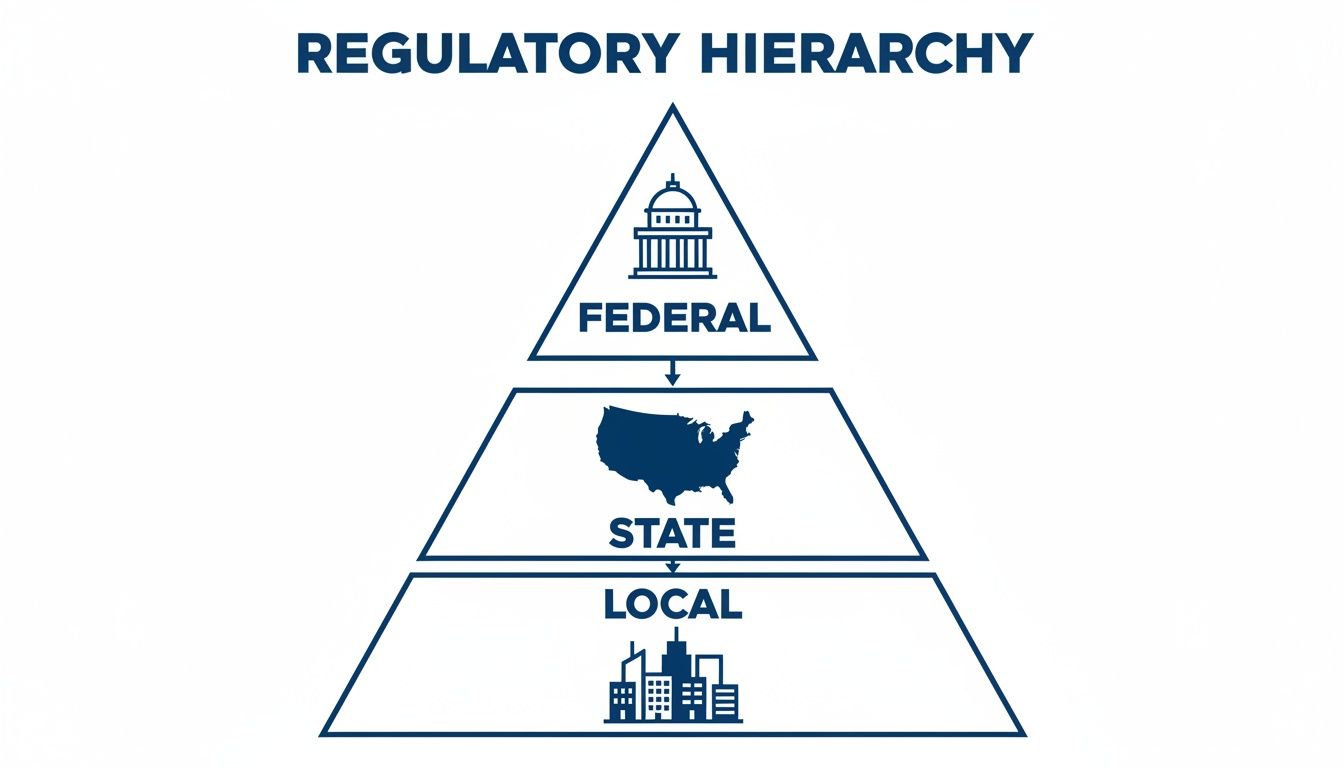
This pyramid makes it clear why a "one-size-fits-all" approach to disposal is ineffective—and often illegal.
Each step in this process demands deep regulatory knowledge and flawless execution, especially when dealing with a traumatic event. The precision required is exactly why trained professionals are so essential. To see how these steps fit into the bigger picture, check out our step-by-step guide to the biohazard cleanup process. A certified team ensures every action is performed correctly, protecting you from health risks and legal fallout when you need it most.
Critical Safety Protocols and Protective Gear
Following correct procedures for handling biohazardous waste is essential, but those steps are only as safe as the gear being worn. When dealing with invisible threats like bloodborne pathogens, safety is not a suggestion—it is an absolute necessity, enforced by layers of personal protective equipment (PPE).
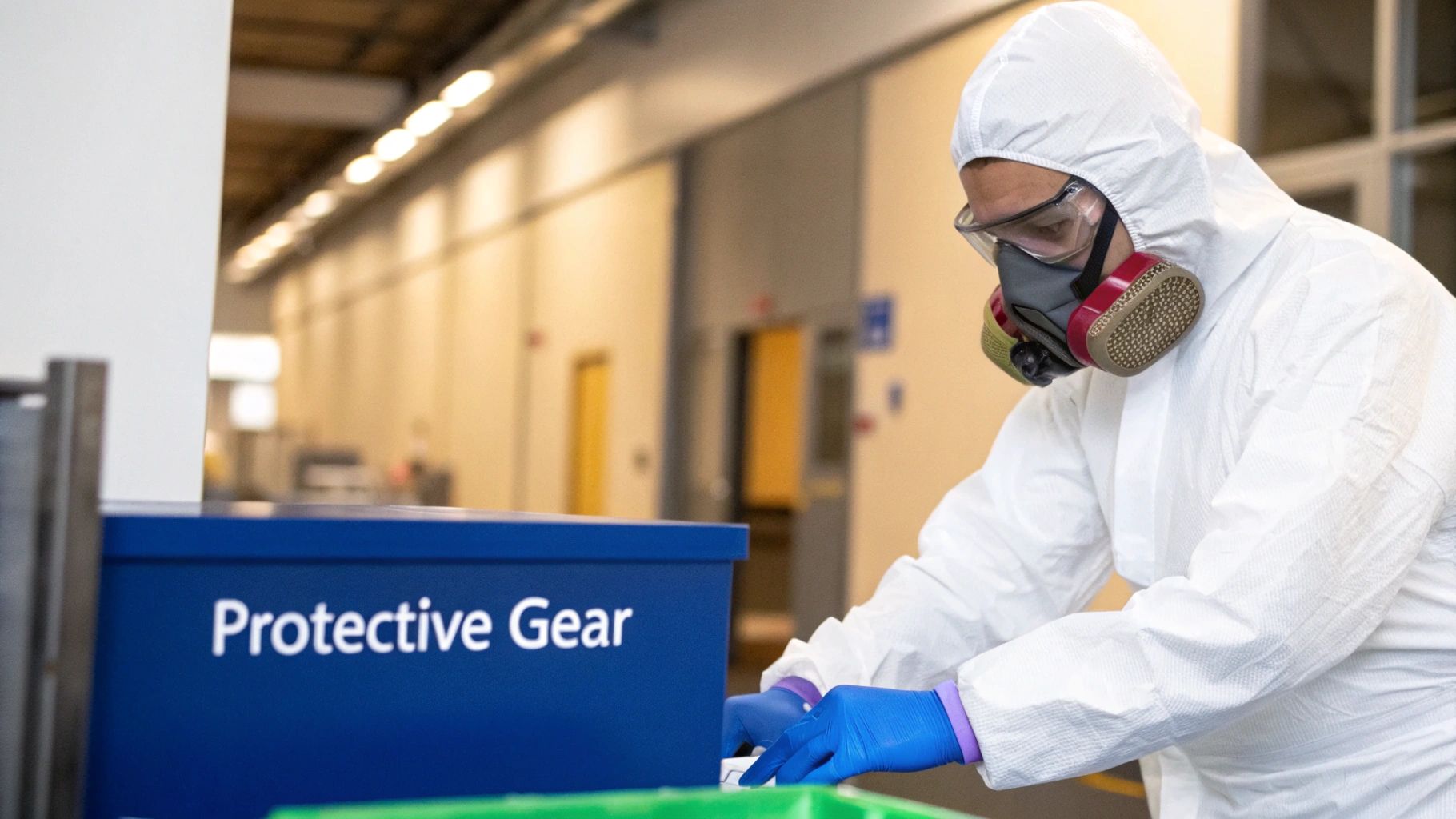
This equipment serves as the only physical barrier between a cleanup technician and contaminants that could be life-altering. Without it, the risk of exposure from inhaling airborne particles, touching a contaminated surface, or an accidental needlestick is unacceptably high. That is why every professional guideline is built on a foundation of using the right PPE, the right way.
Beyond Basic Protection: The Anatomy of Professional PPE
The gear used by certified remediation specialists is fundamentally different from anything available to the public. It is a specialized system where each component is chosen to counter a specific threat, creating a sealed, impenetrable shield.
- Respirators vs. Masks: A simple dust mask or surgical mask is designed to block large droplets. In contrast, a NIOSH-approved respirator with P100 filters is engineered to block 99.97% of airborne particulates, including microscopic viruses and bacteria that can become aerosolized during cleanup. This distinction is critical for safety.
- Biohazard Suits: Professional-grade suits are not just coveralls. They are made from non-porous materials with sealed seams to prevent any liquid penetration. These suits are tested against specific chemicals and biological agents, offering protection far beyond standard workwear.
- Layered Gloves and Footwear: Our technicians almost always wear at least two layers of nitrile or latex gloves. This simple step protects against tears and prevents cross-contamination. It is paired with puncture-resistant, sealed rubber boots that can be fully decontaminated after the job is done.
Understanding the importance of PPE is the first step in appreciating why this work should only be handled by trained experts. A single gap in protection can render the entire safety protocol ineffective.
The most critical aspect of using PPE is not just wearing it—it is the meticulous process of putting it on (donning) and taking it off (doffing). Incorrect removal can easily transfer contaminants from the suit's exterior directly to the skin, defeating its entire purpose.
The Dangers of Inadequate Gear
Attempting to handle biohazardous materials without professional-grade PPE is a dangerous gamble. The risks are severe and can lead to serious, long-term health consequences. Common household gloves, basic masks, and everyday clothing offer virtually no defense against microscopic pathogens.
This protection gap is precisely why professional help is so crucial. Certified teams like 360 Hazardous Cleanup not only have access to this specialized equipment but are also extensively trained in its proper use, maintenance, and disposal. For unique situations, using custom warning signs is also essential to clearly mark specific hazards and ensure everyone's safety.
This commitment to safety protects our technicians and ensures that no contaminants are accidentally carried out of the work zone. By adhering to these strict protocols, we can guarantee a site is not just visually clean but biologically safe, providing our clients with total peace of mind during a difficult time. Choosing a professional team means choosing uncompromising safety.
Final Disposal from Transport to Treatment
Once biohazardous waste has been properly segregated, packaged, and labeled, it is ready for the final—and most heavily regulated—stage of its journey: transport and destruction. This is not a do-it-yourself task. This stage is almost exclusively handled by licensed, professional remediation companies with specialized vehicles, airtight documentation, and the advanced technology needed to neutralize hazardous materials permanently.
Attempting to manage this yourself is not just a poor choice; it is illegal. The Department of Transportation (DOT) has extensive regulations governing every aspect of transport. This is where a professional partner becomes essential, removing the logistical burden and providing official proof that you have met your legal obligations from start to finish.
The Unbroken Chain of Custody
One of the most critical elements of this process is the waste manifest. This is not a simple receipt—it is a legally binding document that tracks the waste from the moment it leaves your facility until it is officially destroyed.
Think of it as a high-stakes package requiring a signature at every handoff. The manifest is signed by you (the generator), the transporter, and finally, the treatment facility. This creates a bulletproof paper trail, proving you transferred the waste to a licensed carrier and that it was disposed of correctly. Without this completed document, you have no legal proof of proper disposal, leaving your organization exposed to liability.
Specialized Transport and Logistics
Biohazard bags cannot be tossed into the back of a standard truck. DOT regulations are incredibly specific about the vehicles used, demanding features like secured, leak-proof cargo holds that are completely sealed off from the driver's cab.
These vehicles are also required to display specific placards—diamond-shaped signs that inform first responders of the type of hazard they are dealing with in an accident. The drivers themselves are not just any drivers; they hold special licenses and undergo continuous training on hazardous materials handling and emergency response. This level of specialization makes professional transport non-negotiable. To see how experts manage this from start to finish, you can learn more about safe and responsible hazardous waste disposal in our detailed guide.
Final Treatment and Destruction Methods
After transport, the waste arrives at a treatment facility to be rendered completely non-infectious. The two most common and effective methods are autoclaving and incineration, each serving a distinct purpose.
These are not simply advanced trash compactors. They are industrial-scale scientific processes engineered to achieve a 100% microbial kill, ensuring dangerous pathogens are permanently destroyed and no longer pose a threat to public health.
The appropriate method depends on the type of waste being treated. Understanding the difference highlights the thoroughness of professional disposal.
Common Biohazard Waste Disposal Methods Compared
Here’s a brief breakdown of how these technologies work and their primary applications.
| Disposal Method | How It Works | Best For | Key Benefit |
|---|---|---|---|
| Autoclaving | Uses high-pressure, superheated steam (around 250°F / 121°C) to sterilize waste, killing all microorganisms. | Most medical waste, including sharps, lab cultures, and soft materials like contaminated PPE. | An environmentally friendly method that sterilizes waste, allowing it to be safely sent to a sanitary landfill. |
| Incineration | Destroys waste through high-temperature combustion, reducing it to sterile ash, gas, and heat. | Pathological waste (tissues, organs), trace chemotherapy waste, and some pharmaceutical waste. | Achieves complete destruction and significant volume reduction, making it ideal for the most hazardous waste types. |
By managing this entire backend process—from manifests and transport to final destruction—a professional remediation company provides complete assurance of compliance. It is the only way to guarantee your organization is shielded from liability and is fulfilling its duty to protect public health and the environment.
When to Call a Professional Remediation Team
Understanding the guidelines for routine biohazard disposal is one thing. Recognizing when a situation has escalated beyond your capacity is another—and it is the most important safety decision you can make.
While a hospital or clinic has clear, daily protocols, some events are so complex, dangerous, and emotionally charged that only a certified professional team can safely manage them. Deciding to call for help is not an admission of failure; it is the most responsible action you can take to protect your family, employees, or the public.
In a crisis, the instinct to do something is strong, but it can lead to dangerous outcomes. Attempting to clean up a trauma scene or a large-scale contamination on your own, without the proper training and equipment, exposes you to significant risks, including exposure to serious pathogens and the potential for severe legal and financial liability.
Scenarios Demanding Professional Intervention
Some situations are far too hazardous for a do-it-yourself approach. What is visible on the surface is often just the tip of the iceberg—the real danger lies where contaminants have seeped into unseen or hard-to-reach areas.
- Unattended Death or Suicide: These scenes are not only emotionally devastating but also profoundly hazardous. Bodily fluids can penetrate deep into porous materials like drywall, subflooring, and furniture, creating a hidden source of dangerous pathogens and persistent odors that surface cleaning cannot eliminate.
- Workplace or Industrial Accidents: A severe injury can contaminate large areas, including complex machinery, with blood and other biohazards. A professional team is needed to ensure the entire site is disinfected to strict OSHA standards, making it verifiably safe for employees to return.
- Hoarding Situations: Hoarding environments are often biohazard minefields. Beyond the clutter, one can find decomposed organic material, animal waste, and massive pest infestations. These sites require a careful, methodical process to safely sort, remove, and dispose of tons of contaminated materials.
The 360 Hazardous Cleanup Advantage in a Crisis
Dealing with the aftermath of a traumatic event is overwhelming. Our role is to lift that burden by providing expert, compassionate, and discreet service, available 24/7. We understand the need for urgency and sensitivity, which is why we can arrive in unmarked vehicles upon request to protect your privacy.
A critical and often overlooked aspect of professional remediation is managing the financial side. We work directly with insurance carriers, handling the claims process on your behalf. Our goal is to minimize or even eliminate out-of-pocket costs for families and businesses already enduring immense stress.
When you choose a certified team like 360 Hazardous Cleanup, you ensure that every regulation is followed, every hidden danger is neutralized, and your property is restored with technical skill and genuine care. When you are facing the unthinkable, let us handle the cleanup. You focus on what truly matters—healing.
Frequently Asked Questions About Biohazard Disposal
When facing a biohazard situation, it is natural to have questions. It is a stressful and often overwhelming time, and you need clear, straightforward answers. Here are the questions we hear most often from property owners, managers, and families.
Can I Just Throw Biohazard Waste in My Regular Trash?
Absolutely not. While it might seem like the simplest solution, placing regulated medical waste—such as items saturated with blood or used needles—into the regular trash is illegal and extremely dangerous.
This is not just about a rule; it is about public safety. Doing so puts sanitation workers, your community, and the environment at serious risk of exposure to infectious pathogens. All biohazardous material must be handled according to strict biohazard waste disposal guidelines for collection, transport, and final destruction.
What Happens if Biohazard Waste Is Handled Improperly?
The consequences of improper disposal are severe, for both public health and your personal liability. Improper handling can lead to the spread of dangerous diseases like HIV, Hepatitis B, and Hepatitis C.
Beyond the health risks, the legal and financial penalties are staggering. Fines for non-compliance can easily reach tens of thousands of dollars per violation, per day. In some cases, it can even lead to criminal charges.
The most important takeaway is that professional remediation is not just about cleaning—it is about mitigating risk. A certified team ensures every regulation is met, protecting you from health threats and long-term legal liability.
How Do Professionals Make Sure the Waste Is Completely Safe?
Certified biohazard professionals do not just "clean up"—we neutralize the threat. We use highly regulated, advanced technologies to render hazardous materials completely harmless and inert.
The two primary industry-standard methods are:
- Autoclaving: This process uses high-pressure, superheated steam to sterilize materials, killing all microorganisms.
- Incineration: This method uses extremely high temperatures to completely destroy the waste and any pathogens within it.
Both of these processes guarantee a 100% microbial kill, ensuring that dangerous pathogens are permanently eliminated and can never pose a threat again.
When you are facing a biohazard situation, you need a partner who can manage the entire process with expertise, compassion, and unwavering compliance. For immediate, professional assistance that prioritizes your safety and peace of mind, trust the experts at 360 Hazardous Cleanup. Learn how we can help at https://360haz.com.