Proper biohazard waste disposal is far more than an intensive cleanup. It is a highly regulated, systematic process essential for safely removing materials contaminated with infectious agents. This process is fundamentally different from standard cleaning and is absolutely critical for protecting public health and safety, particularly after a traumatic event.
Why Professional Disposal Is Non-Negotiable
When dealing with the aftermath of an unattended death, crime scene, or serious accident, the visible contamination is only a fraction of the problem. The true danger lies in what is invisible to the naked eye—bloodborne pathogens, bacteria, and other microscopic threats. These contaminants can persist on surfaces for days or even weeks, posing a significant health risk to anyone entering the space.
This is where the distinction between "cleaning" and "remediation" becomes critically important. Standard household cleaners, including bleach, are insufficient for eliminating these hazards. Attempting a DIY cleanup can inadvertently spread contaminants, expanding the affected area and increasing the risk of exposure.
Beyond Cleaning to True Remediation
It’s crucial to understand that one is about appearances, while the other is about biological safety. Engaging a certified remediation team like 360 Hazardous Cleanup is not merely an option; it is a necessary measure to ensure the safety and well-being of all involved.
- Protecting Health and Safety: Our technicians arrive equipped with specialized gear, EPA-approved disinfectants, and the correct personal protective equipment (PPE). This enables us to safely handle, contain, and remove all contaminated materials without risk of cross-contamination or exposure.
- Ensuring Legal and Regulatory Compliance: Biohazard waste disposal is governed by a complex framework of federal, state, and local regulations. Property owners who fail to comply with these standards can face substantial fines and significant legal liability.
- Preventing Lasting Emotional Trauma: Attempting to clean a trauma scene is not only hazardous but can also be deeply emotionally damaging. A compassionate, professional team handles the difficult physical work with discretion, allowing you the space to focus on healing and recovery.
A professional service provides more than just a cleanup; it delivers a certified-safe environment. It is the definitive step in restoring not only a physical space but also security and confidence after a distressing event.
Ultimately, choosing a certified and compassionate partner for biohazard waste disposal is the most responsible decision you can make. It protects your family, employees, or community from hidden dangers and ensures the recovery process can begin on a safe, compliant foundation.
What Qualifies as Biohazardous Waste
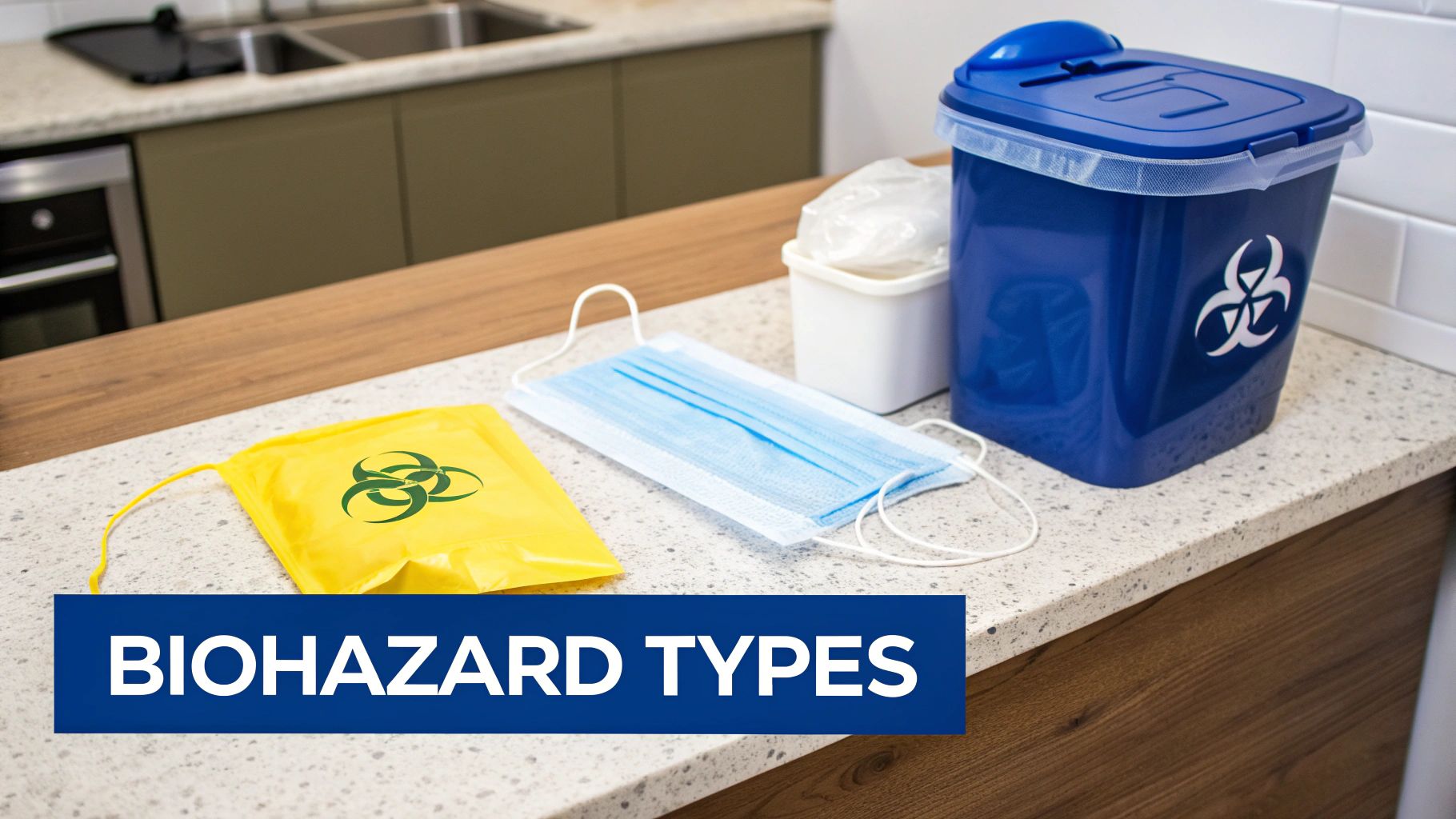
The term "biohazard" often brings to mind laboratories or hospitals, but its scope is much broader. Biohazardous waste includes any material contaminated with biological agents—such as blood or other bodily fluids—that could pose a threat to human health or the environment.
At its core, the definition encompasses any infectious or potentially infectious substance. These materials are not confined to crime scenes; they can be present in clinics, businesses, or private homes following an unattended death or accident. The key is recognizing when a material has the potential to transmit pathogens and cause illness.
For homeowners, property managers, and business owners, this understanding is critical. Proper biohazard waste disposal is not a suggestion but a necessary process designed to contain these threats and prevent the spread of disease.
The Four Main Categories of Biohazardous Waste
To provide clarity, biohazardous waste is generally classified into four main categories. Each presents distinct risks and requires specific handling protocols to ensure public safety.
- Solid Biohazardous Waste (Non-Sharps): This is the most common category and includes any non-sharp item that has come into contact with blood or other potentially infectious materials (OPIM), such as contaminated gloves, soiled bandages, or lab cultures.
- Liquid Biohazardous Waste: This refers to bulk quantities of blood, bodily fluids, or other biological liquids. Any volume beyond a small, contained spill falls into this category and requires specialized containment and removal.
- Sharps Waste: This category poses a dual threat. Any item contaminated with biological material that can also pierce the skin is considered a sharp. This includes needles, scalpels, broken glass, and lancets, which carry the risk of both physical injury and infection.
- Pathological Waste: This category includes human or animal tissues, organs, and body parts. Due to its nature and high potential for carrying infectious agents, it requires the most stringent handling and disposal protocols.
The scale of this issue is massive. Globally, healthcare facilities produce enormous amounts of waste. While around 85% of it is just regular trash, the remaining 15% is the dangerous stuff—infectious, pathological, or sharps waste. This hazardous portion presents a serious biohazard risk that demands professional disposal to prevent outbreaks.
Identifying biohazardous waste isn’t about being an expert—it's about exercising caution. If a material is contaminated with blood or bodily fluids, it must be treated as a potential threat until a certified professional can assess it.
The table below breaks down these waste types, their common sources, and the dangers they pose, underscoring why professional management is an absolute necessity. For a broader understanding of hazardous materials, our guide on what qualifies as hazardous waste and its safe disposal provides additional context.
Common Types of Biohazardous Waste and Their Sources
This table offers a clear overview of the different categories of biohazardous waste to help you identify potential risks.
| Waste Category | Definition and Examples | Common Sources | Primary Risk |
|---|---|---|---|
| Solid Waste (Non-Sharps) | Items contaminated with blood or bodily fluids, like saturated gauze, PPE, or lab Petri dishes. | Trauma scenes, medical clinics, research labs, industrial accidents. | Transmission of bloodborne pathogens like HIV, Hepatitis B, and Hepatitis C. |
| Liquid Waste | Bulk quantities of blood, amniotic fluid, pleural fluid, or other potentially infectious liquids. | Unattended deaths, surgical centers, emergency rooms, accident sites. | High risk of widespread contamination and exposure through splashing or contact. |
| Sharps Waste | Needles, syringes, scalpels, broken glass tubes, or any item that can cut or puncture skin. | Hospitals, dental offices, veterinary clinics, residential settings (e.g., insulin needles). | Puncture wounds leading to direct inoculation with infectious agents. |
| Pathological Waste | Human or animal tissues, organs, body parts, and anatomical specimens removed during procedures. | Hospitals, morgues, funeral homes, veterinary pathology labs. | Exposure to infectious diseases and significant psychological distress for handlers. |
Each category presents unique challenges, reinforcing the fact that these materials are far too dangerous for anyone but trained and certified professionals to handle.
Navigating Disposal Regulations and Compliance
The regulations governing biohazard waste are a complex and strict framework, not a set of mere suggestions. Failure to comply is a serious breach that can result in severe penalties, legal action, and significant risk to public health. This regulatory structure is designed to enforce a non-negotiable standard of safety for everyone.
Consider it similar to the electrical systems in a building. While anyone can change a lightbulb, rewiring the structure requires a licensed electrician. The regulations for biohazard waste disposal function in the same manner, demanding expert knowledge to navigate safely and legally.
Attempting to manage this process independently is a considerable risk. The consequences of non-compliance can range from substantial fines to civil lawsuits, creating a secondary crisis long after the initial event.
The Key Agencies Setting the Rules
In the United States, several federal agencies establish the foundational rules for biohazard waste management. Each plays a distinct and critical role in protecting public health and the environment.
- Occupational Safety and Health Administration (OSHA): OSHA is focused on worker safety. Its Bloodborne Pathogens Standard dictates how employers must protect their teams from exposure to blood and other potentially infectious materials (OPIM), covering everything from personal protective equipment (PPE) to mandatory training and post-exposure protocols.
- Environmental Protection Agency (EPA): The EPA acts as the guardian of the environment, establishing regulations for the treatment and disposal of biohazardous waste to prevent contamination of air, water, and soil.
- Department of Transportation (DOT): Once biohazard waste is packaged for removal, DOT regulations take effect. The DOT enforces strict rules for classifying, packaging, labeling, and transporting hazardous materials to prevent spills and accidents during transit.
To fully comprehend the scope of biohazardous materials, it's helpful to understand broader classification systems like the nine classes of dangerous goods. This is precisely why a professional team is vital—they possess deep knowledge of these classifications and ensure every item is handled in strict accordance with the law.
State and Local Laws: The Critical Layer of Complexity
While federal agencies provide a baseline, state and local regulations add significant layers of complexity. Nearly every state has specific rules that are often stricter than federal mandates, governing everything from storage time limits to required disposal methods.
This jurisdictional variability is where compliance becomes most challenging. A disposal method that is acceptable in one state may be illegal in another. For example, some states may mandate sterilization via autoclave, while others require incineration.
Navigating this patchwork of regulations is impossible without localized, up-to-date knowledge. Compliance is not a one-size-fits-all checklist; it is a dynamic process that demands specific expertise relevant to your exact location.
This is why partnering with a certified, professional remediation company is so critical to protecting yourself from liability. A company like 360 Hazardous Cleanup maintains a deep, current understanding of these jurisdictional nuances. Our team ensures that every step—from containment to final disposal—is executed in full compliance with all federal, state, and local laws.
This diligence removes the burden of regulatory guesswork from your shoulders, providing peace of mind during an incredibly stressful time. To learn more about these complexities, you can read about the risks and hazards of biohazard waste management and how to ensure full compliance. This professional oversight is your best defense against the staggering legal and financial risks of non-compliance, ensuring the situation is resolved safely, discreetly, and correctly the first time.
The Professional Process for Safe Handling and Transport
Properly disposing of biohazard waste is a meticulous, science-backed process that adheres to a strict protocol designed to neutralize risk at every stage—from initial site assessment to the final, documented destruction of the waste.
Attempting to manage this process without professional training and equipment is not just inadvisable; it is dangerous. A single misstep can lead to cross-contamination, transforming a contained incident into a widespread health hazard. This professional process is the foundation of safety, ensuring every potentially infectious particle is handled with absolute precision.
Step 1: Segregation and Containment
The first action a professional team takes on-site is the careful segregation of different types of biohazardous waste. This is a critical safety measure, as different materials require different handling. Sharps, for instance, must be separated from "soft" waste like contaminated PPE to prevent punctures that could cause injury and infection.
Once sorted, all materials are sealed in industry-approved, color-coded containers.
- Sharps: Immediately placed in rigid, puncture-proof containers.
- Solid and Soft Waste: Secured in specialized red biohazard bags that are both leak-proof and tear-resistant, often double-bagged for additional security.
This initial containment is essential for preventing the spread of pathogens. The global market for these specialized biohazard bags was valued at over USD 400 million, reflecting their importance. Strict regulations, such as the U.S. EPA's Resource Conservation and Recovery Act (RCRA), mandate the use of these specific containers.
Step 2: Secure and Compliant Transportation
With all hazardous materials safely contained, the next step is removal from the property. This requires dedicated, licensed vehicles specifically designed for transporting biohazardous materials, fully compliant with all Department of Transportation (DOT) regulations.
From the moment the waste leaves your property until it arrives at a licensed disposal facility, the entire process is handled with discretion and safety. We maintain a detailed chain-of-custody log, a crucial document that tracks the waste every step of the way.
This isn't just about following one set of rules. As you can see, the approval process is a multi-layered system involving local, state, and federal authorities.
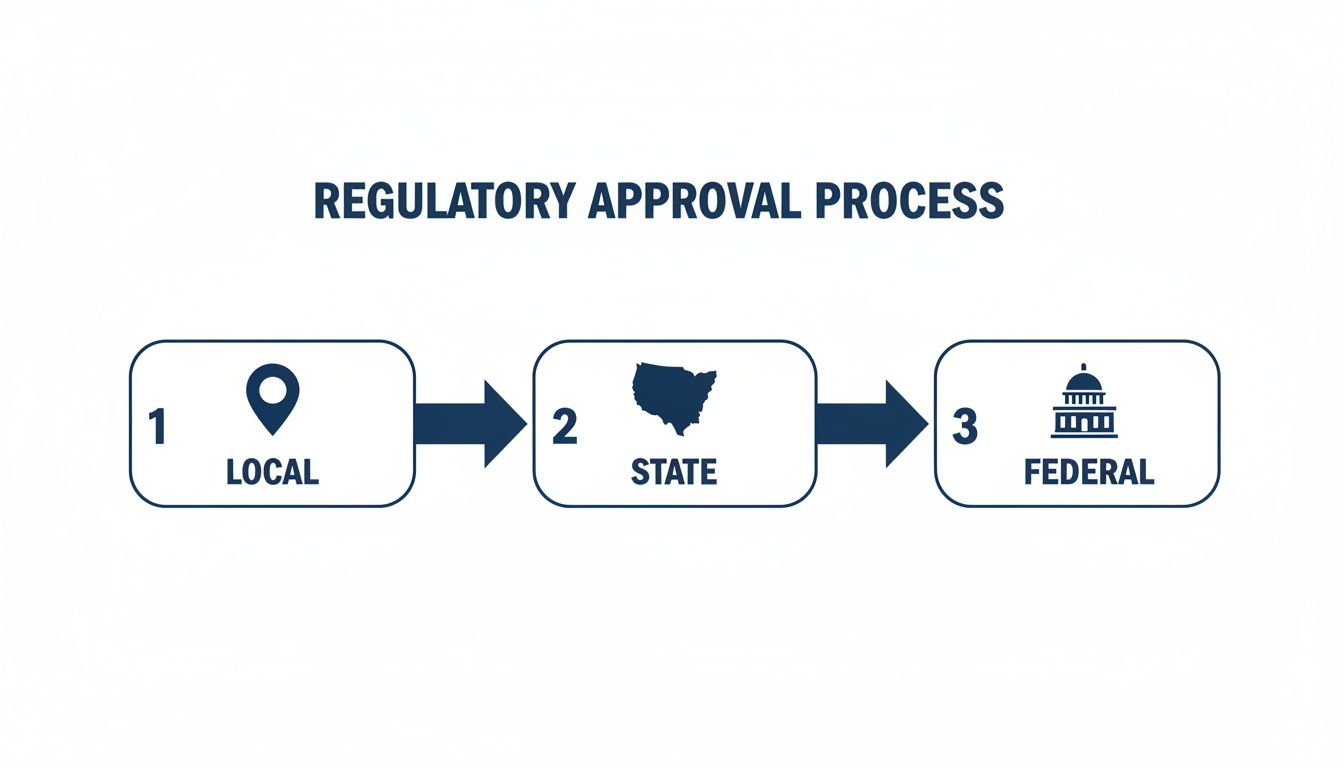
True compliance requires navigating this complex web of regulations—a task best led by an expert.
Step 3: Compliant Disposal and Destruction
The final destination for biohazard waste is a specially licensed facility where it is rendered completely non-infectious. The two most common and effective methods are autoclaving and incineration.
- Autoclaving: This process uses high-pressure steam to sterilize waste, killing all microorganisms. Once sterilized, the material is considered non-hazardous and can be safely disposed of in a sanitary landfill.
- Incineration: This method involves burning the waste at extremely high temperatures. It is the preferred method for pathological waste and certain chemical wastes, as it ensures complete destruction and significantly reduces the final volume.
The right disposal method depends entirely on the type of waste and state-specific regulations. A professional team knows exactly which method to use and provides a certificate of destruction, giving you legal proof that the job was done correctly and safely.
Of course, handling waste is just one part of the picture. For facilities that use reusable equipment, understanding different medical device sterilization methods is key to preventing future contamination and ensuring every tool is safe for its next use.
This entire multi-step protocol shows why professional expertise is so critical. Every phase, from sorting to destruction, is managed by certified technicians to guarantee safety, compliance, and peace of mind. To see how these steps fit into the bigger picture, take a look at our step-by-step guide to the biohazard cleanup process.
Why Documentation and Record-Keeping Are Essential
Proper biohazard waste disposal extends beyond the physical cleanup; it requires a meticulous, legally sound paper trail demonstrating that every step was handled in accordance with all regulations. This documentation is your official record, proving that all hazardous materials were managed, transported, and destroyed in full compliance with federal, state, and local laws.
Without this complete record, you remain exposed to potential liability. Following a traumatic event, thorough documentation serves as a critical shield, protecting homeowners, families, and businesses. It provides definitive closure by verifying that all regulatory requirements were met.
The entire process hinges on the chain of custody, a detailed log that tracks the biohazard waste from the moment of collection to its final destruction.
Securing Your Legal and Financial Protection
Every step is tracked, timed, and signed for, creating an unbroken chain of accountability. The primary document in this system is the waste manifest, which serves as the official record for regulators.
A complete documentation package will always include:
- Waste Manifest: This multi-part form details the waste type, volume, origin, and destination. It is signed by the generator (the property owner), the transporter (the remediation company), and the disposal facility.
- Chain of Custody Records: These internal logs provide granular detail on how the waste was handled, ensuring full transparency.
- Certificate of Destruction: Issued by the licensed disposal facility, this document is your final proof that the biohazardous materials have been properly and legally destroyed, officially closing the loop on your liability.
In the world of biohazard remediation, if it isn’t documented, it didn’t happen. A thorough paper trail is your only verifiable proof of compliance and the most powerful tool for mitigating long-term risk.
This detailed record-keeping is not something you should have to manage, especially during a stressful time. A professional partner like 360 Hazardous Cleanup handles all paperwork, guaranteeing every detail is accurate and every regulation is satisfied.
Streamlining Insurance Claims with Professional Support
Beyond legal protection, this documentation is vital for filing an insurance claim. Most homeowners' and commercial property insurance policies cover professional biohazard cleanup, but carriers require detailed proof to process the claim.
A professional remediation company provides all the necessary paperwork your insurance adjuster needs, including detailed work orders, photographs, and the final certificate of destruction. This simplifies a complex process when you are already under immense stress. For a deeper dive into this, our guide on ensuring adequate insurance and liability coverage for biohazard cleanup offers valuable insights.
At 360 Hazardous Cleanup, we often coordinate directly with insurance carriers on behalf of our clients, providing the exact documentation they require. This proactive approach helps expedite the claims process, ensuring you receive the full coverage you are entitled to without frustrating delays. It is part of our commitment to allowing you to focus on healing and recovery.
When You Absolutely Must Call a Professional Remediation Service
Understanding the regulations for biohazard waste is one thing; recognizing when a situation exceeds your capacity to handle it safely is another. It is a critical judgment call.
Certain situations are inherently too dangerous to be managed by anyone without specialized training, equipment, and certifications. Attempting to do so is a gamble with your health, your property, and potential legal ramifications. Engaging a professional service is an investment in safety, compliance, and peace of mind.
There are clear indicators that signal the risk of exposure and contamination is too high for a DIY approach.
Scenarios That Demand Professional Intervention
If you encounter any of the following situations, it is imperative to contact a certified remediation service immediately.
- Trauma Scenes: Any area where an unattended death, homicide, suicide, or severe injury has occurred is contaminated with blood and bodily fluids that can carry dangerous bloodborne pathogens.
- Large Spills: As a general rule, if a biohazardous spill is larger than a dinner plate, it requires professional remediation due to the high risk of it spreading.
- The Presence of Sharps: Needles, syringes, or contaminated broken glass pose an extreme risk. A single accidental puncture can lead to direct infection and should never be handled by untrained individuals.
- Saturated Structural Materials: When biohazards permeate porous materials like drywall, carpet, subflooring, or wood, simple surface cleaning is ineffective. The contamination lies deep within the material and requires professional techniques for safe removal and decontamination.
What to Expect From a Reputable Service
When you contact a company like 360 Hazardous Cleanup, you should expect a team that responds with compassion, discretion, and profound technical expertise. We understand you are likely navigating a difficult and often traumatic situation. You can find out more about when it's essential to call a hazardous cleanup professional in our detailed article.
A professional response begins with a prompt, discreet arrival. The team will conduct a thorough assessment and present a clear, transparent plan of action. From containment and cleaning to certified disposal of all biohazard waste, they manage every step, allowing you to focus on what matters most.
The broader field of waste management is constantly evolving, particularly with specialized streams like pharmaceutical waste. According to the World Health Organization, 15% of all waste from healthcare activities is considered infectious or toxic. This reality is what drives the strict regulations and the growing need for services that can safely manage things like cytotoxic drugs and expired medications. Discover more insights about the pharmaceutical waste management market.
Your Questions About Biohazard Disposal, Answered
Navigating a biohazard situation naturally brings questions. The process can feel overwhelming, especially during a stressful time. Here are clear, factual answers to common questions about safety, compliance, and the importance of professional services.
Can I just throw away a small amount of biohazard waste myself?
Even for what may seem like a small amount, the answer is almost always no. Disposing of items contaminated with blood or other biological materials in standard municipal trash is not only unsafe but also frequently illegal.
A few saturated items can expose sanitation workers and the public to dangerous bloodborne pathogens, which can remain viable for days. Professional teams utilize specialized, puncture-proof containers and partner with licensed disposal facilities to ensure all waste is managed legally and safely. This process is about protecting the community and providing you with documented compliance.
What should I expect professional biohazard disposal to cost?
The cost of professional biohazard disposal is determined by the specific circumstances of each case. Key factors include the type and volume of biohazardous waste, the size of the affected area, and local disposal regulations. Because every situation is unique, any reputable company will conduct an on-site assessment to provide a detailed, accurate quote.
It is important to note that most homeowners' and commercial property insurance policies cover the cost of professional biohazard remediation. An experienced team can often work directly with your insurance provider, managing the necessary documentation to streamline the claims process on your behalf.
What’s the difference between just "cleaning" and professional "remediation"?
This is a critical distinction that directly impacts safety. Standard cleaning focuses on appearance—wiping away visible dirt. It is not designed to eliminate invisible, microscopic threats like viruses and bacteria.
Professional remediation, on the other hand, is a scientific, multi-step process. It’s designed to contain, remove, and properly dispose of all potentially infectious materials. Certified technicians use specialized gear and EPA-registered disinfectants to bring the area back to a state that is verifiably safe and livable.
In short, cleaning makes a space look clean. Remediation ensures it is biologically safe—a guarantee that standard cleaning can never provide.
When you’re facing a situation that requires professional biohazard waste disposal, you need a partner who can respond with skill, compassion, and discretion. The team at 360 Hazardous Cleanup is available 24/7 to restore safety and provide clear guidance when you need it most. Contact us for an immediate, confidential consultation at https://360haz.com.