
In March 1947, an anonymous caller told New York police there was a dead body inside a Harlem brownstone. What officers found at 2078 Fifth Avenue wasn't just a disturbing death scene. It was a lethal environment built over years of isolation, declining function, and blocked access.
The House on Fifth Avenue
By the time responders forced their way into 2078 Fifth Avenue, the building no longer behaved like a residence. It behaved like an obstructed scene. Doors, hallways, and rooms had been narrowed by years of accumulation until simple entry carried risk, the same pattern seen in many hidden dangers of hoarding environments.
A death scene hidden by accumulation
The call to the New York Police Department came on March 21, 1947, with a report that a body was inside the brothers' Harlem house. Workmen eventually entered on April 8, 1947, and found a property so congested with stored material that movement through it was slow, unstable, and dangerous. Accounts of the case describe towering volumes of books and newspapers, along with improvised traps that turned the interior into a confined, unpredictable environment.
From a remediation standpoint, that changes everything.
A packed house is not just a housekeeping problem. Once access routes collapse, every other system inside the property starts to fail in practical terms. Emergency response slows down. Medical aid gets delayed. Utilities become harder to inspect or shut off. Even locating an occupant can require hours of debris removal before meaningful help can begin.
Homer and Langley Collyer were widely treated as urban legends. In the field, scenes like this read differently. They show what happens when isolation, impaired function, and accumulated possessions overtake the basic purpose of a home, which is to provide safe shelter and reliable access.
Severe hoarding becomes deadly when entry is blocked, hazards are concealed, and no one can reach the occupant fast enough.
More than a headline
The public remembered the case for its shock value. Professionals remember it for the access failure. Langley was found ten feet from where Homer had died, close enough to make the loss even harder to absorb, but separated by conditions inside the home that defeated movement and rescue.
That is the trade-off at the center of many hoarding crises. People hold onto property for reasons that make sense to them, often tied to grief, identity, security, or caregiving. But once stored material blocks doors, stairs, and living areas, the home stops supporting life and starts working against it.
The Collyer case remains a powerful illustration of what can happen when a residence becomes inaccessible long before anyone outside is allowed to see how dangerous it has become.
The Brothers Who Had Everything
Before the house became a public spectacle, it held two men who had every social advantage many families assume will protect them. Education. Professional standing. Money. A respected address.

Promising lives before withdrawal
Homer Collyer trained and worked as a lawyer. Langley was known for music and came from the same highly educated, prominent family. Their later isolation makes the case harder to dismiss as simple eccentricity. In the remediation field, that detail changes how we read the home. Severe hoarding does not only grow in poverty, neglect, or obvious disorder. It can take hold in households with intelligence, resources, and strong reasons to keep private struggles hidden.
After Homer lost his sight, the brothers' world narrowed. Langley became caregiver, gatekeeper, and the person responsible for keeping the household running. That combination is one of the clearest risk patterns I see in difficult hoarding environments. One person starts carrying medical needs, errands, food, repairs, finances, and emotional protection at the same time. The home begins to revolve around survival, not maintenance.
Caregiving strain changes the house
A caregiving crisis rarely announces itself with one dramatic event. It usually builds through small concessions. A repair gets delayed. A room becomes storage because sorting it takes too much energy. Papers pile up because they may contain something important. Useful items are kept because replacing them feels wasteful or unsafe. Privacy starts as dignity, then turns into concealment.
That progression is familiar to families dealing with understanding and managing hoarding disorder. The behavior is not random. It often reflects grief, fear, cognitive strain, trauma, or a desperate attempt to preserve control inside a life that feels less manageable each month.
I have seen the same trade-off play out many times. The person trying to protect a loved one also blocks the very oversight that could keep the home livable.
Several patterns show up repeatedly in real hoarding calls:
- Care work displaces home care: medication, meals, and supervision come first until cleaning, repairs, and disposal stop happening at all.
- Possessions become emotional infrastructure: objects hold memory, identity, preparedness, and security, even when they no longer serve a practical use.
- Isolation protects the problem: once visitors, tradespeople, and relatives stop entering the home, dangerous conditions can intensify for long periods without interruption.
- Shame hardens resistance: outside help feels exposing, so offers of support are heard as threats instead of relief.
People in these homes are often trying to manage loss, responsibility, and fear under conditions that have already exceeded what one household can safely handle.
Why their story still resonates
The Collyer brothers remain part of public memory because their case sits where family loyalty, mental health, property control, and environmental danger collide. Modern remediation teams still enter homes occupied by people who were once organized, accomplished, and fully capable of managing complex lives.
This distinction is critical because judgment gets cleanup wrong. Effective intervention has to address both the person and the site. Families may also need support outside the cleanup itself, including evidence-informed depression therapy when withdrawal, hopelessness, or functional decline are part of the picture. Compassion does not reduce the seriousness of the hazard. It lets responders act early enough to keep a private struggle from becoming a fatal scene.
Beyond Clutter Understanding Hoarding Disorder
People often describe hoarding as messiness, laziness, or stubbornness. That's not a useful frame, and it can make intervention fail before it starts. A trauma-informed response treats the condition as a serious behavioral health issue with environmental consequences, not as a character flaw.
For families trying to understand the emotional burden around isolation, grief, or hopelessness that can coexist with hoarding, outside support can help. Resources such as evidence-informed depression therapy can be part of a broader care plan when a person is struggling to function, engage, or accept help. Guidance like this overview on understanding and managing hoarding disorder can also help families approach the issue with more skill and less blame.
What hoarding is and what it isn't
Hoarding is more than owning too much. The core problem is impairment. Rooms stop serving their purpose. Pathways narrow. Important items get mixed with waste. The person may feel intense distress at the thought of discarding objects that others would see as unusable.
That doesn't mean every collector is hoarding, and it doesn't mean every packed home is driven by the same cause. Some cases involve trauma. Others involve depression, cognitive decline, chronic illness, bereavement, or long periods of social withdrawal. Many involve several at once.
What works and what usually backfires
When families panic, they often push for a fast cleanout. That can create a breakdown in trust. If the occupant experiences the cleanup as a raid, they may shut down, refuse entry, or refill the space later.
A more effective approach usually includes:
- Calm language: describe safety concerns plainly, without shaming labels.
- Specific goals: focus first on exits, utilities, sleeping areas, food prep, and bathroom access.
- Shared decisions: where possible, let the occupant participate in sorting and priorities.
- Parallel support: involve mental health care alongside cleanup when the person is open to it.
If you want a safer home, don't start by arguing about value. Start by restoring access, reducing immediate hazards, and preserving trust.
The Collyer brothers are remembered for the scale of their isolation. The deeper lesson is that untreated distress and blocked support can turn private suffering into a public emergency.
The Anatomy of a Biohazard Scene
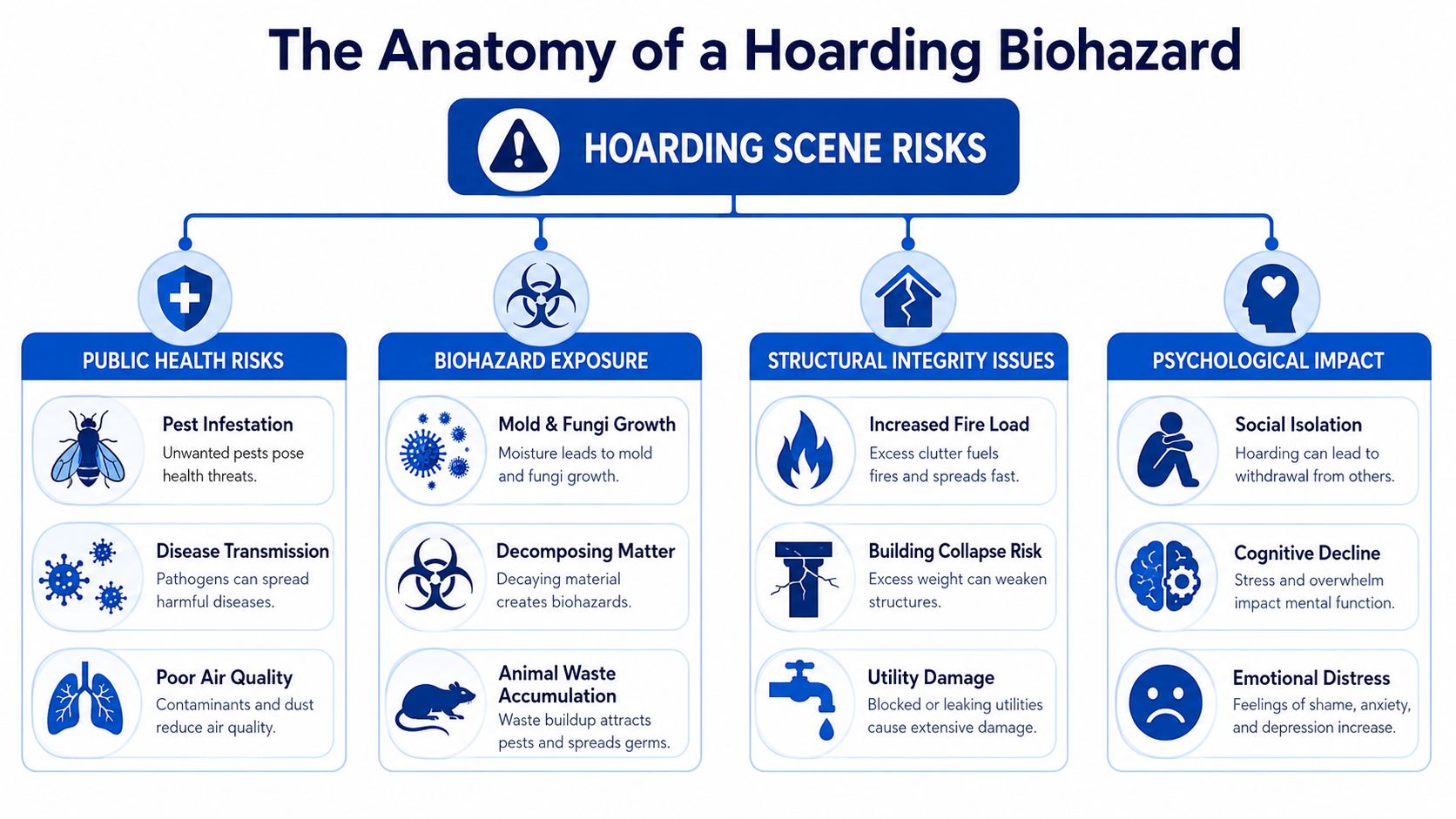
At the worst end of the spectrum, a hoarded property stops being a housekeeping issue and becomes a biohazard scene. The Collyer residence is one of the clearest historical examples because the accumulation itself changed how the building functioned and how people could move inside it.
When contents become a structural hazard
The Collyer brothers' Harlem brownstone contained over 140 tons of hoarded materials, creating a labyrinth of tunnels rigged with booby traps. This extreme volume directly caused Langley's death when a trap collapsed, and led to Homer's death by starvation as he was unable to be reached, according to the historical summary on the Collyer brothers.
For remediation teams, that kind of environment changes everything. You don't just remove items. You assess load, access, hidden voids, unstable stacks, entrapment points, and whether workers can safely enter at all. In many scenes, the visible clutter is only the first layer of risk.
A practical primer on what makes a scene hazardous starts with this principle: if the environment can injure the entrant before cleanup begins, the response has to be structured like hazard control, not janitorial work.
The main risk categories
From the field perspective, hoarding scenes usually combine several danger types at once:
| Risk area | What it means on site |
|---|---|
| Access failure | Narrow or blocked pathways slow escape, rescue, and item removal |
| Air quality problems | Dust, mold, decomposition, and animal waste can make entry unsafe |
| Fire load | Dense paper, textiles, and mixed debris increase ignition and spread risk |
| Utilities and infrastructure | Damaged plumbing, unsafe wiring, and hidden leaks can sit behind piles |
| Biological contamination | Bodily fluids, spoiled food, pests, and feces can contaminate broad surface areas |
Why untrained entry is dangerous
Property owners sometimes assume the first task is “clearing a path.” In a severe case, that can be the most dangerous part. Moving one stack shifts another. Opening a compressed room can release particulates and odor. Pulling debris from a tunnel can trigger collapse.
Practical rule: if occupants, responders, or family members can't move through the home safely and predictably, the scene needs a hazard assessment before anyone starts hauling items out.
The Collyer house became infamous because the risks were dramatic. Modern scenes may look less extreme from the outside, but the underlying mechanics are often similar.
The Collyers Mansion A Professional Benchmark
In remediation and fire services, the phrase Collyer Mansion didn't emerge as folklore by accident. It became shorthand for an environment where clutter isn't merely excessive. It's operationally dangerous.
What the term means in practice
Forensic analysis determined Homer Collyer died from malnutrition and dehydration. Langley died from suffocation after being crushed by debris. The case established the term “Collyer Mansion” in remediation industries to denote environments where extreme clutter creates lethal structural and access hazards, as described in this industry account of the case and its legacy.
That term matters because it guides professional judgment. When responders hear it, they don't think “dirty house.” They think hidden pathways, unstable loads, possible entrapment, delayed body recovery, limited visibility, contamination spread, and a work plan that may need specialized debris removal rather than ordinary cleaning.
The benchmark is still useful today
The Collyer case remains instructive for three reasons:
- It links clutter to mortality: the accumulation wasn't background context. It directly shaped both deaths.
- It shows why access is a life safety issue: being physically close to a dependent person doesn't help if the route is blocked.
- It changed professional vocabulary: emergency and remediation teams still use the case as a reference point for extreme interior hazard conditions.
In field operations, labels matter because they trigger decisions. Teams choose entry methods, PPE levels, staffing, debris-handling strategy, and whether outside trades need to be involved. A "Collyer Mansion" level environment tells a professional not to improvise.
Why historical literacy matters in remediation
A lot of unsafe cleanup happens because people underestimate complexity. They see newspapers, furniture, and household overflow. A trained team sees load distribution, body fluid risk, pest pathways, respiratory exposure, and legal disposal requirements.
That difference is what turns a tragedy from a spectacle into a lesson. The Collyer brothers' story is still taught, discussed, and remembered because modern responders need the same discipline their home demanded, just with better standards and safer tools.
The Modern Solution Professional Hoarding Remediation
The lesson from the Collyer brothers is not that a home can fill beyond reason. It is that once accumulation crosses into contamination, blocked access, and unstable interior conditions, cleanup becomes a regulated life-safety operation. Modern hoarding remediation is built to handle exactly that kind of scene with planning, documentation, and respect for the people tied to the property.
Early decisions matter. Families often assume they need one crew for everything, but clean, salvageable belongings and contaminated contents do not belong in the same workflow. Practical packing guidance, such as TLC Moving & Storage expert packing tips, can help protect items that are safe to move. A separate remediation plan is needed for areas affected by bodily fluids, decomposition, pest activity, mold, sharps, or heavy debris load.
Regulation changes the response
Professional biohazard remediation requires adherence to OSHA's Bloodborne Pathogens Standard (29 CFR 1910.1030). That means written exposure control plans, worker training, PPE selection, and procedures for handling potentially infectious materials. General junk removal crews and ordinary house cleaners are rarely set up for that level of responsibility.
The trade-off is straightforward. A lower-cost crew may clear visible debris faster, but speed without hazard controls can spread contamination, injure workers, and create liability for the owner. In a severe hoarding case, safe progress beats fast progress.
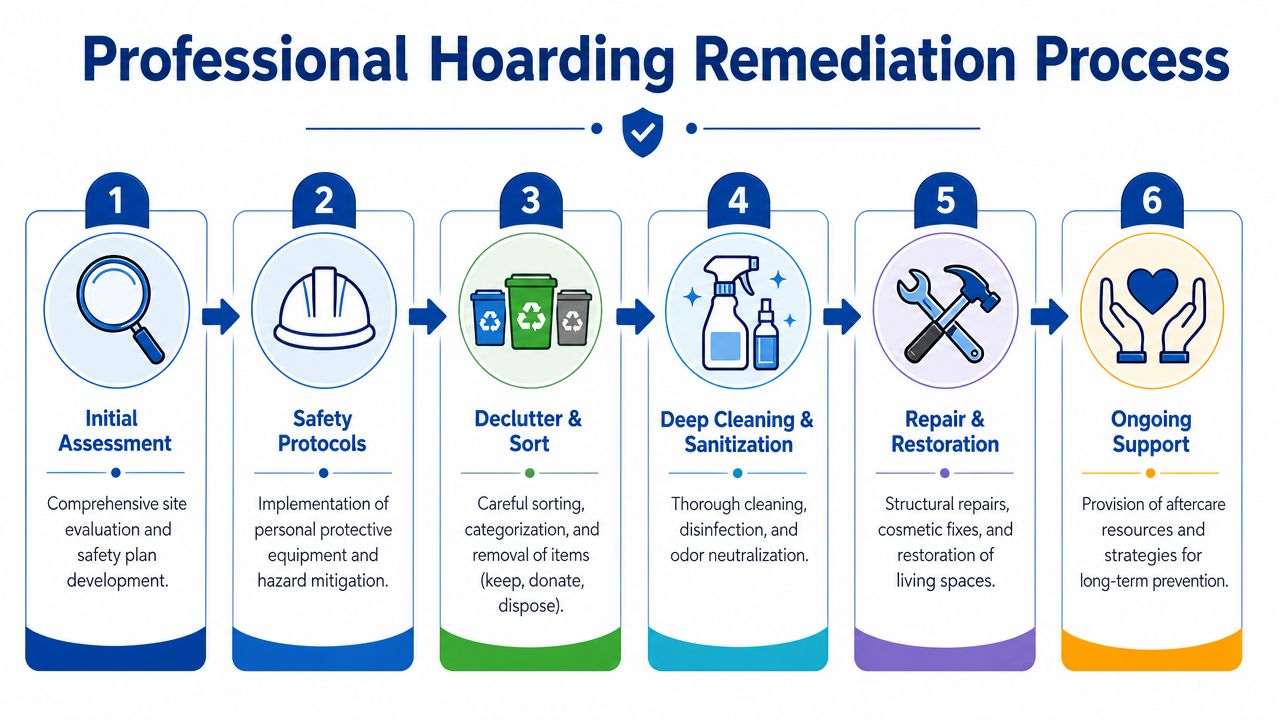
What a real remediation sequence looks like
A disciplined hoarding response follows an order that protects both the crew and the structure.
Assessment comes first
Teams evaluate access points, contamination, utilities, structural stress, pest activity, and the needs of any occupant still connected to the property. Some homes can be entered immediately. Others need limited entry, added lighting, air monitoring, or coordination with other trades before removal starts.Containment and PPE follow
Work zones are established to limit cross-contamination. Respiratory protection, gloves, eye protection, protective suits, and puncture-resistant measures are selected based on what the crew may contact, not what the room looks like from the doorway.Removal is methodical
Crews sort for salvage, general debris, regulated waste, and materials that can fail when shifted. That takes time. In my field, rushing this phase is how hidden sharps, saturated flooring, and collapsing piles hurt people.
Before going further, it helps to see the sequence in action:
Cleaning and disinfection come after gross removal
Surfaces must be exposed before they can be cleaned and treated correctly. Odor reduction, residue removal, and targeted disinfection only work when the buried structure is finally accessible.Waste handling stays compliant
Contaminated materials cannot be bagged with ordinary trash and forgotten at the curb. Packaging, labeling, transport, and final disposal have to match the waste category and local requirements.
What doesn't work
Unplanned family cleanouts fail in predictable ways. People try to save everything at once. They carry contaminated contents through clean areas, miss hidden hazards, and make unstable rooms less stable with every rushed pass.
For people looking at providers, services focused specifically on hoarder cleanup companies are the right starting point. One available option is 360 Hazardous Cleanup, which handles hoarding cleanup and biohazard remediation with in-house technicians, discreet response, and regulated waste procedures. The standard to look for is not marketing language. It is whether the provider can assess the scene correctly, protect the people involved, document the work, and return the property to a condition where recovery can begin.
From Tragedy to Prevention How to Help
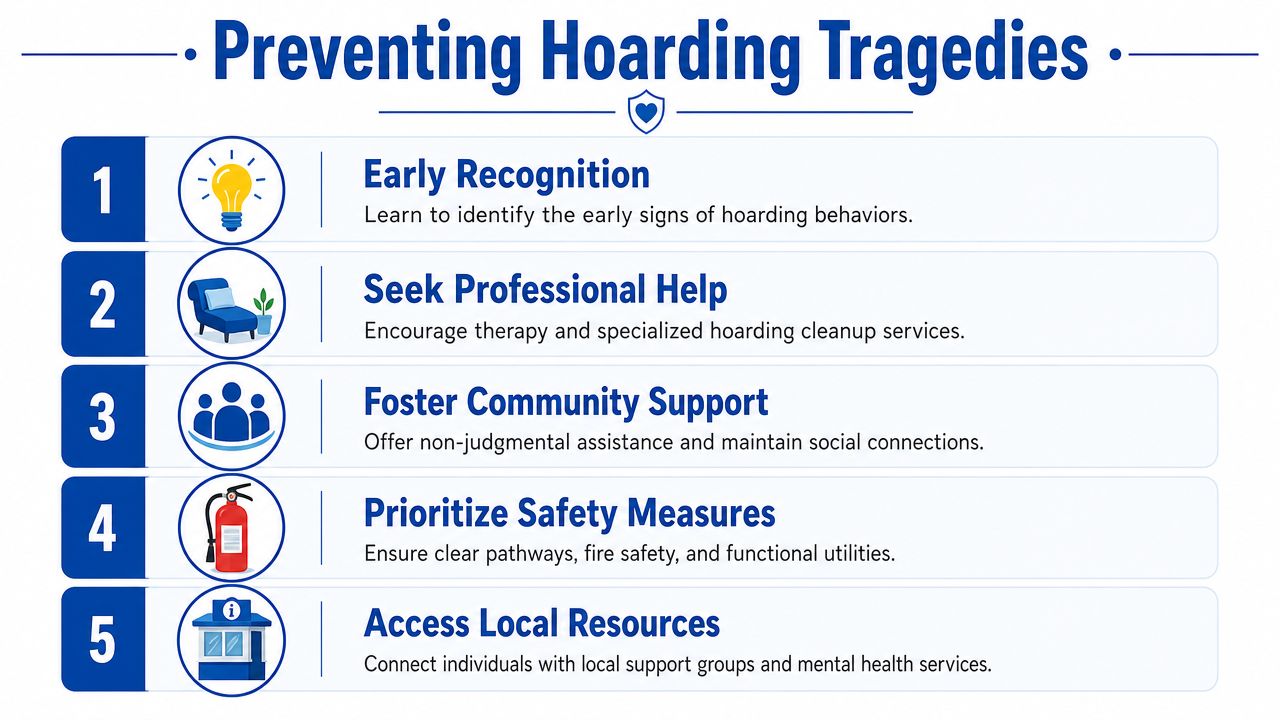
Most hoarding tragedies don't begin with a dramatic collapse. They begin with withdrawal, missed maintenance, blocked rooms, embarrassed silence, and a growing reluctance to let anyone inside. Prevention starts when someone notices those changes and responds without ridicule.
First steps that help
If you're worried about a parent, tenant, neighbor, or client, keep the first conversation focused on safety and support.
- Lead with observation: mention blocked exits, spoiled food, tripping hazards, or nonworking utilities instead of arguing about cleanliness.
- Protect dignity: ask permission before touching belongings or inviting others into the home.
- Build a team: complex cases often need a mental health professional, a medical provider, and a cleanup specialist working in parallel.
- Watch decision-making capacity: if an older adult is refusing obvious help, legal guidance on addressing an elderly parent's care refusal may clarify next steps in difficult family situations.
The most effective intervention is usually the one that reduces immediate danger without treating the person like the danger.
Prevention is practical, not abstract
Safer outcomes usually start with a few concrete priorities:
- Clear egress routes: doors, hallways, and stairs have to remain usable.
- Restore core living functions: sleeping, toileting, medication access, and food preparation come before cosmetic improvement.
- Keep support connected: once the crisis phase passes, people still need follow-up and community contact.
When the behavioral side of the problem is ignored, the environment often deteriorates again. That's why collaboration matters. Programs that describe how cleanup teams work with mental health crisis support organizations reflect the model that tends to protect both the property and the person living in it.
The lesson of Homer and Langley Collyer isn't that some homes become strange. It's that isolation and impairment can make a home unreachable long before anyone calls it an emergency.
When a hoarding situation involves contamination, inaccessible rooms, unattended death, or serious safety hazards, 360 Hazardous Cleanup provides around-the-clock biohazard remediation with a trauma-informed, compliant approach. Families, property managers, care facilities, and first responders can use them as a practical resource for assessment, regulated cleanup, and coordination during high-stress situations.