A lot of people searching for biohazard cleanup in San Antonio are doing it under pressure. A family has just left the scene and doesn't know what to touch. A property manager has a unit that can't be re-entered safely. A clinic, warehouse, or long-term care site has contamination that janitorial staff shouldn't handle. In all of those cases, the first need is the same. Get the area secured, keep people out, and make decisions that protect health, insurance coverage, and legal compliance.
That's why the process matters as much as the cleanup itself. Biohazard remediation isn't just about removing visible material. It's about preventing exposure, documenting what was done, and restoring the space in a way that stands up to scrutiny from carriers, regulators, employers, and occupants.
Facing a Biohazard Emergency in San Antonio
If you're dealing with blood, bodily fluids, decomposition, drug residue, sewage-related contamination, or another potentially infectious scene, the safest first move is simple. Don't start cleaning. Don't sort contaminated belongings. Don't let untrained staff or relatives enter the space.
In San Antonio, these calls are not rare edge cases. The city sits in Bexar County, which recorded 2,391 violent crimes in 2022 and a violent-crime rate of about 171 per 100,000 residents, according to local reporting that summarizes FBI Uniform Crime Reporting data. That local context helps explain why trauma-scene, unattended-death, and crime-scene remediation remains an ongoing need alongside medical, residential, and industrial incidents. It also helps explain why 24/7 response is so important in this market.
What to do in the first few minutes
Focus on safety and control.
- Restrict access: Keep children, tenants, staff, and pets out of the area.
- Avoid contact: Don't touch porous materials, linens, carpet, furniture, or personal items that may be contaminated.
- Pause regular operations: If this is a business, clinic, rental, or common area, stop normal use until the scene has been assessed.
- Preserve documentation: Take only the photos or notes you need for the claim or internal report, and only if it's safe to do so.
- Call qualified help: Use a provider that handles containment, disposal, and documentation, not just surface cleaning.
Practical rule: If the scene involves blood, bodily fluids, decomposition, sharps, or unknown contamination, treat it as a health and liability issue first, not a housekeeping problem.
Families and property managers often want to “at least do something” while they wait. That instinct is understandable, but it usually creates more risk. Moving items can spread contamination. Using household disinfectants can give a false sense of safety. Throwing materials away incorrectly can create chain-of-custody and disposal problems later.
For a calm next-step checklist, review what to do and not do after discovering a biohazard. It helps you protect the site before a remediation team arrives.
Understanding Professional Biohazard Remediation
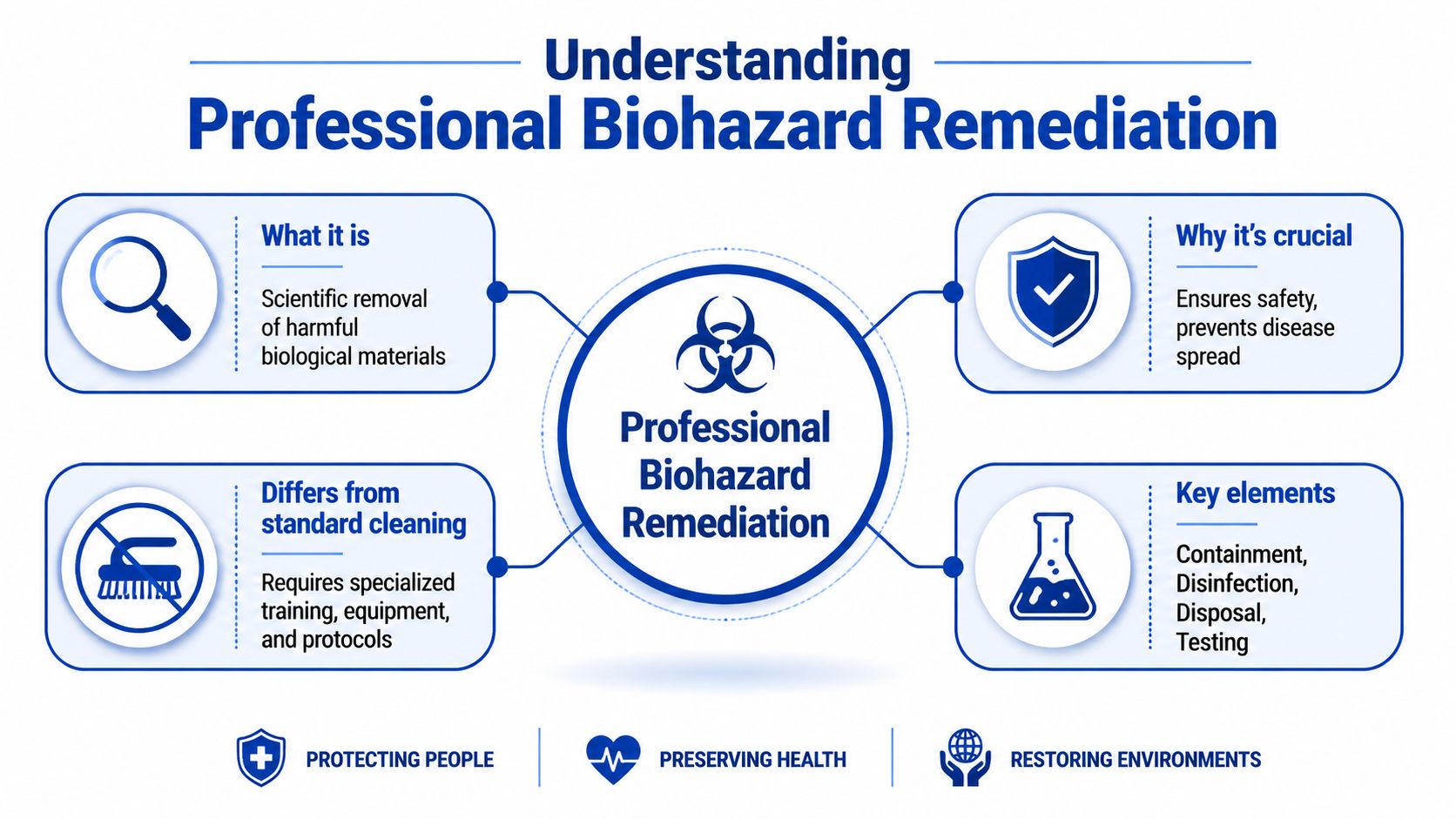
Professional remediation starts where ordinary cleaning stops. A janitorial crew can wipe a counter or mop a floor. A trained biohazard team has to determine what absorbed contamination, what must be removed, what can be disinfected, how to isolate the area, and how to dispose of waste legally.
Why standard cleaning isn't enough
Visible staining is only part of the problem. Fluids travel into seams, subflooring, carpet pad, grout lines, baseboards, upholstery, and cracks around fixtures. Organic residue also interferes with disinfection. If contaminated material stays in place, the chemistry doesn't work the way people assume it will.
Professional biohazard cleanup in San Antonio must follow OSHA 29 CFR 1910.1030 requirements, including the use of EPA-registered disinfectants effective against HIV and HBV, along with three levels of containment and negative air pressure machines with HEPA filters to reduce the spread of airborne contamination, as described in this San Antonio biohazard training overview.
What professional remediation includes
A proper response usually involves several disciplines at once:
| Need | What a trained team addresses |
|---|---|
| Exposure control | PPE, restricted access, containment barriers, safer work practices |
| Decontamination | Removal of solids, cleaning, disinfectant selection, correct dwell time |
| Air management | Negative pressure and HEPA filtration where cross-contamination is a concern |
| Waste handling | Packaging, transport, and disposal through the right channels |
| Documentation | Work records, waste logs, photos, and verification steps for insurers or facility files |
That's why the phrase biohazard cleanup San Antonio should never be confused with “deep cleaning.” One is aesthetic. The other is regulated, safety-driven remediation.
Cleaning what you can see and remediating what can harm people are not the same job.
If you want a plain-language breakdown of the difference, this overview of what biohazard cleanup is and why you should always hire a professional is a useful companion resource.
The Remediation Process Step by Step
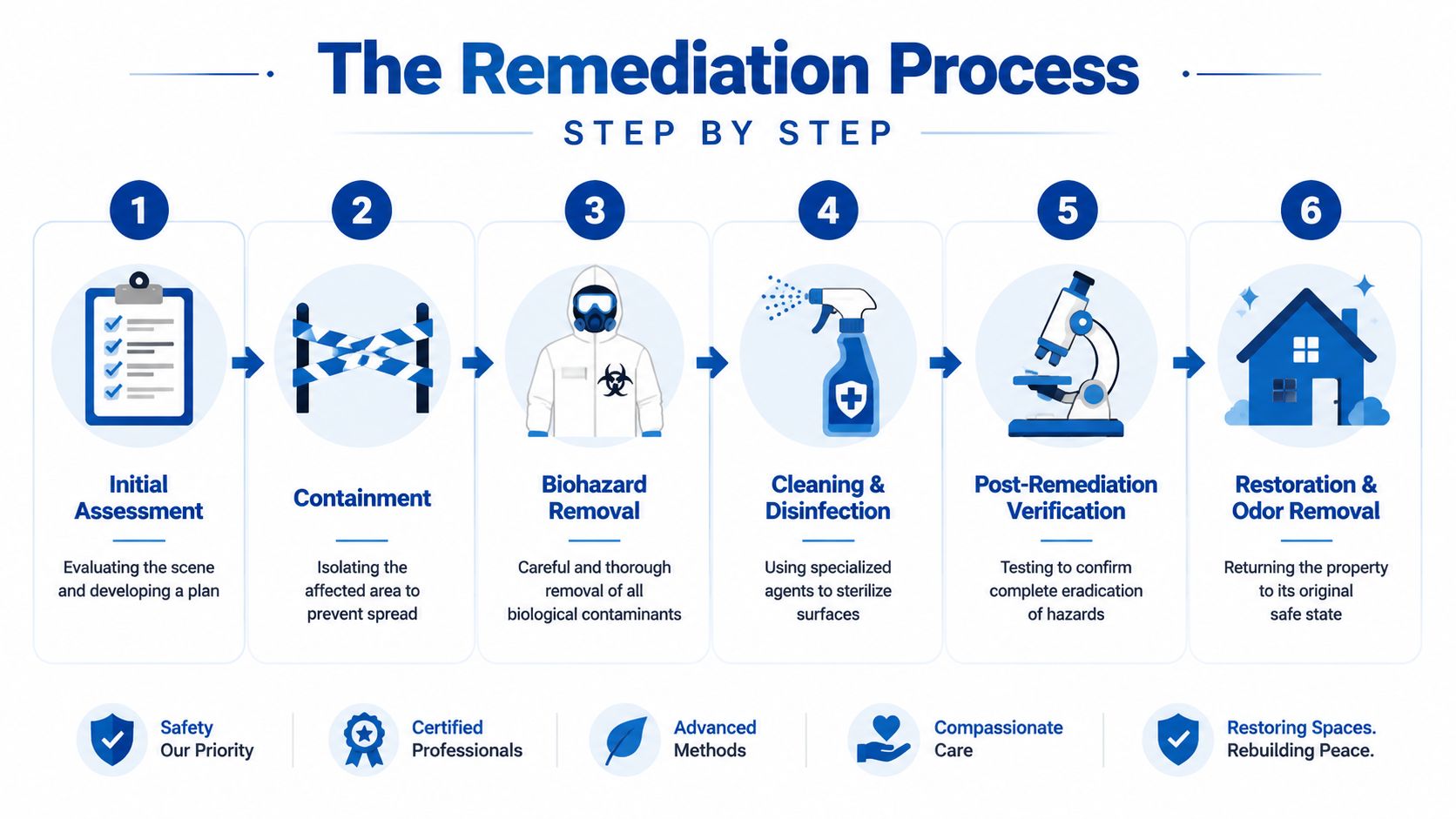
When people don't know what will happen on site, stress goes up. A clear process helps. The work is methodical for a reason. Each stage supports the next one, and skipping steps is where failed cleanup starts.
A visual summary helps before getting into the details.
The seven-step workflow
In San Antonio, the cleanup protocol commonly follows a seven-step process: site assessment and containment, removal of contaminated materials, application of enzymatic cleaners, disinfection, quality assurance with ATP testing to verify microbial extinction, deodorization, and proper disposal of all hazardous waste, as outlined in this step-by-step remediation reference.
Here's what those steps look like in practice.
Assessment and scene control
Technicians identify affected rooms, likely migration paths, porous materials, and any access risks. In a home, that may include flooring transitions, bathrooms, hallways, or HVAC-adjacent areas. In a commercial space, it may include workstations, restroom partitions, dock areas, treatment rooms, or shared corridors.Containment setup
Barriers go up before real cleaning begins. This limits foot traffic and helps keep contamination from moving into clean areas. In more complex losses, air movement also has to be managed.Removal of contaminated materials
Some materials cannot be salvaged safely. Carpet pad, porous furnishings, sections of drywall, insulation, ceiling tile, and soft goods may need to come out. This is often the part families find hardest, but it's also one of the most important.Enzymatic cleaning and disinfection
Organic matter has to be broken down and removed so disinfectants can work as intended. The order matters. Spraying first and hoping for the best doesn't solve the problem.
A short video can make the sequence easier to understand in real-world terms.
What happens after the visible cleanup
The last stages are where experienced teams separate themselves from superficial work.
- Quality assurance: ATP testing provides a verification step rather than relying only on appearance or smell.
- Deodorization: Odor control comes after physical removal and cleaning, not in place of them.
- Waste disposal: Materials must be packaged and routed through proper disposal channels.
- Final review: The site is documented and prepared for safe re-occupancy or the next restoration phase.
If odor is still being “covered up,” the job usually isn't finished. True odor correction follows removal and decontamination.
For a more detailed walkthrough of site flow, expectations, and restoration sequencing, this step-by-step guide to the biohazard cleanup process is helpful for both families and facility teams.
Common Scenarios Requiring Biohazard Cleanup
Not every call looks the same, and that matters because the response plan changes with the setting. A residential death scene, an occupied apartment, a clinic room, and a warehouse incident all carry different risks, documentation needs, and emotional realities.
Residential trauma and unattended death scenes
These are often the calls families fear most. The scene may involve blood, bodily fluids, decomposition, or contamination that has spread beyond the first area people notice. Bedrooms, bathrooms, hallways, mattresses, subflooring, and personal items can all be affected.
The practical challenge isn't only technical. It's emotional. Families need a team that can work without adding distress, while still making firm decisions about what can be cleaned and what has to be removed.
Hoarding and neglected property conditions
Hoarding cases often involve layered hazards rather than a single event. Human or animal waste, pests, sharps, food spoilage, mold-related damage, and blocked exits can all appear in the same structure. Property managers also run into these situations after tenant abandonment or eviction.
What doesn't work in these cases is treating the project like junk removal alone. The cleanup plan has to separate disposal, decontamination, and structural salvage. It also needs a sequence that protects workers and prevents contaminants from spreading to clean rooms or common areas.
Commercial, industrial, and healthcare incidents
This is one of the biggest gaps in local awareness. Beyond residential trauma, biohazard cleanup services are also critical for commercial and healthcare compliance, especially where employers must address OSHA bloodborne-pathogen rules, regulated medical waste handling, and industrial contamination in places such as plants, clinics, and long-term care facilities, as discussed in this San Antonio service overview.
In those environments, a manager usually has to answer questions fast:
- Can in-house staff handle any portion of this safely
- Does the area need to be isolated from patients, tenants, staff, or production
- What documentation will support re-occupancy
- How will waste be tracked and removed
- What should be preserved for HR, legal, risk, or insurance review
Vehicles, common areas, and mixed-use properties
A surprising number of losses happen outside the single-family home. Ride-share vehicles, fleet vehicles, stairwells, elevators, hallways, vacant units, office restrooms, and loading areas all create a harder containment problem because other people may still need access nearby.
That's where experience shows. The work has to stay discreet, but it also has to be controlled. A rushed response that leaves one adjacent area unchecked can create a second problem later.
Navigating Costs and Insurance for Biohazard Services
Cost is usually the question people ask second, right after “How soon can someone get here?” It's a fair question. The problem is that many local pages talk about fast response and compassion but leave out the part clients need most. How billing works, what insurance may cover, and what paperwork matters.
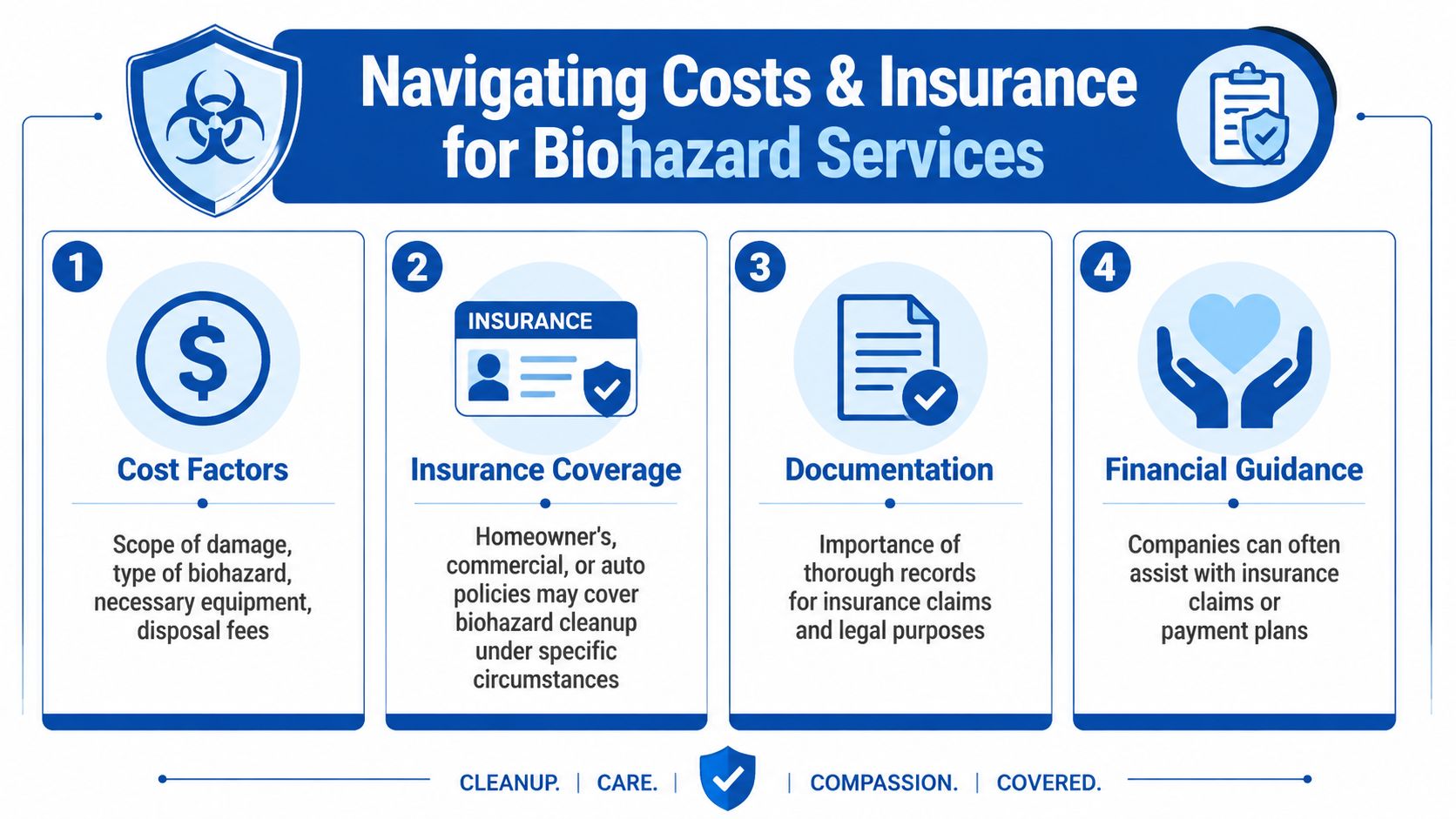
A major information gap in San Antonio is insurance clarity. Local biohazard pages often emphasize around-the-clock service, but few explain that remediation is often covered by homeowners, commercial, or liability insurance policies, or which records insurers may require to move a claim forward, as noted in this industry discussion of the coverage gap.
What usually drives cost
Pricing depends on the actual loss, not just square footage.
- Type of contamination: Blood, decomposition, waste, drug residue, sewage, and mixed losses each require different handling.
- Material impact: Hard surfaces may be cleanable. Carpet pad, upholstery, drywall, insulation, or furniture may not be.
- Access conditions: Multi-unit buildings, active businesses, healthcare spaces, and secured scenes often require more coordination.
- Waste disposal: Regulated disposal is part of the job, not an optional add-on.
- Documentation needs: Insurance, legal, and compliance files may require more detailed records.
A good provider won't guess from a few photos if the conditions require an on-site assessment. That isn't evasive. It's responsible.
What to ask before authorizing work
Insurance coverage depends on the policy, the event, and the cause of loss. That said, homeowners, commercial property, and liability coverage may apply in many situations. The fastest way to avoid confusion is to ask direct questions early.
Use this checklist:
| Question | Why it matters |
|---|---|
| What caused the loss | Coverage often turns on cause, not just cleanup category |
| Is emergency mitigation covered | Some policies treat immediate protective work differently from later repairs |
| What documentation is required | Photos, scope notes, invoices, and disposal records may all matter |
| Is there a deductible | Clients need to know their out-of-pocket responsibility up front |
| Will the carrier review salvage decisions | This can affect contents handling and rebuild scope |
If you need help understanding policy language before speaking with a carrier, this guide on how to read an insurance policy gives a useful plain-English starting point.
Claims advice: Ask for itemized documentation early. It's easier to build a clean claim file from day one than to reconstruct one after emergency work is complete.
A remediation contractor should also be able to explain what they document and why. That includes the condition of the site, affected materials, disposal handling, and the work performed to return the area to a safe state. One option families and property owners consider is insurance guidance for biohazard cleanup through 360 Hazardous Cleanup, which focuses on claim coordination and required paperwork.
Choosing the Right Biohazard Cleanup Company in San Antonio
In a crisis, people often call the first name they find. That can work out fine. It can also leave you with a contractor who knows how to clean visible messes but not how to manage regulated waste, containment, insurance files, or sensitive occupant communication.
What separates a qualified provider
The trade is specialized for a reason. The industry is anchored by the OSHA Bloodborne Pathogens Standard from 1991, and San Antonio job postings for this work commonly show pay around $15 to $25 per hour, or roughly $30,000 to $50,000 annually, which reflects the skill, risk, and availability demands involved, according to local job-market listings for biohazard cleaning roles. That doesn't just tell you what technicians earn. It tells you this is a trained compliance role, not casual labor.
A decision checklist that actually helps
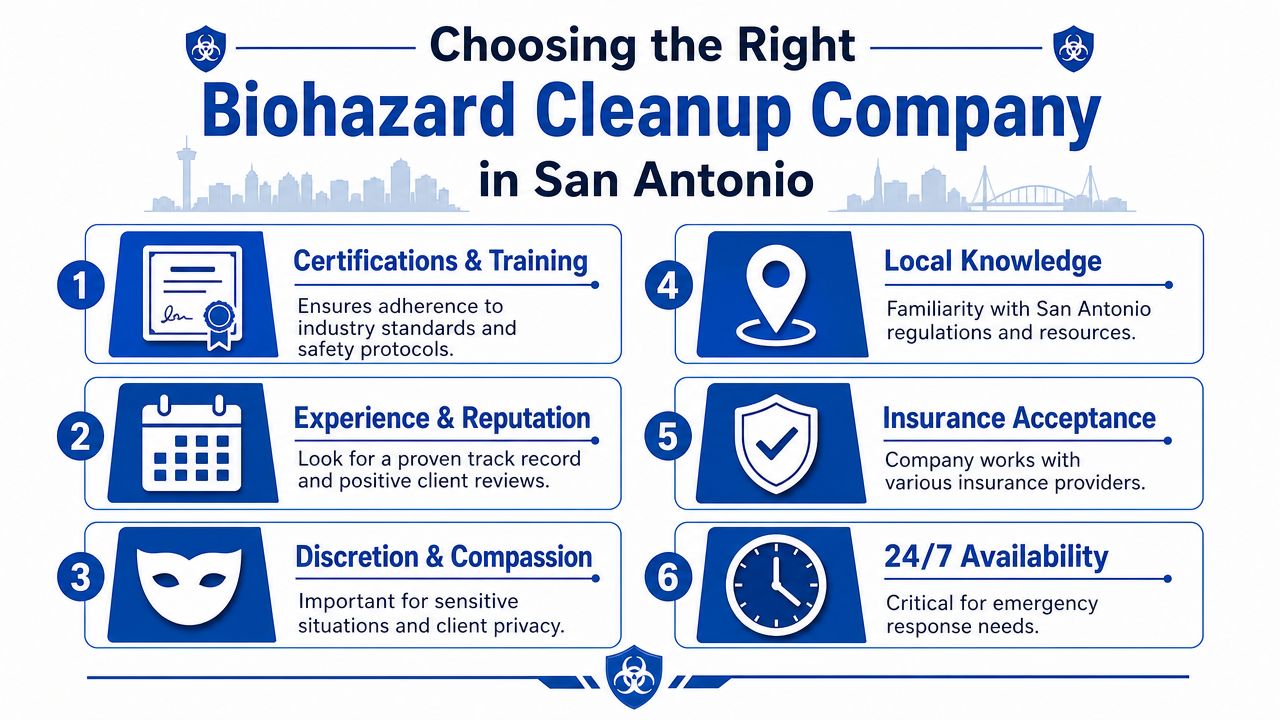
Look for a company that can answer these questions clearly:
- Training and compliance: Can they explain their safety procedures, PPE use, containment methods, and disposal process in plain language?
- Scene experience: Have they handled residential, commercial, and sensitive-loss environments, not just one category?
- Documentation discipline: Can they provide the records an insurer, facility manager, or risk department may need?
- Discretion: Will they discuss vehicle marking, access control, and privacy expectations before arrival?
- Operational readiness: Can they respond quickly and coordinate with law enforcement, property management, maintenance, or clinical leadership when needed?
A weak answer to any one of those doesn't automatically disqualify a company. Several weak answers should.
Red flags to notice early
Some warning signs show up in the first phone call.
- They talk only about cleaning products: That usually means they're underselling containment, disposal, and verification.
- They promise a price before understanding the loss: Serious remediation requires scope.
- They avoid insurance questions entirely: Even if they don't interpret coverage, they should understand claim documentation.
- They can't explain what happens to contaminated materials: Disposal is part of the service, not a vague afterthought.
A practical screening resource is what to consider when choosing a biohazard cleanup company. It helps owners and facility teams vet providers before authorizing work.
Frequently Asked Questions About Biohazard Cleanup
How long does biohazard cleanup take
It depends on the size of the affected area, the materials involved, access conditions, and whether structural removal is needed. Some scenes are resolved quickly. Others require containment, demolition of unsalvageable materials, odor treatment, and detailed documentation before the site is ready for re-entry.
Can family members or maintenance staff clean part of it first
That's usually a mistake. Untrained cleanup can spread contamination, damage salvageable areas, and complicate insurance or internal reporting. If there's any doubt, keep the area secured and wait for an assessment.
What happens to contaminated items
Items that cannot be safely decontaminated are packaged, documented as needed, and routed for proper disposal. The point isn't just to “throw things away.” The point is to remove unsafe materials in a compliant manner and maintain a defensible record of what left the site.
Will the company help with insurance paperwork
A capable provider should help assemble the work records that support a claim, even though they don't decide coverage. That usually means photos, scope notes, invoices, and disposal-related documentation. For property managers and commercial clients, it may also include records needed for internal reporting.
Are discreet response options available
Many clients ask this, especially in residential neighborhoods, multifamily communities, and occupied commercial sites. Discretion is a legitimate operational concern, and it's reasonable to ask about vehicle appearance, site access, and how crews will move through the property.
When should a facility call a remediation vendor instead of using in-house staff
Call a specialist when the situation involves bloodborne-pathogen risk, regulated waste, unknown contamination, occupant exposure concerns, or any event that may require formal documentation before re-occupancy. In-house staff may be excellent at environmental services or maintenance, but that doesn't automatically mean they should handle a biohazard loss.
The safest standard is simple. If the cleanup decision could affect health, liability, or claim approval, bring in trained remediation personnel first.
If you need help now, 360 Hazardous Cleanup provides 24/7 biohazard remediation for families, property managers, healthcare facilities, and commercial sites. The practical next step is to secure the area, avoid disturbing materials, and speak with a trained team that can explain the scope, documentation, and safe path forward.