You walk into a warehouse bay and smell something sharp and unfamiliar near a pallet. Or a nurse manager gets a report about a leaking container in a soiled utility room. Or a property manager opens a rental unit and finds residue, open chemicals, or an unknown powder where no one can explain what happened.
That moment feels chaotic because you don't yet know what you're dealing with. The good news is that emergency hazmat response is not guesswork. It's a controlled process with clear priorities, defined roles, and a sequence of handoffs that carry the incident from first discovery to final clearance.
Property owners and facility managers usually see only one slice of that timeline. They see the 911 call, or the fire department, or the cleanup crew, or the insurance paperwork. What matters most is understanding how those pieces fit together so you can protect people, preserve the scene, and avoid decisions that make a bad event worse.
Understanding Emergency Hazmat Response
A hazmat incident doesn't have to look dramatic to be serious. Sometimes it's obvious, such as a damaged drum at a loading dock. Sometimes it's subtle, like a strange odor in a mechanical room, a leaking battery storage cabinet, or a bodily fluid event mixed with chemical exposure concerns in a healthcare setting.
Emergency hazmat response means the organized actions taken to protect life, control the scene, identify the hazard, and move the incident toward safe resolution. That process starts long before cleanup crews begin scrubbing surfaces or removing waste. It begins with isolation, notification, and command.
The reason for that structure is simple. In the United States, the federal government receives an average of 12 reports of hazardous substance releases every day, and the EPA instructs the public to report hazardous materials releases and oil spills by dialing 911 or the National Response Center, which shows why early response is built around life safety and scene control first, not delayed cleanup decisions (EPA emergency response guidance).
What property owners often misunderstand
Many people hear “hazmat cleanup” and think of mops, absorbents, and disposal drums. That's only one piece. Before cleanup starts, responders need to answer questions that affect every decision after that:
- What is the hazard. Is it known, suspected, or completely unidentified?
- Who may have been exposed. Staff, tenants, patients, contractors, visitors?
- How is it moving. Air, runoff, foot traffic, HVAC, porous materials?
- Who has authority on scene. Fire command, law enforcement, environmental health, site leadership?
If you need a plain-language overview of what hazardous materials cleanup can involve after that initial emergency phase, it helps to think of it as a controlled transition from public safety response to regulated remediation.
The first objective is not to “fix the mess.” The first objective is to stop people from becoming part of the incident.
Why the timeline matters
A strong response protects more than health. It protects business continuity, evidence, insurance recovery, and regulatory standing. When the right steps happen in the right order, the event becomes manageable.
For facility teams that need support after the emergency phase, hazmat services typically begin once the scene is stabilized and access can be coordinated safely.
Immediate Safety Actions You Must Take
When someone discovers a possible hazardous material release, the safest response is usually the least dramatic one. Don't rush in. Don't start identifying containers by smell. Don't send a maintenance worker to “take a quick look” if the situation is unclear.
Most public guidance tells people to isolate the area, move upwind, and avoid entry. CHEMM also says the first priorities are to recognize the incident, establish an isolation zone, take only trained actions, and use a structured notification format that includes location, hazards, access, numbers exposed, and services already on scene (CHEMM quick response guidance).
What to do in the first minutes
Use this checklist if you're the first person to discover the problem or the first manager notified.
Stop entry immediately
Keep staff, tenants, patients, or bystanders out of the area. Close doors if that can be done without entering the hazard zone.Move to a safer position
If you're outdoors, move upwind. If you're indoors, back out and avoid passing through visible residue, vapor, or pooled liquid.Call 911 and give structured information
Give the exact location, what was seen or smelled, whether anyone is injured, how responders can access the site, and whether utilities, alarms, or ventilation systems may affect the scene.Account for exposed people
Identify who was near the area and where they are now. Don't send anyone back in to retrieve personal items or equipment.Preserve the scene
Don't move containers. Don't start ventilation changes unless directed by responders or your internal safety plan.
What not to do
Some of the most expensive and dangerous incidents get worse because someone tries to be helpful.
- Don't improvise cleanup with shop towels, bleach, floor machines, or standard janitorial supplies.
- Don't guess the substance from color, odor, or container shape.
- Don't enter for a rescue unless trained and equipped. A second victim helps no one.
- Don't let untrained staff decide it's “minor” without a hazard-based assessment.
The practical reporting script
When you call, keep it short and useful:
- Location. Exact building, floor, room, dock, or unit number.
- Observed hazard. Odor, smoke, liquid, residue, damaged container, powder, bodily fluid, battery damage, unknown substance.
- Exposure status. Anyone symptomatic, contaminated, or missing.
- Access details. Best entrance, gate code, elevator status, loading route.
- Current controls. Doors closed, area isolated, alarm active, HVAC status if known.
If you want your team to have a simple prewritten playbook for neighborhood or facility incidents, this guide on what to do if you encounter a hazardous situation in your neighborhood is useful because the same first-minute discipline applies on private property.
Practical rule: If you don't know what it is, treat it as more dangerous than it looks until trained responders say otherwise.
Who Is Involved in a Hazmat Response
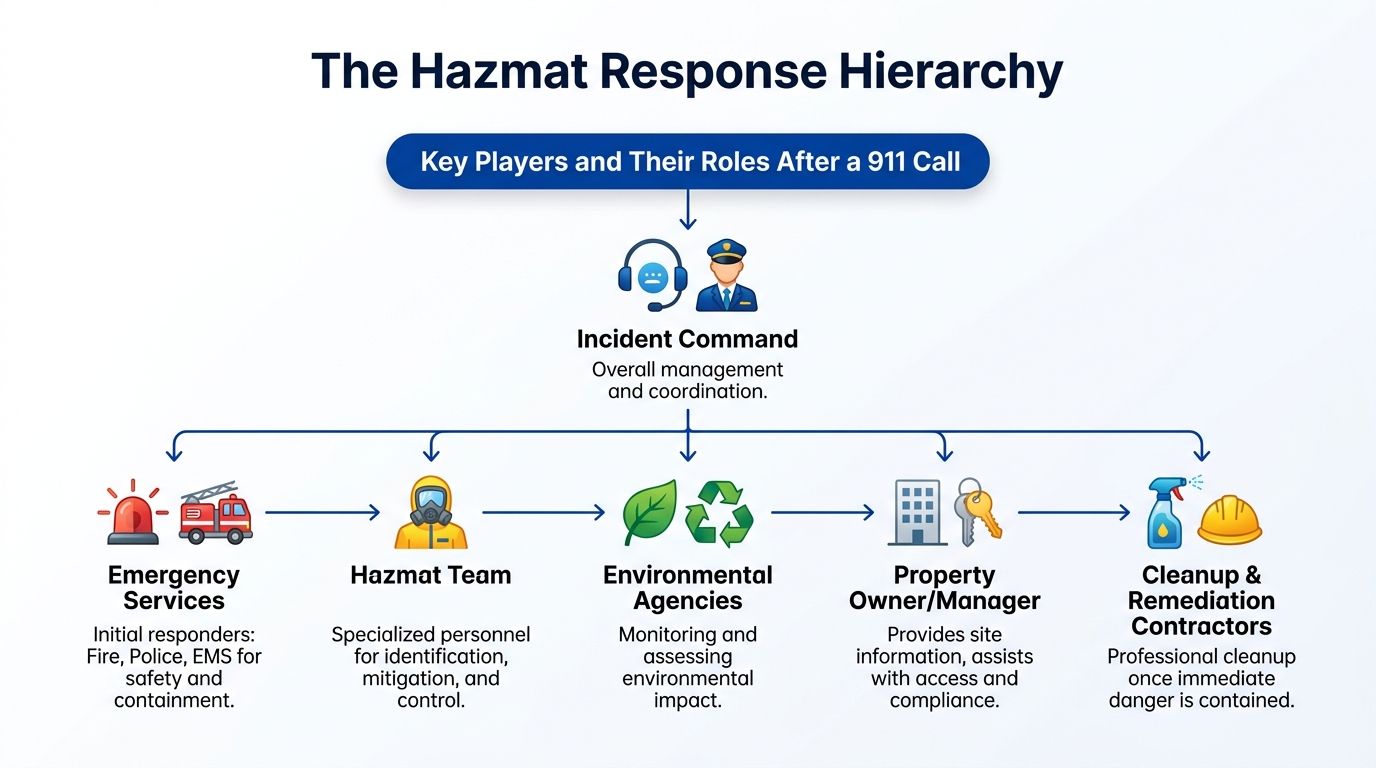
After the 911 call, the scene usually feels busy fast. Vehicles arrive. Someone establishes command. Access gets restricted. Different uniforms appear to be doing different jobs. That isn't confusion. It's specialization.
The command side of the scene
The local fire department often takes the lead in initial incident command. Their priorities are scene safety, protective actions, rescue if feasible, and stabilization. Law enforcement may secure the perimeter, control traffic, preserve evidence, or support evacuation control.
Specialized hazmat personnel handle the technical side. They work on hazard identification, air monitoring, leak control, decontamination strategy, and safe operational entry. Their decisions depend on reliable information, not instinct.
Under PHMSA guidance, hazardous materials in transportation must be accompanied by emergency response information that includes the immediate hazard to health, fire or explosion risks, and spill or leak methods, and this information must be immediately available with an emergency response telephone number. That requirement exists so responders can make better decisions in the first critical minutes (PHMSA emergency response information guidance).
Your role as the owner or manager
You are not expected to run the incident. You are expected to support it.
A good property representative helps by providing:
| Role need | Useful information from you |
|---|---|
| Site access | Keys, gate codes, after-hours entry points |
| Building systems | HVAC zones, shutoffs, utility locations |
| Occupancy details | Who was present, where people moved, restricted populations |
| Site history | Stored materials, recent work, vendor activity, prior complaints |
That information can be the difference between a fast, precise response and a wider shutdown.
The later-arriving players
Environmental health staff, agency representatives, safety officers, insurers, and remediation contractors may come in after the immediate danger is reduced. That's where many owners get frustrated. They expect one team to do everything from first alarm to final invoice.
That's rarely how it works. Public responders stabilize emergencies. Remediation teams restore the property. Insurers evaluate coverage. Regulators focus on reporting, safety, and proper handling. Each handoff matters.
If you want a clearer view of how cleanup contractors coordinate with official responders, how 360 Hazardous collaborates with law enforcement and first responders gives a practical look at that transition.
Understanding Your Legal and Regulatory Duties

Once the scene is stabilized, the next question is usually, “What am I responsible for now?” The answer depends on the material, the setting, who was exposed, and whether the release was incidental or beyond the capability of on-site staff.
OSHA's emergency-response standard covers hazardous waste operations broadly. The critical distinction is whether this was an incidental spill that knowledgeable staff can clean or a situation requiring specialist help. The more useful question is not just what leaked, but who is trained, what is the exposure pathway, and whether the site has been decontaminated enough to re-enter (OSHA 1910.120).
What creates liability
Liability usually grows from decisions made after the incident, not just from the incident itself.
- Allowing untrained cleanup can expose workers and spread contamination.
- Reopening too early can create a second exposure event.
- Poor waste handling can turn a contained problem into a disposal and documentation problem.
- Weak documentation can complicate insurance, employee health follow-up, and regulatory review.
The handoff most people miss
Property owners often assume that once the fire department leaves, the incident is over. In practice, that's when your private obligations become more important.
You may need to coordinate:
- Restricted access until safe re-entry is verified
- Environmental health review for healthcare, housing, or sensitive occupancy
- Waste characterization and disposal records
- Cleaning scope decisions for porous contents, hard surfaces, HVAC components, and adjacent spaces
Re-entry is a decision, not a feeling. The site has to be released based on conditions, training, and decontamination status.
Why compliance helps operations
Compliance is not paperwork for its own sake. It protects your staff from preventable exposure, protects the property from secondary contamination, and protects your organization from making unsupported safety decisions under pressure.
When owners treat hazmat remediation like general janitorial work, they usually create longer closures, more questions from stakeholders, and a harder insurance path. A compliant process is often the fastest route to a defensible reopening.
The Professional Cleanup and Remediation Process
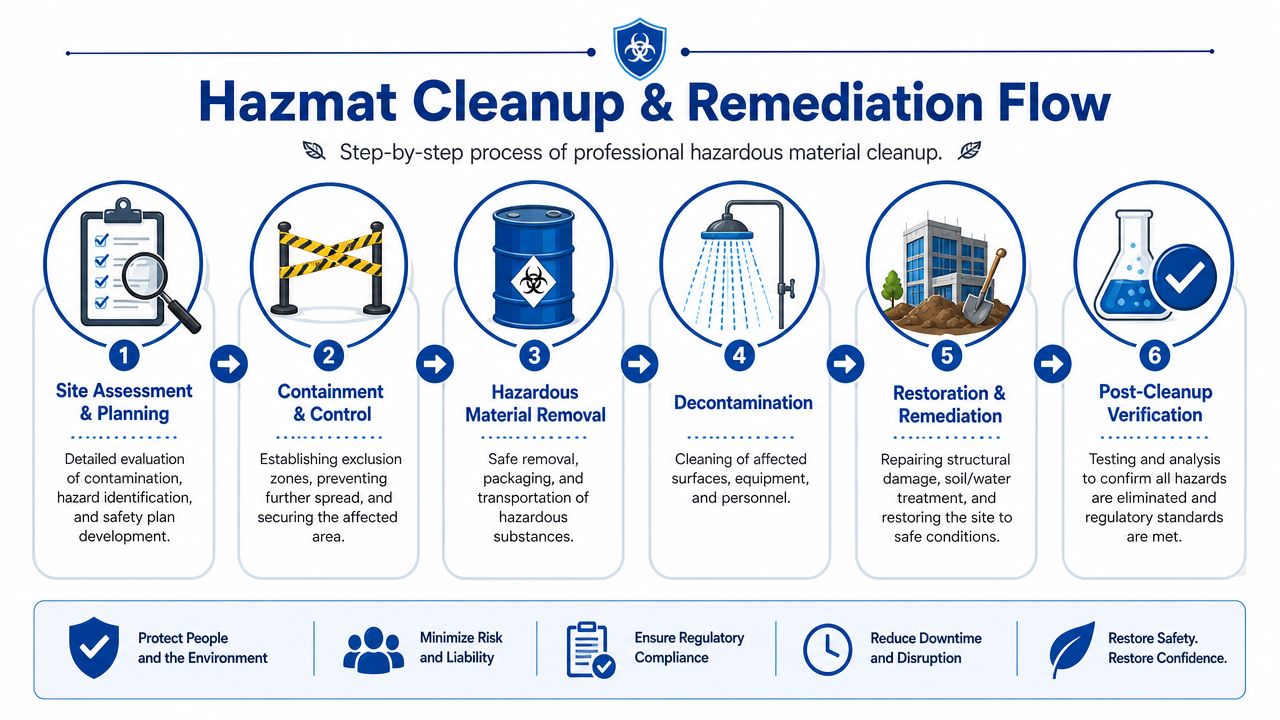
Once first responders release the scene for cleanup, remediation begins as a controlled project. Good teams don't rush to visible residue first. They establish the scope, define the boundaries of contamination, and build a work plan around the actual hazard and occupancy needs.
What happens when the crew arrives
The first phase is assessment. Technicians review incident reports, speak with site contacts, identify affected materials, and decide how the work area should be divided. In a warehouse, that might mean separating the spill footprint from clean inventory aisles. In a clinic, it might mean isolating patient-care pathways and clean utility rooms from the affected space.
Industrial best practice calls for continuous risk evaluation as conditions change. Plans should use pre-defined Emergency Response Zones and stage containment equipment, gas detectors, mobile decontamination units, and PPE. Linked gas detection and perimeter area monitors can create a live plume model without sending workers into the danger zone, which improves situational awareness and reduces unnecessary entry (Hazmat University planning guidance).
The working sequence on site
The actual cleanup usually follows a disciplined sequence:
- Containment first. Crews establish hot, warm, and support areas as needed, protect unaffected spaces, and control traffic paths.
- Removal next. Damaged contents, absorbents, disposable PPE, and unrecoverable materials are packaged for compliant transport and disposal.
- Detailed decontamination. Technicians clean structural surfaces, fixtures, equipment exteriors, and touchpoints using methods matched to the hazard.
- Verification and release. The team documents what was removed, what was cleaned, and what conditions support re-entry.
A related process appears in this step-by-step guide to the biohazard cleanup process ensuring safety and restoration, especially where chemical and biological concerns overlap.
Here's a visual overview of the field workflow in motion:
What good remediation looks like
A professional job looks methodical, not theatrical. The crew wears PPE that matches the hazard, not gear chosen for appearance. Waste streams are segregated correctly. Clean and dirty pathways stay separate. Documentation is produced while the work happens, not reconstructed afterward.
One example of a provider in this space is 360 Hazardous Cleanup, which handles biohazard remediation, environmental mitigation, and emergency hazmat cleanup when a site is ready for private-phase restoration.
The public sees “cleanup.” The crew sees zoning, contamination control, waste handling, verification, and re-entry decisions.
Coordinating Timelines with Insurance and Authorities
The operational emergency may last hours. The administrative recovery often lasts much longer. That's where owners and managers start feeling the full strain, because they're juggling occupants, staff questions, business interruption, vendors, and an insurance file at the same time.
A well-run hazmat project turns that confusion into a sequence. The incident gets documented. The scope gets clarified. Carriers, adjusters, site representatives, and any relevant authorities receive the information they need in a form they can act on.
What drives the timeline
There usually isn't one fixed schedule because the pace depends on conditions, not optimism. A project can slow down when the material is unidentified, when affected contents need separate handling, when access is restricted by investigators, or when clearance decisions require multiple stakeholders.
Common timeline drivers include:
- Scene release status from first responders or investigators
- Hazard identification and whether mixed contamination is involved
- Access constraints in occupied healthcare, multifamily, or industrial spaces
- Insurance review for scope approval and documentation needs
- Waste transport and disposal coordination
What insurers and authorities need
Insurance carriers want a clean factual record. Authorities want a defensible safety record. Those are related, but they are not identical.
A complete file usually includes incident photos, site notes, chain-of-custody or waste records where applicable, labor and equipment logs, affected-area descriptions, and documentation of cleaning and clearance decisions. If your organization carries or is evaluating Environmental Insurance, it helps to understand in advance how environmental claims can differ from ordinary property-loss claims.
The value of one point of coordination
What works best is one person or team translating between field operations and stakeholders. That coordination prevents common failures such as an adjuster receiving an incomplete scope, a facility reopening before all affected areas are released, or a contractor disposing of waste without the paperwork the claim later depends on.
For owners, the practical goal is simple. Keep the project moving without skipping any handoff that protects safety, coverage, or compliance.
How to Choose a Qualified Hazmat Response Provider
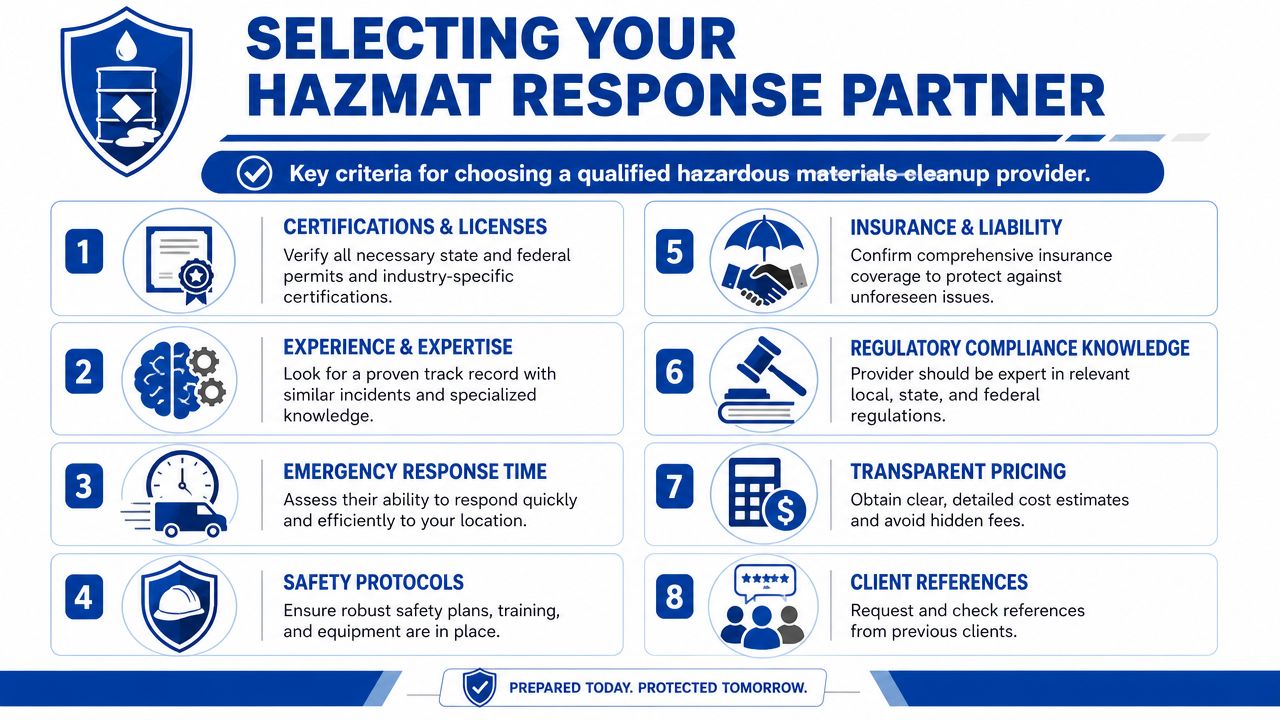
When the incident is yours, every company sounds capable on the phone. The differences show up in what they ask, how they assess risk, and whether they understand the handoff from emergency scene to regulated restoration.
Questions worth asking immediately
Start with operational questions, not marketing claims.
| Ask this | Why it matters |
|---|---|
| What incidents like this do you handle? | You need relevant experience, not general cleaning experience. |
| How do you determine safe re-entry? | This reveals whether they think in terms of exposure and verification. |
| Who handles waste packaging and disposal documentation? | Weak answers here create downstream problems fast. |
| How do you coordinate with adjusters and site contacts? | Good communication shortens confusion and downtime. |
The warning signs
Some providers should be ruled out quickly.
- They talk about cleaning before assessment. That usually means they underweight containment and exposure control.
- They can't explain role boundaries between first responders, investigators, and remediation crews.
- They rely on vague assurances instead of process, documentation, and safety language.
- They treat all incidents the same whether it's an unknown powder, chemical release, medical waste event, or mixed biohazard scene.
What a qualified provider should bring
You want a team that can operate calmly inside a stressful environment. That means technical competence, but it also means discretion, communication, and respect for the people affected by the event.
Look for a provider that can show:
- Appropriate licensing and insurance
- Knowledge of OSHA, EPA, and disposal requirements relevant to the incident
- Technicians trained for hazardous and biohazard conditions
- A clear process for containment, removal, decontamination, and documentation
- Comfort working with property managers, healthcare leadership, adjusters, and public agencies
This checklist on what to consider when choosing a biohazard cleanup company essential tips potential pitfalls and factors to look for is especially useful when the incident involves both contamination control and sensitive occupancy concerns.
Choose the company that asks the hardest safety questions first. That's usually the company least likely to create a second problem.
When a hazardous incident hits your property, you need more than a cleanup crew. You need a team that understands the entire timeline from emergency stabilization to documentation, decontamination, and safe re-entry. 360 Hazardous Cleanup provides around-the-clock support for biohazard and hazmat situations, with a process built around safety, compliance, discretion, and coordination with the people already involved in the response.