You walk into the room and catch that smell before you see the spot. Maybe it's a fresh accident near the dog bed. Maybe it's a dark patch that's been gradually setting into the boards for days. Either way, the reaction is the same. You're worried about the floor, the odor, and whether this is still a cleaning problem or something more serious.
Hardwood doesn't give you much margin for error. A quick wipe can help if the urine is still on the surface, but delayed cleanup lets moisture move through seams, into the finish, and sometimes below the boards. Choosing the right hardwood floor cleaner for pet urine matters, but so does knowing when cleaner alone won't solve the problem.
The Challenge of Pet Urine on Hardwood Floors
Pet urine on hardwood causes more than a surface stain. It attacks a material that's layered, porous at joints and edges, and often protected by a finish that can fail if the wrong cleaner or too much moisture is used. That's why homeowners often feel blindsided. The floor may look intact at first, then develop odor, discoloration, or finish damage later.
Manufacturer and industry guidance agree on the first critical milestone. Remove the urine quickly before it penetrates the finish and wood grain. Nature's Miracle specifically markets a bio-enzymatic hard floor cleaner for sealed wood and other hard surfaces, and its product directions reflect the category's shift toward targeted pet-stain treatment rather than general mopping. For hardwood, other guidance also stresses blotting first, avoiding excess liquid, and drying thoroughly to prevent damage, as summarized in this overview of whether urine is a biohazard.
Why hardwood reacts so badly
Wood and wood finishes don't fail in the same way tile or vinyl does. A puddle can slip into board edges, settle in tiny gaps, and leave odor behind even after the top surface looks dry. If the accident sits long enough, cleaning can turn into restoration.
Pet urine on hardwood is a timing problem first, and a product problem second.
The category has changed because of that reality. Instead of one-size-fits-all floor cleaners, the market now leans toward surface-specific pet cleaners designed for sealed wood, tile, linoleum, and vinyl. That evolution matters because once urine penetrates the floor, you may be looking at sanding, refinishing, or deeper remediation rather than routine cleanup.
What homeowners often miss
The panic usually centers on the visible spot. The bigger risk is the invisible path the liquid takes. If the floor has worn finish, micro-gaps, or repeated accidents in the same area, the contamination can outlast what you can see.
Common consequences include:
- Lingering odor: The smell keeps returning because the contamination wasn't fully neutralized.
- Discoloration: Dark or black staining can signal deeper penetration into the wood.
- Finish damage: Swelling, dullness, and peeling can follow over-wetting or delayed cleanup.
- Hidden contamination: Seams and porous materials below the boards may hold moisture and odor after the surface appears clean.
That's why the right response starts fast, stays controlled, and respects the limits of DIY methods.
Your First Response to a Fresh Pet Accident
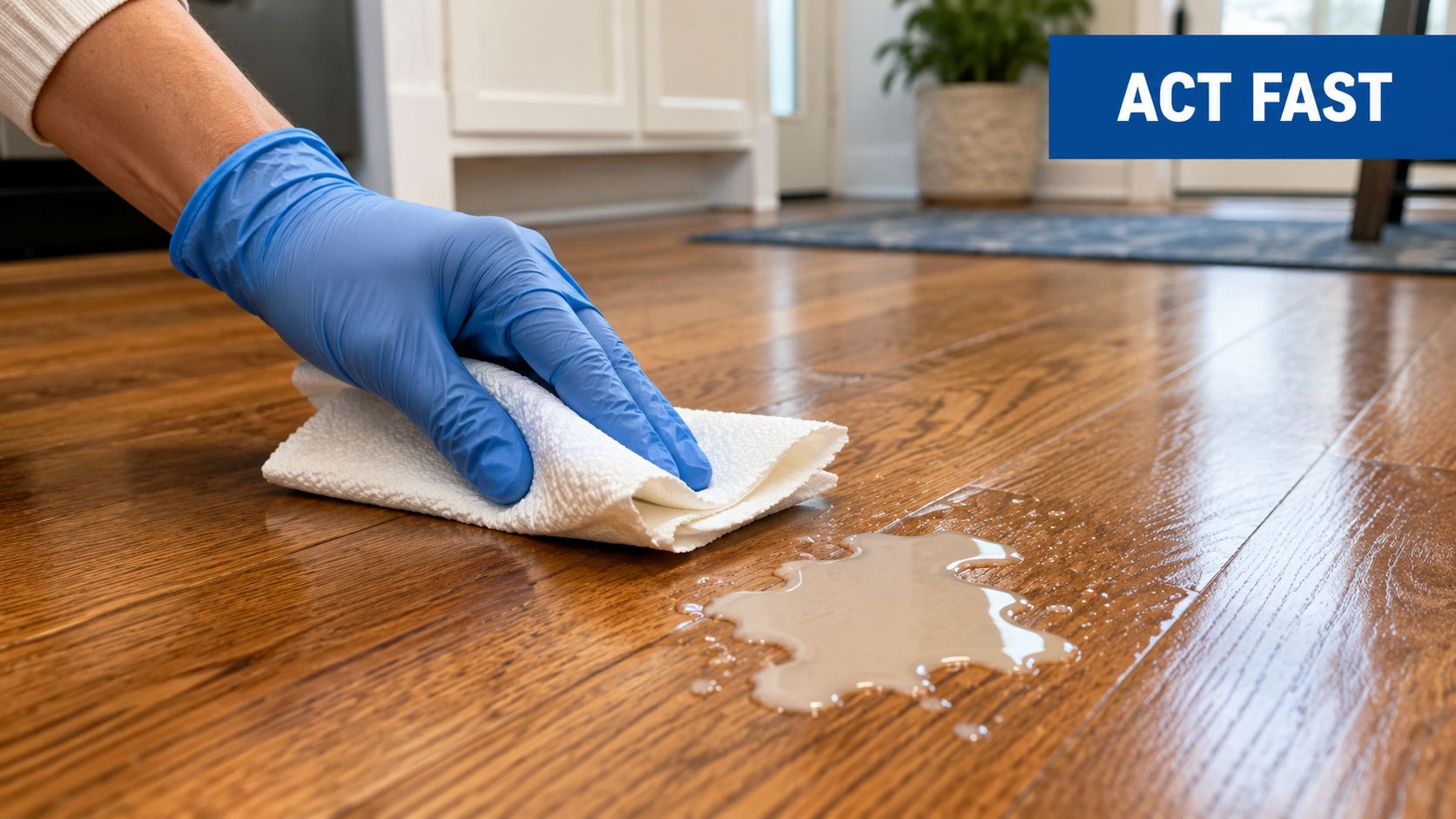
Act immediately. The first few minutes matter more than most homeowners realize. For fresh incidents on hardwood, enzymatic cleaners were reported effective in 76% of cases when applied within 30 minutes, but that dropped to 32% after more than two hours, according to expert tips for hardwood pet accidents.
What to do first
Use paper towels or a highly absorbent cloth and blot, don't rub. Press straight down and lift. Start at the outer edge of the wet area and work inward so you don't spread urine farther across the finish.
Rubbing creates two problems. It pushes liquid into seams and grain, and it drags contamination across a wider area. On hardwood, both mistakes raise the chance of odor and staining.
The immediate triage sequence
- Put on gloves: Even a routine pet accident involves bodily waste, and barrier protection is the right habit.
- Blot repeatedly: Replace towels until they come up nearly dry.
- Check the seams: If liquid pooled between boards, press fresh towels into those joints gently.
- Keep water out of the area: Don't flood the floor trying to “rinse” it.
- Prepare for cleaner application: Once excess urine is removed, move to a hardwood-safe cleaner.
Practical rule: If the floor still feels wet after blotting, don't start scrubbing. Remove more moisture first.
What not to do
A lot of damage happens during frantic cleanup. Avoid these early mistakes:
- Don't scrub with force: That drives liquid deeper.
- Don't use a soaking-wet mop: Hardwood and standing moisture don't mix.
- Don't delay treatment: Even a short delay changes how much urine reaches the wood itself.
- Don't improvise with harsh chemicals: Finish damage can start before the odor issue is solved.
If you're unsure whether the contamination is still minor, it helps to follow a disciplined response process like this biohazard discovery checklist for what to do and not do. The principle is the same. Control spread first, then clean with intent.
Selecting a Safe and Effective Cleaner
Not every cleaner that removes odor is safe for wood. That's the trade-off most DIY guides skip. A product can be strong on smell and still be wrong for the floor finish.
Clorox's hardwood guidance notes that many recommendations for vinegar or bleach can conflict with manufacturer warnings, and the wrong chemistry can accelerate finish failure on certain hardwood types. That makes finish compatibility a real selection criterion, not an afterthought. For a broader look at how cleaning chemistry affects contamination control, this explanation of the cleaning agents used in specialized remediation is useful background.
What usually works best
For sealed hardwood, enzyme-based formulas are a major category because they're designed to break down urine proteins rather than just cover odor. That's different from a general floor cleaner, which may clean the surface but leave the source of the smell behind.
A pH-neutral hardwood-safe cleaner can also be appropriate for light cleanup when the odor issue is minimal. Diluted vinegar is common in household guidance for minor fresh accidents, but it's not universally appropriate for every finish.
Hardwood floor cleaners for pet urine safe vs. unsafe
| Cleaning Agent | Safety on Sealed Hardwood | Notes |
|---|---|---|
| Enzyme-based hard floor cleaner | Generally suitable when labeled for sealed wood | Designed to break down urine-related organic matter. Follow label directions exactly. |
| pH-neutral hardwood-safe cleaner | Generally suitable | Better for routine surface cleaning than deep odor neutralization. |
| Diluted vinegar solution | Sometimes used with caution | Often recommended for minor accidents, but finish compatibility matters. |
| Baking soda | Limited use, with care | More useful for odor absorption than wet cleaning. Don't leave abrasive residue on the finish. |
| Hydrogen peroxide 3% | Spot treatment only | Better reserved for set-in stains, not routine cleaning. Can lighten wood. |
| Bleach | Unsafe choice for many hardwood situations | Can conflict with finish safety and isn't a good default for pet urine on wood. |
| Generic disinfecting wipes | Risky as a default | May leave residue or use chemistry that isn't ideal for the finish. |
How to choose without damaging the floor
Use this quick filter before you apply anything:
- Read the label for surface compatibility: If it doesn't explicitly say sealed wood or hardwood-safe, pause.
- Match the product to the problem: Fresh surface accident, lingering odor, and black stain aren't the same job.
- Respect finish type: Site-finished, oil-finished, and prefinished floors can react differently.
- Avoid “stronger is better” thinking: On hardwood, aggressive chemistry often creates a second problem.
The best hardwood floor cleaner for pet urine is the one that addresses contamination without stripping, dulling, or softening the finish. That balance matters more than brand loyalty.
How to Properly Clean and Neutralize Urine Odor
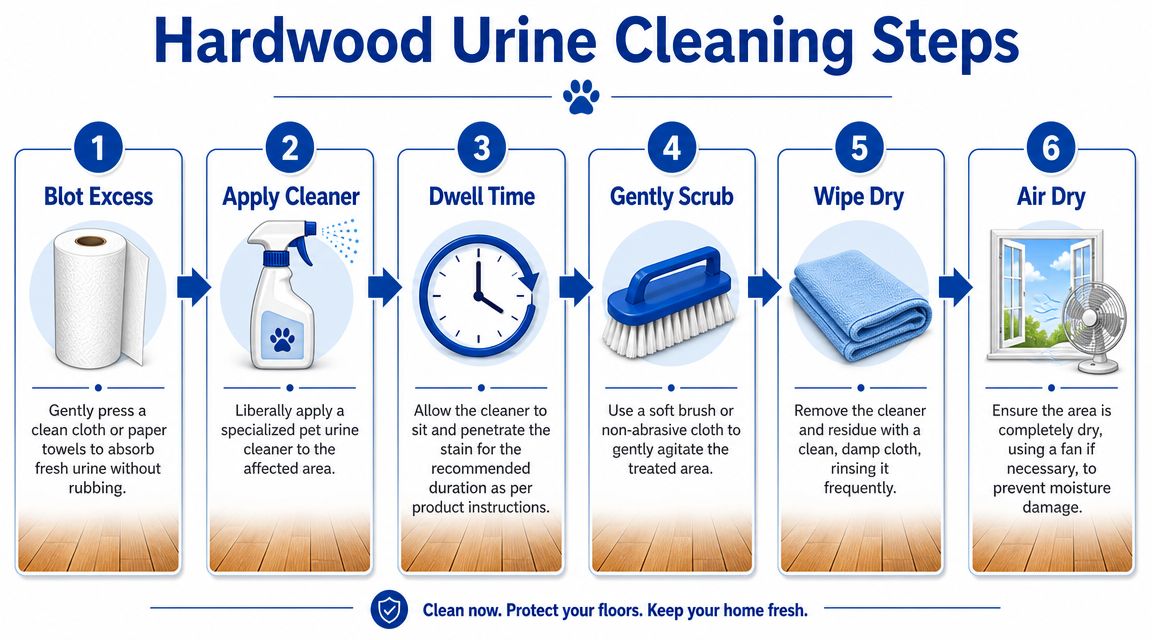
Once you've selected the cleaner, application matters as much as the product. Most failed cleanups happen because the area is either flooded or wiped too quickly. Pet-stain products have evolved toward controlled dwell times and moisture-limited application for exactly this reason. Nature's Miracle's hard floor cleaner, for example, instructs users to saturate the mess, let it work for 5 minutes, then wipe, repeating for tough messes, as described on the Nature's Miracle hard floor cleaner page.
The professional-style workflow
Blot until the area is only lightly damp
Don't rush into spraying cleaner onto standing liquid. Excess urine dilutes the product and carries contamination farther into joints.
Apply the cleaner with control
Use enough product to treat the affected area thoroughly, but don't soak beyond the spot. On hardwood, more liquid isn't automatically more effective.
Let it dwell
Often, homeowners cut corners. Enzymatic products need contact time to work on the proteins that drive odor.
Agitate gently if needed
A soft cloth or non-abrasive pad is enough. Hardwood finishes don't respond well to abrasive scrubbing.
Wipe clean
Lift residue away rather than smearing it around.
Dry completely
Use a clean cloth, then airflow if needed. If moisture remains at the seams, the floor is still at risk.
A cleaner that never gets time to work is just expensive moisture on a hardwood floor.
For a visual demonstration of the general process, this walkthrough is helpful:
Why the drying step is not optional
Urine damage and water damage can overlap. Even after the contamination is treated, leftover moisture can still swell edges, weaken finish adhesion, or feed odor in seams. That's why a complete dry-down is part of the cleaning, not a final convenience step.
A practical drying approach looks like this:
- Use a fresh microfiber cloth: Don't reuse the one that absorbed urine or cleaner.
- Change cloths if needed: Saturated towels stop lifting moisture effectively.
- Improve airflow: A fan can help move the process along.
- Recheck after the area is fully dry: Some odor only becomes obvious again once the floor has dried.
If odor lingers after the first pass
A lingering smell doesn't always mean failure. It may mean the first treatment loosened contamination but didn't fully remove it. In mild cases, a second controlled application may help. Some homeowners also use baking soda carefully as an odor-absorbing follow-up once the main cleaning step is complete, provided residue is removed and the finish isn't scratched.
What doesn't work is layering random products one after another. Mixing methods without a plan often leaves residue, stresses the finish, and makes it harder to judge what's improving.
When Stains and Odors Persist
A dark stain that stays put after cleaning is a different problem than a fresh accident. At that point, you're closer to light restoration than standard maintenance. The wood has likely absorbed contamination below the finish, and surface cleaners won't reverse that by themselves.
A cautious level-two method
One commonly used restoration approach for black urine stains is to lightly sand the area enough to open the finish, then place a white rag saturated with 3% hydrogen peroxide over the stain, cover it with plastic, and check it every 2 hours because peroxide can over-bleach the wood if left too long. After the stain lightens, the area should dry for 24 hours before resealing with polyurethane, according to this restoration guidance from ReallyCheapFloors.
That method can help, but it has real risks. If you skip the monitoring, you may trade a dark spot for a pale one. If you fail to reseal the area, the wood is left vulnerable to future damage.
When this approach makes sense
This kind of spot treatment is most reasonable when:
- The stain is localized: You can clearly identify a contained affected area.
- The floor is otherwise stable: No soft boards, no widespread odor, no signs of moisture below.
- You're prepared to refinish the spot: Bleaching wood without restoring the finish leaves an incomplete repair.
For homeowners who want another perspective on restoration-minded cleanup, Buff & Coat's pet stain guide is a useful reference.
If the stain is changing the wood itself, cleaning alone won't return the floor to its original condition.
Where DIY should stop
A persistent black stain, recurring odor, or damage across multiple boards is often the line where cleaning becomes a professional decision. That's especially true if contamination may have moved under the hardwood. The issue is no longer just appearance. It can involve sanitation, structural materials, and long-term indoor odor control. In those cases, this overview of why biohazard cleanup should be handled by a professional reflects the right mindset.
Recognizing When DIY Cleaning Is Not Enough
The biggest blind spot in most advice is the point where pet urine stops being a surface-cleaning issue. Some accidents stay on the finish and respond to prompt care. Others move through seams into porous material below the hardwood, where odor and bacteria can persist even after the surface looks clean. Quick Shine's consumer guidance highlights that this subfloor contamination question is often left unanswered, even though it carries a hidden sanitation risk, as noted in this discussion of urine contamination beneath hardwood.
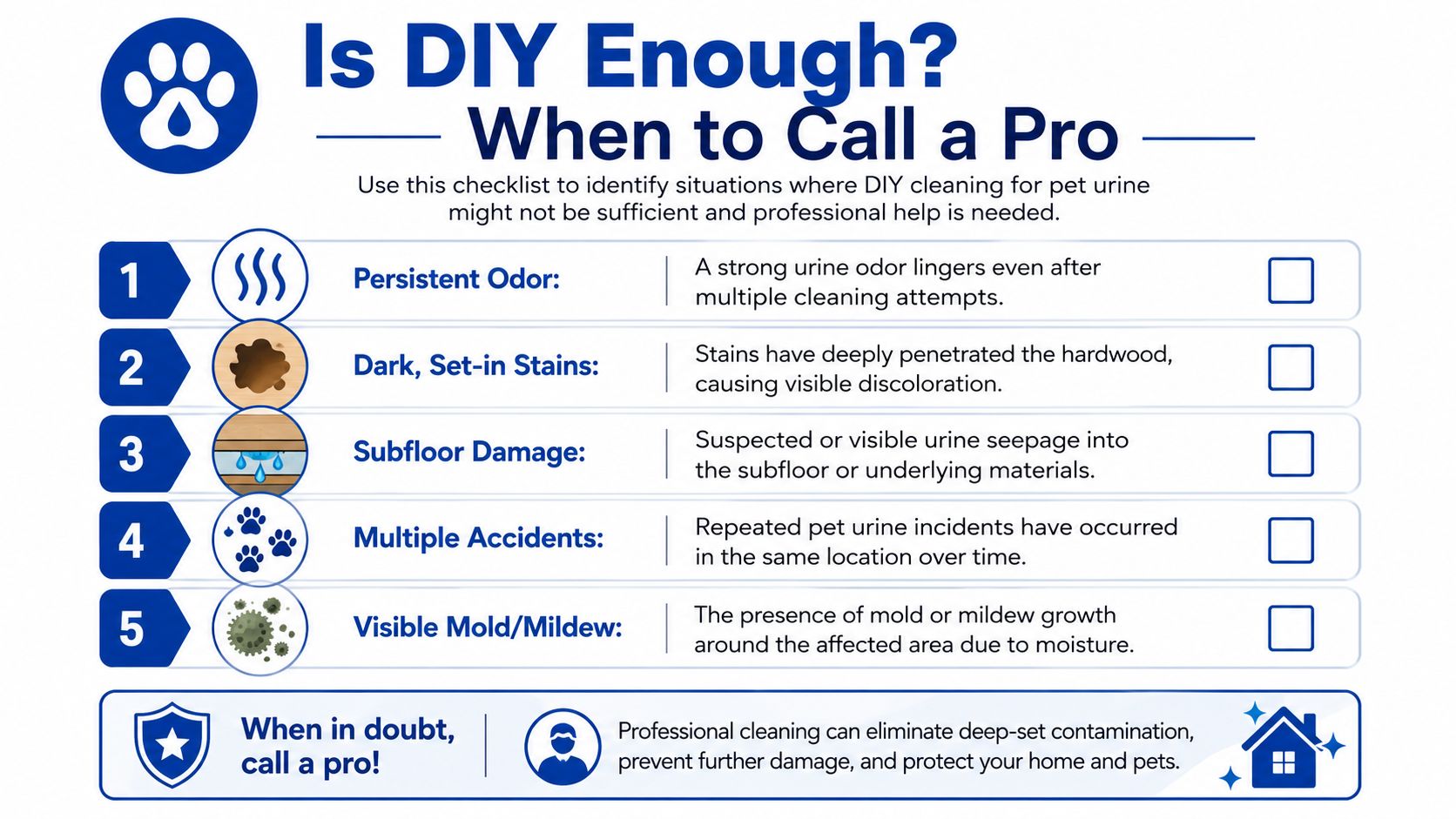
Red flags that change the decision
- Persistent odor: You clean repeatedly, but the smell returns.
- Repeated accidents in one spot: Saturation builds over time.
- Dark set-in staining: The wood itself appears chemically changed.
- Suspected seepage below the boards: Seams, underlayment, and subfloor may be involved.
- Visible mold or mildew: Moisture has been present long enough to support secondary growth.
Those situations call for a different level of response. Surface products can't reach contamination trapped below the finish or inside porous structural layers. They also can't provide the inspection, containment, and safe material handling that severe contamination may require. If you're weighing that risk, this guidance on why DIY biohazard cleanup is a serious health risk is worth reading.
When pet urine has moved beyond a simple wipe-up, the safest next step is to bring in qualified help. 360 Hazardous Cleanup provides compassionate, professional biohazard remediation with a focus on safety, regulatory compliance, and thorough decontamination. If you're dealing with persistent odor, suspected subfloor contamination, or a property where sanitation and liability matter, their team can assess the situation and help you move from guesswork to a clear remediation plan.