You walk into a basement, storage room, bathroom, tenant unit, or mechanical space and catch that stale, earthy odor. Then you see it. A dark patch behind boxes. Speckling around a supply vent. Staining along drywall seams after a leak you thought had dried out weeks ago. At that point, most property owners ask the same questions. How bad is it, is it dangerous, and who can fix it without making it worse?
That uncertainty is normal. Mold problems rarely stay confined to what you can see, and the biggest mistakes happen in the first response. People wipe the surface, spray bleach, repaint, or hire a contractor who treats it like ordinary cleaning. None of that addresses the moisture source, contamination spread, occupant safety, or the documentation you may need for insurance and liability protection.
Professional remediation exists for a reason. The global mold remediation service market was valued at USD 1.50 billion in 2024 and is projected to reach USD 2.02 billion by 2032, reflecting growing demand for compliant cleanup as more owners recognize the health risks tied to mold exposure, according to Stellar Market Research's mold removal services market analysis.
The Discovery of Mold and What It Means for Your Property
Finding mold changes the situation immediately. What looked like a maintenance issue can become an indoor air quality problem, a building materials problem, a tenant relations problem, and sometimes an insurance problem all at once.
Mold is rarely the root issue. Moisture is. The visible growth is the signal that something stayed wet long enough for contamination to establish itself. That could be a roof leak, plumbing failure, failed waterproofing, poor ventilation, HVAC condensation, or hidden seepage inside a wall cavity.
If there has been recent water damage, don't treat mold as a separate event. In practice, water intrusion and mold are often part of the same chain of loss, and the quality of the early dry-out response affects whether a small incident turns into a full remediation project.
What the discovery usually tells us
A small patch on a wall doesn't necessarily mean a small job. It may mean the opposite. Surface growth often points to a larger concealed condition behind drywall, beneath flooring, above ceiling tiles, or inside insulation.
For families, the stress is personal. For facility managers, it becomes operational. For landlords, it quickly becomes a habitability and documentation issue. In healthcare, senior living, and behavioral health settings, it can become a sensitive exposure-control issue where standard janitorial practices are not enough.
Practical rule: Don't judge the scope of a mold issue by the size of the stain you can see.
The right response starts with separating appearance from actual extent. Black discoloration may or may not indicate the most serious contamination. A faint musty odor with no visible growth can still signal active hidden moisture. If you're dealing with recurring spotting, bubbling paint, or staining around windows and exterior walls, it's worth understanding the broader risks discussed in this guide to black mold on walls.
Why the first decision matters
Once mold is disturbed, spores and contaminated dust can spread. That creates more cleaning, more material loss, and more occupant anxiety. It also complicates claims and compliance if the site wasn't properly contained from the start.
The goal isn't panic. It's control. A capable mold clean up company doesn't just remove visible growth. It investigates the moisture source, protects unaffected areas, documents conditions, and creates a path to safe re-occupancy.
Initial Assessment When You Find Mold Growth
The first assessment should answer one question. Are you looking at a limited surface issue, or a condition that requires professional containment and remediation?
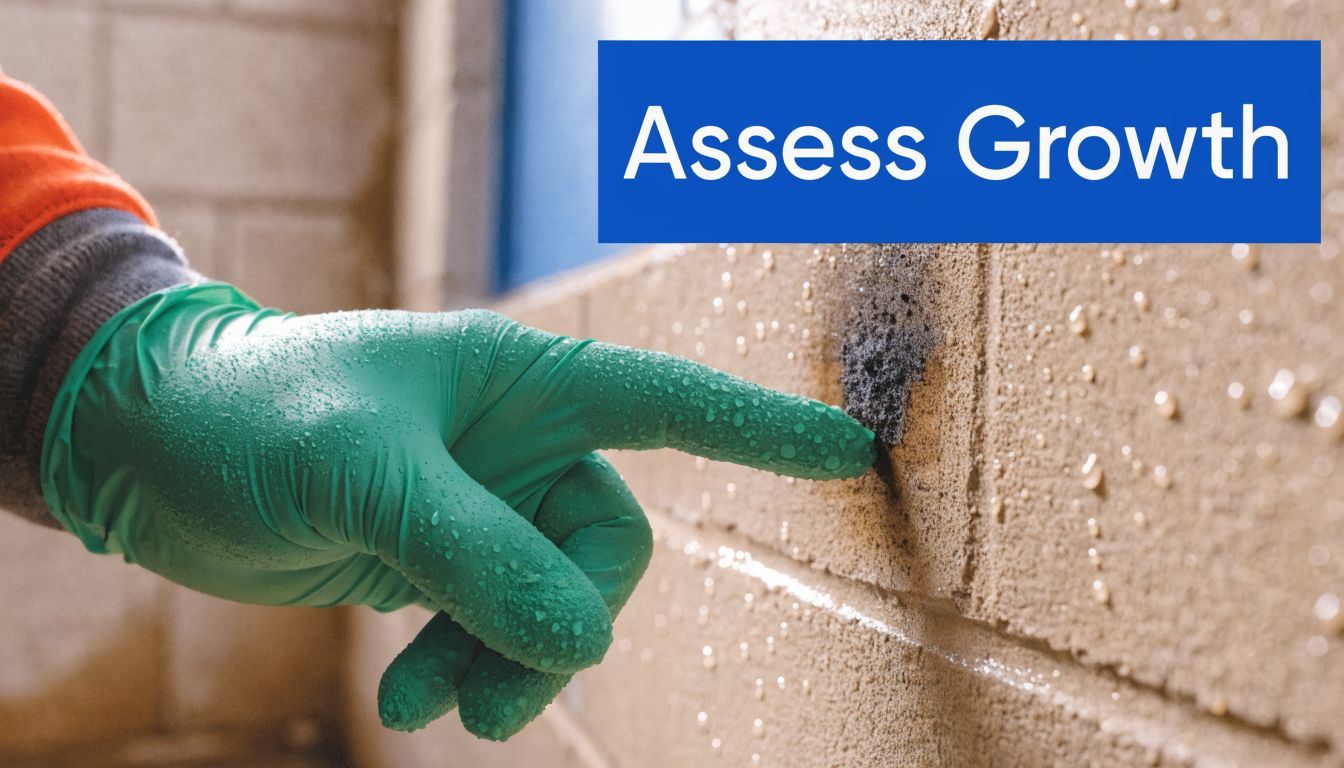
A lot of owners lose time by asking the wrong question first. They ask, "How do I clean this?" before they ask, "Why is this here, what got wet, and what happens if I disturb it?"
When small is actually small
There are situations where limited cleanup may be appropriate. If the area is small, on a non-porous or semi-porous surface, easy to isolate, and clearly tied to a minor moisture event that has already been corrected, the problem may be straightforward.
That is not the same thing as saying most mold is a DIY issue. It isn't. The moment contamination involves porous materials, repeated wetting, hidden cavities, occupant sensitivities, or shared air handling, the risk changes.
Here is the practical line many owners use during first review:
- Visible, isolated growth on a small hard surface may be manageable only if the moisture source is confirmed and corrected.
- Growth on drywall, insulation, carpet, ceiling tile, or contents should raise concern quickly because porous materials usually don't clean reliably once contamination is established.
- Musty odor without visible growth often points to hidden contamination and should not be dismissed.
- Any growth near HVAC components or duct pathways deserves extra caution because air movement can distribute contamination into occupied areas.
For a clear explanation of when a problem crosses into specialized work, this guide on when you need professional mold remediation is a useful benchmark.
The cost of underestimating it
The biggest financial mistake isn't calling a professional too soon. It's waiting while moisture remains active. Every day that wet materials stay in place, the job can widen from localized removal to a broader demolition, cleaning, drying, and verification effort.
Health concerns also shape the response. Even without getting into exaggerated claims, mold exposure is a serious enough concern that occupants with allergies, asthma, respiratory issues, or compromised health shouldn't be asked to "wait and see" in a visibly affected area.
Disturbing mold without containment can turn one room's problem into a whole-building cleaning problem.
A common bad sequence looks like this: maintenance opens a wall to "take a look," the HVAC stays on, debris is carried through clean areas, and then everyone realizes the scope was larger than expected. At that point, what could have been a controlled remediation becomes cross-contamination management.
Quick triage questions that matter
Before anyone wipes, sprays, cuts, or tears out material, answer these:
- What caused the moisture? Leak, flood, condensation, humidity, sewage, or unknown.
- Is the source fully stopped? If not, remediation will fail.
- What materials are affected? Concrete and metal behave differently than drywall, insulation, and carpet.
- Could there be hidden spread? Check adjacent walls, backside cavities, flooring edges, and ceilings below or above.
- Who occupies the space? Homes with children, elderly occupants, and medically sensitive people require a more conservative approach.
- Is this tied to another hazard? An unattended death, sewage backup, hoarding condition, or medical setting changes everything about handling and disposal.
What not to do during assessment
A rushed first response creates most of the avoidable problems.
- Don't spray bleach as a default fix. It doesn't solve the underlying moisture issue and often gives a false sense of completion.
- Don't paint over staining. Coating contamination isn't remediation.
- Don't run demolition before planning containment. Opening walls can aerosolize settled spores and contaminated dust.
- Don't rely on smell alone. Odor matters, but absence of odor doesn't prove safety.
- Don't move contaminated contents through clean hallways without a handling plan.
When in doubt, pause the disturbance and bring in a qualified mold clean up company to inspect before the site gets opened up further.
How to Vet and Select a Mold Remediation Company
Hiring the wrong company is expensive in a way that doesn't always show up on the first invoice. It shows up later in repeat mold growth, tenant complaints, insurance disputes, failed clearance, and damaged trust.
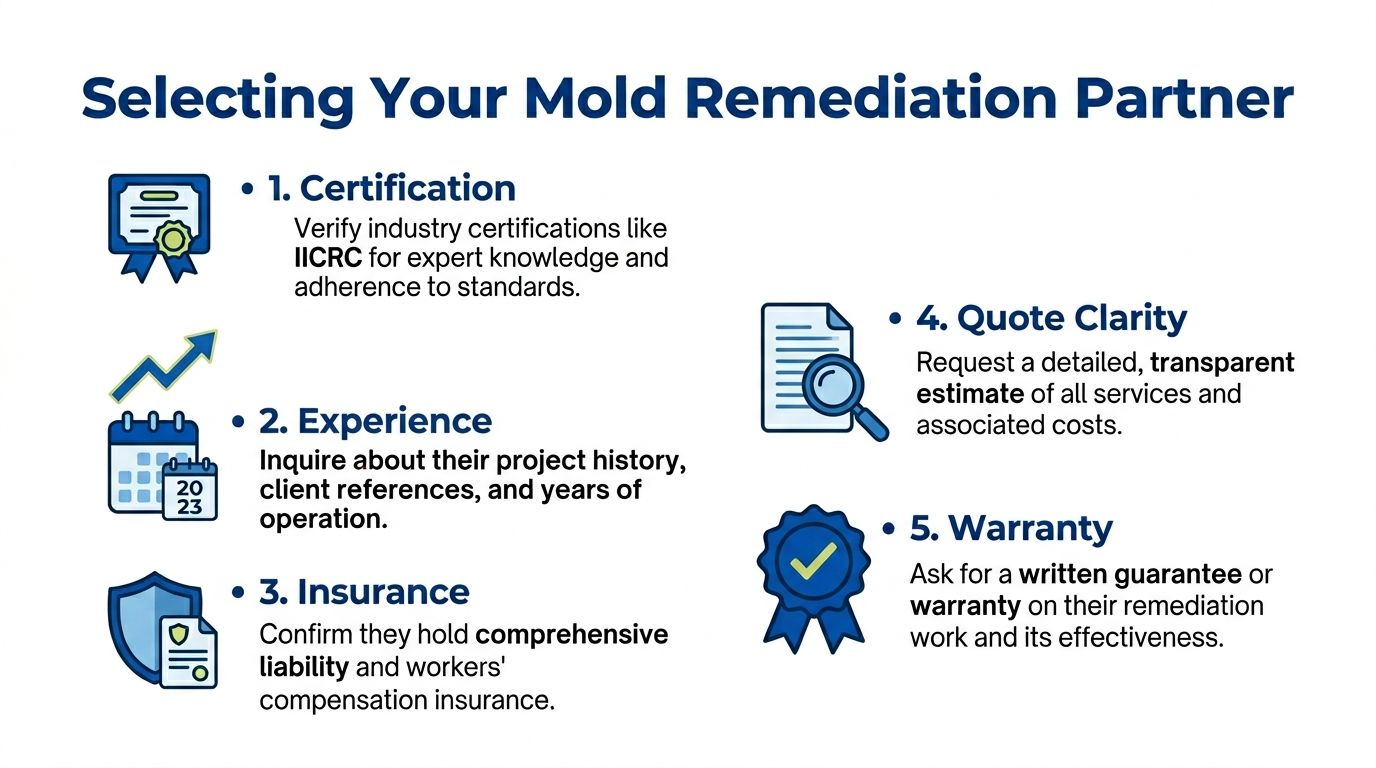
A proper vetting process should feel a little demanding. That's a good thing. If a contractor can't answer direct questions about containment, disposal, worker protection, documentation, and post-remediation verification, keep looking.
What qualified firms should be able to explain clearly
Start with method, not marketing. Ask how they inspect, how they define the work area, how they prevent spread, and how they verify completion. Strong companies can describe their process in plain language without dodging specifics.
Look for these signs first:
- Industry standards knowledge with clear reference to IICRC-based remediation practices and site-specific protocols.
- Insurance clarity including liability coverage and confirmation that mold or pollution-related work is covered under their policy.
- Written scope of work that spells out containment, removal methods, cleaning procedures, and what is excluded.
- Worker safety planning including PPE, decontamination procedures, and regulated waste handling when other hazards are present.
- Documentation discipline such as moisture readings, photos, containment logs, and communication records.
Ask the questions that expose weak operators
A capable contractor shouldn't be irritated by detailed questions. They should expect them.
Ask things like:
- How will you isolate the affected area?
- Will you create negative air pressure and use HEPA filtration?
- Which materials do you expect to remove rather than clean?
- How will you confirm the moisture source has been corrected?
- Who performs post-remediation verification?
- How do you handle contents and debris leaving the work zone?
- If the job involves a healthcare or occupied commercial setting, how do you protect operations and adjacent spaces?
Then listen to how they answer. Specific answers indicate experience. Vague reassurance usually indicates risk.
If a company says "we'll spray it and seal it" before inspecting the moisture source, that isn't a remediation plan.
The overlooked screening question for complex sites
Many owners never ask whether the company can manage multi-hazard conditions. They should.
In hospitals, clinics, long-term care sites, trauma scenes, severe neglect situations, or buildings affected by sewage or decomposition, mold may not be the only contamination issue. Standard mold firms often aren't equipped for that crossover. According to this discussion of mold remediation in healthcare and sensitive environments, bio-contaminated crossover appears in 15% of hospital remediation calls based on 2025 CDC data.
That matters because mixed-hazard scenes require more than mold cleaning. They may involve regulated waste segregation, discreet operations, chain-of-custody concerns, or protocols to prevent cross-contamination between biological and environmental hazards. A company such as 360 Hazardous Cleanup offers mold remediation alongside broader hazmat and biohazard response, which can matter when a property issue doesn't fit neatly into one category.
Green flags and red flags
| Green Flags (Professional) | Red Flags (Unqualified) |
|---|---|
| Provides a written, site-specific scope of work | Gives a price from photos alone without discussing containment |
| Talks about moisture source correction before cleanup | Focuses only on killing or spraying visible mold |
| Explains containment barriers and air control measures | Says containment isn't necessary because the area is "small enough" |
| Recommends independent clearance or PRV | Declares the job complete based only on appearance |
| Documents conditions with photos and moisture readings | Avoids paperwork or says documentation isn't needed |
| Can discuss occupant protection for sensitive environments | Treats hospitals, rentals, homes, and industrial spaces the same |
| Has a plan for disposal and decontamination | Uses generic demolition crews with no contamination controls |
| Coordinates with adjusters and property stakeholders | Leaves insurance communication entirely to the owner without support |
Review the estimate like a risk document
A quote is not just a price. It's a preview of how the project will be run.
A strong estimate should identify the affected area, the assumed cause, containment setup, removal categories, cleaning approach, drying expectations, and whether testing is separate. If a proposal is so thin that you can't tell what is included, disputes are almost guaranteed.
Pay close attention to what the contractor excludes. Hidden conditions may expand the job once walls or flooring are opened. That's normal. What isn't normal is pretending uncertainty doesn't exist.
What experienced buyers notice
Facility managers and adjusters usually look for the same qualities. Calm communication, fast site control, precise documentation, and no shortcuts around safety. Homeowners benefit from using the same standard.
You're not buying paint, labor hours, or demolition. You're buying containment, judgment, documentation, and a safe return to use. That's the standard a mold clean up company should meet.
What to Expect During Professional Mold Remediation
When the right company takes over, the site should feel more controlled almost immediately. There should be less guesswork, fewer people improvising, and a clear sequence from inspection to clearance.
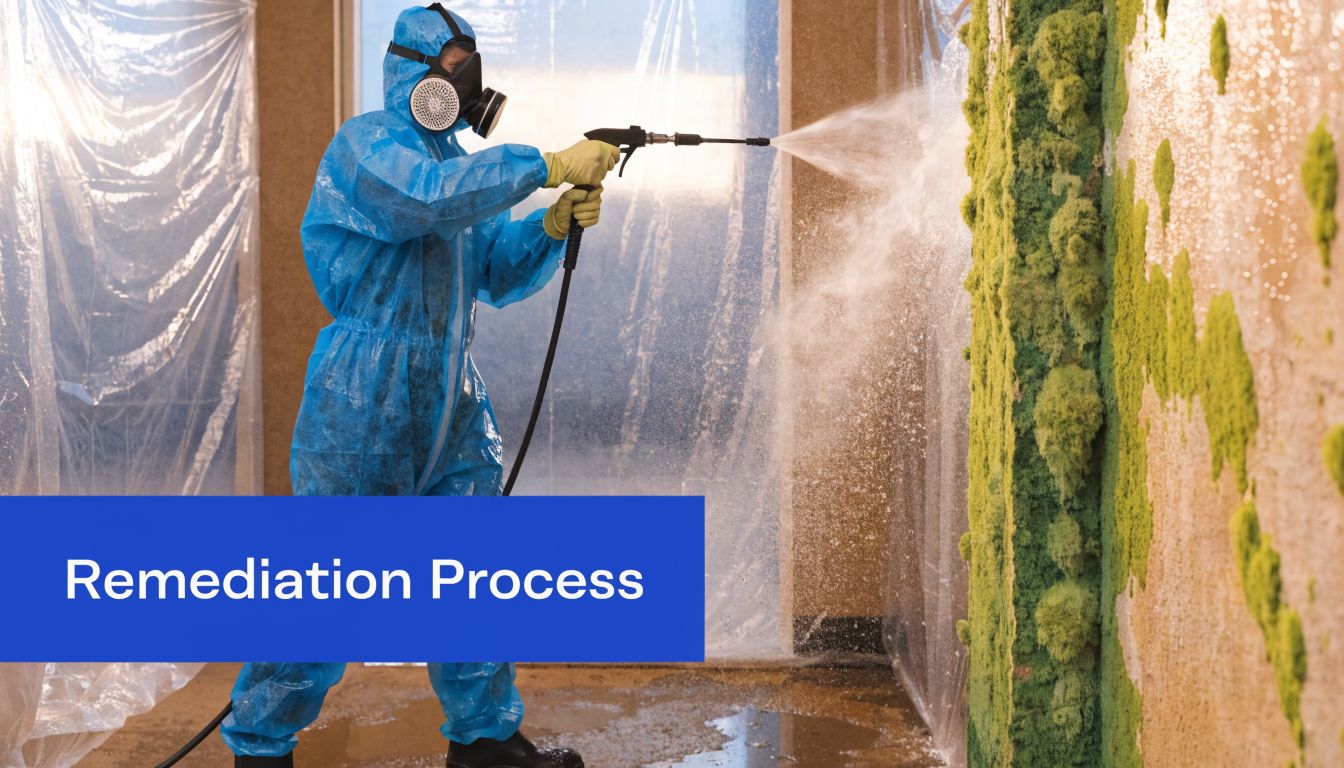
The strongest remediation projects follow the IICRC-recommended two-part inspection methodology. According to this breakdown of the IICRC S520 approach and verification standards, using containment with 6-mil sheeting and HEPA filtration drops failure rates below 10%, while projects that skip those steps have a national average success rate of only 65%. The same source notes that 80% of recurrence cases are caused by incomplete moisture correction.
First comes controlled investigation
The job doesn't start with tearing things out. It starts with defining the area of environmental concern. That means visual inspection, moisture detection, and identifying what is wet, what is contaminated, and what has to be protected.
At this stage, good crews are looking for the moisture source as aggressively as the mold itself. If the wetting mechanism isn't corrected, any cleanup is temporary.
Common findings include:
- Wall cavity moisture from plumbing or exterior envelope leaks
- Ceiling and insulation contamination after roof intrusion
- Flooring edge growth from slab moisture, appliance leaks, or overflow events
- HVAC-related spotting tied to condensation or poor drainage
Then the containment goes up
Containment is where professional work starts to look different from ordinary cleaning. Crews isolate the work area with 6-mil polyethylene sheeting, control entry and exit points, and set up HEPA-filtered negative air so contamination doesn't drift into clean areas.
For owners, this can feel disruptive. That's normal. Doors may be sealed, sections of the building may be temporarily restricted, and contents may be staged for cleaning or disposal. The disruption is there to avoid a larger and more expensive contamination spread.
The inconvenience of proper containment is far less costly than cleaning mold dust out of unaffected offices, bedrooms, or patient areas.
Removal, cleaning, and drying are separate tasks
A lot of confusion comes from treating all remediation activities as if they are the same thing. They aren't.
Removal applies to materials that can't be reliably salvaged, especially porous items that have sustained meaningful contamination. Cleaning applies to salvageable surfaces and contents using HEPA vacuuming, damp wiping, and site-appropriate antimicrobial treatment where indicated. Drying addresses the moisture condition that allowed growth in the first place.
This walkthrough gives a useful visual of what a properly managed job can look like:
What doesn't work is relying on bleach as a cure-all. In the field, bleach is one of the most common homeowner shortcuts and one of the least reliable approaches on porous building materials. It may lighten a stain without solving embedded contamination or the wet condition underneath.
The last phase is verification, not a handshake
At the end of the physical cleanup, the site still isn't done. It needs post-remediation verification, sometimes called clearance. That includes visual review and testing appropriate to the project so the owner isn't just trusting that "it looks clean."
This is also where documentation becomes valuable. Before-and-after photos, moisture logs, containment records, disposal records, and clearance results help everyone involved. Owners understand what was done. Managers can reopen space more confidently. Carriers and adjusters have a cleaner record if coverage issues arise later.
A professional remediation process should feel methodical, not mysterious. When it does, that's usually a sign the company is following a real standard rather than improvising.
Navigating Mold Cleanup Costs and Insurance
Mold remediation costs vary because the work isn't just about square footage. The price changes based on where the mold is, what materials are involved, whether the moisture source is active, how much containment is required, and whether the site is occupied during the work.
A crawlspace, an occupied office suite, a hospital room, and a tenant bathroom can all have "mold," but they do not present the same operational demands. Access, demolition complexity, contents handling, infection control considerations, disposal requirements, and post-remediation testing all change the cost profile.
What usually drives the bill
Owners often focus on the visible growth. Contractors price the whole risk picture.
The major cost drivers usually include:
- Location of the contamination such as inside walls, above ceilings, below flooring, or inside mechanical areas
- Material type because drywall, insulation, carpeting, and upholstered contents often require different handling than concrete, tile, or metal
- Need for containment especially in occupied homes, healthcare spaces, multi-tenant buildings, and commercial environments
- Moisture correction work when leaks, drainage failures, or humidity problems still need to be addressed
- Verification and documentation including third-party inspection, sampling, and claim support records
Low quotes should make you cautious. If a proposal seems cheap, ask what is missing. Often the answer is containment, verification, or enough labor time to do detailed cleaning and drying correctly.
Insurance is often won or lost on documentation
Insurance frustration usually starts when the cleanup company documents the mold but fails to document the cause correction. That gap matters. A significant 40% of commercial mold claims are initially denied due to inadequate proof that the original moisture source was eliminated, according to this review of insurance-related gaps in mold service documentation.
That figure tells owners something important. Cleanup photos alone are not enough. Carriers often want evidence that the underlying condition was identified, repaired, and verified.
For insurance purposes, "we removed the mold" is weaker than "we identified the source, documented corrective action, and verified dry conditions."
What to have ready before talking to the adjuster
If there's any chance you will submit a claim, organize the file early. Don't wait until the carrier asks.
Build a record that includes:
- Photos of the affected areas before anything is disturbed.
- A timeline of discovery including who found it and what happened just before it was noticed.
- Maintenance or incident records tied to leaks, overflows, roof issues, or HVAC problems.
- Professional inspection notes identifying the moisture source and affected materials.
- Repair documentation showing what stopped the water or humidity problem.
- Post-remediation records proving the site was cleaned and returned to acceptable conditions.
If you need help structuring that conversation, this guide on how to talk to your insurance company about cleanup services, insurance tips, common pitfalls, and what you should know lays out the communication issues that tend to trip people up.
Commercial and multi-unit properties need tighter coordination
Commercial owners and property managers usually have more stakeholders. Tenants, legal counsel, operations staff, maintenance vendors, adjusters, and sometimes public agencies all want answers quickly. That makes documentation and sequencing even more important.
In those settings, the best mold clean up company is often the one that can do three things at once. Stabilize the site, preserve the claim record, and coordinate around building operations without creating unnecessary downtime.
When insurance is involved, remediation isn't just a cleaning event. It's a technical and administrative project. Owners who understand that early usually make better decisions and avoid the worst claim surprises.
After the Cleanup Verification and Preventing Future Growth
The cleanup phase ends when the property is clean. The project ends when the property is verified and the conditions that allowed mold growth are under control.
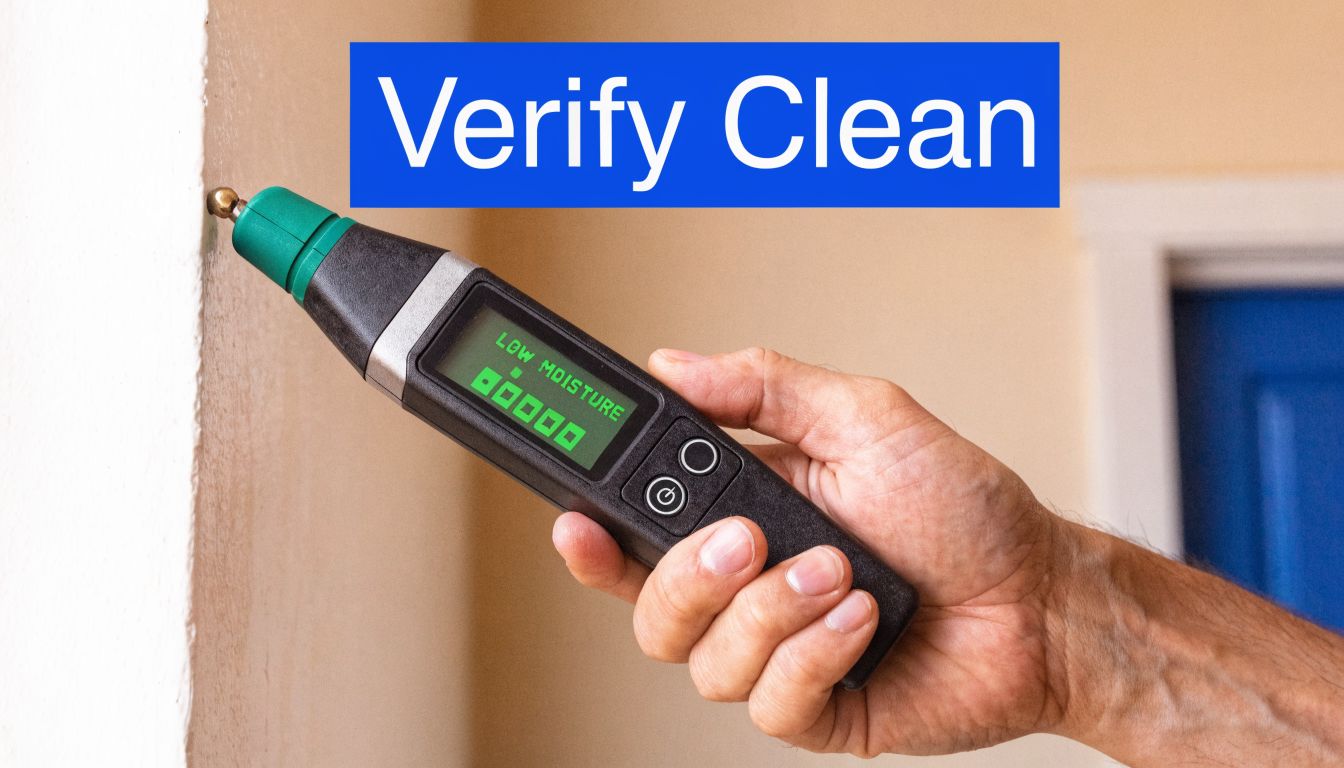
Many owners relax too early. The containment is down, the debris is gone, and the room looks normal again. That visual improvement matters, but appearance alone is not proof of success.
Why independent verification matters
The strongest closeout step is post-remediation verification performed by an independent third party. That separation matters because the company doing the cleanup shouldn't be the only voice declaring the work complete.
A credible verification process typically includes visual confirmation, moisture assessment, and site-appropriate testing or clearance criteria. If the property has sensitive occupants, recurring history, or insurance involvement, independent verification becomes even more important.
The point isn't bureaucracy. It's confidence. You want unbiased proof that the moisture problem was corrected, contaminated materials were properly handled, and the area is ready for normal use.
Clean-looking surfaces don't prove that wall cavities, framing, or adjacent materials are dry.
Prevention is mostly moisture control
Once remediation has reset the space, prevention comes down to controlling water and humidity. The most practical benchmark in the field is keeping indoor humidity below 60% RH, which is part of the drying and prevention guidance discussed earlier in the article.
Focus on the repeat causes that bring mold back:
- Fix leaks promptly from plumbing, roofing, windows, and building envelope failures.
- Inspect concealed risk areas such as under sinks, behind stored contents, around HVAC condensate lines, and inside mechanical rooms.
- Improve ventilation in bathrooms, laundry areas, kitchens, and other moisture-heavy spaces.
- Monitor previous loss areas rather than assuming one successful cleanup means permanent immunity.
- Address HVAC cleanliness and airflow issues when contamination may have circulated through the system.
If ductwork was part of the exposure pathway, it may also be worth reviewing whether professional duct cleaning fits the building's recovery plan after remediation and source correction.
A practical prevention routine for owners and managers
You don't need a complicated program. You need consistency.
| Area to monitor | What to watch for | Why it matters |
|---|---|---|
| Bathrooms and locker rooms | Condensation, peeling paint, persistent odor | Ventilation failures often show up here first |
| Windows and exterior walls | Staining, soft drywall, recurring spotting | May indicate envelope leaks or thermal bridging |
| Under sinks and utility areas | Slow leaks, warped materials, musty smell | Small plumbing leaks can stay hidden for long periods |
| HVAC rooms and ducts | Condensate issues, damp insulation, airflow complaints | Air systems can spread contamination if ignored |
| Storage rooms and basements | Blocked airflow, wet contents, high humidity | Low-traffic spaces often develop unnoticed problems |
For a broader prevention framework, this resource on understanding mold prevention and mitigating risks for healthier homes is a good reference for long-term upkeep.
A successful remediation should give you more than a clean wall or an invoice. It should give you a stable building condition, a documented record, and a realistic plan to keep moisture from taking hold again.
If you're dealing with a mold problem that may involve hidden moisture, occupant safety concerns, insurance questions, or a mixed-hazard environment, 360 Hazardous Cleanup can help you assess the site, document the loss, and move through remediation with a compliance-first plan. Their work includes mold remediation as well as biohazard and hazmat response, which matters when a property issue is more complex than a standard cleanup.