Discovering dark, splotchy stains spreading across your walls can be a distressing experience. For many, the immediate concern is black mold. While this term is often associated with a specific species, Stachybotrys chartarum, the reality is that any mold, regardless of its color, can pose a risk to your health and the structural integrity of your property.
When confronting a potential mold issue, engaging a certified professional for proper identification and remediation is not just a recommendation—it is a critical step in ensuring a safe and healthy environment for your home or business.
What Is Black Mold and How Do You Spot It on Walls
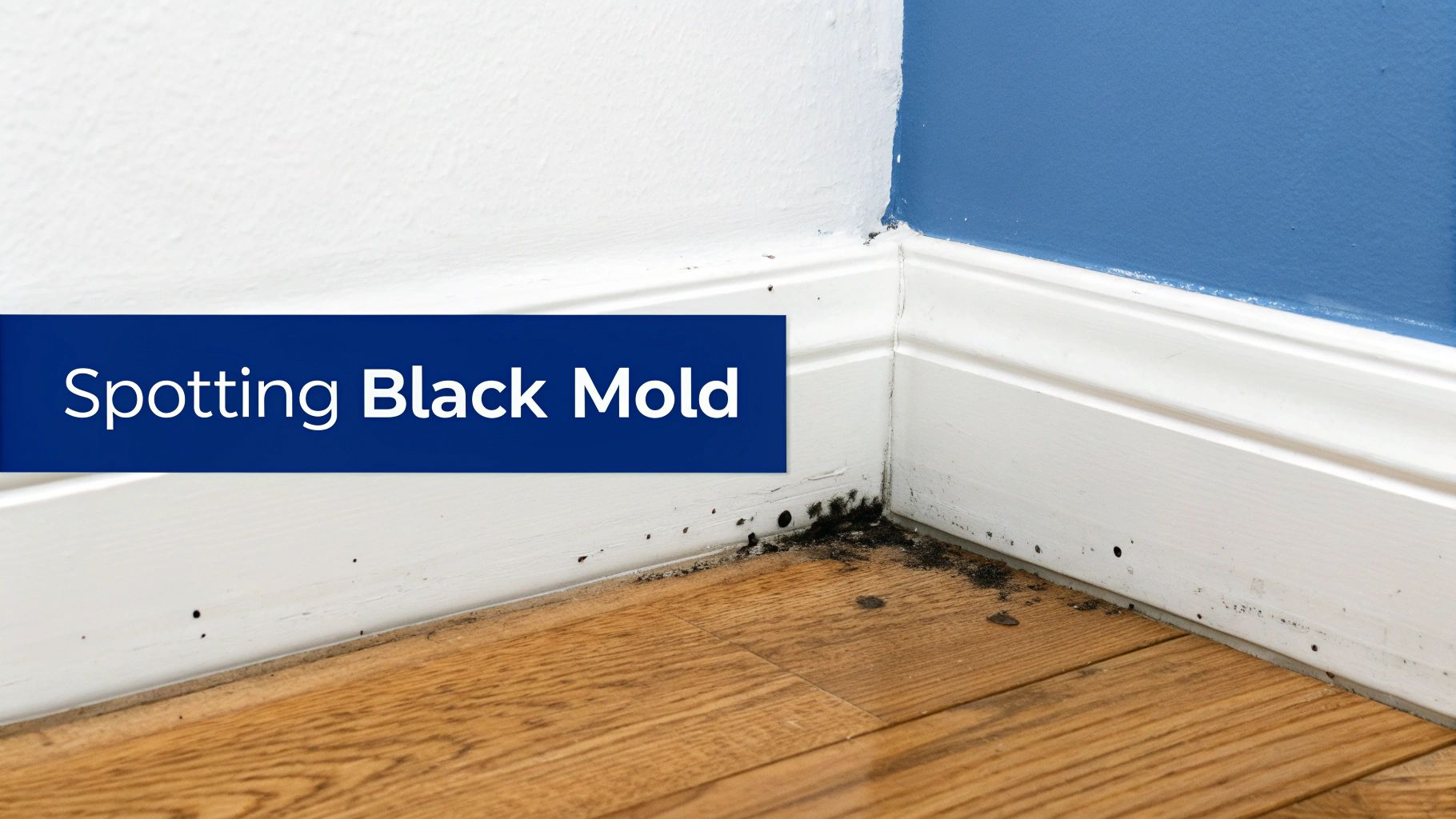
Finding what appears to be black mold on your walls is understandably unsettling. The term itself often brings concerns about significant health issues and a complex cleanup process. However, "black mold" is a common term for any greenish-black fungus, and many different mold species can appear dark. It is impossible to determine the specific species—or the level of risk it poses—by color alone.
For this reason, any visible mold growth demands a serious and methodical response. The visible dark spots on drywall are often just the tip of the iceberg. Beneath the surface, an extensive root system can spread deep into building materials, releasing microscopic spores into the air you breathe.
Telltale Signs of Mold Growth
The first step is to determine if you are dealing with mold or a less invasive substance like common dirt or mildew. While mildew is a surface-level fungus that can often be wiped away, mold embeds itself deeply into materials and requires a comprehensive remediation strategy. Our in-depth breakdown of mold vs. mildew provides further clarity on distinguishing between them.
Be vigilant for these key indicators of a mold problem:
- Distinctive Appearance: Mold typically appears in clusters of black or dark green spots. Its texture may be fuzzy or slimy, depending on the species and moisture levels.
- Musty Odor: A persistent, earthy smell—often compared to damp soil or wet laundry—is one of the most reliable signs of mold. This odor is often detectable long before the growth becomes visible.
- Signs of Water Damage: Look for associated evidence such as water stains, discolored patches on ceilings or walls, bubbling wallpaper, or peeling paint. These are clear indicators of the moisture that mold requires to thrive.
The presence of mold is almost always linked to a current or past water intrusion issue. Simply cleaning the visible spots without addressing the underlying moisture source is an incomplete solution. The mold will inevitably return.
The Growing Need for Professional Solutions
Mold is not a new challenge, but its prevalence is increasing due to a rise in water damage incidents from severe weather, flooding, and aging infrastructure. Consequently, the demand for professional mold remediation is growing significantly, with the market projected to reach USD 1,751.9 million by 2032.
This trend underscores a critical fact for property owners and facility managers: mold is a complex environmental hazard, not a simple cleaning task. Effective remediation requires eliminating the visible growth, its hidden root system, and the airborne spores. This is why engaging a certified professional is a critical health and safety measure that provides true, lasting peace of mind.
Understanding the Health Risks of Mold Exposure
While the appearance of black mold on walls can impact property value, the primary concern is its potential effect on human health. The risk originates from the way mold propagates. As it grows, it releases microscopic spores into the air, which are then inhaled.
For many individuals, the initial response is an allergic reaction. This can manifest as persistent, cold-like symptoms such as sneezing, itchy eyes, a runny nose, or a chronic cough. These are not minor annoyances but are the body's natural alarm system, indicating a response to an airborne contaminant.
The Different Types of Mold-Related Health Threats
Not all mold species present the same health risks. Indoor molds are generally classified into three categories based on their impact on the human body. Understanding these distinctions clarifies why professional remediation is a necessary health and safety protocol, not merely a cosmetic repair.
- Allergenic Molds: These are the most common and are known to trigger reactions in individuals with existing allergies or asthma.
- Pathogenic Molds: This category can cause infections, particularly in individuals with compromised immune systems. Those undergoing chemotherapy, organ transplant recipients, or people with autoimmune diseases are at a heightened risk.
- Toxigenic Molds: This group includes Stachybotrys chartarum. These molds produce mycotoxins, toxic chemical byproducts that can lead to serious, long-term health issues following prolonged or significant exposure.
It is impossible to know what kind of mold you're dealing with—or the level of risk it poses—just by looking at it. All visible mold growth needs to be treated as a potential health hazard until it's been completely and safely removed by a professional.
Who Is Most Vulnerable to Mold Exposure
While anyone can be affected by living or working in a mold-contaminated environment, certain populations are far more susceptible to developing severe symptoms. Their bodies are less equipped to manage the constant exposure to inhaled spores and mycotoxins, making contaminated spaces particularly dangerous.
These at-risk groups include:
- Infants and young children with developing respiratory and immune systems.
- The elderly, who may have pre-existing health conditions.
- Anyone with a compromised immune system due to illness or medication.
- Individuals with chronic respiratory conditions such as asthma or COPD.
The growing scientific understanding of these health risks is a primary driver behind the increased demand for professional remediation services. The global mold remediation service market, valued at approximately USD 1,234.6 million in 2023, continues to expand. This growth is directly linked to greater public awareness of mold's potential health impacts.
You can explore these market trends in the full report from Grand View Research. The data confirms that property owners and facility managers increasingly recognize professional remediation not as an expense, but as a necessary investment in the health and safety of their occupants.
Investigating the Root Cause of Mold Growth
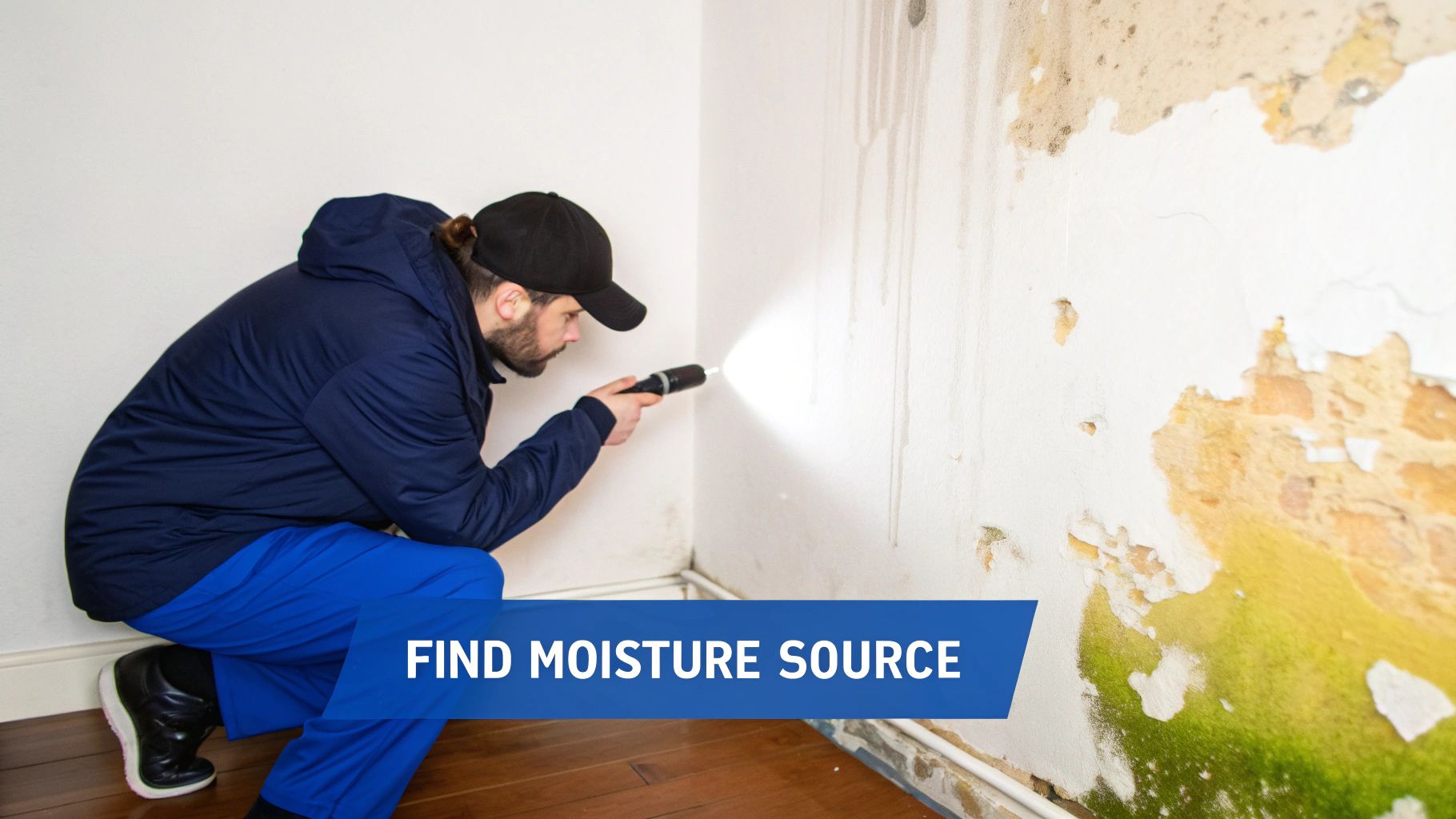
Finding black mold on your walls is a clear signal of an underlying issue. The mold itself is a symptom; the root cause is always excess moisture.
Simply cleaning the visible mold without eliminating the water source is a temporary fix at best. The mold will regrow. To achieve a permanent solution, it is essential to identify and rectify the source of the moisture.
Following the Trail of Moisture
The first step in this investigation is a thorough visual inspection. Your property provides clues that can lead directly to the water source. It is important to look beyond the mold growth itself and identify the subtle signs of water intrusion.
Pay close attention to these indicators:
- Water Stains and Discoloration: Yellowish or brown rings on ceilings and walls often indicate a slow, persistent leak.
- Peeling, Bubbling, or Cracking Paint: Moisture trapped behind paint forces it to separate from the wall surface.
- Warped or Swollen Materials: Porous materials like drywall, baseboards, and wood trim will absorb water, causing them to swell or buckle.
- A Persistent Musty Odor: Even if mold is not visible, a damp, earthy smell is a strong indicator of hidden growth, often within a wall cavity.
These signs are your roadmap. Following them is the first step toward pinpointing what is feeding the black mold on your walls.
Common Culprits Behind Wall Mold
Moisture intrusion can originate from numerous sources, some obvious and others difficult to detect. Since a consistent water source is essential for mold survival, its elimination is paramount. For example, even a minor roof leak can silently cause extensive damage over time.
However, leaks are not the only cause. Several other common issues can create the ideal damp environment for mold to flourish.
A common oversight is underestimating the impact of humidity. A direct leak is not always necessary. If indoor humidity consistently remains above 60%, that alone can be sufficient for mold to grow on surfaces. This is a significant factor in certain regions, as explained in our guide on the link between Illinois' climate and mold growth.
Pinpointing the source requires a comprehensive evaluation, from external leaks to indoor humidity levels. The table below outlines the most frequent causes and their corresponding signs.
Common Moisture Sources and Their Telltale Signs
This table serves as a diagnostic guide to help trace the evidence back to a specific problem.
| Moisture Source | Common Visual Indicators | Typical Location | Recommended First Action |
|---|---|---|---|
| Plumbing Leaks | Sudden spike in water bill; damp spots under sinks or toilets; sound of running water when nothing is on. | Kitchens, bathrooms, laundry rooms, and any wall with plumbing lines. | Check all visible pipes and connections for drips. A professional plumber is recommended for hidden leaks. |
| Roof and Gutter Issues | Water stains on top-floor ceilings; damp attic insulation; clogged or overflowing gutters. | Upper-level ceilings, attics, and exterior walls near the roofline. | Visually inspect your roof for damage and ensure gutters and downspouts are clear and functional. |
| High Indoor Humidity | Condensation on windows; a clammy feeling in the air; musty smells in areas without good airflow. | Basements, crawl spaces, bathrooms, and laundry rooms. | Use a hygrometer to measure humidity. Operate dehumidifiers and use exhaust fans consistently. |
| Foundation Leaks | Water seeping in at the base of a wall; damp basement walls; efflorescence (a white, powdery residue). | Basements, crawl spaces, and ground-floor rooms on a concrete slab. | Inspect the foundation for cracks and ensure landscaping slopes away from the structure. |
This diagnostic approach provides a complete picture. While identifying these signs is a positive first step, precisely locating the source and ensuring its complete repair often requires professional expertise. A certified remediation specialist utilizes advanced tools, such as moisture meters and thermal imaging cameras, to detect hidden water, guaranteeing the root cause is fully resolved.
Why DIY Mold Removal Is a Dangerous Gamble
When you discover black mold on a wall, the natural impulse may be to use bleach and a scrub brush. However, this common reaction can be counterproductive and even dangerous. There is a significant difference between cleaning minor mildew from a shower tile and remediating a mold infestation that has penetrated porous materials like drywall.
Attempting to manage a significant mold problem without proper training and equipment is a considerable risk. While you may address the visible surface contamination, you will likely miss the underlying growth and inadvertently worsen the situation. The potential savings are minimal compared to the risk of spreading contamination and exposing occupants to serious health hazards.
The Myth of Bleach and Surface Wipes
A persistent myth in property maintenance is that bleach is the ultimate solution for mold. While effective for sanitizing non-porous surfaces like glass or porcelain, bleach is largely ineffective on porous materials such as drywall, wood, and insulation—the very places where mold thrives.
The reason for its failure is simple: bleach is composed primarily of water. Its active ingredient, chlorine, remains on the surface and kills some visible mold before quickly evaporating. The water component, however, soaks into the porous material, delivering moisture directly to the mold's root structure and often fueling more aggressive regrowth.
Applying bleach to a moldy wall is like watering a weed. You might damage the leaves, but you are feeding the roots. This action can also trigger the mold colony to release a defensive burst of spores and mycotoxins into the air.
This can quickly turn a localized issue into a building-wide contamination event. The very attempt to solve the problem can make it far more hazardous.
The Unseen Threat of Cross-Contamination
Without professional containment protocols, any attempt to remove mold will likely spread it. The act of scrubbing, sanding, or tearing out contaminated materials aerosolizes millions of microscopic spores. These airborne particles can travel through an HVAC system, settle on new surfaces, and establish new colonies throughout the property.
This is why professional remediation is a process of control, not just cleaning. A certified team establishes critical containment zones using heavy plastic sheeting and negative air pressure machines. This system creates a sealed work area that ensures all disturbed spores are captured by industrial-grade HEPA filters and safely removed, preventing their spread to other rooms.
Understanding the importance of professional biohazard cleanup highlights why certain tasks require specialized training and equipment to be performed safely.
When to Immediately Call a Professional
At what point does a small cleanup task become a hazardous materials situation? While each case is unique, certain red flags indicate that it is time to contact a certified professional.
You should engage a certified mold remediation specialist immediately if you observe any of the following:
- The mold covers more than 10 square feet. The EPA uses this as a general guideline. An area of this size typically indicates a deeper, more extensive problem that cannot be safely managed with DIY methods.
- You smell a strong, musty odor but cannot see all the mold. This powerful, earthy smell is a major indicator of hidden mold growth behind walls, under flooring, or in ceilings.
- The mold returns after you clean it. If a cleaned spot reappears, it means the moisture source and the mold's root system were never addressed.
- Occupants are experiencing unexplained health symptoms. If people in the building are dealing with persistent coughs, headaches, rashes, or allergy-like symptoms, the indoor environment is likely compromised and requires expert assessment.
- The mold resulted from a sewage leak or flood. This is a biohazard situation. The water is contaminated with bacteria and pathogens, requiring specialized protocols and protective equipment.
Engaging a professional is not an admission of defeat; it is the most responsible action to protect the health of building occupants and the value of your property.
What to Expect During Professional Mold Remediation
Choosing a professional to address black mold on your walls is the correct decision for your health and property. Understanding the remediation process can demystify the experience and provide confidence that the problem is being handled with the highest level of care. Professional remediation is a systematic, science-based process designed to contain, remove, and prevent the return of mold.
The entire operation adheres to strict industry standards set by organizations like the Institute of Inspection, Cleaning and Restoration Certification (IICRC). From the initial assessment, every action taken by a certified team is guided by protocols that prioritize safety and effectiveness.
The Initial Assessment and Work Plan
The process begins with a comprehensive inspection. A certified technician will not only examine visible mold but also use specialized tools like moisture meters and thermal imaging cameras to identify hidden water damage within walls or beneath floors. This data-driven investigation maps the full extent of the contamination.
Based on these findings, the team develops a detailed remediation plan, or "scope of work." This document serves as a roadmap, outlining every step of the process, from containment strategies to safety protocols, ensuring full transparency before work begins.
Containment and Air Filtration
Before any contaminated materials are disturbed, the work area must be completely isolated from the rest of the building. This is the most critical step for preventing cross-contamination. Professionals use heavy-duty plastic sheeting to construct a containment barrier, often with a zippered entry.
Inside this sealed zone, they establish negative air pressure using specialized machines called air scrubbers, which are equipped with High-Efficiency Particulate Air (HEPA) filters.
This system functions as a one-way air valve. It continuously draws air from the contaminated area through a HEPA filter—which is fine enough to capture microscopic mold spores—and vents the cleaned air outside. This makes it physically impossible for spores to escape the containment zone and contaminate other areas of the property.
This meticulous setup is a hallmark of professional service and a primary reason why DIY mold removal is so hazardous.
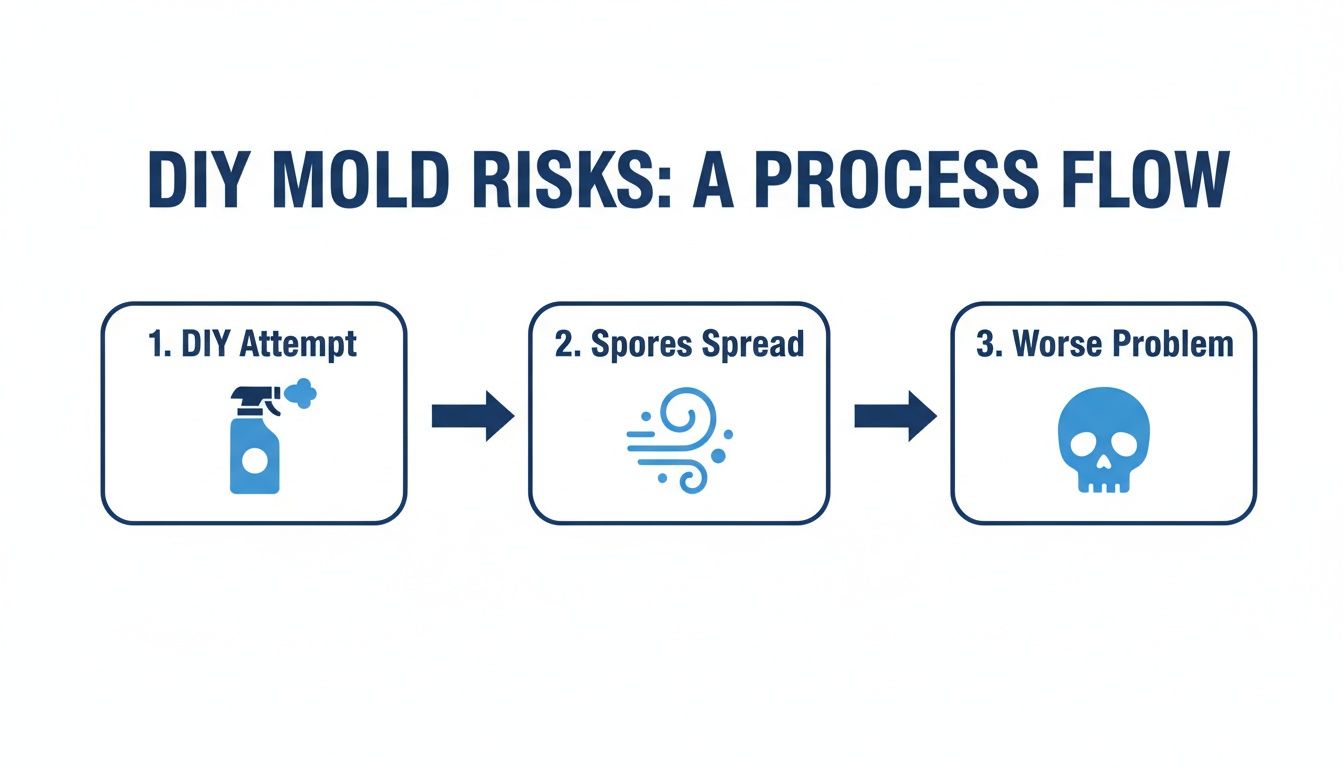
This flowchart clearly demonstrates how an attempt to clean a small area can escalate into a property-wide contamination issue without proper containment.
Safe Removal and Detailed Cleaning
Once containment and air filtration systems are operational, the team begins removing all mold-damaged materials. This typically includes porous items that cannot be salvaged, such as:
- Drywall and insulation
- Carpet and padding
- Ceiling tiles and baseboards
Technicians wear full Personal Protective Equipment (PPE)—including respirators, gloves, and full-body suits—to ensure their safety. All contaminated materials are carefully double-bagged in thick plastic within the containment zone before being removed for proper disposal in accordance with local and state regulations.
After the affected materials are removed, the focus shifts to detailed cleaning. All remaining surfaces within the containment area—from wood studs to concrete floors—are vacuumed with HEPA-filtered vacuums to capture any residual spores. Following this, all surfaces are wiped down with an EPA-registered antimicrobial solution to eliminate any remaining mold. These are professional-grade products designed to eradicate mold at its source without introducing excess moisture.
Our guide on protecting your health and home with mold remediation provides more detail on our specific approach.
Final Verification and Clearance
The process is not complete once the cleaning is finished. A reputable company will conduct a thorough final inspection to verify the remediation's success. Often, an independent third-party industrial hygienist is engaged to perform "clearance testing."
This involves collecting new air and surface samples, which are sent to a laboratory to confirm that the mold spore count has returned to a normal, healthy level. This unbiased verification provides documented proof that the property is safe for re-occupancy. It is the final step in restoring your environment and your peace of mind.
How to Navigate Insurance Claims for Mold Damage
Discovering black mold on your walls is stressful enough without the added complexity of filing an insurance claim. The process requires patience and meticulous organization, but understanding your policy's parameters can significantly improve the outcome.
It is important to know that most standard property insurance policies have specific limitations regarding mold. Coverage is typically contingent on the cause of the mold. If the growth is a direct result of a "covered peril"—such as a sudden pipe burst or a washing machine overflow—the remediation is more likely to be covered.
However, if the mold results from a slow, gradual leak, chronic high humidity, or deferred maintenance, coverage is almost always excluded. This distinction is the critical point where most claims are won or lost.
The Power of Meticulous Documentation
From the moment you suspect a mold problem, begin documenting everything. The quality of your records can be the deciding factor in your claim, as it provides the insurance carrier with the clear evidence they require.
Your documentation should include:
- Detailed Photos and Videos: Capture clear, well-lit images of the mold and any associated water damage. Include both close-up and wider shots to show the full context.
- A Communication Log: Record every conversation with your insurance company, noting the date, time, representative's name, and a summary of the discussion.
- Professional Reports and Assessments: A formal assessment from a certified remediation company, complete with moisture readings and a detailed scope of work, provides the expert validation your claim needs.
A professional remediation company provides more than just cleanup services. They deliver the compliant, detailed reports that insurance adjusters require to process a claim. This expert documentation is crucial for justifying the scope of work and its associated costs, helping to facilitate a smoother approval process.
Your Professional Partner in the Claims Process
Managing a mold infestation and the subsequent insurance claim can be overwhelming. A professional partner like 360 Hazardous Cleanup can serve as your advocate. We are fluent in the language of insurance carriers and understand their documentation requirements.
We can often communicate directly with your adjuster to address technical questions, alleviating that burden from you. This allows you to focus on what matters most: the safety of your property and its occupants.
To better prepare for this process, you can learn more about how to talk to your insurance company and avoid common pitfalls. Our objective is to ensure the remediation is safe and thorough, and that your claim is managed as efficiently as possible during a difficult time.
Black Mold on Walls: Your Questions Answered
Even after identifying a potential black mold issue on your walls and understanding the remediation process, questions will likely remain. We have compiled clear, straightforward answers to the most common concerns we hear from property owners.
Is All Black Mold Toxic?
No, but it should always be treated as a potential health risk. The species Stachybotrys chartarum is often called "toxic black mold" because it can produce mycotoxins. However, many other non-toxigenic mold species can also appear black.
The critical point is that it is impossible to determine the species or its specific risk by sight alone. All types of mold can trigger allergic reactions and respiratory issues, which is why any significant growth warrants professional assessment and remediation.
How Much Does Professional Mold Remediation Cost?
The cost of remediation varies depending on several factors, including the size of the contaminated area, the types of materials affected (e.g., drywall versus structural wood), and the complexity of the containment required. A small, easily accessible area will cost less to remediate than a large infestation hidden within wall cavities.
The only way to determine the precise cost is to obtain a detailed, on-site assessment and a written scope of work from a certified professional.
The cost of remediation should be viewed as an investment in health and property preservation. The long-term consequences of ignoring mold—from structural decay to chronic health problems—are almost always far greater than the cost of proper, professional removal.
Can I Live in My House During Remediation?
This depends on the scale of the contamination. For a small, localized project where professionals can establish a fully sealed containment zone with negative air pressure, it may be possible to remain in an unaffected area of the house.
However, if the contamination is widespread, or if any occupants have compromised immune systems or pre-existing respiratory conditions, relocating temporarily is almost always the safest course of action. Your remediation team will provide a clear recommendation based on the specific circumstances of your project.
Identifying mold is the first step; ensuring its complete and safe removal is what truly matters. If you are facing a potential mold problem, do not risk your health or your property.
Contact the certified professionals at 360 Hazardous Cleanup for a thorough assessment and a clear plan to restore a safe environment. Learn more about our process and schedule a consultation at https://360haz.com.